Showing posts with label national debt. Show all posts

Friday, April 3, 2020

Could Coronavirus Lead To A Debt Crisis?


We aren’t done fighting the Coronavirus and repairing the economy, but the next crisis may already be shaping up. Part of the prescription for getting the country through the pandemic was a $2 trillion relief bill. Unfortunately, most of the cost of that bill is going to be added to our national debt.

The problem is that the national debt is a lot bigger than the $2 trillion price tag of the rescue package. At the end of 2019, the national debt was $23.2 trillion and today, before the relief money is added to the total, it stands at 23.6 trillion per the Debt Clock.

We don’t know how much of the total will be financed by debt at this point, but it is reasonable to assume that the relief spending added about two years’ worth of debt (the 2019 deficit was $984 billion) to our national credit card. With a rapidly shrinking economy, the red ink will probably be even worse. While the relief spending won’t break the bank immediately, it does move us closer to the possibility of a debt crisis.  

For decades now, we have been spending far more than the government takes in, but the problem has gotten worse since the turn of the century. The US has been running deficits and carrying debt for much of its history, but the past three presidents have done the most damage. Presidents Bush and Obama both watched as the debt almost doubled on their watch. Under Obama, the debt exceeded 100 percent of GDP for the first time. President Trump was on track to add almost five trillion dollars to the debt even before the Coronavirus emergency.

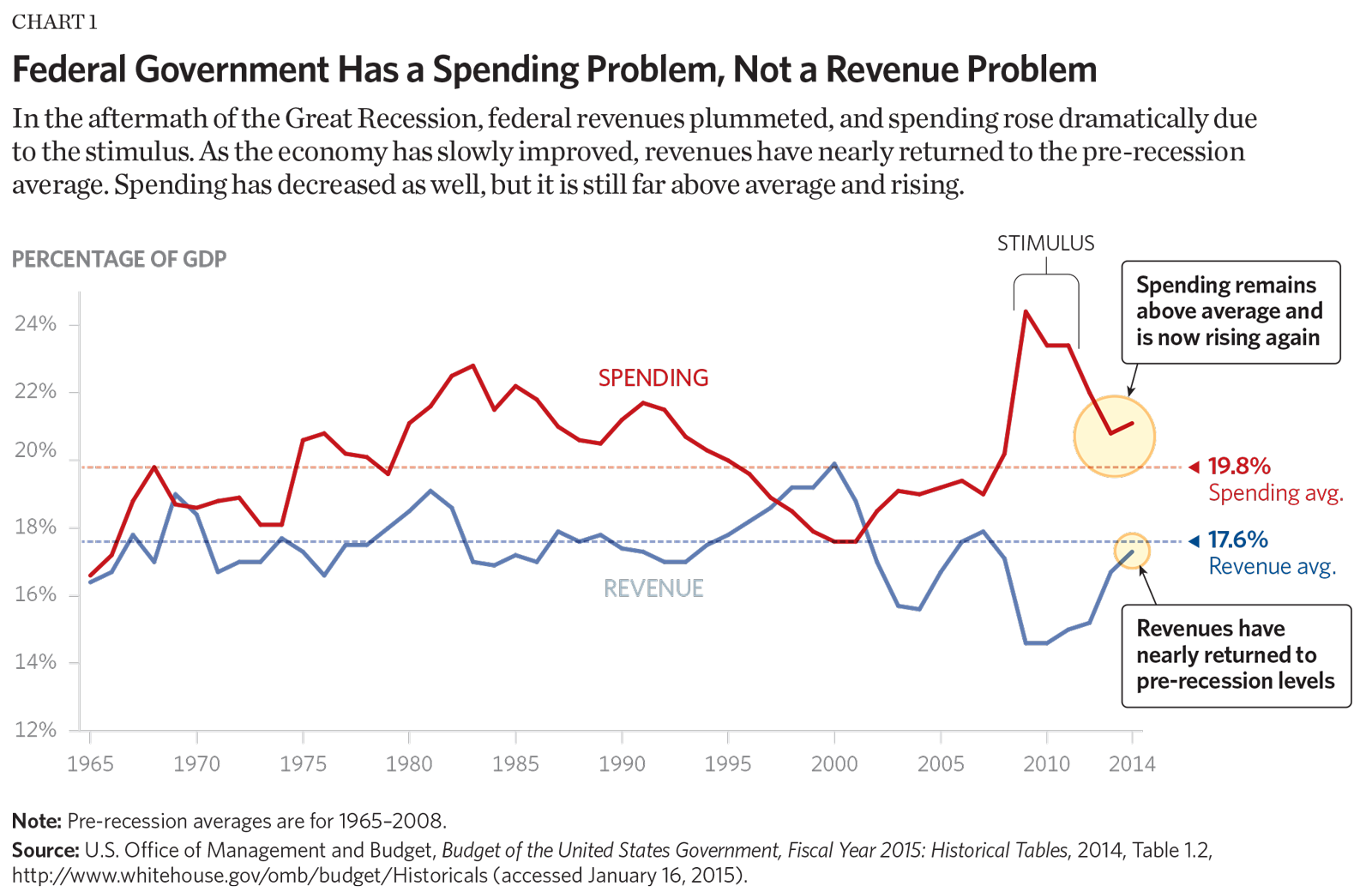
For many, the answer to the impending debt bomb has been that we should grow our way out. If the economy was growing at a faster rate than the debt then we could eventually solve the problem. It would be like using a larger salary to pay off debts incurred when you weren’t making as much. The problem is that our borrowing has increased at a faster rate than our revenues.

If we are honest, tax reform was part of the problem. Although the economy grew after the tax overhaul in 2017, tax revenues were flat. The fruits of the boom did not fill government coffers. The problem was made worse by the fact that spending continued to increase.  

And now our economy is not growing at all. It’s contracting and probably doing so at a record clip. The result is going to be a YUGE increase in our debt as a percentage of GDP.

In times past, deficit spending was used by governments in times of emergencies to see the nation through the crisis. Debt would be paid down when times were good to keep the economy healthy. These days, government spending is debt-financed in both good times and bad, leaving little room for emergency funds when things truly hit the fan.

I’m not saying that we shouldn’t have passed the relief bill. It was and is an emergency and we were between a rock and a hard place. With or without social distancing measures and the economic pause, the country was going to face a downturn because of the pandemic. The only question was whether we would try to minimize the death toll or let the virus run rampant. Trying to save millions of lives was the right choice.

But let’s be realistic: The $2 trillion is probably not going to be enough. When Congress passed the bill, we were thinking about a two-week economic hiatus. Now the president has extended the social distancing guidelines through the end of April. Some states are planning on longer breaks. Individuals and businesses are both going to need more bailout money than the initial package provides.

And even when we restart the economy, things won’t immediately go back to normal. The virus will still be around and we still won’t have a vaccine. We’ll have to be careful about a second wave of outbreaks. High-risk people – and many others – won’t feel comfortable being in large groups or traveling for a long time. Some parts of the economy may never return to the pre-Corona status quo.

But that choice does come at a price and prices must be paid. And the fact that we are running about three years’ worth of debt in one year is going to make tackling America’s debt problem an even bigger priority. It should anyway but what are the odds?

Unlike the Coronavirus crisis, the looming debt crisis is not coming out of the blue. It’s like watching a train approaching on a long, straight track. You have plenty of time to step out of the way, but if, you don’t move, you’ll eventually get run over.

In the case of a debt crisis, getting hit by a train might take several forms. One possibility is that our debt might become harder to finance. Right now, with the world in chaos and interest rates at zero that may sound ridiculous but this situation won’t last forever. At some point, interest rates are going to return to normal, however. Interest on the federal debt is already more than six percent of federal spending and that number has nowhere to go but up.

A worst-case scenario is a Greek-style crisis in which the government loses the ability to borrow more money or a federal default. Can you imagine a world in which federal spending was limited to actual revenues minus payments on debt and interest? The economy would almost certainly collapse under the weight of lost entitlements and subsidies. The effects could cascade around the world given the amount of spending that the US government does in other countries.

One thing that has saved the US in the past is the dollar’s status as a world currency and Treasury debt as a safe haven. However, there has been a movement afoot for years, driven by China and Russia, to create a global competitor to the dollar. A debt crisis in the US could spur those efforts and deepen an American debt spiral.

Unfortunately, neither party seems interested in the debt problem. In fact, days after putting the $2 trillion relief bill on the national credit card, President Trump announced his intention to spend another $2 trillion on an infrastructure bill, touting the fact that interest rates are currently at zero.

There are two problems with that plan. The first is that interest rates will not always be zero. The second is that we owe more than we can pay back even without paying interest.

It is difficult to fight two wars at once and Coronavirus is the most dangerous short-term threat. We have to beat back the pandemic before we can do anything else. Doing that is probably to require more deficit spending. However, the increased deficit spending in this emergency is going to mean that the ballooning national debt is dangerous in the long term. That should be our next focus.


Originally published on The Resurgent

Tuesday, September 10, 2019

Deficit Tops $1 Trillion


It has become a trope among many on both sides whenever a big news story breaks to ask, “What are they not wanting us to pay attention to?” I’m not a conspiracy theorist, but I will admit that today’s firing of National Security Advisor John Bolton overshadows what is, in reality, a much more pressing issue. As both sides react to Bolton’s ouster and even people who, as recently as yesterday were critics of the mustachioed advisor, weigh in on how his departure is a bad sign for the president, what many people are missing is the news that the federal budget deficit just exceeded $1 trillion.

In a report released on September 9, the Congressional Budget Office noted that the deficit for the first eleven months of the 2019 fiscal year was $1.067 trillion, which was $168 billion more than for the same period in 2018.

The historic deficit occurred as both revenues and spending increased over last year. Per the CBO, “revenues were $102 billion higher and outlays were $271 billion higher” than the first eleven months of 2018. Expenditures increased by seven percent, a larger rate than the three percent increase in total revenues, which accounts for the larger deficit.

I’d like to say that the lack of an outcry from Republicans is surprising, but it wouldn’t be true. At this point, it is no longer shocking that fiscal hawks from the Freedom Caucus and elsewhere are silent on the issue of Trumpian spending. Even Mark Sanford, the newest Republican challenger who is running on a platform of fiscal conservatism, was didn’t mark the occasion.

According to the White House Office of Management and Budget, the last year that the US ran a trillion-dollar deficit was 2012 when the red ink totaled $1.076 trillion in the wake of the Great Recession. Given that President Trump’s deficit this year is already at $1.067 trillion, it seems likely that Mr. Trump will exceed Obama’s spending level by the fiscal year ends on Sept. 30.

What makes the current budget deficit even worse is that President Obama’s spending was justified as a response to the 2008 financial crisis. I don’t believe in Keynesian stimulus spending but at least there was a crisis to blame back then. The current spending levels are in a relatively stable economy. With no crisis to avert, neither side is offering any pretense that the deficit will ever be under control.

Both sides like to talk about the various crises that America faces, but neither wants to face the difficult choices that will be required to solve our budget crisis. It is easier to attack AOC and the squad than to talk about the reality that entitlements are bankrupting our country. As commenters illustrate whenever I point out that Social Security and Medicare are both entitlements, even conservative voters are loathe to talk about cutting the programs that are driving us bankrupt.

Here’s the truth: Social Security, Medicare, Medicaid, and other safety-net programs make up 61 percent of the federal budget while interest on the debt adds another seven percent.

More truth is that Social Security and Medicare are entitlements, not savings accounts. Your payroll tax dollars that are euphemistically called “contributions” do not go into an account with your name on it. They go to pay current recipients. The Social Security trust fund is expected to be exhausted by 2032 and Medicare will be bankrupt by 2026.

Yet another difficult truth is that we could all foreign aid and trim wasteful spending until the sacred cows come home and we would still have a debt crisis. Entitlements are the problem and Social Security is the largest entitlement in the federal budget.

The YUGE national debt is the root of many of our problems. The Fed must keep interest rates low, punishing savers and investors, because higher rates will mean even more federal debt and a higher deficit. We are vulnerable to China because they hold much of debt and can dump it, causing a financial crisis, if we give them too many problems. The need to make payments on debt and interest crowd out many other things that we could be spending money on (although let’s be honest, not having money doesn’t stop the government from spending). The deficit also crowds out private borrowing and leads to higher taxes.

Maybe Rush Limbaugh was right when he said a few months ago that “all this talk about concern for the deficit and the budget has been bogus for as long as it’s been around.” It sure looks that way.


Originally published on The Resurgent

Wednesday, August 14, 2019

Deficits Soar To Obama-like Levels


Once upon a time, there was a country that spent too much. This country had the largest economy on the planet and took in trillions of dollars from its citizens in taxes, but every year it went deeper into debt because it always spent more than it took in. The overspending created a monster called “the national debt.” This went on for years and years and both of the ruling groups pretended to care about the overspending, but no one ever did anything about it.

For years, the federal budget deficit was relatively small and only caused the national debt to grow a little every year. Even then people worried about both. Then, about 40 years ago, the deficit got bigger and the national debt started growing by leaps and bounds.

Things really got bad after an enemy attacked the country. The government had to borrow money to fight the evil people that had murdered thousands of its citizens. The war lasted a long time and the national debt had doubled in short order.

As the threat of war receded, the country went into a financial crisis. The country’s new leader decided that the answer was to throw money at the problem. His spending increases caused the largest deficits that anyone had ever seen and pretty soon the national debt had doubled again.

After the financial crisis, a brave knight came to the king and said that spending was at dangerous levels. When the knight confronted the king, they finally were able to come to an agreement that cut spending for the first time in the reigns of many, many leaders.

But, alas, the spending cuts didn’t last long. And the knights never slayed the deficit. They only made it smaller for a little while. Pretty soon, both the deficit and the debt started growing again.

A new king soon came to power and, despite the fact that there was no war or financial crisis, the new king quickly grew the deficit back to levels that it had only seen during national emergencies under the old kings. The national debt looked like it might double again during the new king’s reign but this time no one was worried. In fact, one of the knights who had fought the deficit years before now said that no one had ever really worried about the deficit at all!

I wish I could say that this story has a happy ending where “they all lived happily ever after,” but obviously this is not true. This story doesn’t have an ending yet and this year the deficit monster is going to be as big as ever, feeding the national debt to levels that are unprecedented during peacetime with a good economy.

The sad truth for Americans is that the Republicans who valiantly fought the deficit during the Obama years, now don’t seem to care about it. While most Republicans are merely silent about the deficit, which will exceed $1 trillion this year, the highest point since 2012, none other than Rush Limbaugh has now embraced the once-liberal position that deficits don’t matter.

Responding to a caller last month who argued that President Trump was not a “fiscal conservative,” Rush responded, “Nobody is a fiscal conservative anymore. All this talk about concern for the deficit and the budget has been bogus for as long as it’s been around.”

Rush is wrong. There are many of us who are still fiscal conservatives and whose concerns about the deficit were genuine from the beginning. We may not hold office, but we do vote.

The unpleasant truth for Republicans is that Donald Trump is worse on the deficit than either Barack Obama or George W. Bush or any prior president. Trump’s deficit is going to rival the worst years of Barack Obama and be worse than that of any other president. This is without the excuse of a war or the Keynesian excuse of needing deficit spending to overcome a financial crisis. In the US today, deficit spending is the rule regardless of what is happening in the economy or the rest of the world.

To be fair, Donald Trump did inherit much of the mess. The largest part of the deficit is driven by mandatory spending on entitlements that Congress and the president don’t control on an annual basis. In the 2019 federal budget, Social Security, Medicare, unemployment, and health spending account for more than 60 percent of federal spending. In contrast, defense spending (including veteran’s benefits) makes up only 20 percent. Interest on the federal debt accounts for almost six percent by itself.

But Trump has made the problem worse. Under President Trump, federal spending reached a record high. This is partly due to increases in mandatory entitlement spending, but it is also due to increases in discretionary spending championed by Mr. Trump. Earlier this year, the president proposed a record $4.7 trillion budget, which would increase federal spending by almost a trillion dollars over the current year. The proposed budget cuts some programs but includes a big increase in military spending.

The Trump Administration has also hurt the income side of the deficit equation. Tax reform slashed corporate income tax rates, but, despite this, tax revenues are at a record high. They are not, however, as high as they would be in a growing economy if the tax rates had been left unchanged.

The theory is that the lower tax rates would help to grow the economy and to some extent that has been true. The theory did not account for President Trump’s tariff war, however. President Trump’s increases to tariff taxes have offset the benefits of tax reform for millions of American individuals and businesses. The higher the tariffs go, the more they are a drag on the economy.

Mr. Trump’s economy has not yet achieved his target growth rate of three percent per year. Despite achieving three percent growth in several quarters, Donald Trump’s annual growth rates average worse than Barack Obama’s. This is due in large part to his tariffs.

The best news for Republicans is that Democrats would probably be worse on deficits and the debt. With a number of Democrats proposing giveaway programs like free college tuition and Medicare-for-all, there is no political home for deficit hawks. Neither party really wants to cut spending. They just want to cut spending on the other side’s priorities so that they can shift tax dollars to their own programs. Meanwhile, politicians on both sides of the put on an Alfred E. Neuman grin and say, “What? Me Worry?”

The bad news for us all is that the overspending, particularly that of Barack Obama and Donald Trump, have boosted to the national debt to 104 percent of GDP. No one knows how such a high debt level will affect the world’s largest economy and the holder of the world’s reserve currency.

What we do know is that the high debt level restricts the number of tools that the Fed has to deal with future recessions and economic problems. For example, with interest rates at near-zero, there is little room to reduce them further to goose the economy. If the Fed raises interest rates, the deficit will go up as the government’s interest payments on the debt increase. The flip side is that low interest rates come at the cost of discouraging saving and investment.

Do deficits matter? We are about to find out.
Originally published on The Resurgent
Friday, July 12, 2019

Under Record Spending, The Deficit Is Great Again


A popular meme from a few years ago was based around Heath Ledger’s portrayal of the Joker in the 2008 film, The Dark Knight. In the movie, the Joker contrasts the different reaction to threatening different people.  

“If, tomorrow, I tell the press that, like, a gang banger will get shot, or a truckload of soldiers will be blown up, nobody panics, because it's all 'part of the plan,'” Ledger’s Joker opined, “But when I say that one little old mayor will die, well then everyone loses their minds!”


These days the deficit is a lot like that.

Currently, it’s easy to imagine (as I memed on my Facebook page) the Joker saying, “A Democrat runs a trillion dollar deficit and everyone loses their minds; a Republican does it and no one cares.”

The Treasury Department announced yesterday that the federal budget deficit for the fiscal year to date was 23 percent higher than for the same period last year. The deficit for the current fiscal year, which began last October, stands at $747.1 billion and is forecast to top $1 trillion by the end of the fiscal year.

As some Republicans have noted, the 2017 tax reform bill was followed by record-high federal revenues, but this was not enough to prevent the massive deficit for two reasons. The first reason is that federal spending also reached a record high, $3.36 trillion for the period. Per the Office of Management and Budget, federal spending has increased dramatically under President Trump. In 2016, federal outlays were $3.852 trillion and this year the government is expected to spend $4.529 trillion.

Increased spending is only half the equation, however. While federal revenues are at a record high, they have grown at a slower rate than federal spending. This is due in large part to tax reform. While tax receipts did increase after tax reform, they fell far below the Congressional Budget Office projection. The OMB tables show flat revenues between 2017 and 2018 when tax reform took effect, followed by a modest increase projected for 2019.

In 2017, I saw corporate tax reform as necessary to keep American companies competitive in a world economy where the US corporate tax rate was among the highest in the world. However, President Trump’s decision to launch numerous tariff wars in the wake of tax reform has almost totally offset the benefit of the lower income tax rates, resulting in sluggish growth and flatter tax revenues. In any case, the dramatic increases in federal spending, including billions to aid farmers hurt by the unnecessary and ill-advised trade wars, was the wrong policy prescription after a tax cut.

Under President Obama, Republicans took a hard line on the deficit and the federal debt limit. Speaker John Boehner, much maligned by conservatives, used the sequester to cut federal spending in real dollars, not merely reducing the amount of increases. Increases to the debt ceiling were paired with cuts to spending. The OMB data shows that federal outlays declined in 2012 and 2013. One must look back to the Eisenhower Administration to find similar spending cuts in consecutive years.

Now, as the government approaches the debt ceiling yet again, there is no sign of fiscal restraint from the Trump Administration. Mr. Trump’s proposed budget for 2020 is the largest ever at $4.75 trillion. In March, Treasury Secretary Steven Mnuchin asked Congress to pass a clean bill, one with no spending constraints, to increase the debt ceiling. Earlier this week, White House Economic Advisor Larry Kudlow said of the $22.5 trillion national debt, “I don't see this as a huge problem at all right now.”

But the debt and the deficit do represent a huge problem, even if the Trump Administration and Republicans now fail to recognize them as such. When the deficit tops $1 trillion this year, it will be in the midst of peacetime and a strong economy. The last time that the deficit exceeded $1 trillion it was in 2012, in the wake of President Obama’s stimulus spending after the Great Recession. With President Trump’s massive deficits in good times, there is absolutely no realistic plan to reduce the deficit at any point in the near future, especially if the economy sours.

While the debt limit must ultimately be increased to avoid the financial chaos of a default, it should be paired with spending cuts under the successful Boehner strategy. However, Speaker Nancy Pelosi is pushing in the opposite direction. Fortune reported that House Democrats were advocated for a vote that would pair the increase to the debt limit with a spending bill that would increase the deficit by as much as $300 billion.

Even the House Freedom Caucus has been silent about the looming increase to the debt limit. The group has instead focused on rebuking Rep. Justin Amash for his stance on impeachment. A search for recent comments about federal overspending and borrowing from caucus members yielded nothing.

It seems that if there are any fiscal hawks left in Washington that they are in full retreat.

Originally published on The Resurgent
Monday, March 25, 2019

The Graveyard Spiral Election


The election of 2016 was sometimes referred to as the “Flight 93 election.” The metaphor of doomed passengers fighting back to save both themselves and other innocent people was not totally without merit, but it won’t apply to the upcoming 2020 elections. Instead, there is another aviation metaphor that much better suits next year’s presidential election: the graveyard spiral.

I hesitate to use this term because, as a technical aviation term, the phrase is somewhat obscure. Some aviation metaphors, such as “crash and burn” or “auger in,” are more well-known and easily understood, but I cannot escape the thought that the graveyard spiral provides an apt description of where we are as a country.

While the phrase “Flight 93” evokes a sense of impending doom, the graveyard spiral is also deadly but much more insidious. Essentially, a graveyard spiral is circular dive caused by the pilot’s loss of equilibrium. In a graveyard spiral, the pilot thinks that he’s flying the airplane straight and level, but, in reality, he is in a turn. When an airplane is in an established turn, the fluid in the pilot’s inner ear which generates the sensation of turning stabilizes and the feeling that the airplane is in a bank is lost. In a frequent scenario, after rolling out of an established turn in one direction, it can feel as though you enter a turn in the opposite direction. The effect is similar to spinning around in a chair and then trying to walk straight.

Often, the pilot’s response is to turn back in the original direction, which feels to the pilot’s inner ear like straight and level flight. Because some of the airplane’s lift is used in the turn, this can be accompanied by altitude loss. At that point, the pilot pulls back on the controls to raise the nose and maintain altitude. This causes the airplane’s turn to become steeper and steeper as it loses altitude. If the pilot doesn’t realize his mistake and recover, the airplane ultimately crashes into the ground.

Right now, it feels as though America is in a graveyard spiral. What we have seen over the past two years is a Republican attempt to recover from the abuses of power, divisive politics, and out of control spending of the Obama era with abuses of power, divisive politics and out of control spending of their own. Yet, ironically, many Republicans now argue that President Trump’s actions, which are very similar to President Obama’s on many levels, are needed to put the country back into straight and level flight. Executive abuses and flagrant disregard for law and the Constitution have become the new normal for both parties.

What is actually happening is called spatial disorientation. Republicans are so used to the executive abuses and bad leadership of the Obama Administration that they don’t realize that the country is dangerously close to spinning out of control (to use another aviation metaphor). Our national leaders literally don’t seem to understand which way is up.

So, what is the proper way to recover from our self-induced crisis, preferably before the country crashes and burns? The only way to stop a graveyard spiral is to stop flying by the seat of your pants and trust the instruments and standard procedures.

In our case, the recovery technique is found in the Aircraft Operator’s Manual for the country, the Constitution. We should be following the established procedure, i.e. the rule of law, to get the country headed in the right direction. America cannot be returned to safe and stable flight by ignoring and subverting the very guidelines that made us a great nation in the first place. Both Barack Obama and Donald Trump are guilty of abusing their position as president because Congress wouldn’t give them what they wanted. Far from being saviors, both men are contributors to our national crisis of stalemate, division, anger, and mistrust.

Congress is also complicit. A fundamental concept of aviation is that of cockpit resource management (CRM). Gone are the days of aviation when an aircraft captain was the onboard equivalent of God who suppressed any attempt by his crew to question his decisions. Nowadays, crewmembers are expected to speak up and tell the captain when he’s acting foolish. Too many airplanes have crashed and too many people have died because copilots sat quietly by and let their captain make deadly mistakes.

Today, Congress has abdicated its responsibility to speak up when the president is wrong. Partisanship has triumphed over the rule of law in both parties. Democrats protected Obama as he ran roughshod over the Constitution and Republicans are doing the same thing for Donald Trump. As Congress fails to take the controls, the graveyard spiral steepens.

Finally, an airplane needs fuel to recover and our national engines are almost to the point of burning fumes. Aside from the national graveyard spiral toward an autocratic presidency, our most pressing national emergency is the fact that our deficit is at a record high. At more than $22 trillion, our national debt is 20 percent larger than our GDP. The United States is rapidly spiraling toward Greek and Italian levels of debt. As the world superpower and guarantor of the world reserve currency, our extreme levels of debt not only threaten our economy but that of the rest of the world as well.

Both parties are filled with deficit hawks but only when they are out of power. However, when in control of the levers of government, all either party seems to be able to think of is borrowing and spending on the priorities of its base. While compromise is rare in American government these days, the parties can usually find a shared interest in spending increases.

As we gear up to pick a new captain next year, remember the graveyard spiral, a situation in which the people at the controls are literally flying into the ground. Don’t subjectively rate candidates by the seat-of-your-pants feeling that they are steady pilots. Instead, rate them objectively by whether they follow the principles and guidelines laid out in the Constitution, our national operating manual, and whether their policies will leave us out of control and out of fuel. Picking a good pilot who follows the guidelines and who can bring the entire crew of the country together to work toward a common purpose is essential if we are to avoid a catastrophic crash.

Originally published on The Resurgent

Wednesday, March 6, 2019

Debt Crisis: Deficit Balloons 77 Percent In First Four Months Of Fiscal Year


Despite the strong economy, the Treasury Department reports that the federal budget deficit surged 77 percent in the first four months of the 2019 fiscal year. The total deficit for the current fiscal year, which began on Oct. 1, has already reached $310 billion compared to $176 billion for the same period last year per the Washington Post.

While it is tempting for the two parties to point fingers at each other over the increase in the deficit, the truth is that both are to blame. The tax reform bill caused corporate tax revenues to plummet by about 25 percent, equivalent to a $17 billion drop in revenues. At the same time, spending increased by nine percent. The largest increases were for Medicare, which grew by 16 percent, and military spending, which grew by 12 percent.

“It’s big tax cuts combined with big increases in spending when they already had big deficits,” said former Senate Budget Committee Chairman Kent Conrad (D-N.D.). “So, guess what, it’s craziness.”

White House economic advisor Larry Kudlow told The Post, “We are making an investment in America’s future… and if that means we incur some additional debt in the short run, so be it.”

“Growth solves the problem,” Kudlow added. “That will solve all of these problems and people will be very prosperous.”

In theory, the reductions to the corporate tax rate will spur investment. The resulting economic growth will reduce the deficit as a share of GDP and make the problem less pressing.

So far, that has not happened. As Resurgent reported last October, federal revenues were flat for the 2018 fiscal year. Total federal receipts were $3.329 trillion in 2018 compared with $3.316 trillion in 2017. Tax revenues from individuals increased by one percent but were corporate tax revenues fell by 30 percent. FY 2018 included three months — October, November and December 2017 — at higher tax rates. This means that the 2019 revenue picture looks even worse. Even though federal revenues did not fall after tax reform, the fact that they did not increase as they would have in a growing economy is a contributor to the growing deficit.One drag on economic growth is President Trump’s trade war. Tariffs have impacted segments of the US economy and uncertainty over future trade policies could cause companies to scale back expansion plans. Many economists predict a slowdown in growth in 2019 due to the taxes on international trade.

Prior to the tax reform, the United States had the third highest corporate tax rate in the world. While tax reform was needed to make American companies more competitive in the global marketplace, Republicans completely dropped the ball on getting federal spending under control. During the Obama Administration, House Republicans under John Boehner forced the first real spending cuts in consecutive years for the first time since the Eisenhower Administration, but fiscal restraint has been sorely lacking during the Trump Administration. Where Republicans went to the edge of the fiscal cliff to force spending cuts under Obama, the GOP forced a government shutdown last December to try to force Congress to borrow and spend more money for a border wall.

Prospects look bleak for any deficit reduction in the near future. Entitlement programs such as Social Security, Medicare, and Medicaid make up more than 60 percent of federal spending but President Trump has consistently refused to consider cuts to entitlement programs. This is not without good reason. Even conservative Republican voters balk at cutting these programs and many refuse to even acknowledge that they are entitlements. Paul Ryan, the GOP’s chief advocate for entitlement reform, has returned to private life.

The third largest spending program is the military, which represents about 16 percent of all federal spending. The Trump Administration is about to propose increasing military spending by shifting defense funds to an account for Overseas Contingency Operations. These funds are not capped under the Budget Control Act, unlike traditional military spending.

The increased borrowing comes at a particularly bad time since interest rates are beginning to rise back to normal rates following the recovery from the Great Recession. The government is forecast to spend $383 billion on interest payments this year. By 2022, that amount will increase to about $581 million, almost as much as we currently spend on defense.

As the old saying goes, to get out of a hole, the first step is to stop digging. The United States has yet to take even this first basic step. Thus far, the only thing that the parties have been able to agree on is to keep spending at ever greater levels. With the US national debt already at more than 100 percent of GDP and the deficit projected to be at more than $900 billion for the year, American debt is approaching Greek and Italian levels. If there is a national emergency, it is the looming debt crisis, but no one in Washington seems to care.  

Originally published on The Resurgent


Friday, December 14, 2018

Federal Deficit For November Hits Record High Despite Tax Reform

Tax reform stands as the one major legislative accomplishment of the Trump Administration. The measure became law a year ago and, as forecasted, jumpstarted growth in an economy that had been largely stagnant since the Great Recession. Unfortunately, tax reform has so far not lived up to its promise of paying for itself with that increased growth. In fact, the deficit for the 2018 fiscal year, which ended in September, is the largest in six years despite increased growth and revenues.

Figures from November show that the budget deficit was the largest ever recorded for that month. The Treasury Department reported Thursday that federal spending increased by 18 percent to $411 billion for the first two months of FY 2019.

Despite the tax reform and the increased tariff taxes on trade, revenues were flat at $206 billion, about half of what the government spent. The deficit of $205 billion, 49.8 percent of spending, was almost twice as high as last November’s $139 billion deficit. Increased tariffs led to an 86 percent increase in customs duties received but still only accounted for $11.8 billion in revenues.

As Resurgent noted in October, the deficit problem is two-fold. Data from FY 2018 show that while individual tax receipts increased by one percent, overall tax revenues were flat because corporate tax receipts fell by 30 percent. Total federal receipts were $3.329 trillion in 2018 compared with $3.316 trillion in 2017.

The other side of the coin is that spending continues to increase while revenues are stagnant. Military spending increased by 27 percent over the same two months last year per the Wall Street Journal[DT1] . Interest payments on the ever-growing national debt increased by seven percent, partly due to higher interest rates.

The core problem is that the economy is growing but borrowing and spending are growing even faster. Over the past 12 months, spending increased by 5.1 percent while revenues only increased by 0.2 percent. The Trump Administration says that deficits will shrink in coming years as tax reform spurs growth and investment. In the meantime, the deficit is expected to reach the Obama-esque level of $1 trillion in the current fiscal year.

Other factors will drive increased spending that will compete with growth in coming years. Spending on Medicare and Social Security is projected to rise as more Baby Boomers retire. Interest payments on the debt will also increase as the Fed raises interest rates.

In the meantime, Trump Administration trade policy counteracts the economic benefits of tax reform. While businesses benefit from lower corporate tax rates and deregulation, tariffs and trade restrictions make it more expensive and difficult to import and export raw materials and finished products.

As the deficit rises, there is little reaction from either party in Congress. Where Republicans went to the mat to curb President Obama’s spending, most seem to have no qualms about the spending increases under President Trump. In fact, the big news on the budget lately is that Republicans are prepared to shut down the government if Democrats don’t agree to authorize even more taxpayer dollars for President Trump’s pet border wall project.

Originally published on The Resurgent


Thursday, October 18, 2018

Mitch McConnell Is Right About Social Security

Truth is something that we are not used to hearing in the current political climate so it can come as a bit of a shock when a politician blurts out a harsh dose of reality. That was the case yesterday when Mitch McConnell confronted the American people with the bitter fact that the deficit is too large and the only way to cut it is by slashing the sacred cows of Social Security, Medicare and Medicaid.

“It’s disappointing but it’s not a Republican problem, McConnell told Bloomberg. “It’s a bipartisan problem. Unwillingness to address the real drivers of the debt by doing anything to adjust those programs to the demographics of America in the future.”

While it is not solely a Republican problem, the GOP has done little in the way of deficit reduction recently. This week the Treasury Department revealed that the deficit grew to $779 billion, its highest level since shortly after the Tea Party revolution. After trimming budgets during the Obama Administration, the Republican Congress enacted tax reform that stimulated the economy but slashed corporate tax revenues. At the same time, spending increased due to a larger military budget as well as increased interest payments on the national debt and increased Social Security spending.

The four percent increase in Social Security spending represents a major part of America’s debt problem. While it is tempting to blame foreign aid, military waste, welfare or a number of other programs for America’s mounting debt, the big three entitlement programs (Social Security, Medicare and Medicaid) together make up a whopping 46 percent of the federal budget per the CBO. The biggest of the big three is Social Security at 23 percent of federal spending.

The entitlement problem is so big that it really doesn’t matter how much cutting we do in other parts of the budget if we don’t reform entitlements. For example, the entire defense budget is only 14 percent of federal spending. The sum total of all foreign aid is only 1.2 percent of the federal budget.

The entitlement programs are at a crisis stage. The Social Security trustee report predicts that in only four years Social Security will begin to pay out more than it takes in. If nothing is done, only 16 years from now in 2034 the Social Security trust fund will be bankrupt.

While McConnell’s truth-telling is a rare act of political courage, it is unlikely that Social Security and other entitlements will be reformed soon. The majority leader’s timing in his truth-telling is less than opportune. Midterm elections are only three weeks away and the Democrats undoubtedly have a pushing-granny-off-the-cliff ad ready to go, just waiting to insert the name of anyone who touches the third rail of American politics.

The truth is that not even conservative voters really want to reform Social Security. Many conservatives have bought into the lie that the Social Security tax that comes out of their paychecks is a contribution that goes into their account. In reality, involuntary Social Security “contributions” go into a trust fund, per the Social Security Administration, from which benefits are paid from the trust fund and the excess “must be invested, on a daily basis, in securities guaranteed as to both principal and interest by the Federal government.” This is another way of saying that the Social Security benefits are paid from current contributions. Any funds left over are loaned to the federal government, which must pay them back with interest.

The plan of using current Social Security taxes to pay current retirees worked well at first. But the architects of Social Security did not foresee the Baby Boom. Now, as Baby Boomers retire in droves, fewer workers are being asked to support more and more retirees. There are only two options to save Social Security: Cut benefits or increase taxes.

Voters seem to be of two minds about Social Security. On one hand, many believe that Social Security is a socialist Ponzi scheme, redistributing wealth from workers to retirees. Nevertheless, the voters also become militant at the very suggestion that benefits might be cut and that they could lose some of their “contributions.”

Even though there is no individual account containing their Social Security savings, American workers have been promised that their taxes will go to fund their retirement. It would be unconscionable for the government to break this promise to those in or near retirement. That is why Republican plans to reform the entitlements would preserve the status quo for retirees and older workers while giving younger workers the option to take part in a plan that has a better chance of being there when they retire.

Mitch McConnell gets credit for facing the tough problem that is America’s entitlement crisis. The majority leader realizes that the deficit crisis cannot be solved without reforming the sacred cow entitlement programs. Unfortunately, admitting that there is a problem is not the same as being able to solve it.


Originally published on The Resurgent

Tuesday, October 16, 2018

Deficit Reaches Highest Level In Six Years

The economy boomed in the three quarters that followed last year’s Republican tax reform, but economic news has become more mixed of late with a topsy-turvy stock market and Mr. Trump’s tariff war beginning to affect bottom lines and employment. Now comes more news about the deficit that should rankle any fiscal conservatives who remain in Congress or the country at large.

The fiscal year for the US government ended in September and the figures on the federal budget deficit are not good. In fact, even though the US economy is booming, the deficit is the largest deficit run by the government in six years. The deficit for the 2018 fiscal year was $779 billion, a 17 percent increase over the $666 billion deficit in fiscal 2017. The last time the deficit was higher was in 2012 when Barack Obama presided over a deficit of more than a trillion dollars.

The deficit is the difference between what the federal government spends and what it earns. When the federal government spends more than it receives in revenues, as it has every year since 1960 (with the exception of 1998), it must borrow the difference. Each annual deficit is added to the mountain of federal debt which currently stands at more than $21 trillion.

Democrats were quick to blame tax reform for the exploding deficit. A deficit of this magnitude in an economy this strong is historically unprecedented,” Jason Furman, chairman of the Council of Economic Advisers in the Democratic administration of President Obama and an economic policy professor at Harvard University, told the Wall Street Journal. “Undertaking permanent fiscal stimulus [through tax cuts] at this stage of the economic expansion is contrary to all sound tenets of economic policy.”

According to Treasury Department statistics, flat federal revenues were part of the deficit problem. Total federal receipts were $3.329 trillion in 2018 compared with $3.316 trillion in 2017. FY 2018 included three months – October, November and December 2017 – at higher tax rates. This means that the 2019 revenue picture looks even worse.

Under tax reform, withholding was lowered in February for individual taxpayers. Despite this, tax receipts from individuals increased by one percent. Tax payments by businesses fell more than 30 percent for the year, however.

Flat revenue was not the only contributor to the rising deficit. Federal spending also increased. Total outlays for 2018 were $4.108 trillion compared to $3.981 trillion in 2017. The spending increases were driven by rising interest costs paid on a greater amount of federal debt as well as increased military spending, which rose by six percent, and Social Security spending which increased by four percent.

Republicans argue that the tax reform is fueling economic growth, which will eventually lead to higher tax revenues. Nevertheless, Kevin Hassett, chairman of the Council of Economic Advisers, admits that spending and the deficit are big problems.

“The deficit is absolutely higher than anyone would like,” Hassett told Bloomberg last week. “As you watch our next budget come out -- and you’ll start to see things in the next few weeks -- then you’ll see a much more aggressive stance” on spending issues.

For the past half-century, the only combination that resulted in lower deficits was when a Republican Congress put the brakes on spending by a Democrat president. The much-maligned John Boehner led the Republican House to cut the deficit in real dollars between 2012 and 2015 thanks to the sequestration. Interestingly, once Republicans gained control of both houses of Congress in the 2014 elections, both spending and the deficit again started to climb. The same combination of Republican Congress and Democrat president yielded the last budget surplus in 1998.

It is perhaps ironic that the Republican deficit hawks would preside over a blowout in the deficit. It is unsurprising, however. Historically, the only thing the parties have been able to agree on is borrowing and spending at ever higher levels and the problem seems to get worse when one party controls both Congress and the White House.

Regardless of the outcome of the election, the deficit problem seems unlikely to change any time soon. Unless federal revenues can be increased or spending can be cut, the 2019 federal deficit is forecast to be on the wrong side of a trillion dollars once again.

Originally published on The Resurgent


Tuesday, February 13, 2018

Why Federal Deficit Spending Will Never Be Fixed. Ever.

If there was any notion that the Trump Administration was fiscally conservative, those beliefs should be reconsidered in light of last week’s bipartisan spending deal and the president’s spending proposals from the State of the Union speech. Despite the Republican victory on tax reform, it seems that the party is veering toward massive spending increases rather than fiscal restraint and entitlement reform.

Rand Paul (R-Ky.) was one of the few congressional voices that spoke out against the spending bill. In a speech on the Senate floor, Paul described why Congress is unlikely to ever resolve the problem of deficit spending. Ever.

“The right cries out, 'Our military is hollowed out!' Even though military spending more than doubled since 2001,” Paul said. “The left is no better. Democrats don't oppose military money as long as they can get some for themselves... for their pet causes.”

“The dirty little secret is that, by and large, both parties don't care about the debt,” the senator charged.

The truth that Paul stumbled upon is that neither party can spend taxpayer money on its own. The Democrats want to spend on entitlements and social programs, but don’t have the votes by themselves. The Republicans have their own priorities, among them the military and up to $67 billion for President Trump’s border wall. Even though they have majorities in both houses, the Republicans don’t have the votes to pass a budget on their own either. On the other hand, when both parties come together in a bipartisan compromise, they have enough votes to spend like the proverbial drunken sailor.

Neither party sees their priorities as frivolous. Both see themselves as patriotic lawmakers looking out for the wellbeing of their constituents. They agree to each other’s priorities to secure their own and the deficit goes up and the national debt continues to mount.

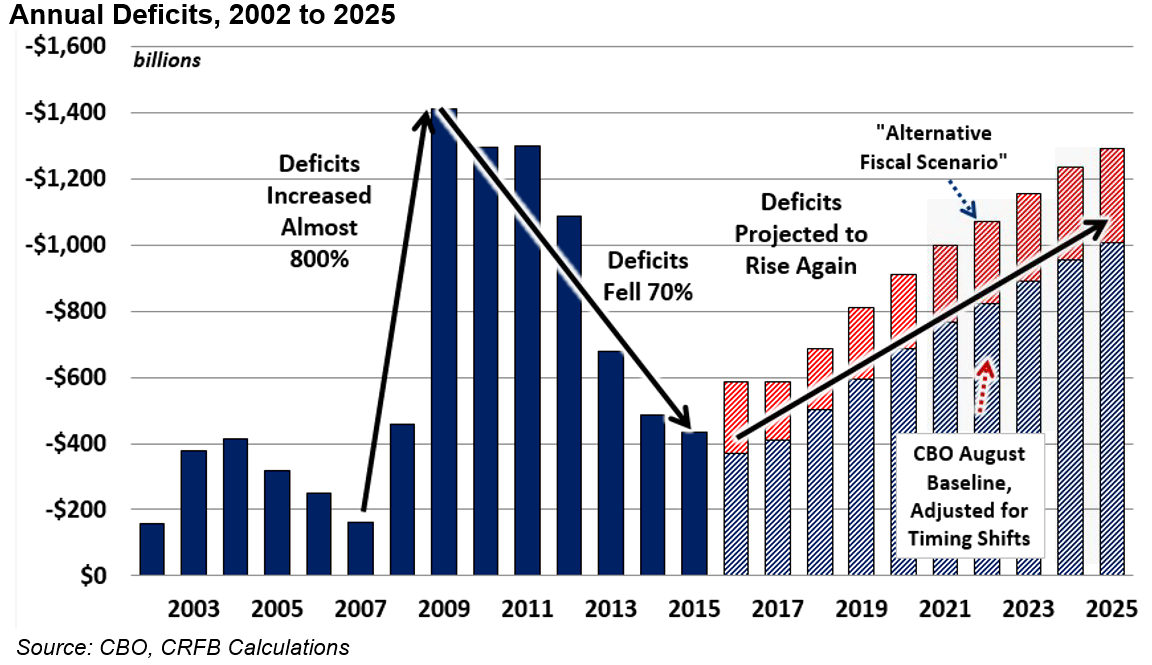
There have been pauses in the trend. When Republicans won control of the House in the Tea Party wave of 2010, they kept a tight grip on the federal checkbook. Under Speaker John Boehner, the Republicans reduced spending in real dollar terms and reduced the deficit by 70 percent, thanks to the sequester’s spending caps. Nevertheless, the borrowing continued and the debt continued to grow, albeit at a slower rate. In the late 1990s, a booming economy paired with spending cuts actually led to federal surpluses for a few years.

By the end of Barack Obama’s second term, the federal debt had almost doubled. The US debt to GDP ratio reached 108 percent. This is far behind Japan with a 240 percent ratio and Greece at 180 percent, but the level of debt is generally acknowledged to be at a serious problem. The Keynesian ideal of deficit spending in times of crisis has given way to deficit spending to avoid a financial crisis.

Where Rand is incorrect is in his hostility to military spending, a constitutional mission of the federal government. Paul argues that “military spending more than doubled since 2001,” but fails to consider how much the world changed on Sept. 11, 2001. Two wars and numerous missions against Islamic terrorism are only the most obvious aspect of the problem. Chinese and Russian expansionism represent serious Cold War-like threats.

In 2016, under President Obama, military leaders said that sequestration was a serious threat to military readiness. Budget cuts have led to difficulties in replacing and upgrading equipment. Financial limitations have also impacted training and troop retention.

Military spending is costly, but it is not the largest share of the federal budget. Defense and security spending (including veterans programs) make up only 20 percent of federal outlays. Over half of the federal budget is made up of health care spending (28 percent) and Social Security (25 percent). It is entitlements that are breaking the federal budget.

Democrats may get the lion’s share of the blame for entitlement spending, but the truth is that it is a bipartisan problem. Conservative voters claim to favor spending cuts, but quickly change their tune when the discussion moves to reforming Social Security. They have bought into the fiction that their “contributions” to Social Security are held into an account for when they retire. In reality, Social Security taxes are quickly spent on current retirees as soon as they are received. (If you think your payments to Social Security are a voluntary “contribution,” try not paying them.)

Speaker Paul Ryan is one of the few politicians of either party to dare to even mention entitlement reform. For his bravery, he is shown in Democrat ads pushing an old lady off a cliff. His own party was no better. When Ryan voted for the 2013 budget deal that included cuts in military retirement pay, he was skewered by Republicans even though the bill was supported by military leaders.  

In the end, Rand Paul is right. Neither party cares about the debt, at least not enough to allow cuts to their favorite programs, although they are more than willing to cut the other party’s pet projects. The minority party becomes a deficit hawk to use the deficit as a club to beat their opponents and roles reverse when the parties change control. The few politicians who want to make real spending reforms are opposed by both parties.

There will be no spending reform for the foreseeable future. The US government will continue to spend like a billionaire’s wife in Saks Fifth Avenue as long as it can borrow. With the dollar maintaining strength and few other bastions of stability for world investments, many assume that purchases of treasury bonds will never stop.

But one day, sooner or later, interest payments will combine with other budget items to exceed the government’s ability to borrow. The government will not be able to pay its bills. When that day comes, members of both parties will have to get serious about spending cuts regardless of what their voters think.


Originally published on The Resurgent

Thursday, May 25, 2017

Debt ceiling battle heats up again

Think that confrontations over the debt ceiling left town with the Obama? You might want to think again.

“I urge you to raise the debt limit before you leave for the summer” [on July 28], Treasury Secretary Steven Mnuchin told the House Ways and Means Committee on Wednesday according to the Wall Street Journal. Mnuchin said that he prefers a clean increase without conditions.

In response, the House Freedom Caucus released a statement opposing a clean increase. “The U.S. federal government is drowning in debt, yet continues to spend into oblivion on the backs of future taxpayers,” the statement said. “We have an obligation to the American people to tackle Washington’s out of control spending and put in place measures to get our country on the right fiscal course.”

The Freedom Caucus adopted a three-fold position on the issue. First, they categorically oppose a clean increase. Second, the group agrees that the debt ceiling should be address by Congress before it recesses for the summer. Finally, the statement demands “that any increase of the debt ceiling be paired with policy that addresses Washington’s unsustainable spending by cutting where necessary, capping where able, and working to balance in the near future.”

The government reached the debt ceiling imposed by Congress in March. Since then, the Treasury Department has been using cash conservation methods to keep the government operating. The shuffling of funds is a temporary solution that typically is only viable for a few months.

Previous estimates indicated that congressional action on the debt limit would need to be taken by late September or early October. Earlier this week, budget director Mick Mulvaney told Politico that the date might come sooner than expected.

“My understanding that the [tax] receipts, currently, are coming in slower than expected and you may soon hear from [Treasury Secretary Steven] Mnuchin about a change in the date,” Mulvaney said before the House Budget Committee.


The US national debt currently stands at $19.9 trillion. The House Freedom Caucus and other Republicans fought the Obama Administration on the debt ceiling several times during the past eight years. In exchange for increasing the debt limit, the GOP was able to win some concessions on spending from Obama and the Democrats. 

Originally published on The Resurgent

Wednesday, January 25, 2017


A battle over spending is shaping up between President Trump and congressional Republicans. Many of Trump’s campaign promises involved spending large amounts of tax money on items from the military to infrastructure. Now budget hawks in Congress are gearing up to try to prevent the deficit from exploding over the next four years.

The Wall Street Journal reports that the tensions surfaced in the confirmation hearing of Mick Mulvaney, a South Carolina congressman who has been nominated by Mr. Trump to head the White House Office of Management and Budget. Mulvaney faced sharp questions from two different camps in the GOP. On one side were defense hawks who were concerned about Rep. Mulvaney’s past votes to cut military spending. On the other were those at odds with Mr. Trump’s campaign promise not to cut Social Security or Medicare.

While the Trump Administration has indicated that it plans some cuts in government spending, the elephant in the room is that programs like the National Endowment for the Arts and the Center for Public Broadcasting aren’t what’s busting the federal budget. Even foreign aid only represents about one percent of federal spending.

Let’s face it, America. We have an entitlement problem.

Entitlements make up about half of the federal budget. The largest entitlement of all is a program that many don’t even think of as an entitlement. Social Security accounts for 24 percent of the federal budget and is the largest single budget item. Health spending in the form of Medicare, Medicaid, the Children’s Health Insurance Program (CHIP) and Obamacare subsidies account for another 25 percent. Defense spending is a distant third at 16 percent. Entitlement spending is expected to rise even further as Baby Boomers age and leave the workforce.

“I’m not looking to pick a fight with the president of the United States, but if his goal is to put the country on a fiscally sound course, he’s going to have to address entitlement reform,” Rep. Tom Cole (R., Okla.) told the Journal. “Anybody who is going to balance the budget on discretionary spending [cuts] is on a fool’s errand.”

A fight that is likely to come before entitlement reform is Mr. Trump’s plan for an infrastructure stimulus. Rep. Mulvaney and many Republicans were critical of the infrastructure spending plan before the election, but a separate Journal article noted that Democrats were embracing the $1 trillion proposal.

“We’re challenging him to join us even if his Republican colleagues in the House and Senate aren’t for it,” Sen. Chuck Schumer (D-N.Y.) said. This raises the possibility that President Trump could form a bipartisan alliance with congressional Democrats to enact his spending proposals as well as block conservative attempts at entitlement reform.

The Republican budget hawks will have allies in the Trump Administration. Mr. Mulvaney, a proponent of entitlement reform during his four terms in Congress, said, “I haven’t been quiet and shy since I’ve been here. The president knew what he was getting when he asked me to fill this role.”

Likewise, the fiscally conservative Heritage Foundation was influential in the Trump transition team. Since the group holds President Trump’s ear, reports like the one that advise him to “not be taken in by hyperbolic rhetoric about the state of the nation’s infrastructure or lured by false promises of stimulus-induced job creation” may prove influential in the long term.

The Trump campaign has led to a Trump Administration that is filled with contradictions. Trump’s promises of spending, some made as recently as last week, conflict with his appointment of fiscal conservatives like Mulvaney. Other appointees, such as Steven Mnuchin, seem to be more squishy on deficit spending.

Will Trump follow his advisors or his instincts? Will Republicans back him if Trump follows his liberal inclinations on spending? Stay tuned and find out.


Originally published on The Resurgent

Wednesday, January 18, 2017

Obama's legacy of failure


As the Obama era draws to a long awaited close, it’s appropriate to look back on the past eight years and contemplate the legacy of Barack Obama. For those seeking to put a positive spin on President Obama’s seemingly endless administration, I’m reminded of Mr. Chow’s standard of excellence from the “Hangover” movies: “Did you die?” No, I didn’t die during Obama’s tenure, but by any other standard his administration will probably be judged a failure by history.

Mr. Obama’s signature piece of legislation, the law that bears his name in popular culture, is a failure and its days are numbered. The Affordable Care Act, better known as “Obamacare,” has not lived up to its name. Health insurance premiums have increased sharply under Obamacare, even as deductibles and coinsurance have increased. This means that Americans are paying more for healthcare both at the insurance office and the doctor’s office. And, of course, Barack Obama’s promise that “If you like your health care plan, you can keep it” went down in history as the Lie of the Year.

Even by the standard of providing coverage to the uninsured, Obamacare is a failure. The uninsured rate is at a historic low, but remains above 10 percent. For its enormous cost and disruption, Obamacare hardly ushered in an era of universal healthcare.

Obama’s 2009 stimulus plan is largely forgotten now, but it is part of his legacy. The plan failed to stimulate the economy, but the Obama era has been a period of heady deficit spending. The borrowed $787 billion stimulus set the tone for the rest of Obama’s presidency. In the final analysis, President Obama nearly doubled the national debt. According to data from USgovernmentspending.com, the total federal debt has increased to more than 100 percent of GDP under Obama. The debt increased from $12 trillion under President Bush to about $23 trillion today. That is more than a trillion dollars per year of debt for every year of the Obama presidency!

Even after inflating the national debt, the US has still not fully recovered from the Great Recession. Even though unemployment has stabilized and decreased, the labor participation rate, the metric that shows how many Americans are in the work force, has decreased throughout Obama’s presidency. To find a historic level that is as low as the current level under Obama, you’d have to look all the way back to 1978 and the presidency of Jimmy Carter.

One part of the Obama legacy that will stand, for better or for worse, is the redefinition of marriage. While this was an action of the Supreme Court and not the president, Obama failed to adequately defend marriage laws in court and appointed justices that helped to upend thousands of years of tradition. As the first sitting president to embrace same-sex marriage, the landmark decision will be linked to his presidency.

Barack Obama also has a secure place in history as the first black president. His election did not heal the racial divide among Americans however. His tenure was marred by racial tension, especially over shootings by police, and race riots. A CNN/ORC poll in October found that more than half of Americans think that race relations have gotten worse under Obama.

President Obama’s record on foreign policy isn’t much better than his domestic record. One of the first things that comes to mind with President Obama’s efforts at diplomacy is the withdrawal from Iraq. President Obama campaigned in 2008 on withdrawing from Iraq and, in 2012, made good his promise after failing to negotiate a status of forces agreement that would permit US troops to remain in the country.

In 2012, Iraq was a stable and functioning democracy. A short time later, after US troops left the country, the Islamic State launched an offensive and gained control of large parts of both Iraq and Syria. Military leaders say that Obama ignored their advice to maintain a US force in Iraq to stabilize the region. The hundreds of thousands of dead, many brutally murdered by ISIS, are a part of Obama’s legacy as well.

The Middle East is not the only region where America’s enemies advanced during the Obama years. Russian President Vladimir Putin brazenly annexed Crimea in 2014. Russia has been fighting a proxy war against the Ukraine ever since. The Ukraine had relied on US and British protection under the 1994 Budapest Memorandum in which Ukraine gave its nuclear weapons to Russia in exchange for “security assurances.”

In Asia, China has not fired shots in anger, but the communist country has illegally been turning South China Sea atolls into artificial islands. Military bases are being built on the islands that could threaten many US allies in the region.

Obama’s seminal foreign policy achievements are abject failures. His nuclear deal with Iran was never ratified by Congress and is already being violated by the Iranians. The Trans Pacific Partnership, one of Mr. Obama’s few conservative achievements, was pronounced dead on arrival by President-elect Donald Trump, who is on par with Bernie Sanders when it comes to free trade agreements.

Ironically, one of the biggest legacies of Obama, the champion of the nanny state, is the loss of faith in government among Americans. Gallup shows that American trust in government peaked in 2003 when 60 percent of Americans believed that government would do the right thing most of the time. The current number is lower even than when President Bush left office amid the Iraq War and the Great Recession. In spite of – or perhaps because of – Obama’s conviction that government is the solution to every problem, only 19 percent of Americans now trust the government. Gallup also shows that 67 percent of Americans see government as the biggest threat facing the country. This is a 13-point increase over Obama’s term.

The falloff in trust in government may explain another Obama legacy. Under President Obama, the Democratic Party has been devastated at the state and local level. During Obama’s eight years, the party of Big Government lost more than 1,000 seats in state legislatures, governorships, Congress and the White House.


Even though President Obama leaves office with a respectable approval rating of 57 percent, his coattails have been short to nonexistent. Barack Obama’s personal popularity has not translated into popularity for his party or his ideas. With few rising stars surviving the Republican electoral victories of the past four years and Democratic ideas rejected by voters, the Democratic Party has a difficult road ahead. 

Originally published on The Resurgent