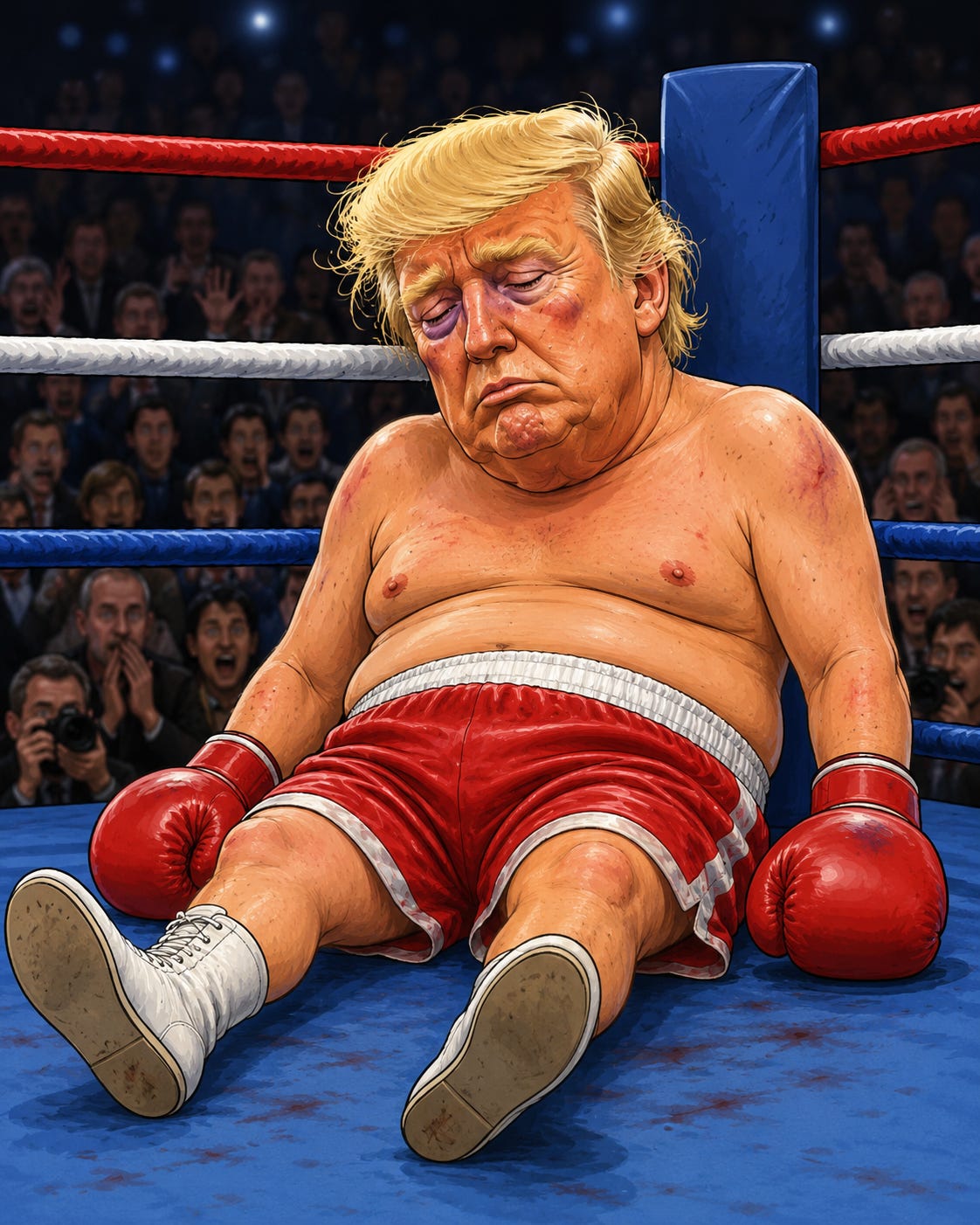
Let me begin by saying, “I told you so.” Right after the war began and again a couple of weeks ago, I told you that the Iran war was going to end badly, specifically noting in March, the “most likely scenario is that Trump finds something to call a victory and walks away.”
This deal could be the worst deal ever, and Trump would still tout the fact that a deal was made and call it the greatest diplomatic victory in world history. Assuming that the end is finally here, which is not necessarily a safe assumption with Netanyahu and Israel not playing ball, those predictions seem to have been fulfilled.
As I pointed out, Trump really needed to make a deal to get oil flowing again and keep gas prices from skyrocketing before the midterms. There are several big questions about the deal, not least the question of exactly what Trump just agreed to, but also whether the framework will restore the oil trade and save the Republicans from midterm voter anger.
Right now, we don’t know a lot about the contents of the deal, but we do know that a lot of Trump supporters (and anti-anti-Trumpers) who are Iran hawks are angry about what seems to be a capitulation, while other, more cultish Trump supporters are simply cheering the fact that a deal was made. More ideological Trumpists are concerned about the future of the Persian Gulf, while Trump partisans, who applaud anything and everything Trump does, are just concerned about Trump’s popularity and the effect on the midterms and his continued power.
I think one thing that we can be sure of is that oil prices will decline in the short term. Over the past few months, it has become apparent that the markets like hints of peace. Oil prices fall at the mere suggestion of a possible deal, and financial markets soar when oil prices fall. At the very least, it seems likely gas prices will not be astronomical for the remainder of the summer travel season, but they probably won’t be as low as the status quo antebellum.
Don’t expect Trump supporters to make this distinction. They’ll credit Trump for the fact that gas prices are coming down without any regard for the fact that Trump caused gas prices to spike in the first place. It will be another case of “Trump Solves Problem Created By Trump.”
The next question would be how long the peace will last. Netanyahu refuses to be bound by the deal and says Israeli troops won’t be withdrawn from Lebanon. If Israel keeps fighting in Lebanon, and Iran retaliates by striking targets in the Persian Gulf or clamping down on access to the Strait of Hormuz, this may be the shortest peace deal since Trump’s last Persian Gulf ceasefire.
Let’s assume the current ceasefire does more or less hold and that Iran allows shipping to resume through the Strait of Hormuz. Will those relative victories avert a Republican cataclysm in the midterms?
That’s a nah from me, dawg, and I’ll give you a few reasons why. Most obviously, Trump and Republicans will still need to answer for why they started - and lost - an unnecessary war. All other things being equal, Republicans are going to have to explain why they spent hundreds of billions of dollars (not counting the money they may or may not be giving to Iran), killed 13 and injured scores of American soldiers, depleted stocks of munitions that leave us vulnerable elsewhere, and, in the end, left Iran richer and strategically stronger than it was before the war. Trump’s war achieved none of his stated goals, and it doesn’t look like Iran will even give up its enriched nuclear material.
Voters may not care about theoretical issues on the other side of the world if there is no active shooting and dying, but that still does not mean that Republicans are out of the woods. Prices are still elevated, and not just for gas. Food prices were up even before the war, driven partly by Trump’s trade wars.
The price of food will likely remain high for the time being and may get worse before it gets better. Much of the world’s fertilizer came through the Strait of Hormuz, and the supply was effectively cut off during the war. Prices spiked for the available supply. This means that the cost of growing food was more expensive this year, and crop yields may be lower. Those costs will be passed along to consumers.
In fact, many of Trump’s policies directly contribute to higher prices. In addition to the war and its associated energy and fertilizer spikes, the tariffs that Trump schemes to keep in place despite court rulings that strike them down and the war on immigrants also create upward pressure on prices.
Pocketbook issues often drive voters. If that’s the case this year, Republicans can expect a shellacking as voters watch grocery prices rise while they see clips of Trump saying, “I love inflation.”
Nothing seems to be going well under the Trump regime. From disastrous foreign policy to spending millions on the reflecting pool only to have the water promptly turn green from an algae bloom, the meme that Everything Trump Touches Dies (#ETTD) is on display on a daily basis, and with Trump putting his name on everything, it’s difficult for voters to avoid making the connection.
Even traditional Republican issues like immigration have seen an erosion in voter approval and trust. In particular, there has been widespread dissatisfaction with Trump’s heavy-handed immigration enforcement, especially among the independent and Hispanic voters who helped put Trump and Republicans over the top in 2024.
As it stands now, Republicans will be arguing that inflation is good, food prices aren’t as bad as consumers think they are, pallets of cash for Iran were bad under Obama but even more cash from Trump is good, and that taxpayers should pony up $600 millionfor a presidential ballroom at a time when many are worried about how to pay for their next meal. That’s not only tone-deaf, it’s also politically disastrous. Republicans might as well campaign under the slogan, “Let them eat cake.”
And all this assumes that Trump will be on his best behavior and won’t do anything to create more bad news for Republicans before Election Day. Friends, I’m here to tell you that won’t happen. There is no way that Trump can go four months without creating a plethora of new messes. By next week, let alone four months from now, he may have declared war on Greenland or who knows what?
There are not many consistent things about Donald Trump, but there are a few. One is that he will never give up on tariffs, no matter how much they strangle the economy. Find someone who loves you as much as Donald Trump loves tariffs (and himself).
Another major point of consistency is that Donald Trump cannot go long without being in the limelight. That’s true even if he gets in the limelight by doing crazy and destructive things. That’s going to be true between now and the midterms as well, and you can take that to the bank.