Showing posts with label Polling. Show all posts

Thursday, November 5, 2020

What happened to the polls?

 It wasn’t very far into the counting on Tuesday night when many people started attacking the polls. There were definitely problems with some polls, but much of the anger was premature.

One major problem with many of the early allegations of bad polling was that the counting was ongoing. At the point where many people, notably Trump supporters, were attacking the polling, states had often reported only about 60 to 80 percent of their vote.

In this year’s election, many of the battleground states followed a pattern that The Dispatch has called the “red mirage.” Because early in-person votes were counted first, Joe Biden often started with a healthy lead. As Election Day in-person ballots were counted, Donald Trump closed the gap and often took a lead. It was at this point that many casual observers assumed that the polls were wildly inaccurate.

But the story doesn’t end there. There was an abnormally large number of absentee ballots this year. When these votes were counted, the gap closed once again. In some states, mail-in ballots allowed Biden to take the lead. In others, the outcome is still up in the air.

Votes are still being counted so it is still premature to say exactly how close the polling was this year, but it looks a lot closer on Thursday morning than it did on Tuesday night. Having said that, some polls were better than others and some races look more problematic than others.

I did my last analysis of the presidential election polling on Oct. 27, a week prior to the election, but the polls didn’t stop coming in at that point. Real Clear Politics has a handy page that sums up battleground state polling (excluding Georgia and Nevada, which you have to look up separately) as it stood on Election Day. Here is a breakdown that compares these numbers with the actual results currently reported by the AP. My Oct. 27 article covered several additional states, but for brevity, I’ll concentrate on the ones that have been decisive or are still in play.

Arizona –
RCP spread – Bden + 0.9
The First Oct. 27 – Biden + 2.2
Current count- Biden + 2.4 (88 percent reporting)

Florida –
RCP spread – Biden + 0.9
The First Oct. 27 – Biden + 1.2
Current count – Trump + 3.4 (99 percent reporting)

Georgia –
RCP Spread – Trump + 1.0
The First Oct. 27 – Trump + 0.4
Current count – Trump + 0.4 (99 percent reporting)

Michigan –
RCP spread – Biden + 4.2
The First Oct. 27 – Biden + 9
Current count – Biden + 2.7 (99 percent reporting)

Nevada –
RCP spread – Biden + 2.4
The First Oct. 27 – Biden + 5.2
Current count – Biden + 0.5 (75 percent reporting)

North Carolina –
RCP spread – Trump + 0.2
The First Oct. 27 – Biden + 1.2
Current count – Trump + 1.4 (94 percent reporting)

Pennsylvania –
RCP spread – Biden + 1.2
The First Oct. 27 – Biden + 4.5
Current count – Trump + 2.6 (89 percent reporting)

Looking at the data, a clear pattern emerges. The polling in every state tightened noticeably in the last week before the election. As I frequently point out, polls are not predictive. They are snapshots of current opinion. They are also not exact. Every poll includes a margin of error that is typically between about two and four points.

So far, the largest error seems to be Florida where polling swung by about four points. Pennsylvania currently has the second-largest error, but votes are still being counted there and the president’s lead is shrinking as absentee ballots are counted. Nate Silver of FiveThirtyEight noted on Twitter that Biden’s margin on the absentee ballots so far has been enough to eventually put him in the lead, which will also close the polling gap.

If we exclude the two outlier states and average the current polling error for the remaining battleground states, we find that the polls were only off by an average of 1.3 points. That’s pretty dang close. That margin may shrink as well as more votes are counted, particularly in Nevada, which is running behind. Even including Florida and Pennsylvania, the polling error was only 2.4 points. That’s still not far off and well within the margin of error.

Admittedly, the shift in all cases was toward Donald Trump, but that does not necessarily mean that pollsters were biased against Trump. There is some evidence that late-deciding voters went for Donald Trump, which would have impacted the accuracy of the final polls. New York Times exit polls show that Trump won voters who decided in the last week by a two-to-one margin. There were also big demographic swings that confounded pollsters. This year, Trump gained with minorities but lost ground with white voters.

No one pollster seems to have gotten it all right. Trafalgar is becoming the darling of the right for showing a two-point Trump lead in Florida. However, Trafalgar also showed Trump up by three points in Arizona, five in Georgia, and two in Michigan, Those surveys were outliers that overestimated support for Trump.

The best way to watch the polls is to look at averages and trends. Don’t obsess over individual polls. Polling averages are generally pretty close since they smooth out the difference between the Trafalgars and other polls that swing in the opposite direction, such as the Nov. 1 Quinnipiac poll that showed Biden leading by five in Florida. The big takeaway from the polling average for Florida that showed Biden with a less-than-one-point lead should have been that the race was too close to call.

The polls were not exact in 2020, but they never are. They aren’t intended to be. The polling averages were mostly very close, however, and Florida may turn out to be the only state where the polling average did not correctly pick the ultimate winner. Reports of the polling industry’s imminent demise seem to be very premature.

Originally published on The First TV

Wednesday, October 28, 2020

Can Republicans hold the Senate?

 President Trump is trailing in both national polling and in the Electoral College. If Joe Biden becomes president, it becomes even more important for Republicans to maintain control of the Senate, but the structure of the 2020 elections in which the GOP is defending many more vulnerable seats than Democrats, as well as alarming polls, make keeping control of Congress’s upper body a difficult proposition.

As I discussed two weeks ago in my last look at Senate races, the dynamics of this year’s election mean that Republicans are defending 23 Senate seats while Democrats only have to defend 12. Most of these seats on both sides are in states that are not competitive, but, as you might expect, the sheer numbers mean that more Republican seats are vulnerable. As 2020 has turned progressively more ugly for Republicans, seats once thought safe for the GOP have become vulnerable. At this point, 10 Republican seats are at risk compared to only two Democratic seats.

On the Democratic side, the two seats that it was considered possible for Republicans to flip were those of Doug Jones in Alabama and Gary Peters in Michigan. When Doug Jones won the special election to fill Jeff Sessions’ seat against Roy Moore in 2018, everyone knew it was a temporary thing. Moore, a former state supreme court justice who was removed from the bench for judicial misconduct and who was the subject of sexual assault allegations, was a uniquely bad candidate. No one expected that Jones would win re-election against a more mainstream Republican.

The conventional wisdom appears to be correct. Most polling shows Jones trailing former Auburn coach Tommy Tuberville by double-digit margins. As you’d expect for one of the reddest states in the nation, this looks like a Republican pickup.

Not so for Michigan. Republicans had high hopes for the Wolverine State after 2016, but it looks as though they will be disappointed. After a narrow win there over Hillary Clinton, Donald Trump is trailing by nine points. Republican John James is doing slightly better than the president but is still trailing by six points. Michigan seems destined to go blue again this year, leaving the Republicans with a gain of one seat.

That was the good news for Republicans. Now let’s look at the list of Republican seats that are at risk.

  • Arizona – Republican Martha McSally is not a bad candidate, but she is the victim of the poor timing of being a Republican candidate in the Trump era. McSally lost the race to replace Jeff Flake to Kirsten Sinema in 2018 and then was appointed to fill Jon Kyl’s seat. Now she is trailing Democrat Mark Kelly by four points, which is slightly better than Donald Trump’s position in the state. The race is somewhat of a tossup, but McSally is the clear underdog. The seat is likely to go blue.
  • Colorado – Republican Cory Gardner came into the Senate as a Tea Party candidate in 2014, but Colorado is trending more and more blue. Gardner is trailing by double digits in most polls and looks to be toast. This would be the Democrats’ second pickup.
  • Georgia – Republican David Perdue is facing surprisingly stiff opposition from Democrat Jon Ossoff. Perdue has narrowly led in most polling but a partisan Civiqs poll released yesterday showed Ossoff ahead by six points. Georgia’s requirement that a candidate wins a majority means that the race will probably go to a runoff in January where Perdue would likely have an advantage.
  • Georgia special election – Kelly Loeffler was appointed to replace Johnny Isakson last winter and now she is fighting for her political life. Loeffler is competing in a jungle primary against both Doug Collins, a Republican congressman, and Democrat Raphael Warnock (as well as a handful of other candidates). Both Republicans now trail Warnock but the runoff would likely favor the eventual Republican nominee.
  • Iowa – Joni Ernst, another 2014 Tea Partier, is in a close race with Democrat Theresa Greenfield. The race has tightened in recent weeks with two polls that show a one-point lead for Ernst, but Greenfield still leads the polling average by two points. This race could go either way but is a likely Democratic pickup even though Donald Trump may win the state.
  • Kansas – Republican Roger Marshall and Democrat Barbara Bollier are vying to replace the retiring Pat Roberts in this sleeper race. The race is surprisingly close, but Republicans should retain the seat.
  • Maine – Susan Collins has been a Republican that other Republicans love to hate for as long as I can remember. It looks as though Republican voters won’t have to worry about her swing votes after this year. They’ll be complaining about Democrat Sara Gideon, who has led in every poll since July. Maine could be the fourth seat that Democrats flip.
  • Montana – Donald Trump will win Montana handily but the Battle of the Steves in the Senate race is much closer. Republican Steve Daines narrowly leads Democrat Steve Bullock by three points. The seat will likely stay red.
  • North Carolina – Both the Senate and the presidential races in the Tar Heel State are tossups this year. Democrat Cal Cunningham has lost some of his lead after a sex scandal erupted a few weeks ago. Nevertheless, Cunnigham still holds a polling edge over Republican Thom Tillis. This is another tossup, but North Carolina could easily become a fifth Republican loss.
  • South Carolina – Polling favors Lindsey Graham in this surprise tossup although several recent polls have shown a tied race or a slight lead for Democrat Jaime Harrison. Republicans should hold this seat but there is a good opportunity for an upset.

The changing political situation is also leading to an additional Republican seat that may be vulnerable. Polling in Texas shows a very close race between Donald Trump and Joe Biden, but so far Republican John Cornyn has maintained a comfortable lead over Democrat MJ Hegar. The race is not a tossup but a few recent polls have indicated that the race may be tightening. As Trump struggles in the Lone Star State, the Senate race bears watching as well.

The big picture here is that Democrats are likely to lose one seat (Alabama) while Republicans are almost certain to lose three seats (Arizona, Colorado, and Maine) and are somewhat likely to lose as many as five (adding Iowa and North Carolina). If the Democrats get the breaks on Election Day, things could get even worse for the GOP. A net gain of at least two seats for Democrats is a virtual certainty.

A net gain of three seats for Democrats would mean a 50-50 tie in the Senate. In that case, the vice president would cast the deciding vote for legislative ties.

If Democrats take the three likely seats and then add two or more tossup races to their tally, they will win control of the Senate. They would fall short of a filibuster-proof majority, however. If Senate Democrats elected to retain the filibuster, Republicans would still have enough clout to act as a speedbrake on the progressive agenda, except for judicial nominations where Harry Reid and Mitch McConnell have exercised their respective nuclear options.

At this point, the odds seem close to even money that the balance of the Senate next term will be a tie or a Democratic majority. The Senate races are looking slightly better for Republicans than the presidential race. Republican candidates may benefit from split-ticket voters who are experiencing Trump-fatigue but don’t want to hand the Democrats a blank check.

Originally published on The First TV

Tuesday, October 27, 2020

Could problematic polling lead to another surprise Trump victory?

 As I discussed yesterday, it’s a week out from Election Day and the polls are not looking good for Donald Trump. The question on everyone’s mind is whether the polls could be off, leading to another unexpected result similar to 2016. Democrats are fearfully considering the possibility while Republicans are clinging to the hope that Trump can once again beat the odds.

The only way to answer that question for sure is to wait until next Tuesday, but we can gain some insights by comparing 2020 polling to that of 2016. Real Clear Politics has archived the final polls of 2016 for comparison to current polls.

On a national level, we see a very different race between 2016 and 2020. The race between Hillary and Trump was consistently much closer than the Biden-Trump race. Over the course of the 2016 campaign, Trump led in the polling average at least four times. In 2020, Trump has never been ahead of Joe Biden.

Hillary also maintained a much smaller lead than Biden. Over the final months of the campaign, when she was bedeviled by Wikileaks, Hillary never opened up a lead of more than seven points. In contrast, Biden’s lead over the same time period has not fallen to less than six points.

Further, the closing weeks of the campaign show a sharp decline for Clinton. Hillary’s polling average peaked on Oct. 18 and then began a decline that continued until Election Day on Nov. 8. Donald Trump experienced a sharp increase a few days later, which coincides perfectly with the release of James Comey’s letter to Congress on Oct. 28.

What do the polling trends show this year? Biden did begin a decline on Oct. 10. This predates the publication of the Hunter Biden emails on Oct. 14. At the same time, Trump closed slightly in the polls. The difference is that Hillary began her decline with a seven-point lead where Biden held a 10-point lead. As of this writing, Biden maintains a 7.3-point average lead even after the polls have tightened.

Finally, Hillary was never able to close the deal with voters. In the last days of the campaign, she never averaged better than 49 percent. In contrast, Biden is currently at 50.5 percent even after his polling drop.

Now, let’s look at the swing states. We’ll compare the current polling averages with the archived data from 2016. States where the result was contrary to polling are denoted by an asterisk.

  • Arizona
    2016 polling spread – Trump +3.5
    2016 result – Trump 4.0
    Current polling spread – Biden + 2.2
  • Colorado
    2016 polling spread – Clinton + 4.9
    2016 result – Clinton + 2.9
    Current polling spread – Biden + 9
  • Florida
    2016 polling spread – Trump + 0.2
    2016 result – Trump + 1.2
    Current polling spread – Biden + 1.2
  • Georgia
    2016 polling spread – Trump + 4.8
    2016 result – Trump + 5.1
    Current polling spread – Trump + 0.4
  • Iowa
    2016 polling spread – Trump + 3.0
    2016 result – Trump + 9
    Current polling spread – Biden + 0.8
  • Michigan*
    2016 polling spread – Clinton + 3.4
    2016 result – Trump + 0.3
    Current polling spread – Biden + 9
  • Nevada*
    2016 polling spread – Trump + 0.8
    2016 result – Clinton + 2.4
    Current polling spread – Biden + 5.2
  • North Carolina
    2016 polling spread – Trump + 1.0
    2016 result – Trump + 3.7
    Current polling spread – Biden + 1.2
  • Ohio
    2016 polling spread – Trump + 3.5
    2016 result – Trump + 8.1
    Current polling spread – 0.6
  • Pennsylvania*
    2016 polling spread – Clinton + 1.9
    2016 result – Trump + 0.7
    Current polling spread – Biden + 4.5
  • Wisconsin*
    2016 polling spread – Clinton + 6.5
    2016 result – Trump + 0.7
    Current polling spread – Biden + 5.5

As you can see, the state polls were not exact. In some cases the error benefitted Clinton, but in others it benefitted Trump. Clinton outperformed the polls in New Mexico and Nevada, where the polling average picked Trump to win, but we don’t hear about these examples because the election did hinge on these states.

There were only four states where the final results did not match the polls (Michigan, Nevada, Pennsylvania, and Wisconsin) and the election swung on three of them. In three of the four states, the polling error was about four points or less, which would have been within the margin of error of most polls. The 7.2-point error in Wisconsin is the exception.

A post-mortem of 2016 polling error by the American Association for Public Opinion Research found several reasons for the erroneous polls. These include shifting preferences in the closing days of the campaign, underrepresentation of non-college graduates, and late-revealing Trump voters.

So could the same factors skew the 2020 election in key states? I’m skeptical for several reasons. First, Biden’s lead is larger than Clinton’s but in terms of national polling and the Electoral College. Biden leads Trump in a number of battleground states in which Trump led in 2016. That means that a larger polling error would be required to swing the election or an individual state than in 2016.

And pollsters aren’t using the same models that they used in 2016. It would be a mistake to assume that pollsters didn’t look at the 2016 results and try to learn from their mistakes. It is doubtful that pollsters will repeat the same errors they made last time, but correcting those mistakes might lead to new errors. It is just as likely that Joe Biden will outperform this year’s polls, which are trying to correct for undercounting Trump voters last time, as it is that they will err against Trump again. The AAPOR report found “no consistent partisan favoritism in recent U.S. polling.”

Finally, there were far more undecided voters in 2016 than today. Donald Trump was a relatively unknown quantity and many people assumed that he could become more serious and presidential if he won the elections. Today, voters know and dislike Trump. Fifty-six percent of voters believe that Trump does not deserve re-election. This is slightly higher than the 52 percent who said last year that they would not support Trump. In states where Biden leads by more than 50 percent, it is unlikely that late-deciding voters will swing the election to Trump.

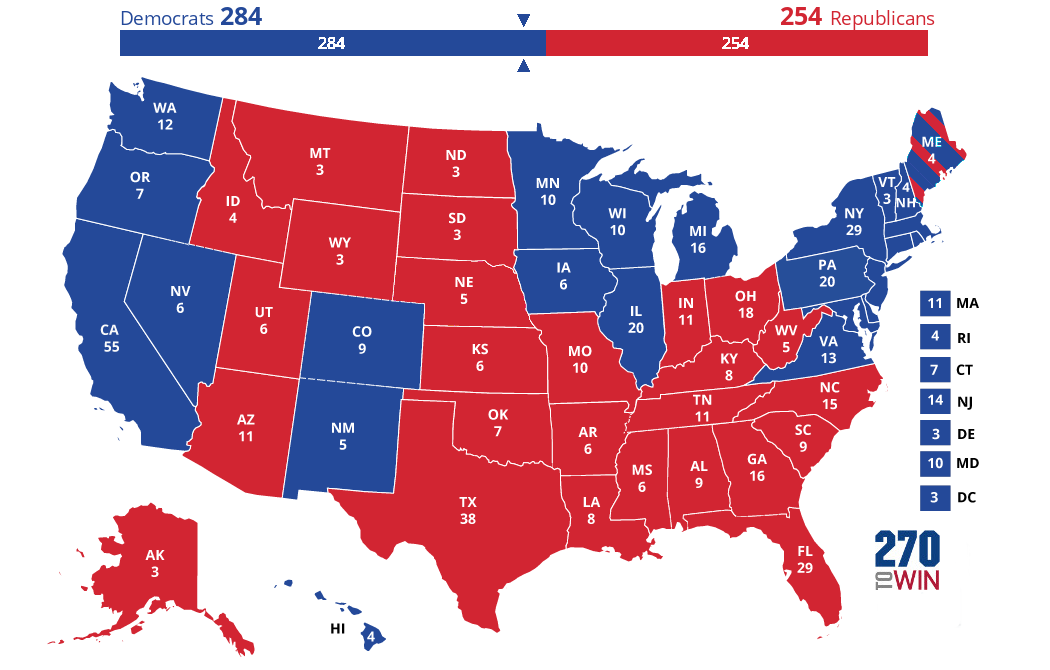
Donald Trump’s difficulty this year is illustrated by the fact that, even if he ran the table on every swing state where he is trailing by less than four points, he would still lose the election, as shown by the map below. The president would need to win at least one of the three Rust Belt states where Wisconsin-size polling errors are required.

We are unlikely to see a repeat of Trump’s surprise victory this year. Joe Biden holds a larger lead that would require a bigger error to change results at a time when pollsters are very keen to overcome their mistakes from 2016. At the same time, most voters have made up their minds about the election years ago.

Barring another Comey letter that upends the race at the last moment, there seems little chance of a last-minute Biden collapse. With almost half of the electorate having already cast ballots in early voting, there is a diminishing chance that even an October surprise of YUGE proportions could remake the race.

Originally published on The First TV
Monday, October 26, 2020

Here’s how the Electoral College is shaping up with a week to go

 We are a week away from Election Day and the debates are over. There is little time left for the race to swing and few opportunities for candidates to change the current trends. With that in mind, let’s take another deep dive into the Electoral College to see how the presidential race is shaping up.

Looking at the national polls, we see that Joe Biden retains a healthy lead over Donald Trump. Currently, Biden has a nine-point lead in the FiveThirtyEight average. Biden’s lead narrowed slightly over the past two weeks, coinciding with the breaking of the Hunter Biden laptop story, but now Biden seems to be surging again. Even with the alleged corruption story at the forefront of the news, Trump never led in the polling average and Biden now averages 51 percent support.

But the real race is in the swing states, so let’s look at them individually. For these numbers, I’m primarily relying on FiveThirtyEight but I’m also looking at the Real Clear Politics polling average.

  • Arizona – Biden leads by three points
    Biden – 49
    Trump – 46
  • Colorado – Biden is up by 13 points
    Biden – 53
    Trump – 40
  • Florida – Biden leads by about two points
    Biden – 49
    Trump – 47
  • Georgia – Biden leads by less than one point
    Biden – 47.6
    Trump – 47.1
  • Iowa – Biden leads by one point
    Biden – 47
    Trump – 46
  • Michigan – Biden leads by eight points
    Biden – 51
    Trump – 43
  • Minnesota – Biden leads by eight points
    Biden – 51
    Trump – 43
  • North Carolina – Biden leads by about two points
    Biden – 49
    Trump – 47
  • Ohio – Trump leads by one to two points
    Biden – 47
    Trump – 48
  • Pennsylvania – Biden leads by five points
    Biden – 50
    Trump – 45
  • Texas – Tie per FiveThirtyEight but Trump leads by two per RCP
    Biden – 48
    Trump – 48
  • Wisconsin – Biden leads by six points
    Biden – 51
    Trump – 45

What we are presented with is a picture of a near-sweep of the swing states by Joe Biden. Even worse for Donald Trump, as I’ve noted in the past, is that several red states (Georgia, Iowa, and Texas) have slipped into battleground status. Still worse, Biden holds narrow leads in two of these states.

It is also worth pointing out that Biden is now polling at 50 percent or above in five of the battleground states (Colorado, Michigan, Minnesota, Pennsylvania, and Wisconsin). Three of these are the states where Donald Trump’s surprise victories in 2016 propelled him to the presidency. Pollsters have paid more attention to these states this year, however, and Democratic margins are much greater than they were in the last cycle with one exception.

In Wisconsin, Biden’s six-point lead is similar to Hillary Clinton’s lead in 2016. That year, Hillary’s 6.5-point polling lead turned into a 0.7-point Trump victory, a swing of 7.2 points. Such a swing is possible this year but unlikely since more pollsters are surveying Wisconsin and have taken the 2016 failure to sample enough non-college-educated white voters into account.

In the other two decisive states from 2016, Michigan and Pennsylvania, Biden’s lead is much greater than Hillary’s. In Michigan, Hillary led by 3.4 points while she held a 1.9-point lead in Pennsylvania. This year, Biden leads by eight and five points respectively.

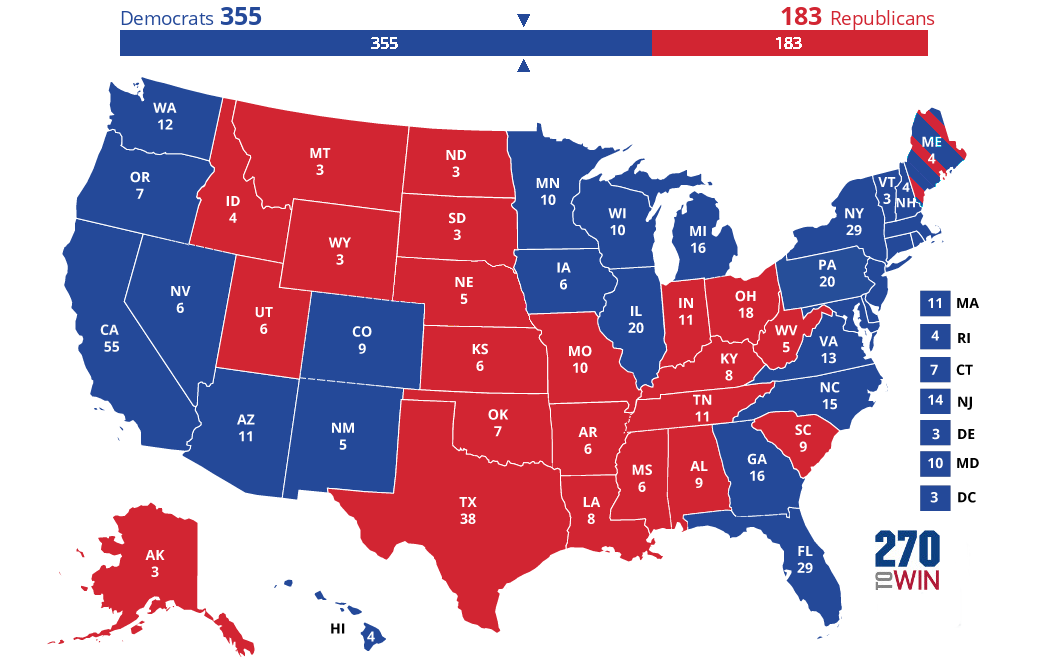
If we put everything together and plug it into the Electoral College map, we find Biden in landslide territory. Giving Biden credit for every state where he is leading, he would win the Electoral College by a 355-183 margin. If Texas and Iowa fall into the Biden column, the outcome could be as lopsided as 411-127.

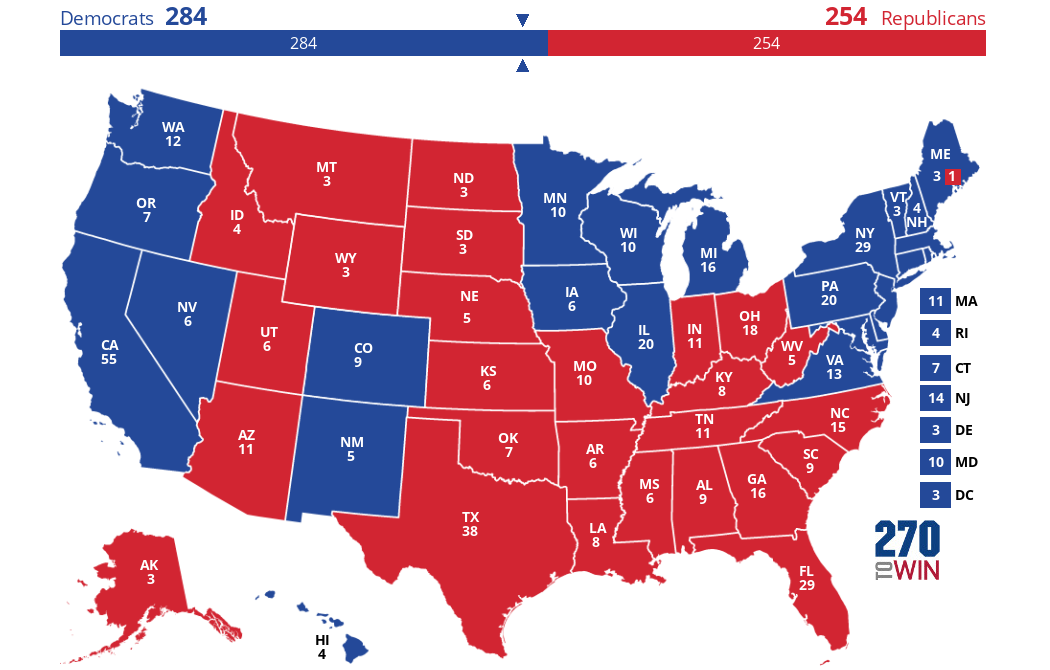
Statistically, it is unlikely that Biden would win every toss-up state where he leads, however. On a good night, Republicans might hold Arizona, Georgia, Florida, and North Carolina. Anything else would be a very long shot. This scenario still leaves Biden the victor by a 284-254 margin.

Time and opportunity for Donald Trump to shift the course of the race are slipping away. At this point, FiveThirtyEight gives Joe Biden a 92 percent of winning the Electoral College (compared to 72 percent for Hillary Clinton in 2016).

Of course, this does not mean that Donald Trump cannot win, but the odds against him are much longer than in 2016. Could the polls be wrong again? Will the race abruptly tighten as it did in 2016? I’ll look at the chances of such a swing next time.

Originally published on The First TV
Wednesday, October 7, 2020

The polls look bad for Trump

 The first debate marked a major shift in presidential polling. The entire campaign up to that point seemed to have been beset with bad news for Donald Trump, but it got worse in the debate week. First, there was Trump’s disastrous performance in the debate itself and then, a few days later, came the news of the president’s Coronavirus diagnosis. Now, less than a month before Election Day and with much of the country already voting, that onslaught of bad news is being felt in the polls.

The big news has involved an NBC News/WSJ poll released October 4 and a CNN poll from October 6 that show Joe Biden with a 14-point and 15-point lead respectively. The good news for the Trump campaign is that those polls both seem to be outliers with abnormally large leads for the Democrat. The bad news is that most other polls show trends toward Biden, just not as large.

Many conservative pundits and writers won’t tell you that the news is bad and that it has been bad all along. My view, however, is that conservatism needs to be grounded in truth, even when that truth is unpleasant. As Ben Shapiro is fond of saying, “Facts don’t care about your feelings.” That applies to the right as well as the left.

The truth is that Donald Trump has been in trouble throughout the entire campaign. While some cherry-pick favorable poll results, I have long been a proponent of looking at trends and averages in polling. This helps to account for outlier polls, surveys with atypical results, and is a way of looking at the big picture. Looking at trends and averages helps us to see the entire forest rather than focusing on individual trees.

So, what do the polling averages tell us? FiveThirtyEight and Real Clear Politics are the two best-known sites for polling averages and they both tell the same story: Donald Trump has consistently trailed Joe Biden. The FiveThirtyEight model goes back to March 2020 while Real Clear Politics provides a 12-month look-back. In both cases, President Trump has never led Joe Biden in the polling average. While Trump did lead in some individual polls, the closest he got to Biden in the average of polls was when he trailed by about three points last April.

Lately, it has gotten worse. Trump trailed by eight-to-nine points through much of the summer but closed to within six-to-seven points in September with his post-convention bump. Now, after the debate and with the news of his infection with Coronavirus, that slight gain seems to have evaporated.

Since the beginning of October, two days after the debate, the polling averages show an unmistakable dip for Trump and a corresponding surge for Joe Biden. Both sites currently show Biden with an average nine-point lead.

And the news is only going to get worse in coming days. Most of the new polls coming out show Biden with leads that are larger than the current polling average. In many cases, the former vice president holds a double-digit lead, even if 15 points is still outside the norm. Mathematically, that means that Biden’s average lead will continue to expand.

At this point, a lot of my readers will be saying, “So what? The polls were wrong in 2016 and they are probably wrong now.” Here’s why that isn’t so.

Both sites have also archived polling results from 2016. If you look at the historical trends, you can see that 2016 was a much different race from 2020. Throughout the entire summer, Trump polled much closer to Hillary, who was dogged by bad news the way Trump has been this year, than he has to Biden. Trump led in the polling average briefly in late July and was within three points in mid-September and again just before Election Day.

This year, not only has Biden maintained a wider lead than Hillary for the entire campaign, but his lead seems to be increasing as the campaign draws to a close. Hillary never led the average with more than 50 percent support, but we are seeing that from Biden now. 2016 was closer than most people realized throughout the entire campaign. 2020 is not close.

The history of the last four weeks of the 2020 campaign has not been written yet, but the situation is looking very bleak for Republicans. Donald Trump needs a big break – and soon – to turn things around. With much of the country already voting, good news for Trump – if he can find any – will have diminishing returns as we get closer to Election Day.

Of course, the deciding factors will be the swing states and the Electoral College. That’s where some key election forecasts went wrong in 2016. I’ll take a look at the state of polling in the swing states in a future article.

The bad polling news is an unpleasant truth for many conservatives and Republicans to hear, but it is also an important truth. It is important that we not live in a bubble but that we face real-world facts about the probable outcome of the election rather than live in denial.

Originally published on The First TV
Tuesday, September 29, 2020

Trump Outperforms Senate Republicans

 When I was writing about Lindsey Graham earlier this week, I noticed that the South Carolina senator was actually running behind Donald Trump in the Palmetto State. This was somewhat surprising since Mr. Trump underperformed most Republican candidates in 2016 and it made me wonder how the president stacks up against other Republican incumbents.

This year, Republicans will be defending a total of 23 Senate seats. Here is how the current RealClearPolitics polling averages (or FiveThirtyEight when no RCP average is available) compare for each Senate race and the presidential election, along with each Senate race’s current rating from Cook Political Report:

Alaska – Likely R (no polls since July)
Sullivan (R) leads by five points
Trump (R) leads by three points

Arizona Lean D
McSally trails by five
Trump trails by three

Arkansas Solid R
(No Senate polls and no presidential polls since June)
Trump leads by two

Colorado Lean D
Gardner trails by eight
Trump trails by 10

Georgia Toss up
Perdue leads by three
Georgia special election Lean R
Loeffler leads by three
Trump leads by one

Idaho Solid R
Risch leads by 26
Trump leads by 25

Iowa Toss up
Ernst trails by three
Trump is tied with Biden

Kansas Lean R (open seat)
Marshall leads by three
Trump leads by nine

Kentucky Likely R
McConnell leads by eight
Trump leads by 18

Louisiana Solid R
No Senate polls
Trump leads by 11

Maine Toss up
Collins trails by seven
Trump trails by 15

Mississippi Solid R
Hyde-Smith leads by 10
Trump leads by 12

Montana Toss up
Daines leads by two
Trump leads by nine

Nebraska Solid R
No Senate polls
Trump trails by seven (this was a shocker)

North Carolina Toss up
Tillis trails by six
Trump trails by less than one point

Oklahoma Solid R
Inhofe leads by 20
Trump leads by 24

South Carolina Lean R
Graham is tied
Trump leads by eight

South Dakota Solid R
No polls

Tennessee Solid R (open seat)
No Senate polls
Trump leads by 13

Texas Likely R
Cornyn leads by eight
Trump leads by four

West Virginia Solid R
No recent polls

Wyoming Solid R (open seat)
Barasso leads by 29
No presidential polls

Of the polls where we have decent data on both races, the Republican candidate polled better than the president in seven cases. This does not include Idaho where James Risch fared only one point better than President Trump, a statistical tie. That leaves nine states where Donald Trump is running ahead of the Republican Senate incumbents.

It is also worth noting that Republican incumbents trail in five states, not counting South Carolina. Democrats need to gain a net of four seats to gain control of the Senate (three if Kamala Harris becomes president of the Senate) and Doug Jones’s seat in Alabama appears to be the only likely Democratic loss.

It is difficult to draw firm conclusions in the midst of the campaign but the polling currently shows a stark change in the nature of the Republican Party since November 2016. That year, Trump outperformed Republican senatorial candidates in only three of 12 races.

The data so far for 2020 is incomplete but shows that Donald Trump is far more accepted among red-state Republicans now than in 2020. This is true despite the fact that Joe Biden is a much more popular candidate than Hillary Clinton. With no polling in so many deep-red states, it will be interesting to watch the margins of the elections to see whether Trump maintains his edge over Senate Republicans.

Despite Mr. Trump’s unpopularity in the country at large, it shouldn’t come as a surprise to anyone that Trump remains popular in red states. What is surprising is the extent to which Trump has become more popular than traditional Republicans. That truth underscores the fact that, even if Mr. Trump is shown the door by voters, his influence will be felt in the GOP for years to come.

Originally published on The Resurgent