I normally sleep pretty well, but I woke up in the middle of the night last night thinking about Ben Sasse. If you don’t recall, Sasse is a former Nebraska senator who announced a few months ago that he has pancreatic cancer. There’s really no kind of cancer that anyone should want to get, but pancreatic cancer is one of the ones that most of us emphatically hope that we never end up with. Because it is hard to diagnose and there are few treatment options for the advanced disease, the lifespan of pancreatic cancer patients tends to be pretty short.
At least, it did. There are now a growing number of experimental treatments for the dread cancer, and one of them reportedly shrank Sasse’s tumor. I don’t know if Sasse will survive the disease, but at least he has some hope for a positive outcome.
Many people think I never say anything good about Donald Trump, but I applaud him for signing the Right to Try Act in 2018. This law allows terminally ill patients to try experimental treatments, and I suspect that Sasse’s good news may be related to the law.
From there, I started thinking about my own experience with prostate cancer. After almost three and a half years, my PSA levels are still very low, which is much better than I had hoped for at the time.
My nighttime reverie continued as I pondered the US healthcare system. Sasse is a former senator and university president with a lot of money and connections. I had few connections, but I did have savings and good insurance. It was a good thing too.
If you’ve never had a serious illness, you may not know much about the process. As most of you are aware, health insurance in the US is tied to the employer for the vast majority of us. Whether you have good insurance or not depends not only on your choices, but those of your employer. You may have the choice of a few different plans, such as high or low deductible options, but they’re probably all with the same insurer unless you forgo the company contribution and strike out on your own.
The same goes for disability insurance. Your company may not offer it. You might not have elected to buy the coverage if it does.
If you have an illness severe enough to be out of work for a long time, the company will typically use your vacation or PTO (Paid Time Off) days first. Then there is short-term disability and long-term disability with separate time limits if you’re still sick. If you aren’t aware, long-term disability insurance does not pay your full salary; about 50 to 60 percent is typical.
So, in the case of a long-term illness or injury, you have more bills than normal coming in, especially if you chose the high-deductible plan, and at the same time, your earnings have just been cut by about half. On top of that, if you stay out long enough, you may have to start paying your full health insurance premium out of pocket.
On top of all that, if the condition lasts long enough, you might lose your job when benefits run out. That doesn’t mean the illness goes away, but it does mean that you might lose your insurance.
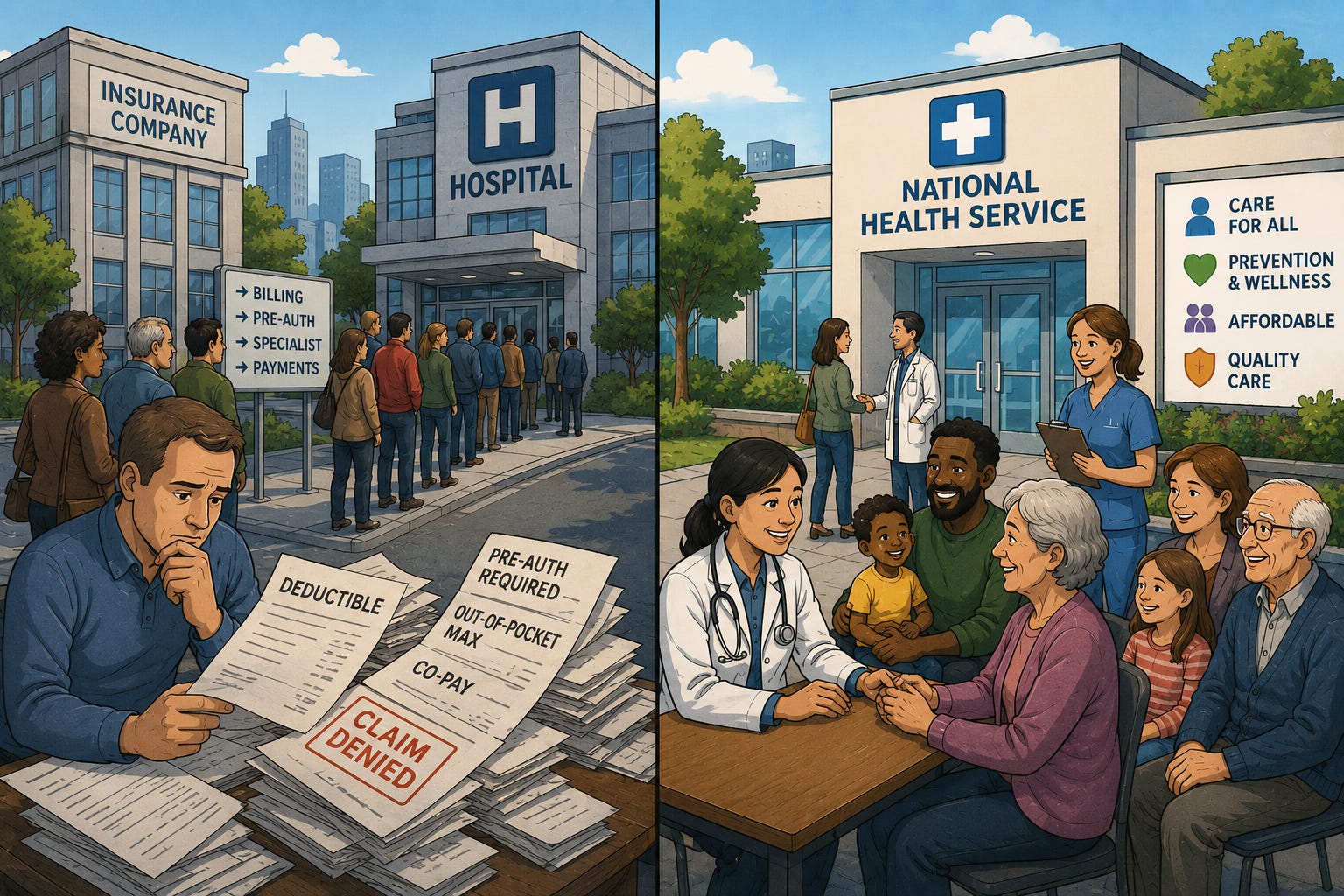
That quick walk-through illustrates the insanity of the American health insurance system. Our current system is only marginally more market-based than the national health insurance systems in those “socialized medicine” countries. The consumer doesn’t have much choice under either model.
In both cases, the health care access is set up to serve people who aren’t very sick. It’s easy to get preventive care or antibiotics, but in the national health care model, you might go on a waiting list for a vital surgery. In the US, you can probably get the surgery scheduled quickly, but you may not be able to pay for it, and the odds are good that you won’t have any idea how much it costs until it’s over.
For most of my life, the conservative line was about personal responsibility, but under our current system, you can do everything right and still be bankrupted by a medical emergency. If you have a serious, long-term illness, you’d better hope that you can get added to your spouse’s insurance. If you aren’t married, start looking. It also helps with auto insurance.
In my prostate cancer experience, I was out of work for three months. I had bought the disability insurance and was covered on that for two months. The rub is that after my doctor cleared me to go back to work, I had to wait on the FAA to renew my flight physical. Because this was a paperwork issue, rather than a medical problem, the disability payments stopped. That was an oversight (since corrected) by my employer, and I can thank Senator Raphael Warnock’s office for helping to speed my paperwork along. (I contacted my local Republican congressman first and never got a response.)
I don’t know what the best solution is. I’m not a fan of government-run healthcare any more than I’m a fan of employer-run healthcare. Having said that, putting governments in charge at least makes more sense than tying medical insurance to a job, which makes none at all.
The healthcare problem also impacts the retirement problem. If people spend their retirement savings on medical issues or drain their IRAs to survive while out on medical leave, they are likely to run out of money later in life, just when they need it most.
There has to be a better way, and I think it will take both sides working together to find it. We owe it to ourselves to create a system that can supply timely, effective care without destroying our finances.
Cancer is already a nightmare. The healthcare system shouldn’t make it worse.


No comments:
Post a Comment