Showing posts with label ELECTORAL MAP. Show all posts

Monday, October 26, 2020

Here’s how the Electoral College is shaping up with a week to go

 We are a week away from Election Day and the debates are over. There is little time left for the race to swing and few opportunities for candidates to change the current trends. With that in mind, let’s take another deep dive into the Electoral College to see how the presidential race is shaping up.

Looking at the national polls, we see that Joe Biden retains a healthy lead over Donald Trump. Currently, Biden has a nine-point lead in the FiveThirtyEight average. Biden’s lead narrowed slightly over the past two weeks, coinciding with the breaking of the Hunter Biden laptop story, but now Biden seems to be surging again. Even with the alleged corruption story at the forefront of the news, Trump never led in the polling average and Biden now averages 51 percent support.

But the real race is in the swing states, so let’s look at them individually. For these numbers, I’m primarily relying on FiveThirtyEight but I’m also looking at the Real Clear Politics polling average.

  • Arizona – Biden leads by three points
    Biden – 49
    Trump – 46
  • Colorado – Biden is up by 13 points
    Biden – 53
    Trump – 40
  • Florida – Biden leads by about two points
    Biden – 49
    Trump – 47
  • Georgia – Biden leads by less than one point
    Biden – 47.6
    Trump – 47.1
  • Iowa – Biden leads by one point
    Biden – 47
    Trump – 46
  • Michigan – Biden leads by eight points
    Biden – 51
    Trump – 43
  • Minnesota – Biden leads by eight points
    Biden – 51
    Trump – 43
  • North Carolina – Biden leads by about two points
    Biden – 49
    Trump – 47
  • Ohio – Trump leads by one to two points
    Biden – 47
    Trump – 48
  • Pennsylvania – Biden leads by five points
    Biden – 50
    Trump – 45
  • Texas – Tie per FiveThirtyEight but Trump leads by two per RCP
    Biden – 48
    Trump – 48
  • Wisconsin – Biden leads by six points
    Biden – 51
    Trump – 45

What we are presented with is a picture of a near-sweep of the swing states by Joe Biden. Even worse for Donald Trump, as I’ve noted in the past, is that several red states (Georgia, Iowa, and Texas) have slipped into battleground status. Still worse, Biden holds narrow leads in two of these states.

It is also worth pointing out that Biden is now polling at 50 percent or above in five of the battleground states (Colorado, Michigan, Minnesota, Pennsylvania, and Wisconsin). Three of these are the states where Donald Trump’s surprise victories in 2016 propelled him to the presidency. Pollsters have paid more attention to these states this year, however, and Democratic margins are much greater than they were in the last cycle with one exception.

In Wisconsin, Biden’s six-point lead is similar to Hillary Clinton’s lead in 2016. That year, Hillary’s 6.5-point polling lead turned into a 0.7-point Trump victory, a swing of 7.2 points. Such a swing is possible this year but unlikely since more pollsters are surveying Wisconsin and have taken the 2016 failure to sample enough non-college-educated white voters into account.

In the other two decisive states from 2016, Michigan and Pennsylvania, Biden’s lead is much greater than Hillary’s. In Michigan, Hillary led by 3.4 points while she held a 1.9-point lead in Pennsylvania. This year, Biden leads by eight and five points respectively.

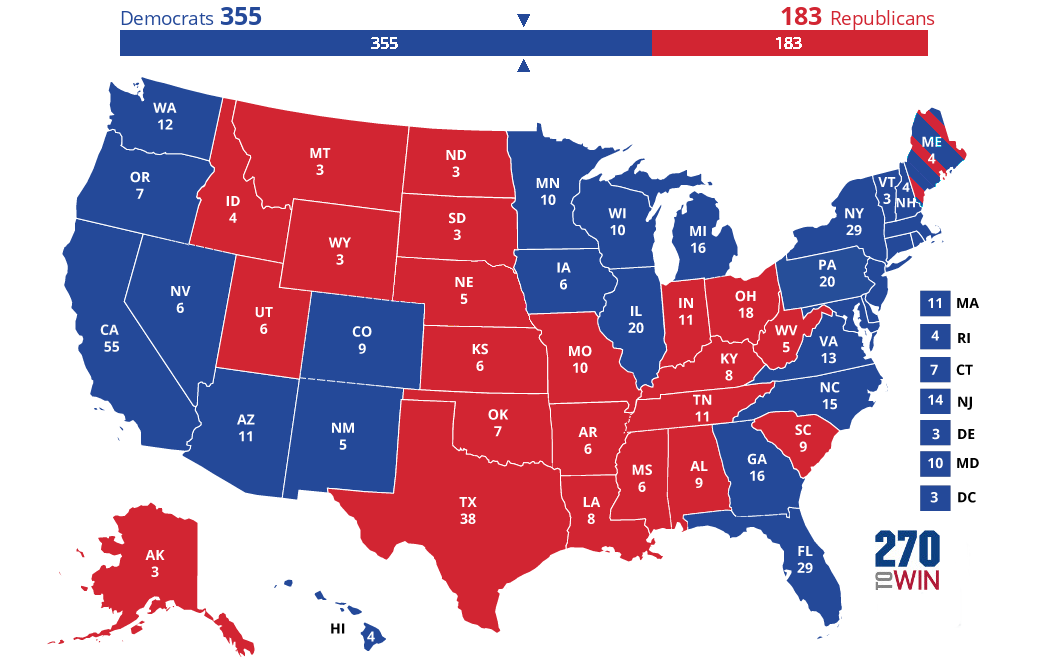
If we put everything together and plug it into the Electoral College map, we find Biden in landslide territory. Giving Biden credit for every state where he is leading, he would win the Electoral College by a 355-183 margin. If Texas and Iowa fall into the Biden column, the outcome could be as lopsided as 411-127.
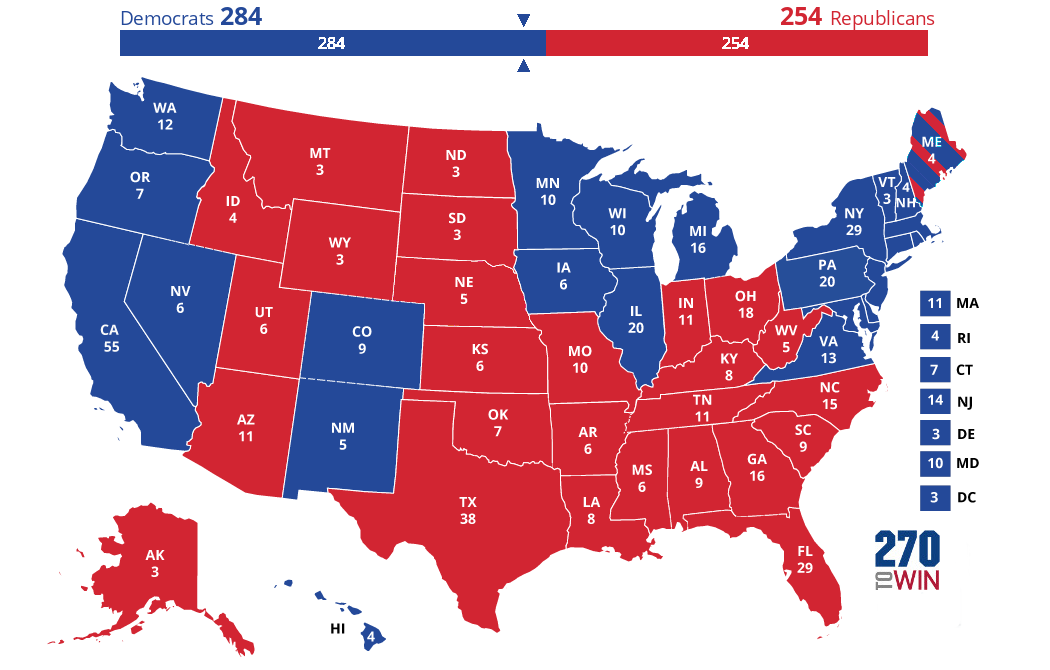
Statistically, it is unlikely that Biden would win every toss-up state where he leads, however. On a good night, Republicans might hold Arizona, Georgia, Florida, and North Carolina. Anything else would be a very long shot. This scenario still leaves Biden the victor by a 284-254 margin.
Time and opportunity for Donald Trump to shift the course of the race are slipping away. At this point, FiveThirtyEight gives Joe Biden a 92 percent of winning the Electoral College (compared to 72 percent for Hillary Clinton in 2016).

Of course, this does not mean that Donald Trump cannot win, but the odds against him are much longer than in 2016. Could the polls be wrong again? Will the race abruptly tighten as it did in 2016? I’ll look at the chances of such a swing next time.

Originally published on The First TV

Friday, September 23, 2016

It's still Hillary's race to lose

(Gage Skidmore/Wikimedia)
Numerous stories over the past few weeks have shown a surge in the polls for Donald Trump. Trump now leads Clinton in a number of polls and the Real Clear Politics average shows Hillary ahead by a scant one percent, a statistical dead heat. In spite of Trump’s surge, the race remains Hillary’s to lose and if the election were held today, she would almost certainly win. The reason is the Electoral College.

The Clinton advantage is derived from the fact that the presidential election is not a single election but a series of 51 separate elections in the states and the District of Columbia plus a final election in the Electoral College. The entire election hinges on a handful of swing states. To win the Electoral College election, Donald Trump has to win several states that Barack Obama won twice. The states of Florida and Ohio, won both times by Obama, are particularly important due to their large number of electoral votes. Without winning these two states there is almost no chance that Mr. Trump can win the presidency.

The typical list of swing states includes Colorado, Iowa, New Hampshire, Florida, Nevada, North Carolina, Ohio and Virginia. The problem for Trump is that all of these states, with the sole exception of North Carolina in 2012, were won twice by Barack Obama.

The crux of the problem for Trump is that any Democrat starts with a lock on more electoral votes than a Republican does. This is thanks to the Democratic strongholds in the Northeast and on the West Coast, population centers that are rich in electoral votes.

Trump’s first task is not to lose any red states from previous elections. Unfortunately, polling shows that Clinton is threatening Trump’s lead in both Georgia and Arizona. She has also polled strongly in Missouri and Texas.

After securing the red states, Trump’s next chore is to turn swing states red. He is having some success in Florida and Ohio. Florida, which was very close in 2012, is currently in a dead heat. Trump has also surged in Ohio in recent weeks, but the state is still a statistical tie, as is North Carolina. Trump does hold a convincing lead in Iowa, where he holds a six-point advantage in the RCP average.

Hillary Clinton, on the other hand, holds convincing leads in New Hampshire and Virginia. She also has a two-point advantage in the RCP average for Colorado.

Even if Trump holds the red states and wins all of the swing states where he leads or is in a dead heat today, he would still lose the election. Trump victories in Florida, Iowa, North Carolina, and Ohio would not give him the 270 electoral votes needed to become president. Without losing any red states, Trump would have 264 electoral votes.

Three states would provide a possible pickup of six more electoral votes. Michigan, Pennsylvania and Wisconsin are all considered to be in play. Each of these Rust Belt states has been considered a possible Republican pickup in recent elections, but they have all remained in the Democrat column.

Trump has pinned his hopes on Pennsylvania from the beginning. It still looks like a long shot. Hillary leads in all recent polling by seemingly comfortable margins. The story is similar in Michigan and Wisconsin where Clinton leads, but by slightly smaller margins than Pennsylvania. As it stands, these states will all stay blue.

It will take a near sweep of the swing states by Donald Trump to win an Electoral College victory. With the debates looming and the possibility of more embarrassing email releases for Hillary Clinton, a continuing Trump surge is not impossible.


Considering the number of states that Trump needs to flip, the odds are against Trump running the table to pull off an upset victory. A win by Trump would require victories in states that have trended more and more blue in past elections. Hillary still has a distinct advantage even as Trump surges in the polls.    

Sunday, December 20, 2015

Electoral map requires flipping four states in 2016

While moving toward the 2016 presidential election, Republican voters would do well to remember that the election is not a single election, but 50 state elections plus the final election in the Electoral College. When these individual state elections are taken into account, national polls are almost meaningless. What matters is the polling in the individual states.

To be more precise, what matters is the polling and the elections in a handful of swing states. In 2012, Mitt Romney needed to win several swing states to win the Electoral College election. These states included Florida, North Carolina, Virginia, Ohio, Colorado, New Hampshire and Iowa. Of these, Romney was only able to win North Carolina with President Obama winning all other swing states.

Below is the actual 2012 electoral map.


To win in 2016, the Republican candidate must hold onto every state won by Romney as well as adding several more states to the Republican column. The map below flips the swing states of Florida, Virginia and Ohio to the Republicans. It is worth noting that no Republican has ever won the presidency without winning Ohio.

In past elections, Republicans have hoped for victories in other blue states such as Pennsylvania, Minnesota, and Nevada. So far these hopes have not been realized and at this point there is no reason to expect that 2016 will be different.


Moving these three states to the Republican candidate moves a total of 60 electoral votes, but this is still not enough to secure a Republican victory. A fourth state needs to be flipped to send a Republican to the White House.

There are several candidates for the state to bring the Republicans to 270 electoral votes, the number needed to win the presidency. The two most likely would be Iowa and Colorado, commanding 6 and 9 electoral votes respectively. Both states seem to have shifted to the right since 2012. In the 2014 midterm elections, both states replaced a Democratic senator with a Republican one (Joni Ernst and Cory Gardner)

The final electoral map shows the effect of adding Iowa’s six electoral votes to the Republican column.


Iowa’s six electoral votes would allow the Republican candidate to eke out a win in the Electoral College. The slim two vote margin above the required 270 is one of the most likely routes to a Republican victory.

The question that Republican primary voters should be asking is which candidate can deliver Florida, Ohio, Virginia and Iowa. A candidate that cannot deliver those four states is not going to win, regardless of how conservative he or she is.


The conservative leader, William F. Buckley, famously said that conservative voters should vote for the most conservative candidate who can win. Conservative voters should bear the electoral map in mind when deciding which Republican candidates are viable… and which are not.