Showing posts with label quarantine. Show all posts

Monday, April 20, 2020

Pandemics Are Not New. They Are Just New To Us.


The Coronavirus pandemic has had America in its grip for weeks. As some Americans isolate themselves from the virus and others lament the restrictions, one obvious point is that our collective national memory has lost sight of the fact we, as a nation, have been here before. Even if we don’t remember it, the United States and its various parts have suffered through many epidemics and pandemics of infectious diseases before. In fact, especially before the introduction of vaccines and antibiotics, pandemics and epidemics could almost be considered a way of life, occurring every few years.

In our own time, we have seen the HIV/AIDS pandemic but that differed from COVID-19 in two important ways. At its peak, HIV was much more lethal than Coronavirus, but it was also much less contagious and took longer to kill. Although AIDS killed millions around the world over several decades, it was easy to avoid becoming infected. You couldn’t catch AIDS from a cough or a sneeze.

We have seen other pandemics as well. Influenza pandemics went around the world in 2009, 1968, 1956, and 1918. Most of these pandemics killed relatively few people but the 1918 Spanish flu was responsible for an estimated 50 million deaths worldwide, including 675,000 Americans.

Some of you may have heard older friends and relatives talk about the Spanish flu pandemic. My grandmother was a young girl at the time and told my mom about her memories of the pandemic. My grandmother’s family took in another young girl who lost both her parents to the 1918 flu. Unlike most strains of the flu, which primarily kill the old and young, the H1N1 strain that caused the Spanish flu pandemic killed many healthy young adults.

The fight against the Spanish flu, a pandemic that had its origins in the US, used many of the same strategies as the fight against COVID-19. Although the lead in containing the Spanish flu was taken by city and local authorities rather than state and federal officials, the cities that fared best reacted quickly by closing schools, churches, theaters and banning public gatherings. Several studies reported in National Geographic found that cities that were early adopters of that era’s social distancing strategies had death rates 50 percent lower than those who did so later or not at all. The experience in 1918 also showed that lifting restrictions too early could cause a second wave outbreak. Obviously, these restrictions were dropped after the crisis had passed.

Going back even further, there was yet another flu pandemic in 1889 that killed a million people worldwide. There were also wave pandemics of cholera in the mid-1800s and 1910 with similar death tolls.

Beyond the pandemics, there were also localized epidemics of smallpox, yellow fever, and scarlet fever. If you read The Adventures of Huckleberry Finn, you may remember a reference to smallpox in which Huck keeps two slave-hunters away from his raft by convincing them that his family has the infectious disease. Other Western novels contain references to white men giving blankets contaminated with smallpox to the Indians. The plot device has its roots in a real incident in 1763 in which the British attempted to induce a smallpox epidemic on Indians laying siege to Ft. Pitt in Pennsylvania. This early attempt at biological warfare is the only known such effort and apparently failed, but Europeans did accidentally wipe out 70 percent of the Native American population when they first brought smallpox to the New World in the 1600s.

Since our forebears were more accustomed to dealing with epidemics and pandemics than we are, we must now relearn the old lessons. Smallpox, yellow fever, scarlet fever, and cholera are no longer diseases that concern us. An obvious question is why we don’t still suffer through epidemics of these diseases the way we do the flu.

The answer is vaccines and antibiotics. In 1757, Edward Jenner developed the first vaccine in history to fight smallpox. Yellow fever has been almost eradicated through a combination of vaccines and mosquito control. Scarlet fever and cholera are treated with antibiotics. While there is also a flu vaccine, the flu virus mutates so rapidly that a new vaccine must be created for each year’s prevalent strain.

The second tactic that our great-grandparents used to fight pandemics was isolation. Quarantines have been around for hundreds of years. The origin of the word “quarantine” dates back to the 1300s when the bubonic plague, more famously known as the “Black Death” was ravaging Europe.

Science Friday tells the story of how the death of about one-third of Europe’s population from the Back Death inspired the port of Ragusa (now Dubrovnik, Croatia) to impose a trentino, a 30-day isolation period, on ships arriving from plague-stricken ports. When the 30-day period was increased to 40 days, the quarantino gave birth to the English word, “quarantine.”

Contrary to a popular meme going around, quarantines are not an isolation of the sick. By definition, they are isolation of people who are infected or who have been exposed to infectious diseases. As with COVID-19, victims of pandemics past could spread the disease to others long before they showed symptoms and became visibly sick.

The strategy of isolating the infected goes back far beyond the bubonic plague. For example, the Levitical laws of the Bible, written down thousands of years before Christ, instructed the ancient Israelites to cast out people with certain diseases for specified periods until they were once again clean. In the Christian Post, Scott Brown notes that Jews in Europe who practiced the Biblical guidelines suffered lower death rates than the gentile Christians who did not.

A major challenge of our time is that both tactics used against pandemics are under assault. COVID-19 will eventually be defeated with a vaccine. However, the anti-vaccination movement in the US has gained steam in recent years. It is an open question whether anti-vaxxers will accept a Coronavirus vaccine or take their chances with the virus, especially since many deny that COVID-19 is as serious as medical experts claim and some even deny that it is a pandemic.

Similarly, many Americans are resisting the social distancing measures that have been introduced to slow the spread of COVID-19. From day one, they have chafed at the need to stop public gatherings where the virus is spread and accused people who wear masks and gloves of being afraid.

Now, the pandemic skeptics are going a step further by holding protests aimed at reopening the economy. During many of these rallies, protesters crowd together without masks or protective gear, practically daring God and the virus to strike them down.

While most Americans are anxious to get back to work, as Ben Shapiro is fond of saying, facts don’t care about your feelings. In this case, the fact is that a dangerous viral pandemic is at peak levels around the country.

Restarting the economy now would be akin to dancing outside in a thunderstorm. There’s a chance that you won’t get struck by lightning but the elevated risk makes it very likely that you will. The danger is so high that most people, people with normal levels of common sense and self-preservation, would say that taking the risk would be both unnecessary and foolhardy.

There is a lot of irony in the current situation. One such bit is that, despite our technological advances, we are reduced to fighting the virus the same way that viruses have been fought for hundreds of years: With isolation and researching a vaccine. A second bit of irony is that, in our educated world, both strategies are being undercut by people who reject the scientific consensus and refuse to take a vaccine, to stay isolated, or even to take precautions such as wearing masks, maintaining social distancing, or washing hands.

Many Americans fail to realize that our current situation, in terms of both the pandemic and the restrictions, is not unprecedented. Just because it isn’t something that we haven’t been through, doesn’t mean that the country as a whole hasn’t experienced something similar. As a result, people who are accusing the media and government of being fearmongers are fearmongering themselves with wild claims that the pandemic is being used to usher in a coup or steal constitutional liberties.

The risks of these conspiracy theories and irrational fears are that people will abandon the social distancing that has so far worked well and that civil disturbances may be incited. Both could extend the pandemic by spreading infections. Spreading disease and inciting riots risks both thousands of lives and the economic recovery.

Pandemics are not new. The United States has experienced them before and, even with modern medicine, will experience them again. The question for our generation is, when the history of the Great Coronavirus Pandemic of 2020 is written, will we be remembered as people who banded together and rose to the occasion or will we be people who cracked under pressure and couldn’t stay home for a few weeks, stoking the fire of a second wave of infections and deaths?

Originally published on The Resurgent


Sunday, April 5, 2020

Don’t Go To Church Today. Don’t Go Anywhere.

sually, I write Sunday articles and post memes encouraging people to get up and go to church. Not this week. This week I’m telling you not to go to church. In fact, don’t go anywhere.
It seems that stay-at-home orders and bans on large crowds over the past few weeks have angered many would-be churchgoers. I’m not sure how many of them would normally be in church if no one had told them to stay home but I digress. Anyway, many people seem to feel that the fate of religious liberty in our Republic depends on whether they can go to church in the middle of a pandemic.
I’m here to tell you that it doesn’t.
The people raising Cain (to use a Southern expression) about closing churches make a couple of bad assumptions. Some believe that closing churches in the face of the virus shows a lack of faith. Others don’t believe that the government has the authority to close churches. Neither is true.
First of all, even the ancient Israelites understood that people infected with contagious diseases needed to be isolated from others to prevent a larger outbreak. Both Jewish and Christian sources agree that it is Biblical to separate people to prevent the transmission of disease.
Closing churches to prevent the spread of a communicable disease is not cowardice or lack of faith. It is an example of using our God-given brains and knowledge to help save lives. In this case, the lives that church members save by not meeting together may be their own as well as those of their families.
Second, quarantines have a long history in the US as well. Even before the US was a nation, colonial governments instituted quarantines for diseases such as yellow fever and smallpox. The practice continued after independence by state and local governments. In 1878, Congress passed the National Quarantine Act to give the federal government a role in quarantines under the Commerce Clause. Even today, state governments retain most of the control on the handling of public health crises. The National Conference of State Legislatures has a handy chart that describes different state laws.
There is well-established legal precedent that the government has the power to suspend public gatherings in the midst of a public health crisis. That does not mean, however, that governments can declare an emergency without an actual crisis to gain access to emergency powers. For example, in 1900 courts struck down a San Francisco quarantine of Chinese residents on the grounds that it was not justified.   
As the American Constitution Society points out, COVID-19 is lethal and can be spread by asymptomatic carriers in public places. Further, the restrictions were not enacted out of religious bias since they apply to secular gatherings as well. You can’t go to church but schools and bars are also closed.
Recent history has shown that church gatherings in a pandemic can be deadly. Sixty percent of known Korean cases of Coronavirus cases in March were traced to large church gatherings. On this side of the Pacific, an East Georgia church was the focal point for the spread of a cluster of cases near Augusta. Across the state in Albany, an infected person attending a funeral led to more than 500 cases and at least 29 deaths. Across the country, a California church that defied orders to close now has 71 cases and one death. The Sacramento Bee reported that members continued to meet in homes after the church canceled its formal services.
Finally, I must add a third unfortunate reason that some Christians insist on holding church services without interruption. Some Christians have been deceived by fake news and conspiracy theories to believe that what they are doing is a form of righteous resistance to some sort of new world order. The Florida pastor arrested last week for defying a legal and constitutional order to temporarily stop holding services fits right in among the “pandemic deniers” that I wrote about a few days ago.
“I have to do this to protect the congregation—not from the virus but from a tyrannical government,” Rodney Howard-Browne said on his internet radio show. “The World Health Organization has come in and is using a pandemic to take over not just America but the whole of the world.”
Crazy talk. And not the slightest bit Christian.
Right now, the way for Christians to show the love of Christ is to stay home. While God does want believers to meet and worship together, meeting under current circumstances is both dangerous and prideful. In fact, insisting that we must continue to meet when a temporary hiatus would save lives smacks of works righteousness, not faith. From a practical standpoint, after the pandemic is over, other members of the community are more likely to be willing to hear the Gospel from churches that didn’t actively try to kill them during the emergency.
If you want to worship – and I think prayer and worship is a great idea right now – it is well-established by now that many churches are using the internet to livestream services to their own congregations and beyond. One option is to watch the service at my church at 11:00 am Eastern time on its Facebook page (or you can go back and watch it later). We’d love to have you join us. I can promise the sermon won’t involve conspiracy theories about WHO.
For the next few weeks, one of the best ways to show your love for God and your fellow man is to stay home on Sunday. In a few weeks, it will be safe to return to church. Make sure you take your family then like you say you want to now.
Originally published on The Resurgent

Monday, March 30, 2020

De Blasio’s Church Threat Is Unconstitutional

There have been accusations of First Amendment violations in orders that prohibited church gatherings due to Coronavirus. Some have claimed that those orders violated religious freedoms because they included churches. Those people were wrong, but now New York Mayor Bill De Blasio has gone a step beyond what the law allows.
In a televised address, De Blasio told New Yorkers, “A small number of religious communities, specific churches and specific synagogues, are unfortunately not paying attention to this guidance even though it’s so widespread. I want to say to all those who are preparing for the potential of religious services this weekend: If you go to your synagogue, if you go to your church and attempt to hold services after having been told so often not to, our enforcement agents will have no choice but to shut down those services.”
De Blasio then said that law enforcement had been instructed “if they see worship services going on they will go to the officials of that congregation and they will inform them that they need to stop the services and disperse. If that does not happen, they will take additional action up to the point of fines and potentially closing the building permanently.”
To be clear, quarantines and orders limiting public gatherings are both legal and constitutional. The understanding of the need for quarantines goes back beyond the understanding of germ theory. The CDC notes on its site that the word “quarantine” dates back to the Middle Ages and literally means “40 days,” which coincidentally, is about how long it’s going to take to slow the spread of COVID-19.
In early American history, quarantines were instituted by both the colonial governments and the fledgling government of the United States. Federal action today is justifiable under the Interstate Commerce Clause, the General Welfare Clause and the Public Health Service Act. Though modern Americans have not had to deal with a situation like the Coronavirus pandemic, quarantines and other restrictions were common in our history as our forefathers fought diseases such as smallpox and yellow fever.
In the past, however, many quarantine actions were undertaken by state and local governments. In the current health crisis, we see a similar pattern as governors and city leaders take the lead on restricting movements to slow the infection. In fact, states have much broader quarantine powers than the federal government. Vox has a good explanation of quarantine law and a rundown on various state laws here.
New York Mayor Bill De Blasio is one of these local leaders. To be clear, De Blasio is within his authority and is doing the right thing to ban public gatherings. As David French and Sarah Isgur discussed on the Advisory Opinions podcast two weeks ago, if the government issues a blanket ban on public gatherings in an emergency that includes but does not single out religious gatherings, it is not a violation of the First Amendment or religious freedom.
A popular meme going around the internet says that quarantines only apply to sick people. This is also incorrect. Quarantines apply to people who might be infected. Sickness is not required.
Where De Blasio crosses the line is with his threat to permanently close churches and synagogues. Once the emergency is over, the city would have no authority to keep houses of worship open. If the City of New York tried to enforce such an unconstitutional order, it would lose.
Until the outbreak is stopped, however, De Blasio does have the authority to shut down religious services and fine those who flout the order. I hope that he does use these powers because the situation in New York is beyond the pale. Christians should have more consideration for their fellow man than to risk the deaths of thousands simply because they insist on meeting in person.
That does not mean that the faithful can’t continue to worship in small or virtual groups. Online services have become the norm around the country over the past few weeks as Chris Queen wrote two weeks ago.
When the plague has subsided, many Americans will rejoice and thank God in churches around the country. There will be more Americans alive to do so if churches and businesses don’t act stupidly in the meantime.

Originally published on The Resurgent

Trump Extends Social Distancing Through April As Fauci Predicts 100,000-200,000 Deaths

I'm frequently critical of President Trump and it’s usually for good reason. However, I try to be objective and give the president credit when he does the right thing. That was the case yesterday when he ordered an extension of the federal call for social distancing to April 30.
About this time last week, President Trump was wondering whether the cure was worse than the disease and speculating that the country could be back to normal by Easter. At the time, I advised the president to listen to his doctors. Apparently he did.
By yesterday, Mr. Trump seemed to be taking the crisis more seriously. Speaking to reporters at the daily Coronavirus press briefing, the president said he would extend the federal social distancing guidelines to the end of April. The guidelines, originally set for two weeks, were due to expire on Monday.
As he spoke to reporters, Trump seemed like a different person from the president who wanted to fill churches for Easter only a few days before.
President Trump told reporters, “The modeling estimates that the peak in death rate is likely to hit in two weeks, so I’ll say it again: the peak, the highest point of death rates, remember this, is likely to hit in two weeks.” Two weeks from yesterday would be Easter Sunday.
So far, the US has reported 2,582 Coronavirus deaths per tracking site, Worldometer.com. There were 362 new deaths reported on Sunday, March 29, which was down from 525 on Saturday. The site cautions that Sunday’s data may be incomplete due to delayed reporting from New York. Coronavirus deaths have been doubling every 2-3 days.
“Nothing would be worse than declaring victory before the victory is won,” the president continued. “That would be the greatest loss of all. Therefore, the next two weeks, and during this period it’s very important that everyone strongly follow the guidelines.”
“The better you do, the faster this whole nightmare will end,” the president told the country.
The credit for Trump’s turnaround almost certainly goes to Drs. Fauci and Birx. The two medical experts are frequent fixtures are the press conferences and have won the respect and admiration of the country.
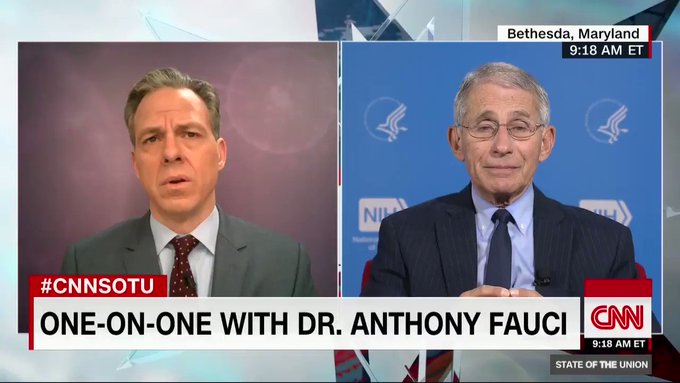
Speaking to CNN’s Jake Tapper on Sunday, Dr. Fauci said, “Looking at what we’re seeing now, you know, I would say between 100 and 200,000 (deaths)” from Coronavirus in the US. Fauci said that the US would have millions of COVID-19 cases.
“Whenever the models come in, they give a worst-case scenario and a best-case scenario,” Fauci explained. “Generally, the reality is somewhere in the middle. I’ve never seen a model of the diseases that I’ve dealt with where the worst case actually came out. They always overshoot.”
The worst-case scenario presented by the models would be millions of deaths. At the press conference, Dr. Birx said that models predicted “1.6 and 2.2 million fatalities if we didn’t mitigate.” Fauci called that worst-case scenario “not impossible, but very, very unlikely.”
Presenting bad news with good, the president also veered off-script to accuse New York health authorities of something “worse than hoarding.”
“I want the people in New York to check Governor Cuomo, Mayor de Blasio, that when a hospital that’s getting 10,000 masks goes to 300,000 masks during the same period, and that’s a rapid period, I would like them to check that because I hear stories like that all the time,” Trump said. “We’re delivering millions and millions of different products, and all we do is hear, ‘Can you get some more?””
Actor Lou Diamond Phillips responded to the charge on Twitter, pointing out that 1,000 nurses changing their masks between treating 30 patients per day would use 300,000 masks over 10 days. The dramatic increase in the usage of medical products is tied directly to the dramatic increase of infectious patients.  
At the end of the day, however, President Trump stepped up and made a very difficult decision. Keeping the economy in hibernation for another month as we approach a presidential election was not an easy thing to do, but, when the evidence of the spreading outbreak was considered, there was really no choice at all. When given a choice between a recession or millions of dead Americans plus a recession, the president acted wisely and against the wishes of many in his base. He deserves credit for that.

Originally published on The Resurgent