Showing posts with label china. Show all posts

Monday, August 10, 2020

The Triple Threat: Election Interference By China, Iran, and Russia Is Back

 On Friday, William Evanina, director of the National Counterintelligence and Security Center, told us what most of us already knew. Evanina detailed threats from Russia, China, and Iran, to interfere with the upcoming presidential elections. Interestingly, the intelligence assessment is that the cyber aggressors are taking different sides.

In a written statement, Evanina said, “Foreign states will continue to use covert and overt influence measures in their attempts to sway U.S. voters’ preferences and perspectives, shift U.S. policies, increase discord in the United States, and undermine the American people’s confidence in our democratic process.”

He also warned, “They may also seek to compromise our election infrastructure for a range of possible purposes, such as interfering with the voting process, stealing sensitive data, or calling into question the validity of the election results.”

Interestingly, Evanina said that the intelligence community assessed that our adversaries have different goals and are targeting their efforts to help different candidates and for different purposes.

Most obviously, China seems to be trying to undermine President Trump’s re-election campaign. After years of trade wars, Evanina says that Beijing views Trump as “unpredictable.”

“China has been expanding its influence efforts ahead of November 2020 to shape the policy environment in the United States, pressure political figures it views as opposed to China’s interests, and deflect and counter criticism of China,” Evanina said in the statement.

So far, Chinese efforts concentrated on criticizing the Trump Administration on numerous fronts. These include Trump’s response to the pandemic, the closure of the Houston consulate, the TikTok ban, and China’s efforts to dominate the 5G market through Huawei. As I’ve pointed out for years, China does not have to outlast the US economy to win the trade war, they only have to outlast Donald Trump.

Russia is taking the opposite side. Evanina said, “Russia is using a range of measures to primarily denigrate former Vice President Biden and what it sees as an anti-Russia ‘establishment.’ This is consistent with Moscow’s public criticism of him when he was Vice President for his role in the Obama Administration’s policies on Ukraine and its support for the anti-Putin opposition inside Russia.”

 Evanina pointed to “pro-Russia Ukrainian parliamentarian Andriy Derkach” as a proxy in Russia’s efforts. Derkach “is spreading claims about corruption – including through publicizing leaked phone calls – to undermine former Vice President Biden’s candidacy and the Democratic Party,” per the intelligence assessment. Derkach was one of the local politicians who met with Rudy Giuliani during the president’s personal lawyer’s dirt-digging expeditions to Ukraine.

If Russia and China are each backing their favorite horse in the presidential race, Iran’s goal is primarily to sow chaos and undermine American institutions, but also to undermine President Trump, “driven by a perception that President Trump’s reelection would result in a continuation of U.S. pressure on Iran in an effort to foment regime change.” Iran’s activities are expected to include “spreading disinformation on social media and recirculating anti-U.S. content.”

Speaker Nancy Pelosi responded that one of these threats is not like the others, calling the Russian interference the most serious of the three.

“They’re not equivalent,” Pelosi told the Associated Press. “Russia is actively 24/7 interfering in our election. They did so in 2016, and they are doing so now.”

Pelosi’s statement has been supported by intelligence assessments for the past several years. Even Trump appointees such as Mike Pompeo and Nikki Haley have confirmed Russia’s interference in 2016, which Haley called an act of “warfare.” A major theme of the Mueller report was detailing Russia’s actions and Robert Mueller used his live testimony to warn against Russian meddling in the 2020 elections.

Many Republicans will call Pelosi hypocritical for focusing on the Russian threat, but many in the GOP have spent the past four years downplaying concerns about Russia’s role in 2016. Many of those same Republicans will now be up in arms over Chinese and Iranian activities.

The truth is that all Americans should be upset about any foreign attempts to tip the scales on our elections. Regardless of whether foreign powers support your candidate or his opponent, nations who are our adversaries have no business influencing American voters or, worse, trying to manipulate vote totals by hacking databases and voting machines. Undermining the integrity of elections is undermining the foundation of our government.

Unfortunately, both sides are predictably playing politics with the issue. Democrats in the House, considering themselves the victims, have passed several bills aimed at curbing election interference over the past few years. Republicans, perhaps sensitive that admitting the problem would further undermine Donald Trump’s credibility, have killed most of them. As recently as June, Senate Republicans quietly removed a requirement that campaigns report attempts by foreign governments to interfere in US elections from the National Defense Authorization Act.

The integrity of elections is a cornerstone of our republic and a national security priority. Defending the electoral process against foreign adversaries should not be a partisan issue and it should not matter which candidate is assumed to benefit.

As Robert Mueller warned in his testimony to Congress more than a year ago, “Over the course of my career, I have seen a number of challenges to our democracy. The Russian government’s effort to interfere in our election is among the most serious.”

“This deserves the attention of every American,” he added.  

Now, we have the Chinese and Iranians piling on as well. We should take the threats seriously.

Originally published on The Resurgent

Friday, August 7, 2020

Trump Tackles TikTok; Here’s How It Might Be Legal

Yesterday, President Trump issued an Executive Order that prohibits “to the extent permitted under applicable law: any transaction by any person, or with respect to any property, subject to the jurisdiction of the United States, with ByteDance Ltd,” the Chinese company that owns TikTok or its subsidiaries and associated companies. The ban takes effect on September 20, which is 45 days from when the order was signed. A second Executive Order targeted the Chinese company Tencent and its WeChat app.

The obvious question is whether and how President Trump has the authority to unilaterally ban one of the most popular apps in the country. The answer that the president offers in his Executive Order is through the “International Emergency Economic Powers Act (50 U.S.C. 1701 et seq.) (IEEPA), the National Emergencies Act (50 U.S.C. 1601 et seq.), and section 301 of title 3, United States Code.”

The International Emergency Economic Powers Act regards the president’s ability to “investigate, regulate, or prohibit… any transactions in foreign exchange… transfers of credit or payments… [and] the importing or exporting of currency or securities” during an “unusual and extraordinary threat.” In the past, the Act has been used to block the assets of terrorist organizations.

The National Emergencies Act is a general law giving the president the power to declare emergencies. The law gives the president additional powers during an emergency but is not a blank check and imposes additional duties as well, such as notifying Congress and publishing the emergency proclamation in the Federal Register.

Similarly, Section 301 of Title 3 is a general law allowing the president to delegate authority. In this case, the Executive Order delegates authority to the Secretary of Commerce to identify prohibited transactions and take steps to implement the Order.

Whether the Executive Order is legal depends on whether courts could be persuaded that TikTok’s presence on American computers and electronic devices presents a national emergency. Courts are generally deferential to executives in an emergency but Donald Trump has shown an alarming tendency to use his emergency powers to legislate when he cannot persuade Congress to go along with his policies.

President Trump had declared at least eight national emergencies before his TikTok ban. Some were legitimate, such as the emergency regarding the pandemic declared on March 13 and the September 2018 emergency providing for automatic sanctions against foreigners who interfere in a US election. Others, such as the February 2019 emergency on the Southern Border after Congress refused to fund the wall and the May 2019 emergency that allowed a massive arms sale to Saudi Arabia against the wishes of Congress, are more questionable.

Aside from the question of legality, the other obvious question about the TikTok ban is why now? The Administration and TikTok had been in negotiations for months and Microsoft was already exploring the possibility of buying the app to break the connection with China’s communist government.

The timing of the move has not been discussed by the Administration but there is speculation that it might relate to a Trump campaign rally back in June. There was disappointing attendance at the rally and, along with the pandemic, much of the blame was assigned to TikTok users who reserved seats and then did not show up. Would the president ban an entire app because its users embarrassed him? Only Mr. Trump and his closest advisors know for sure.

Finally, there is the question of how the ban can be implemented. The Order bans “transactions” and not the use of the app. The focus seems to be on demonetizing the app and keeping it out of American app stores. The real goal may be to interfere with TikTok’s ability to make money and force a sale of the app to an American company. Mr. Trump has already said that the ban would be lifted if Microsoft or another American company bought the app.

President Trump has also suggested that the US should get a cut of any sale, telling reporters, “It’s a little bit like the landlord/tenant; without a lease the tenant has nothing, so they pay what’s called ‘key money,’ or they pay something, but the United States should be reimbursed or should be paid a substantial amount of money, because without the United States they don’t have anything, at least having to do with the 30 percent [Microsoft had been considering purchasing a 30 percent stake in the company rather than buying it outright].”

“What’s appalling is the bundling,” Dr. Nikolas Guggenberger, Executive Director of Information Society Project at Yale Law School, told Engadget. “Even if there were some sort of toll or some sort of tax that they could levy on the transaction, bundling that to a threat to ban something, then nudging a US company into buying the foreign entity, and then levying a tax… even if you found a legal basis for doing so, bundling that is beyond anything that’s even halfway legally sound.”

Guggenberger also questioned the First Amendment implications of the case, saying, “Shutting down TikTok as a medium does chill free speech in an area that is a crucial tool for young Americans to express themselves and [you could see] how impactful it is, whether you agree with what happened or not in Tulsa.”

TikTok doesn’t plan to take Trump’s ban lying down. In a statement, the company said that it was “shocked” at what it said was “no due process or adherence to the law.”

“We will pursue all remedies available to us in order to ensure that the rule of law is not discarded and that our company and our users are treated fairly – if not by the Administration, then by the US courts,” the statement said.

The controversy may impact the election. Per Omnicore, the average age of TikTok users is between 16 and 24, a demographic that already dislikes President Trump. Slightly more than half of TikTok users are male. A ban on the popular app may spur more younger voters to get to the polls.

While there is a lot of evidence that TikTok is a security risk and is in bed with the Chinese government, the precedent of a unilateral ban on a commercial app is troubling. A better course would have been to take the case for a ban to Congress, but Mr. Trump’s toxic relationship with Democrats makes that difficult.

Whether the TikTok ban is legal depends largely on how you view the threat that TikTok presents. US law does give the president authority to take economic action in a national emergency but the law does not define what constitutes a national emergency.

Congress has given presidents a lot of latitude – too much – in their ability to make unilateral decisions for the country. A second timely example is Mr. Trump’s decision to impose new tariffs on Canada despite the ink not being dry on the USMCA. The only real solution is for Congress to exert its constitutional authority and take back the power that it has delegated to the president, but with great power comes great responsibility. Until Congress acts, voters need to make sure that we elect presidents who will use that power responsibly and not another executive who will abuse his authority.


Originally published on The Resurgent

Monday, June 15, 2020

China Imposes “Wartime” Measures After New COVID Outbreak In Beijing


Many people have postulated that the Coronavirus pandemic has run its course and that the outbreak is yesterday’s news. However, fears of a second wave of infections are being bolstered by the news of a new outbreak of cases in Beijing and China’s decision to lock down its capitol for a second time.
Beijing was largely spared the original outbreak and has been considered one of the safest cities in China. That has changed, however, with the discovery of 79 new cases reports CNN. The new outbreak was first reported on June 12 and 36 new cases were added to the total on Monday. The initial case of the new outbreak was the first new local case reported by China’s National Health Commission in two months.
The new cases all stem from the Xinfadi market, which deals in fruits, vegetables, meat, and seafood. The market was closed by authorities on Saturday.
The new outbreak has already spread to the nearby provinces of Liaoning and Hebei. The five known cases there have been traced back to contacts in Beijing.
The local government in the Fengtai district has imposed a “wartime mechanism” to combat the new spread of the virus. These measures include establishing a command center and the lockdown of 11 residential areas near the market. Residents of the areas are prohibited from entering or leaving and residents are required to have their temperatures checked daily. People who have visited the market recently and their close contacts have been ordered to stay home for two weeks under medical observation. Schools, which were scheduled to reopen Monday, will now remain closed.
China has also introduced nucleic testing on a mass scale with 193 testing locations across the city. Nucleic testing detects the virus’s genetic code and is more effective at detecting the disease in its early stages than other tests.
The Chinese government seems confident in its ability to contain the new outbreak. Hu Xijin, editor-in-chief of Global Times, a communist party newspaper, tweeted, “There is no way Beijing becomes Wuhan 2.0.”
So far, the source of the outbreak has not been identified. Yang Peng, a researcher with the Beijing Center for Disease Prevention and Control, said that the virus found in Beijing is similar to strains seen in Europe. He speculated on China state television that the virus “could have come from contaminated seafood or meat, or been transmitted by people who have come into the market via their secretions.”
The new outbreak is a reminder that the danger from the virus is not yet past. Even in places where new cases are rare, the virus can lurk, hidden, and then explode into a new cluster under the right conditions. The threat of a second wave underscores the fact that the world cannot return to the pre-COVID normal until an effective vaccine or treatment is found.
In the US, the virus is not yet under control although the curve has been flattened. Coronavirus cases are still increasing in 18 states and the number of new cases reported daily in the US averages about 20,000, a rate which has not changed significantly since early May.
While the US seems to be experiencing pandemic-fatigue with many states lifting restrictions and President Trump resuming political rallies, the local Beijing government is taking even the small number of confirmed cases seriously and bracing for a more widespread outbreak. This attitude may be bolstered by the dismissal of several local party officials.
Lockdowns are easier to enforce in China due to the country’s authoritarian style of government and the ease with which the Chinese can order food and economic relief to quarantined areas. In the US, efforts to provide relief have been hamstrung by partisan wrangling and bureaucratic roadblocks. Congress passed the CARES Act in March, which included payments to individuals and loans to businesses, but many aspects of the bill expire in September and it seems increasingly likely that the crisis will last much longer than that. Agreement on a second relief bill has so far not materialized.
“The risk of the epidemic spreading is very high, so we should take resolute and decisive measures,” Xu Hejian, a spokesman for the Beijing city government, said in The Guardian, calling the crisis “an extraordinary period.”
Originally published on The Resurgent

Friday, May 15, 2020

Why Mandating That Essential Drug Production Remain In The US Is A Bad Idea

Sources in the US government say that President Trump will issue an Executive Order that will require that certain essential drugs be produced in the US. The order, which is a response to shortages incurred in the Coronavirus pandemic, could come as soon as today reports CNBC. Unfortunately, the move is likely to be counterproductive.
The text of the Order has not yet been released but White House trade advisor Peter Navarro has pushed a plan that would streamline approvals for American-made products and impose similar FDA restrictions on US facilities as on those abroad. Navarro’s proposal would also encourage government agencies to buy only American-made products.
The Executive Order, which will probably be popular, is reminiscent of a famous quote by H. L. Mencken: “There is always a well-known solution to every human problem—neat, plausible, and wrong.”
In this case, the fallacy is that America’s medical supply problem can be fixed by mandating that American companies produce the items at home. The idea of “just make everything here” is appealing in its simplicity but, in reality, is fraught with problems.
Aside from the fact that moving production to the US would take at least a year, one of the most obvious problems is that the United States has a finite industrial capacity and labor pool. If we move essential pharmaceutical production to the US, that means that we can’t make something else.
Scott Lincicome, a trade lawyer at the Cato Institute, notes that such a policy would have many other hidden problems as well, comparing the idea to the Jones Act on a recent Jonah Goldberg podcast. The Jones Act is a shipping law that requires that all goods shipped between US ports be shipped on vessels that are flagged under the US as well as being built, owned, and crewed by Americans. In theory, it’s a sensible idea but in practice, it has led to higher costs, cronyism, inefficiency, and decreased national security, Lincicome wrote in 2015.
Lincicome recently penned a critique of the idea of “repatriating” supply lines that appeared in National Review. In it, he addressed the question of critical medical supplies, pointing out that the claim that the majority of America’s medical supplies come from China is “essentially baseless.”
Per Lincicome’s investigations, China’s stranglehold on American medical supplies is greatly exaggerated. For example, even though China produces 30 percent of imported medical equipment, it accounts for only nine percent of medical items used in the US because American companies already produce more than 70 percent of items consumed here.
Further, only 13 percent of factories that produce active pharmaceutical ingredients (APIs) are in China compared with 28 percent in the US. Most of the remainder are in the EU, Canada, or India. For essential medicine APIs, 21 percent are already produced in the US versus only 15 percent from China.
If the threat of China to our medical supplies and pharmaceuticals is overblown, the threat of protectionism is not. Protectionist policies have a history of backfiring and weakening the industries they were supposed to protect while stifling innovation at the same time. President Trump’s own steel and aluminum tariffs are one recent example of such a failure.
Rather than inspiring companies to become more innovative and competitive, protectionism does the opposite. Companies spend more time and energy lobbying to protect their fiefdom than in expanding their core business. Often higher costs are associated with protectionism as well.
There are better options than government edicts moving production to the US. For example, when the pandemic is over and prices of medical supplies drop, the government should replenish strategic stockpiles. Both the Obama and Trump Administrations failed to restock N95 mask supplies that were used in the 2009 flu outbreak. Proper planning would make a big difference in future pandemics. This year the Trump Administration wasted months and did not order necessary supplies until mid-March, weeks after the pandemic was well underway.
As I’ve pointed out before, another good solution is to provide companies with an alternative to China. Or better yet, with several. The Trans Pacific Partnership was supposed to be an counterweight to China but the president canceled the agreement as one of his first acts.
If we had free trade agreements with countries such as Australia, Japan, Vietnam, and Malaysia, it would diminish China’s influence in the region as well as providing an incentive for companies to move operations out of China. The pandemic should make the risks of doing business with an untrustworthy authoritarian regime obvious but businesses still need viable alternatives.
There are better solutions to the problems in medical supplies than to decree a top-down order for companies to realign their supply chains and unilaterally force them to move production to the US, regardless of the costs. The idea that government knows best and that businesses should just fall into line and do as they are told is the sort of thing that Republicans and conservatives used to oppose.
Originally published on The Resurgent

Monday, May 4, 2020

China Lied To Hoard Medical Supplies


The Director of National Intelligence last week debunked claims that China intentionally released COVID-19 as a bioweapon, but that doesn’t mean that China’s actions in the opening weeks of the pandemic were aboveboard. A new assessment by the Department of Homeland Security says that China concealed the extent of the outbreak in order to get a head start on hoarding medical supplies.
The Associated Press reports that Chinese leaders “intentionally concealed the severity” of the pandemic, citing a four-page intelligence report dated May 1 that was obtained by the outlet. The report was not classified but was marked “for official use only.”
The report indicates that China increased imports of medical supplies and decreased exports as the Coronavirus epidemic grew. These actions were covered up by “denying there were export restrictions and obfuscating and delaying provision of its trade data.” China reportedly sharply increased imports of masks, gloves, and gowns.
The Chinese informed WHO of the outbreak on December 31 and publicly identified the virus as a novel Coronavirus on January 8, but the report found that they did not communicate that the disease “was a contagion” for much of January. The delay allowed China to continue importing large quantities of medical supplies before other countries were aware of the extent of the danger.
The AP notes that there is no public evidence that there was “an intentional plot to buy up the world’s medical supplies” and postulates that “many of the Chinese government’s missteps appear to have been due to bureaucratic hurdles, tight controls on information and officials hesitant to report bad news.” However, the intelligence report found a 95 percent probability that China’s trade moves were not in the normal range.
Separately, Secretary of State Mike Pompeo said that there was a “significant amount of evidence” that the virus was related to the Chinese medical lab in Wuhan.
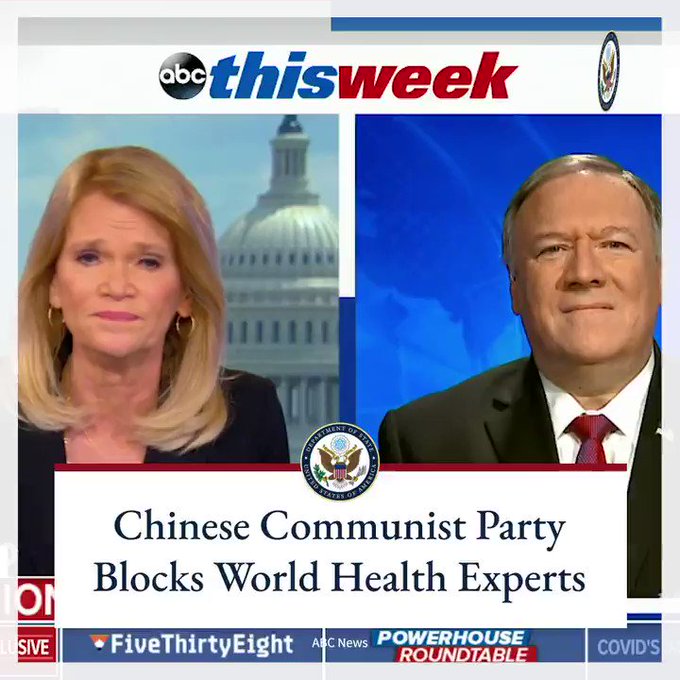
On ABC’s “This Week,” Pompeo said, ““These are not the first times that we’ve had a world exposed to viruses as a result of failures in a Chinese lab. And so, while the intelligence community continues to do its work, they should continue to do that, and verify so that we are certain, I can tell you that there is a significant amount of evidence that this came from that laboratory in Wuhan.”
Pompeo doubled down on the claim in a tweet Sunday afternoon without offering evidence.
While the revelations tarnish China’s reputation in the eyes of the world, they also undercut claims of some in the United States who say that fears of the virus are overblown. The news of China’s manipulation of world trade to hoard medical supplies is an indication of just how dangerous the Coronavirus pandemic is.
New reporting by the Washington Post underscores the danger as well. As reports come in from the first weeks of the American outbreak, statistics show that excess deaths surged above 37,000 in March and early April. These deaths could not be firmly classified as Coronavirus deaths to lack of available testing, but indicate that official death counts, which require a positive test, are likely far too low.
Earlier models had predicted a death toll of 60,000 people by August after shelter-in-place orders were implemented across much of the country. The US blew past that figure last week, however. The current death toll stands at 68,678 with many states and cities still facing rising curves.
Our first priority should be containing the Coronavirus pandemic and saving lives, but the world should absolutely hold China accountable for its actions. One good way to do so is to revive the Trans-Pacific Partnership, canceled by President Trump in one of his first actions as president. The TPP would help to isolate China and give Pacific Rim nations a better alternative to dealing with an untrustworthy communist regime.

Originally published on The Resurgent