Showing posts with label Mueller report. Show all posts

Sunday, June 7, 2020

The Law And Order President


Earlier this week, President Trump declared himself “your president of law and order.” In the June 1 speech in the Rose Garden, the president sought to draw a distinction between himself and the rioters around the country, but, after three years of the Trump Administration, it may be too late to pivot to law and order. Thus far, the Trump presidency has been anything but a law and order administration.
Mr. Trump first got himself into legal trouble when he admitted firing FBI Director James Comey over “this Russia thing” on national television. The statement was tantamount to an admission that Trump had been attempting to interfere with a federal investigation.
When the Mueller report on the Russia investigation was completed two years later, it did not find conclusive evidence that the Trump campaign conspired with Russia, although it noted that members of the Trump campaign and Russian government agents did attempt to share information on several occasions. The report did, however, set out 10 separate counts of obstructive behavior by the president. Mueller could not indict the president due to longstanding Justice Department guidelines.
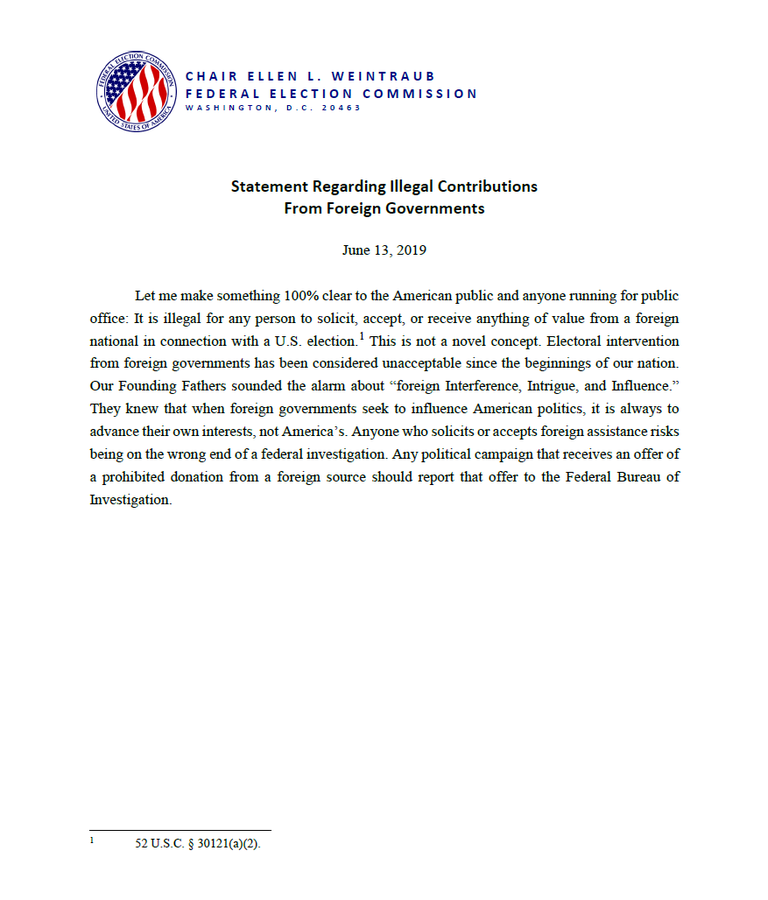
The ink was no sooner dry on the Mueller report than President Trump told ABC’s George Stephanopoulos “I think I’d want to hear it” if a foreign government offered information on an opponent to his campaign. The interview prompted FEC Chair Ellen Weintraub to tweet that it is “illegal for any person to solicit, accept, or receive anything of value from a foreign national in connection with a US election.”
Of course, we now know that Donald Trump was already actively soliciting help from another foreign government by that point. By June 2019 when the interview took place, Trump and his subordinates were already working to get dirt on Joe Biden from Ukraine. In the course of trying to use military aid to pressure the Ukrainian government, the Trump Administration violated the Impoundment Act, which regulates how money appropriated by Congress must be spent.
President Trump also played fast and loose with the law when Congress didn’t accede to his demands. In February 2019, the president declared an emergency in order to divert military funds toward building a border wall. A few months later in May 2019, the president declared another national emergency to enable the sale of $8.1 billion of military items to several countries, including Saudi Arabia and the United Arab Emirates. In both cases, the only emergency was the inability of Donald Trump to negotiate a favorable deal with Congress.
President Trump has also abused his authority to protect some of his loyal footsoldiers. Last month, the president persuaded the Justice Department to drop the charges against former National Security Advisor and longtime Trump friend, Mike Flynn, who had pled guilty to lying to the FBI. Just a few days ago, Trump signaled his intention to protect another longtime ally, Roger Stone. Stone was convicted of seven counts relating to obstructing the Russia investigation including witness tampering and lying to investigators. Trump retweeted a Charlie Kirk tweet calling for a pardon for Stone, who Trump said could “sleep well at night.”
Finally, the president has left a trail of destroyed careers in his attempts to cover his tracks and exact revenge on people who stood up for “law and order.” Most recently, President Trump has fired four inspectors general including the man who vetted the Ukraine whistleblower claim, the woman who revealed the Administration’s poor early response to the pandemic, the man who would chair the board providing oversight for the Administration’s disbursement of pandemic relief funds to businesses, and the man who was investigating both Secretary of State Pompeo’s use of government employees for private errands as well as the national emergency declaration relating to the Saudi arms sale. The common thread in all four cases was that the IGs were doing their jobs in ways that were embarrassing to Donald Trump.
Former Secretary of State Rex Tillerson said that Trump’s ideas often included violating the law.
“So often, the president would say, ‘Here’s what I want to do, and here’s how I want to do it,’ ” Tillerson said, according to the Houston Chronicle, “and I would have to say to him, ‘Mr. President, I understand what you want to do, but you can’t do it that way. It violates the law.’”
A major problem since 2018 is that people like Tillerson, John Kelly, and James Mattis are no longer in the White House. That trio had the intestinal fortitude and independence required to tell a president “no.” Now that these adults are gone, few have enough gumption to tell the president harsh truths and the result has been a long chain of catastrophically bad decisions.
Donald Trump wants to be the law and order president but, for many voters, it is too late for that. For the past four years, we have seen President Trump twisting the law and abusing his office to protect himself and his friends. Sending troops to put down riots won’t erase those abuses of power. In fact, as the president claimed to be “your president of law and order and an ally of all peaceful protesters,” park police were clearing peaceful protesters out of Lafayette Park for the president’s photo-op at St. John’s church in what turned out to be one of the great public relations disasters of the Trump Administration (of which there have been many),
Donald Trump obviously believes that law and order are ideas that apply to others, but not himself or his friends. It is unAmerican for presidents, elected officials, and, yes, police, to have the attitude that the law is for thee but not for me.
Originally published on The Resurgent

Tuesday, November 19, 2019

House Democrats Investigate Whether Trump Lied To Mueller


A new aspect of the House impeachment inquiry is an investigation into whether President Trump lied in a written, sworn statement prepared for the Mueller investigation earlier this year. The Washington Post reports that the House general counsel revealed the investigation into Trump’s statement during proceedings in which the House is asking for the release of secret grand jury information from the Mueller investigation.

The House request for grand jury information comes in the wake of Trump crony Roger Stone’s conviction last week. Stone’s conviction stemmed from attempting to cover up his contacts with WikiLeaks during the 2016 campaign. Stone passed along information from WikiLeaks to the Trump campaign and then lied about these communications to investigators.

House investigators say that testimony and evidence at Stone’s trial cast doubt on President Trump’s claims that he was not aware of the contacts between his and WikiLeaks regarding the release of the stolen emails from the Democratic National Committee.

In one particular instance during Stone’s trial, Rick Gates, a longtime partner of Paul Manafort, who was a former Trump campaign manager, testified that Donald Trump took a phone call from Roger Stone in July 2016. Immediately after hanging up, Trump told those in attendance that “more information would be coming” from Wikileaks. Gates’ testimony contradicts Trump’s written statement, which said, “I do not recall discussing WikiLeaks with” Stone, “nor do I recall Mr. Stone having discussed WikiLeaks with my campaign.”

Gates pled guilty to charges of conspiracy and making false statements as part of a deal with prosecutors. He was the star witness in the trial of both Paul Manafort in addition to testifying against Roger Stone. He is also scheduled to testify against former Obama White House counsel and Manafort associate, Geoffrey Craig, who was also indicted for lying to investigators about Manafort’s work in Ukraine. Gates has not yet been sentenced.

“Did the president lie? Was the president not truthful in his responses to the Mueller investigation?” General Counsel Douglas N. Letter asked rhetorically in the court appearance.

“The House is now trying to determine whether the current president should remain in office,” Letter told the court. “This is something that is unbelievably serious and it’s happening right now, very fast.”

Last month, a federal judge ordered the Department of Justice to turn over grand jury material referenced in redacted portions of the Mueller report to House investigators. In the ruling, Beryl Howell, chief district judge for the DC district court, wrote, “The Department of Justice claims that existing law bars disclosure to the Congress of grand jury information. DOJ is wrong.”

There were hints earlier this year that Mueller suspected that the president’s answers to his team’s questions were not completely honest. The Mueller report called Mr. Trump’s responses “inadequate" and "incomplete or imprecise." The report noted that investigators had considered subpoenaing the president but ultimately decided against it.

President Trump’s statement to Mueller was written, but it was also given under oath. If prosecutors can demonstrate that the president lied under oath to investigators, it would not only be a crime, but there is precedent for impeaching a president for a similar act of perjury. If perjury is added to the Articles of Impeachment against President Trump, it would represent the parties coming full circle in the space of 20 short years.

Originally published on The Resurgent

Thursday, September 26, 2019

Why Impeachment Is Justified


The transcript of President Trump’s telephone with Ukrainian President Zelensky is out, but the fallout continues. As expected, the call is damning enough to keep the Trump critics on the offensive but vague enough for Trump supporters to explain the president’s actions away. In my view, which does not represent the other writers here or The Resurgent itself, the transcript combined with other evidence against President Trump easily justifies impeachment despite the defenses offered by Republicans.

Defenders of the president make several mistakes in rejecting the impeachment option, the first of which is to claim that impeachment requires an underlying crime. As I’ve pointed out before, impeachment is a political process, not a legal one. Even though the constitutional basis for impeachment includes “high crimes and misdemeanors,” the original intent of the phrase did not preclude impeaching officials for abuses of office that were not criminal in nature.

At the micro end of the scale, the president’s supporters deny that the phone call transcript is enough to warrant impeachment. I believe that they are wrong. While there is no explicit quid pro quo, there is an implicit one, especially in the context of the fact that President Trump had suspended aid to Ukraine the week before. Trump laments that the relationship with Ukraine is not “reciprocal” and Zalensky responds that he wants to cooperate and buy more Javelin anti-tank missiles. President Trump then says that he wants a “favor” from Zalensky. The favor turns out to include investigating Crowdstrike, the US cybersecurity company that investigated the 2016 DNC hack, as well as Joe Biden’s role in dismissing Ukraine’s former top prosecutor.

Trump’s defenders set the bar impossibly high. The only thing that would convince some people is an explicit, Godfather-esque statement in which Trump tells Zalensky, “I’m about to make you an offer you can’t refuse.” Nevertheless, the implication is clear: Play ball and you get your aid and the Javelins.

Trump’s defenders also tend to take each piece of evidence against him individually rather than looking at the big picture. In truth, the revelations of the Mueller report, in which Trump staffers testified under oath that the president ordered them to take action to impede or shut down a federal investigation, detailed an impeachable abuse of power. Mueller explained that the president couldn’t be indicted because of Justice Department policy, but any one of us who acted similarly would likely be sent to jail. Just ask Mike Flynn or George Papadopoulos.

But wait, as they say, there’s more. We also have the president’s decision to declare a national emergency to bypass the will of the people as expressed through their representatives to Congress. This is an egregious affront to the Constitution’s system of checks and balances and, if not corrected, will establish a precedent to be further abused by future presidents. Yesterday, in a vote that included 11 Republicans, the Senate voted to end the national emergency farce, but opponents lack the numbers to override an almost certain veto.

Further, the Trump Administration has habitually refused to respond to congressional oversight, again setting a precedent that will be followed and expanded by future presidents. Like Obama before him, Trump refuses to respond to congressional subpoenas for both documents and testimony. It was the refusal to provide the whistleblower complaint to Congress, not the contents of the telephone call, that spurred Democrats to open an impeachment inquiry.

An additional error on the part of Republicans is using the wrong yardsticks to measure President Trump. Frequent defenses are that he’s an outsider and doesn’t know any better or that the Democrats acted similarly. Both are damning. If the president is so ignorant that he can’t understand the law and ethics when his advisors explain it, then he should not be leading the country. Likewise, if an Administration whose stated goal was to “drain the swamp” is looking to swamp denizens for moral guidance, it has lost its way.

An objective measure rather than a subjective one is much better for the country. Ask the simple question, should any president use his office and taxpayer-funded foreign aid to influence a foreign country to investigate a political rival? Should the president use his office to block an investigation into his campaign? If you view the rule of law and the Constitution objectively, the answer has to be no.

To check whether you are viewing the situation objectively, simply imagine that Obama did the same things that Trump is accused of doing. Republican heads would be exploding rather than offering rationalizations. That’s the next error: Tribalism. Republicans defend Trump, not only because they like his policy and his style, but because he is leader of their tribe. This is simply a different strain of Trump Derangement Syndrome.

The bottom line here is that there is an abundant record of abuses of office by President Trump. Some would justify impeachment on their own, but taken as a whole, they provide a strong argument that the president should be removed from office. He is simply is not trustworthy with the power that he has been granted.

In fact, the case against Trump is much stronger than the cases against the two previously impeached presidents. Bill Clinton was impeached for perjury, an offense that even many Republicans felt could have been handled by censure, and Andrew Johnson was impeached for appointing a replacement cabinet official without congressional consent. Quinn Hillyer makes a detailed comparison of other incidents where impeachment was considered in the Washington Examiner. Trump’s case is stronger than any of them. As Erick Erickson pointed out, the case is likely to become stronger when the whistleblower complaint drops.

Trump’s abuses of power, encroachment on congressional authority, and failure to accept congressional oversight have essentially left Congress no choice but to impeach or accept a diminished role. While I cannot say for sure that impeachment is politically wise or good for the country, it is clearly justified by President Trump’s actions. If impeachment is not justified for President Trump, it may as well be written out of the Constitution. Especially for a party that claims to favor the rule of law and the Constitution, an elected official should be held to a higher standard, not graded on a curve.  

Originally published on The Resurgent

Monday, July 29, 2019

Nomination Of Ratcliffe To DNI Is In Trouble Already


Another high-ranking official is departing the White House and there are already concerns about the congressman that President Trump has named to replace him. The current director of national intelligence, Dan Coats, has submitted his resignation, which will become effective on August 15. Rep. John Ratcliffe, a Texas Republican known for his loyalty to President Trump and who was last seen criticizing Robert Mueller for his report’s take on President Trump’s alleged obstruction of justice, is the president’s pick for a replacement.

Dan Coats, a veteran of the US Army Corps of Engineers who served from 1966 through 1968, was an Indiana congressman throughout the 1980s. He was elected to the first of two stints in the Senate in 1988, filling the seat of Vice President Dan Quayle. Coats left the Senate in 1998 and was appointed ambassador to Germany by George W. Bush in 2001. He was re-elected to the Senate in 2011 where he served until Donald Trump appointed him DNI in 2017.

In his role as DNI, Coats has been at odds with the president several times. He has publicly criticized Trump’s relationship with Vladimir Putin and his handling of North Korean dictator Kim Jong Un. Coats has also contradicted Trump’s claims that Putin was innocent of interfering in the 2016 presidential elections and defended the US intelligence community’s assessment of Russia’s actions.

There are signs that Coats has been outside of Trump’s inner circle for a while. In July 2018, he appeared to be blindsided by news of Vladimir Putin’s upcoming White House visit when NBC’s Andrea Mitchell broke the story on national television. Rumors of Coats’ departure have been swirling for months.

In contrast to Coats’ long record, John Ratcliffe is a law professor who was the mayor of Heath, Texas prior to being appointed DOJ Chief of Anti-Terrorism and National Security for the Eastern District of Texas by George W. Bush in 2004. He subsequently served as the US Attorney for East Texas from 2007 through 2008. Afterward, he returned to a private law practice until he was elected to Congress in 2014.

As a congressman, Ratcliffe was chairman of the House Homeland Security Subcommittee on Cybersecurity and Infrastructure Protection. In 2017, he was instrumental in the passage of the “Strengthening State and Local Cyber Crime Fighting Act of 2017,” which authorized the Secret Service to train and educate state and local law enforcement and judicial officials about cybercrime.

The hurdles to Ratcliffe’s confirmation will likely be in regard to both his inexperience in intelligence as well as his embrace of conspiracy theories regarding the Russia investigation. Indeed, Ratcliffe may have been catapulted to the top of the president’s list with his spirited attacks on Robert Mueller during the special counsel’s House testimony last week.

In the hearing, Ratcliffe attacked the Mueller report’s statement that President Trump could not be exonerated, saying, “So Americans need to know this, as they listen to the Democrats and socialists on the other side of the aisle, as they do dramatic readings from this report: that Volume 2 of this report was not authorized under the law to be written. It was written to a legal standard that does not exist at the Justice Department. And it was written in violation of every DOJ principle about extra-prosecutorial commentary.”

Politifact examined Ratcliffe’s claim and judged it to be false. Politifact points out that federal regulations state, “At the conclusion of the Special Counsel's work, he or she shall provide the Attorney General with a confidential report explaining the prosecution or declination [emphasis mine] decisions reached by the Special Counsel.”

Ratcliffe has also repeated the debunked claim that the Steele dossier was the origin of the Russia investigation.  The Steele dossier was referenced in an October 2016 FISA warrant application for Trump associate Carter Page, but, by that point, the FBI investigation of Russian contacts with Trump campaign staffers had already been underway for several months, initiated by the news that George Papadopoulos had been telling contacts about a Russian offer of information on Hillary Clinton since May 2016.

Already, some Democrats are questioning whether Ratcliffe is qualified and suited for the chief intelligence post. There are questions about whether Ratcliffe is too political for the national security position and whether his allegiance to President Trump would allow him to present information objectively.

“I don't know this guy,” Sen. Chris Murphy (D-Conn.) said on MSNBC. “I think he's a television character that the president has watched on TV, and he wants to put somebody in this position who's going to agree with his political take on intelligence.”
  
“I'll certainly do my own evaluation, but it strikes me as a very inappropriate choice for the job in a moment when we are trying to lift intelligence out of the political soup,” Murphy said, adding that Ratcliffe had a history of acting as “one of the president's accomplices in trying to politicize intelligence.”

“The president doesn't want people to challenge him, and when you think about an intelligence director, you want independent advice,” Sen. Gary Peters (D-Mich.) told CNN. “You want to have the best available intelligence to make decisions that are based on facts and reality. That is not something our current president wants.”

Republicans have not jumped to defend their colleague. Although many Republican officials have issued statements lauding Coats and his tenure as DNI, so far none have offered support for Ratcliffe’s nomination. To the contrary, the New York Times reported that Intelligence Committee Chairman Richard Burr (R-N.C.) “cautioned the president's advisers that he considered Mr. Ratcliffe too political for the post, according to people familiar with the discussions.”

Blocking an appointment to the cabinet is notoriously difficult. FiveThirtyEight points out that only nine cabinet appointments have been voted down by the Senate throughout US history. The last time a Senate controlled by the president’s party nixed a nominee was in 1925. However, it is more common and recent for presidents to withdraw nominations for candidates who may lack sufficient support for confirmation.

It is too early to predict the outcome, but with Republicans only holding a three-vote majority in the Senate, few defections would be needed to sink Ratcliffe’s nomination. Ratcliffe’s most likely fate might be to have the president withdraw his nomination after several Republican senators voice their doubts about his qualifications.  

Originally published on The Resurgent

Thursday, July 18, 2019

Nunes 'Expects Worst' From Mueller Testimony


Rep. Devin Nunes (R-Calif.), the ranking Republican on the House Intelligence Committee, says that he “expect[s] the worst” when former special counsel Robert Mueller testifies before Congress next week. Speaking to Fox News, the California congressman said that he expects Mueller to show up for the testimony and hinted that what he tells Congress could be damaging to President Trump.

“I really expect the worst, because Bob Mueller does not have to show up,” Nunes said. “So, he's doing this on his own free will. That tells me the last time he operated on his own free will, everybody forgets, (Attorney General William) Barr came out with a memo, was very clear about the decisions that he had made, and then a few days later, Mueller decided on his own to go out and hold a nine-minute press conference.”

“So I am very concerned,” Nunes continued. “I think we should expect the worst because he only has to say a couple [of] things and the rest of the media -- not saying you here at Fox, but 90 percent of the media will take one little phrase and run with it and try to run towards impeachment.”

“And look, I know there was no collusion and I know there was no obstruction, so in that sense it was fine,” Nunes added. “However, there shouldn't -- this whole investigation was an obstruction of justice trap.”

Nunes fails to point out that avoiding the “obstruction of justice trap” was a simple matter. All the president had to do was not attempt to obstruct the ongoing investigation. Per the testimony of Trump Administration officials contained in the Mueller report, however, the president did not meet this low bar.

Since the Mueller report was released last April following a summary version by Barr in March, Republicans have claimed that Mueller found no collusion and no obstruction. However, Nunes’ uneasiness with Mueller’s testimony indicates that the claim is on shaky ground. Mueller’s previous public statement in May seemed explicitly tailored to counter Republican claims that the report had exonerated the president.

“If we had had confidence that the president clearly did not commit a crime, we would have said so,” Mueller pointed out in both the written report and his public statement. “We did not, however, make a determination as to whether the president did commit a crime.”

Not making a determination is not the same thing as an exoneration.

In his statement, Mueller went on to explain why his team did not make a determination as to whether President Trump broke the law, saying, “Under long-standing department policy, a president cannot be charged with a federal crime while he is in office…. Even if the charge is kept under seal and hidden from public view, that, too, is prohibited.”

“A special counsel’s office is part of the Department of Justice, and by regulation, it was bound by that department policy,” Mueller continued. “Charging the president with a crime was therefore not an option we could consider.”

Mr. Mueller will testify in open session on July 24 before the House Judiciary and Intelligence Committees. His testimony was originally scheduled for July 17 but was moved in order to give members of both parties more time for questioning. It is also possible that the change could have been due to the fact that President Trump had scheduled a rally in North Carolina for the same day, which could have distracted from Mueller’s testimony.

At this point, no one knows what Mueller will say in his testimony, but Republicans are obviously nervous that he will undercut their claims that President Trump did not obstruct justice in his attempts to block the Russia investigation. A question that is certain to be asked is whether Mueller would have indicted Mr. Trump for his actions if he had not been president. If Mr. Mueller answers directly, it could do more serious damage to President Trump’s already shaky reputation.

Another likely line of questioning involves Mueller’s letter to Barr contradicting his public characterization of the report. In the private letter sent after the release of Barr’s summary but before his decision to release a redacted version of the report, Mueller said that the public summary “did not fully capture the context nature, and substance of this Office’s work and conclusions” and that it had led to “public confusion about critical aspects of the results of our investigation.”

The bottom line is that if, as President Trump and Republicans have claimed for the past several months, that the president did nothing wrong then there would be nothing to fear from Robert Mueller’s testimony. The fact that Republicans “expect the worst” from the author of a report that the GOP has claimed exonerates the president should make us wonder how honest Republicans have been in their defenses of the Donald Trump.  

Originally published on The Resurgent

Thursday, May 30, 2019

What Robert Mueller Really Said


You have to wonder if some people holding forth on Robert Mueller’s public statement yesterday actually listened to what the special counsel said. I’ve seen people once again claim that Mueller exonerated the president, that he agreed with Attorney General Barr that there was no obstruction and that Mueller muddied the issue. None of these is true.

Mueller’s statement seemed specifically designed to counter the spin of the Trump Administration while pointing out they Russia systematically attacked the 2016 election, a fact that Mueller obviously believes is getting lost in the debate over whether Donald Trump obstructed justice. The special counsel also takes time to refute many of the allegations made against the investigation.

There are four main takeaways from Mueller’s statement:
1.      Russia launched systematic cyber attacks on the 2016 election.
2.      There was insufficient evidence to charge Americans with conspiring with Russia.
3.      There was evidence that Trump obstructed justice.
4.      DOJ policy prevented an indictment of Trump from being considered.

I am going to include selected portions of the statement in the following article. As always, I encourage everyone to go straight to the source. Mueller’s statement is less than 10 minutes long and is available for viewing on YouTube. You can also read the transcript here. I recommend reading Mueller’s full report as well.

Russian intelligence officers who are part of the Russian military launched a concerted attack on our political system. The indictment alleges that they used sophisticated cyber-techniques to hack into computers and networks used by the Clinton campaign. They stole private information and then released that information through fake online identities and through the organization WikiLeaks. The releases were designed and timed to interfere with our election and to damage a presidential candidate. And at the same time as the grand jury alleged in a separate indictment, a private Russian entity engaged in a social media operation where Russian citizens posed as Americans in order to influence an election.

Mueller stresses that Russian interference with the election went far beyond buying social media ads. They included computer hacking and dissemination of stolen data. As discussed in other indictments and the full version of the Mueller report, Russian activities also included cyber attacks on state and local election infrastructure such as voter databases and companies that build and write software for voting machines. The Russian attacks go far beyond any known previous attempts to interfere in our elections. They are also very different from Barack Obama’s support for an Israeli group that opposed Benjamin Netanyahu in the 2015 Israeli elections.

Mueller’s statement contradicts claims that there was no underlying crime and that the investigation was a waste of time. The crime was a concerted attack on a foundation of the American Republic.

That is also a reason we investigated efforts to obstruct the investigation. The matters we investigated were of paramount importance. It was critical for us to obtain full and accurate information from every person we questioned. When a subject of an investigation obstructs that investigation or lies to investigators, it strikes at the core of their government's effort to find the truth and hold wrongdoers accountable.

The order appointing me special counsel authorized us to investigate actions that could obstruct the investigation.

Mueller here provides the justification for the obstruction investigation. Even if there were no crime, obstruction could still take place because investigators were legally trying to determine whether a crime had taken place or not. In this case, crimes did take place and others were indicted and convicted even if President Trump was not.

The document appointing Robert Mueller authorizes him to investigate “any links and/or coordination between the Russian government and individuals associated with the campaign of President Donald Trump,” which would include Trump himself, and “any matters that arose or may arise directly from the investigation,” as well as other matters within the jurisdiction of the special counsel law, which specifically includes “perjury, obstruction of justice, destruction of evidence, and intimidation of witnesses.” Rosenstein’s instructions to Mueller are available online here.

This volume includes a discussion of the Trump campaign's response to this activity as well as our conclusion that there was insufficient evidence to charge a broader conspiracy.

Mueller does not say that there was “no collusion.” He says that evidence to prosecute collusion was “insufficient.” This implies that evidence of collusion did exist.

And as set forth in the report, after that investigation, if we had had confidence that the president clearly did not commit a crime, we would have said so. We did not, however, make a determination as to whether the president did commit a crime.

This is not, as many Republicans claim, a statement that there was no obstruction. This is the opposite. Mueller is saying that if the president was innocent he would say so, but there is evidence against him so he cannot be exonerated.

It [the full report] explains that under long-standing department policy, a president cannot be charged with a federal crime while he is in office. That is unconstitutional. Even if the charge is kept under seal and hidden from public view, that, too, is prohibited.

A special counsel's office is part of the Department of Justice, and by regulation, it was bound by that department policy. Charging the president with a crime was therefore not an option we could consider. The department's written opinion explaining the policy makes several important points that further informed our handling of the obstruction investigation. Those points are summarized in our report and I will describe two of them for you.

Mueller explains here that he could not indict the president due to Justice Department policy even though he found evidence that crimes were committed. Essentially, the Justice Department view is that prosecuting the president is illegal under the Constitution. My own opinion is that the framers of the Constitution, who had just fought a revolution to free themselves of rule by a king, did not intend to place the president above the law.

Regardless, Mueller next explains why he investigated obstruction if an indictment of the president was “not an option” from the beginning.

First, the opinion explicitly permits the investigation of a sitting president because it is important to preserve evidence while memories are fresh and documents available. Among other things, that evidence could be used if there were co-conspirators who could be charged now.

And second, the opinion says that the Constitution requires a process other than the criminal justice system to formally accuse a sitting president of wrongdoing.

First, the investigation was to preserve evidence for possible prosecution of co-conspirators. Second, the evidence could be used in an impeachment trial.

And beyond department policy, we were guided by principles of fairness. It would be unfair to potentially — it would be unfair to potentially accuse somebody of a crime when there can be no court resolution of the actual charge.

So that was Justice Department policy. Those were the principles under which we operated.

Mueller then reiterates that his decision was guided by DOJ policy. He also states that it would be unfair to accuse the president of a crime when he would not have a trial that could be used to clear his name.

At one point in time, I requested that certain portions of the report be released and the attorney general preferred to make — preferred to make the entire report public all at once and we appreciate that the attorney general made the report largely public. And I certainly do not question the attorney general’s good faith in that decision.

This is a reference to the leaked letter in which Mueller took Attorney General Barr to task for mischaracterizing the special counsel report in his public summary. Mueller requested that certain portions of the report be made public. Barr elected to release a redacted version of the report. Mueller seems satisfied with this.

Now, I hope and expect this to be the only time that I will speak to you in this manner. I am making that decision myself. No one has told me whether I can or should testify or speak further about this matter.

Mueller does not intend to make further public statements. He says that this is his own choice and not a decision by the Justice Department or President Trump.

There has been discussion about an appearance before Congress. Any testimony from this office would not go beyond our report. It contains our findings and analysis and the reasons for the decisions we made. We chose those words carefully and the work speaks for itself. And the report is my testimony. I would not provide information beyond that which is already public in any appearance before Congress.

While Mueller does not rule out congressional testimony, he says that he will not provide further public information. As I advised above, if you want to know more, read his report.

These individuals who spent nearly two years with the special counsel's office were of the highest integrity.

This counters claims by President Trump and other Republicans that the investigators were corrupt.

And I will close by reiterating the central allegation of our indictments, that there were multiple systemic efforts to interfere in our election. And that allegation deserves the attention of every American.

Mueller closes by again stressing the fact that the United States was the subject of a campaign of cyber attacks in 2016. If steps are not taken to defend against similar attacks, it is likely to happen again next year. At some point, aggressors are likely to penetrate election defenses and find the ability to manipulate vote totals. As Mueller said, this should be alarming to every American, even if you happen to like the outcome of the last election.


Originally published on the Resurgent

Wednesday, May 29, 2019

Mueller: Indicting Trump Was ‘Not an Option’


In a public statement today, Special Counsel Robert Mueller said that the investigation into Russian meddling in 2016 presidential campaign and the ancillary investigation into possible obstruction of justice were both justified “in order to find truth and hold wrongdoers accountable.”

Mueller said that there were “numerous efforts emanating from Russia to influence the election.” Mueller added that there was “insufficient evidence” of a “broader conspiracy” involving the Trump campaign.”

Mueller added again that “if we had had confidence that the president clearly did not commit a crime then we would have said so. We did not, however, make a determination that the president did commit a crime.”  This underscores the fact that the president was not exonerated.

Mueller cited “longstanding Justice Department policy” that president cannot be indicted while in office, calling the possibility “unconstitutional.”

“Charging the president with a crime was therefore not an option that we could consider,” Mueller said.

Mueller said that he wanted the report to be seen as his testimony and that he was would not testify further by his own choice. He added that the wording of the report was chosen carefully and that he would not add any new public information in testimony to Congress.

He also said that he believed that Attorney General Barr acted in “good faith” in disclosing the report.

In his closing, Mueller underscored the fact that Russia had attacked the election, a point that the Special Counsel obviously believes should receive more attention. “There were multiple, systematic efforts to interfere in our election and that allegation deserves the attention of every American,” Mueller said in closing.

Originally published on The Resurgent

Monday, May 6, 2019

Democrats Set To Hold Barr In Contempt

The House Judiciary Committee has taken the first step towards holding Attorney General William Barr in contempt of Congress. The committee announced this morning that it will consider a contempt citation against Barr on Wednesday. If the committee approves the citation, it would advance to a vote before the full House.
“The attorney general’s failure to comply with our subpoena, after extensive accommodation efforts, leaves us no choice but to initiate contempt proceedings in order to enforce the subpoena and access the full, unredacted report,” Chairman Jerry Nadler (D-N.Y.) said in a statement reported by Politico.
The contempt citation refers to a House Judiciary Committee investigation into possible obstruction of justice by the president as well as Barr’s refusal to provide an unredacted version of the Mueller report to congressional investigators. It also notes the Department of Justice guidelines against indicting a sitting president and Mueller’s acceptance of that policy.
“Congress is therefore the only body able to hold the president to account for improper conduct in our tripartite system, and urgently requires the subpoenaed material to determine whether and how to proceed with its constitutional duty to provide checks and balances on the president and executive branch,” the contempt citation says. “Otherwise, the president remains insulated from legal consequences and sits above the law.”
Rep. Doug Collins, the ranking Republican on the committee, said in a statement, “Democrats have launched a proxy war smearing the attorney general when their anger actually lies with the president and the special counsel, who found neither conspiracy nor obstruction.”
NBC News noted last week that Congress has three methods of enforcing its subpoenas. First, the sergeant-at-arms could be dispatched to arrest Barr. This is unlikely since the attorney general is protected by armed DOJ officers. Second, federal prosecutors could charge Barr with criminal contempt. Again, this is unlikely.
The most likely option is the last one. Congress can sue the attorney general under civil contempt statutes. If a federal judge finds that Barr is in contempt, the court can apply civil penalties to attempt force Barr to comply with congressional requests.

Originally published on The Resurgent
SHARE

Thursday, May 2, 2019

The Accurate-But-Incomplete Barr Summary


One of the newest spats to erupt in the continuing saga of the Russia investigation is over Robert Mueller’s letter to Attorney General William Barr regarding his representation of the Mueller team’s findings. As with much of the Russia scandal, the details are sufficiently vague that both sides can claim to be supported by the facts, but Barr’s critics do make valid points. The release of Mueller's letter and Barr's congressional testimony lead to more questions that need to be answered.

To recap the situation for those who came in late, on March 24 Barr released a four-page summary of the Mueller team’s findings. Barr wrote that, with respect to a criminal conspiracy with the Russians, “the Special Counsel did not find that the Trump campaign or anyone associated with it conspired or coordinated with Russia in its efforts to influence the 2016 presidential election.”  Few, if any, serious observers have problems with this statement.

With respect to the second part of Mueller’s report, the investigation into possible obstruction of justice by the president, Barr quotes the report directly, saying, “While this report does not conclude that the president committed a crime, it also does not exonerate him.” Barr then goes on to say that he and Deputy Attorney General Rod Rosenstein “concluded that the evidence developed during the Special Counsel’s investigation is not sufficient to establish that the President committed an obstruction-of-justice offense.” Barr also notes that this determination was made “without regard to, and is not based on, the constitutional considerations that surround the indictment and prosecution of a sitting president.” Barr further says that Trump’s actions could not be proven to have “corrupt intent” beyond a reasonable doubt. Barr’s defenders argue quite reasonably that nothing that Barr wrote in his summary is inaccurate.

As promised in his summary, Barr released a redacted version of the Mueller report on April 18. Readers quickly discovered that while Barr had not misstated any facts in his summary, the facts that he had chosen not to mention changed the characterization of what Mueller and his investigators had determined. Where Barr correctly said that Mueller found no evidence of a criminal conspiracy by the Trump campaign, Mueller’s report found tacit approval of Russia’s actions by the campaign, prefacing its exoneration with the statement, “Although the investigation established that the Russian government perceived it would benefit from a Trump presidency and worked to secure that outcome, and that the Campaign expected it would benefit electorally from information stolen and released through Russian efforts…” But this was not criminal behavior. Fair enough.

Barr’s characterization of the obstruction investigation is more problematic. Barr omitted two very important points from Mueller’s failure to find indictable actions by President Trump. First, Barr ignored Mueller’s statement that the report did not make a prosecutorial judgment because the team “accepted OLC’s legal conclusion” that “’the indictment or criminal prosecution of a sitting president would impermissibly undermine the capacity of the executive branch to perform its constitutionally assigned functions’ in violation of ‘the constitutional separation of powers.’”

Second, Barr omitted Mueller’s statement that “Congress may apply the obstruction laws to the President's corrupt exercise of the powers of office accords with our constitutional system of checks and balances and the principle that no person is above the law.” This statement, paired with the statement that, “if we had confidence after a thorough investigation of the facts that the President clearly did not commit obstruction of justice, we would so state,” contradicts Barr’s determination that no prosecutable obstruction occurred. Given abuses of power in the examples cited by the report, President Trump’s actions might rise to the level of impeachable offenses even if Barr is correct that they were not prosecutable.

While Mueller did not specifically state that Trump’s actions were impeachable offenses, he seems to have hinted at that possibility. The reference to corruption refers to a “subversion of the political process” and an “act done with intent to give some advantage inconsistent with official duty and the rights of others.” The Constitutional Rights Foundation points out that the “high crimes and misdemeanors” cited in the Constitution as grounds for impeachment don’t necessarily require a finding of illegality. In English law that was familiar to the framers of the Constitution, the phrase had been applied to remove officials from office on a variety of charges, some that were criminal and some that were not. “The one common denominator in all these accusations was that the official had somehow abused the power of his office and was unfit to serve,” the Foundation notes.

Immediately after the release of Barr’s summary, President Trump took to Twitter to claim, “No Collusion, No Obstruction, Complete and Total EXONERATION.” This tweet explicitly contradicts Mueller’s findings on obstruction. Conservative media outlets picked up the message and trumpeted what they saw as Trump’s vindication.


What we now know is that after Barr released his summary, Mueller sent the attorney general a private letter behind the scenes. In the letter, Mueller stated that the “summary letter the Department sent to Congress and released to the public late in the afternoon of March 24 did not fully capture the context, nature, and substance of this Office's work and conclusions.” He wrote that the discrepancy had led to “public confusion about critical aspects of the results of our investigation.” The obvious conclusion is that the confusion that Mueller referred to was the fact that Trump and his supporters were claiming exoneration where the Mueller team failed to find it and specifically pointed out that fact.

Ben Shapiro has said that Mueller was wrong to complain about Barr’s characterization of the report. In Shapiro’s view, the details that the report includes serve only to embarrass the president in the absence of a finding that Trump broke the law. He points out that the details can be found in the publicly released report and were irrelevant to Barr’s summary. This is wrong for two reasons. First, a finding that the president acted corruptly enough that he could not be exonerated deserves a detailed explanation, especially when the president is claiming “no obstruction” and “total exoneration.” Second, at the time Mueller wrote his letter on March 27, the report was not public and there was no way to counter the president’s claims.

Even before this week’s release of the Mueller letter, there were rumblings that Mueller’s investigators were unhappy with Barr’s synopsis of their work. On April 3, the New York Times reported some members of Mueller’s team had said that Barr’s summary failed to accurately reflect their findings.

In his testimony yesterday, Barr said that Mueller told him that he was frustrated with the way the media was portraying the report and that “he was not suggesting that we had misrepresented his report.” It seems likely that Mueller’s problem was with the way that Trump-friendly media was covering the report as an exoneration of Trump rather than the mainstream media parsing the words of Barr’s letter.

The current state of affairs leaves a number of unanswered questions. First, is whether Barr’s failure to find obstruction legally accurate. Several conservative legal scholars such as Judge Andrew Napolitano, Reagan Justice Department official and current Republican candidate Bill Weld, law professor Mimi Rocah and former federal prosecutor Renato Mariotti dispute Barr’s (and Shapiro’s) interpretation of the obstruction statutes.

Second, there is the question of whether Barr intentionally tried to gloss over the parts of the Mueller report that were more damaging to President Trump. A follow-up to this question is whether the instances of Trump’s obstructive behavior cited in the report would have been redacted if it had not been likely that Mueller would have gone public with his objections.

Finally, there is the question of Mueller’s side of the story. Does Mueller agree that Barr’s summary was an accurate representation of the special counsel’s findings? If so, why did he send a written complaint? Barr suggested to House members that Mueller’s letter was “a bit snitty, and I think it was probably written by one of his staff people.” If so, why did Mueller sign it?

When the big picture is examined, it is apparent that while Barr’s summary was factually accurate, it did omit important aspects of Mueller’s report. These omissions changed the characterization of Mueller’s findings that “the evidence we obtained about the President's actions and intent presents difficult issues” to Barr’s determination that “the report identifies no actions… done with corrupt intent.” The only way to resolve these discrepancies and know exactly what Mueller and his investigators took issue with is to have Mueller testify.

Originally published on The Resurgent