Showing posts with label sequester. Show all posts

Tuesday, February 13, 2018

Why Federal Deficit Spending Will Never Be Fixed. Ever.

If there was any notion that the Trump Administration was fiscally conservative, those beliefs should be reconsidered in light of last week’s bipartisan spending deal and the president’s spending proposals from the State of the Union speech. Despite the Republican victory on tax reform, it seems that the party is veering toward massive spending increases rather than fiscal restraint and entitlement reform.

Rand Paul (R-Ky.) was one of the few congressional voices that spoke out against the spending bill. In a speech on the Senate floor, Paul described why Congress is unlikely to ever resolve the problem of deficit spending. Ever.

“The right cries out, 'Our military is hollowed out!' Even though military spending more than doubled since 2001,” Paul said. “The left is no better. Democrats don't oppose military money as long as they can get some for themselves... for their pet causes.”

“The dirty little secret is that, by and large, both parties don't care about the debt,” the senator charged.

The truth that Paul stumbled upon is that neither party can spend taxpayer money on its own. The Democrats want to spend on entitlements and social programs, but don’t have the votes by themselves. The Republicans have their own priorities, among them the military and up to $67 billion for President Trump’s border wall. Even though they have majorities in both houses, the Republicans don’t have the votes to pass a budget on their own either. On the other hand, when both parties come together in a bipartisan compromise, they have enough votes to spend like the proverbial drunken sailor.

Neither party sees their priorities as frivolous. Both see themselves as patriotic lawmakers looking out for the wellbeing of their constituents. They agree to each other’s priorities to secure their own and the deficit goes up and the national debt continues to mount.

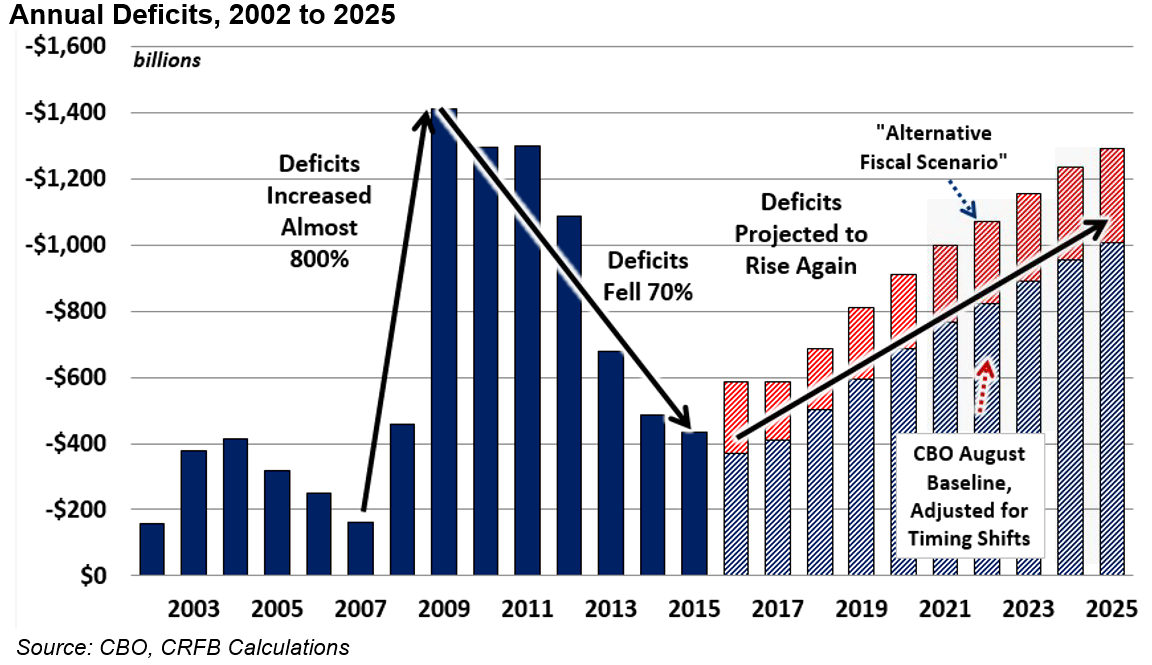
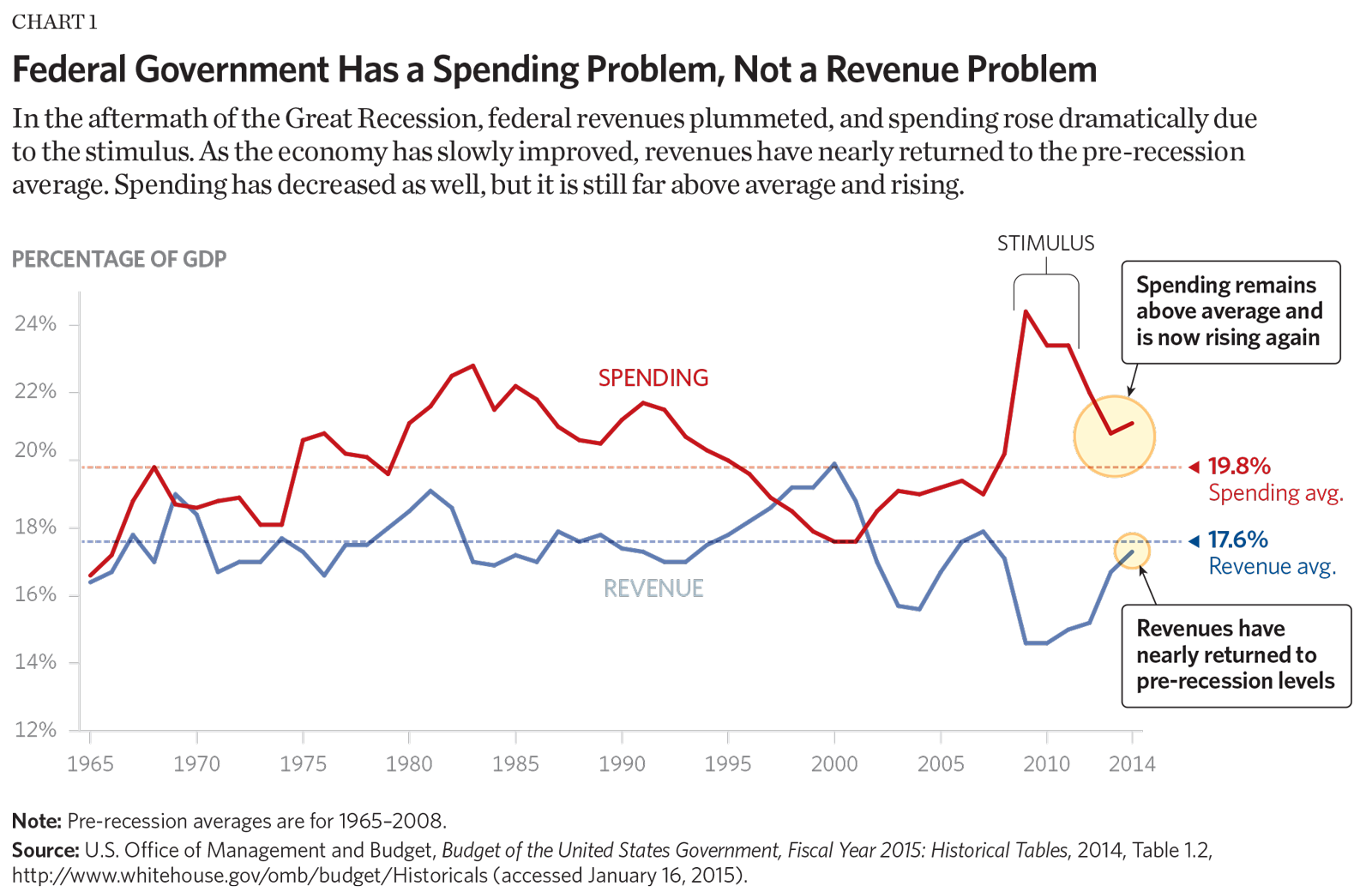
There have been pauses in the trend. When Republicans won control of the House in the Tea Party wave of 2010, they kept a tight grip on the federal checkbook. Under Speaker John Boehner, the Republicans reduced spending in real dollar terms and reduced the deficit by 70 percent, thanks to the sequester’s spending caps. Nevertheless, the borrowing continued and the debt continued to grow, albeit at a slower rate. In the late 1990s, a booming economy paired with spending cuts actually led to federal surpluses for a few years.

By the end of Barack Obama’s second term, the federal debt had almost doubled. The US debt to GDP ratio reached 108 percent. This is far behind Japan with a 240 percent ratio and Greece at 180 percent, but the level of debt is generally acknowledged to be at a serious problem. The Keynesian ideal of deficit spending in times of crisis has given way to deficit spending to avoid a financial crisis.

Where Rand is incorrect is in his hostility to military spending, a constitutional mission of the federal government. Paul argues that “military spending more than doubled since 2001,” but fails to consider how much the world changed on Sept. 11, 2001. Two wars and numerous missions against Islamic terrorism are only the most obvious aspect of the problem. Chinese and Russian expansionism represent serious Cold War-like threats.

In 2016, under President Obama, military leaders said that sequestration was a serious threat to military readiness. Budget cuts have led to difficulties in replacing and upgrading equipment. Financial limitations have also impacted training and troop retention.

Military spending is costly, but it is not the largest share of the federal budget. Defense and security spending (including veterans programs) make up only 20 percent of federal outlays. Over half of the federal budget is made up of health care spending (28 percent) and Social Security (25 percent). It is entitlements that are breaking the federal budget.

Democrats may get the lion’s share of the blame for entitlement spending, but the truth is that it is a bipartisan problem. Conservative voters claim to favor spending cuts, but quickly change their tune when the discussion moves to reforming Social Security. They have bought into the fiction that their “contributions” to Social Security are held into an account for when they retire. In reality, Social Security taxes are quickly spent on current retirees as soon as they are received. (If you think your payments to Social Security are a voluntary “contribution,” try not paying them.)

Speaker Paul Ryan is one of the few politicians of either party to dare to even mention entitlement reform. For his bravery, he is shown in Democrat ads pushing an old lady off a cliff. His own party was no better. When Ryan voted for the 2013 budget deal that included cuts in military retirement pay, he was skewered by Republicans even though the bill was supported by military leaders.  

In the end, Rand Paul is right. Neither party cares about the debt, at least not enough to allow cuts to their favorite programs, although they are more than willing to cut the other party’s pet projects. The minority party becomes a deficit hawk to use the deficit as a club to beat their opponents and roles reverse when the parties change control. The few politicians who want to make real spending reforms are opposed by both parties.

There will be no spending reform for the foreseeable future. The US government will continue to spend like a billionaire’s wife in Saks Fifth Avenue as long as it can borrow. With the dollar maintaining strength and few other bastions of stability for world investments, many assume that purchases of treasury bonds will never stop.

But one day, sooner or later, interest payments will combine with other budget items to exceed the government’s ability to borrow. The government will not be able to pay its bills. When that day comes, members of both parties will have to get serious about spending cuts regardless of what their voters think.


Originally published on The Resurgent

Tuesday, October 18, 2016

Congress is the key to stopping Hillary

A major argument for Donald Trump has been that “He’s not a great candidate or a conservative, but we need him to prevent Hillary from picking Supreme Court justices who will gut the Second Amendment.” Given the numerous questionable characters that Trump has chosen to work on his campaign, the idea that he knows how to “hire the best people” is dubious at best. Now, as the “Trump train” goes off the rails three weeks before the election, it is becoming apparent that conservatives need to find an alternative strategy to save the Court and block Hillary. The key to stopping the liberal agenda for the next four years is Congress, specifically the Senate. 

Let’s face it. Depending on Trump to appoint strict constructionists to the Supreme Court was always a long shot. The possibility that Trump might appoint good judges outweighs the certainty that Hillary won’t, Trump supporters argue. If one ignores all the other arguments against Trump, it might even be convincing. Yet as Trump goes rogue on the campaign trail, even that slim possibility seems to be vanishing as a Clinton victory grows more and more likely.

The only certain way to stop Hillary’s agenda before it starts is to make sure that the Republican majority in the Senate is preserved. Many Trump supporters will say that the Republicans in Congress didn’t do much to stop Obama for the past six years. They are wrong. The truth is that Republicans in Congress were very successful at stopping Obama’s legislative agenda.

After the Tea Party wave election of 2010, the Democrats did not pass any major legislation for the next six years. Obama’s landmark laws, the stimulus, the Affordable Care Act and the Dodd-Frank financial reform bill, were passed with Democrat majorities in both houses. Not a single Republican voted for Obamacare or the stimulus.

The Republicans in Congress were remarkably successful at stopping President Obama’s legislative agenda. Obama tried to push through gun control in the wake of the Newtown massacre. Republicans stopped him. They actually cut spending in terms of real dollars in consecutive years for the first time since the administration of Dwight Eisenhower. After the death of Antonin Scalia, Republicans in the Senate tabled President Obama’s nomination of Merrick Garland to fill the vacant seat on the Supreme Court. How much credit did Republicans get for these victories? Approximately zero.

Much of the confusion over the Republican Congress “surrendering” to Obama, as many claim, is the difference between stopping Obama and passing legislation to roll back what Obama has already done. Congress is set up so that it is easier to prevent a bill from becoming a law than to enact a new law. This is particularly true in the Senate.

In the Senate, the first hurdle that a bill must pass to become a law is a cloture vote. Cloture is a gentleman’s filibuster. Rather than speaking for hours on end as they did in the old days, today’s Congressmen can block a bill from coming to a vote by rallying 41 opponents to vote against cloture, or ending the filibuster. Therefore, the 46 Democrats in the Senate could effectively block any Republican bill from ever coming to a vote and that is precisely what they did.

The cloture rule is not part of the Constitution. Senators could decide to eliminate it in favor of a straight majority vote. The problem is that there is an even greater hurdle. If a bill passes both houses of Congress, it still faces a presidential veto. To override a veto requires 67 votes in the Senate. Logically, if a bill can’t pass a cloture vote, the veto can’t be overridden.

When the Republicans blocked Obama legislatively, he began issuing expansive Executive Orders and having regulatory agencies issue rulings with the force of law. Because these tactics bypassed Congress, Republicans could not block them. Stopping these abuses would require passing new laws, but the 54 Republicans could not pass new laws without Democratic support. That reality doesn’t change even with a government shutdown. The situation has effectively been a stalemate with neither side willing to compromise on most issues.

Because of the number of Republican Senate seats up for reelection in swing states this year, it was generally assumed that the Republican majority would be smaller for the next Congress. As recently as a few weeks ago, it looked like Republicans would retain control of the Senate, even if they lost some seats. Then came Trump’s implosion.

Not only have the Trump scandals hurt down ballot Republicans, but Trump and his supporters have attacked his fellow GOP candidates. At this point, it seems increasingly likely that the Democrats will win control of the Senate. Even the large Republican majority in the House may be threatened.

While retaining the House would allow Republicans to block legislation such as gun control measures from becoming law, losing the Senate would mean that Democrats could easily appoint extremist liberal judges to the courts with a simple majority vote. There is no filibuster for most judicial appointees thanks to Sen. Harry Reid’s (D-Nev.) use of the “nuclear option” in 2013. With a Democrat Congress and a Democrat president, the filibuster might be eliminated entirely.

On the other hand, retaining control of the Senate would allow Republicans to stop Hillary’s agenda right out of the gate. Appointments to the Supreme Court could theoretically be blocked until after the 2020 elections, if necessary. The Senate has already shown its willingness to stop bad treaties and liberal legislation in its tracks.

There should be no illusions, however, that Republicans can roll back eight years of Obama under Hillary. Even if they retain a majority, they will almost certainly be weaker, at least until the midterm elections. Historically, the opposition party gains seats in the midterms, but even then there is almost no chance of a 67 vote Republican majority.

While it would be preferable to have a Republican president to help pass conservative reforms, Donald Trump is no conservative and has shown little inclination to work with his party. If Trump becomes president and Republicans lose Congress, he could not be trusted to nominate constructionist judges or veto gun control bills. He cannot be trusted to support religious liberty. There is a high probability that he would act with liberal Democrats like Bernie Sanders to scuttle free trade agreements and military alliances.

With Trump falling to the 30 percent range in many polls and trailing in most swing states, there is little chance of a recovery. Republican funds would be better spent on tossup congressional races to preserve the Republican majority than in attempting to shore up a candidate who is biting the hand that feeds him.

If the choice is between an unreliable President Trump and a Republican Senate that has shown its mettle, I’ll throw in my lot with the congressional Republicans.

Originally published on The Resurgent


Thursday, January 15, 2015

America’s most underrated politician


John Boehner “don’t get no respect” from conservatives

John Boehner is not going to win any popularity contests among conservatives. The Republican speaker of the House is much maligned among his own party and has even been the target of several unsuccessful coup attempts by Tea Party factions, including the one last week. In spite of his unpopularity on the right, Boehner has done much to stymie President Obama’s agenda and to make the 2014 Republican sweep possible. In spite of his accomplishments, most members of his own party would not vote for Boehner as speaker according to an EMC Research poll released on January 2. Boehner is truly the most underrated man in American politics today.

The road to speaker

John Boehner has served Ohio in the U.S. House of Representatives since 1991. In February 2006, he replaced Tom DeLay (R-TX) as majority leader. After the Democrats won control of the House in the 2006 elections, Boehner served as minority leader, a position he held until 2010 when victorious Republicans unanimously elected him speaker.

Even though Republicans gave Obama and the Democrats “a shellacking” in 2010, the party was still at a terrible disadvantage. The GOP controlled only half of one of the three branches of government. Democrats still held the presidency and a majority in the U.S. Senate. The Republican majority in the House gave conservatives just enough power to block the liberal agenda, but not enough to enact their own policies.

Boehner’s war on spending

Republican control of the House came too late to stop landmark Democratic bills such as the Affordable Care Act and the Dodd-Frank financial reform, but the GOP did score important victories under Boehner. The website of Sen. Bernie Sanders (I-VT) includes a list of bills that were blocked by Republicans. These include the DREAM Act, the DISCLOSE Act , the Paycheck Fairness Act, a millionaire tax, federal firearms background checks, increased taxes for companies relocating outside the U.S. and subsidies to keep federal student loans below market rates. Additionally, Republicans also blocked an internet sales tax and a bill that would have gutted the First Amendment by allowing Congress to regulate spending on federal elections.

Boehner and the House Republicans began to fight Obama’s out-of-control spending as soon as they reached Washington. In 2011, Democratic spending had almost reached the debt ceiling specified by law. The battle that raged over raising the debt ceiling culminated in the Budget Control Act of 2011, a compromise bill that raised the debt limit in exchange for spending cuts and the creation of a “super committee” on deficit reduction. While Republicans did raise the debt limit, that outcome was never in doubt because it was necessary to preserve the “full faith and credit” of the United States. It was a victory for Republicans in the sense that they exacted meaningful cuts without corresponding tax increases from the Democrats.

The spending victory was also due to another Boehner victory, that of the fiscal cliff and the sequester. For those who don’t recall, the fiscal cliff was the large number of tax increases scheduled to automatically go into effect at the end of 2012 as the low Bush-era tax rates expired. The tax increases coincided with automatic spending cuts that hearkened back to the Budget Control Act of 2011. When President Obama ignored the recommendations of the super committee in favor of pursuing tax increases, automatic spending cuts were scheduled to go into effect across the board.

In spite of having lost the presidential election, Republicans in Congress stood firm under Boehner. In a last minute deal, the GOP was able to prevent income tax rates from increasing for the majority of Americans, a compromise endorsed by Grover Norquist of Americans for Tax Reform. The deal also postponed the sequester and permanently fixed the Alternative Minimum Tax, a previously ever present threat to middle class taxpayers, but resulted in a number of other tax increases. Elections have consequences and the Republicans simply did not have the numbers to force a better deal.

Two months later, everyone once again expected Boehner to cave in on the sequester negotiations. Republicans hoped to avoid defense cuts, while Democrats opposed entitlement cuts and pushed for tax increases. In the end, there was no agreement and the budget cuts went into effect across-the-board. Much to everyone’s surprise, the sequester was scarcely noticed by most Americans. What they did notice was the government shutdown a few months later.

The defund disaster

As the implementation of ObamaCare approached in October 2013, a faction of the Republican Party proposed an attempt to defund the Affordable Care Act. As opponents of the plan noted at the time, the defund attempt was unlikely to succeed because ObamaCare was already funded and the Republicans did not have the votes to overcome the Democratic majority in the Senate. Nevertheless, with a large number of Republicans in favor of trying to defund the ACA, Boehner and the rest of the party went along as well.

The attempt was disastrous. The government was shut down at the same time that ObamaCare enrollments started and the exchange websites crashed. Because of the shutdown, the focus was on the Obama’s negotiations with Republicans rather than on the website catastrophe. For 16 days in October 2013, Republican poll ratings were in freefall. Boehner attempted to negotiate with Obama during the shutdown, but with Obama enjoying the Republican self-destruction, no agreement was reached. Senate Minority Leader Mitch McConnell (R-KY) and Majority Leader Harry Reidn (D-NV) finally reached a deal to end the shutdown. This deal was passed with mostly Democratic support and has rightly been called a Republican surrender. The alternative to surrender, however, was the destruction of the Republican Party. For Republicans, the best thing that can be said about the deal that ended the shutdown is that it kept the sequester, the only real leverage against Obama that the Republicans had, in place.

The sequester also survived a late 2013 budget deal brokered by Paul Ryan (R-WI) and Patty Murray (D-WA). This deal kept the sequestration in place while Republicans held the line against Democratic calls for more taxes.

From hero to zero

Less than a year after the failed attempt to defund Obamacare, Boehner and other conservatives were campaigning hard for the midterm elections. Boehner campaigned hard for Republican candidates around the country and raised $100 million for the party according to USA Today. Boehner’s own PAC doled out $1.3 million to dozens of Republicans according to campaign finance data from Open Secrets. The 2014 Republican landslide was due many people, but John Boehner deserves much credit for his hard work in recruiting candidates and his tireless campaigning. The resulting Republican majority, the largest since 1928, would not have been possible with an ineffective Republican leader in the House.

As 2014 drew to a close, Boehner was again criticized for the passage of the so-called “cromnibus,” a compromise bill to fund the government through the remainder of the fiscal year. While many conservatives were angry about the bill, few proposed viable alternatives. Also, as U.S. News pointed out, the bill was hardly a sellout to the Democrats. Republicans gained many concessions, including cuts to the budgets of the EPA and IRS, no new funding for Obamacare, and a prohibition on the transfer to Guantanamo Bay detainees to U.S. courts. Nevertheless, for many conservatives, any credit that Boehner had earned with the election victory was lost in the cromnibus deal. This led to the recent coup attempt by a small number of Republicans.

The next two years

In the end, cuts to federal spending may be Boehner’s biggest triumph. According to Congressional Budget Office figures, federal spending has fallen each year since 2011 when Republicans assumed control of the House. The budget deficit has fallen by nearly 70 percent in that time. As Michael Medved recently pointed out on his radio show, the last time that federal spending declined in three consecutive years was under President Calvin Coolidge.

In the new session, the House has already approved construction of the Keystone pipeline and passed a bill restoring the 40-hour work week. These bills will now go to the Senate where, with Mitch McConnell in charge, they will probably pass and go to the president’s desk.

As Boehner shifts from defense to offense, it is likely that many of his critics will be surprised. With a record of strong accomplishments from a weak position, the man that Ralph Benko of Forbes called “the worst thing to happen to progressives since” the fall of the Soviet Union, will be a much more capable foe of Obama and the Democrats when allied with Mitch McConnell’s Senate. The alliance is likely to produce results that cannot be ignored.

Read the rest on Examiner.com

Monday, December 2, 2013

Voters oppose further cuts to military spending

A new Rasmussen poll indicates that a majority of Americans feel that United States military spending is either just right or not enough. The poll, released on Dec. 1, found that 64 percent of likely voters approve of the current level of military spending or would like to see it increased.

The poll comes as the Obama Administration touts a new deal that would delay the Iranian nuclear program for six months in exchange for relief from international sanctions. Another Rasmussen poll from last week found that voters were split on the Iran deal. Forty-one percent favor the deal while 43 percent are opposed.

American foreign policy is also being challenged in the Far East. After China declared an air defense identification zone (ADIZ) over the disputed Japanese Senkaku Islands. President Obama sent a flight of U.S. Air Force B-52 Stratofortresses to challenge what Stephanie Kleine-Ahlbrandt, director of Asia-Pacific programs at the U.S. Institute of Peace, called “a bolder foreign policy in light of an anticipated U.S. decline” in CNN.

In light of the recent foreign policy news, the Rasmussen poll found that only 29 percent say the U.S. spends too much money on defense. Twenty-seven percent say that the U.S. currently spends the right amount on defense. A plurality, 37 percent, say that the U.S. does not spend enough on defense and national security in spite of the fact that the federal defense budget spends more than the next 10 countries combined.

The percentage of Americans supporting the current level of military spending has increased sharply since a February 2013 Gallup poll. The poll of adults found that 36 percent felt that military spending was too high and 35 percent found it about right. Only 26 percent thought that military spending was too low. The trend toward more support for military spending was already underway, however.

Similarly, an ABC News/Washington Post poll from March 2013 found that American adults supported federal budget cuts by a two-to-one margin, but that a nearly identical margin opposed cuts to the military budget. The poll specifically addressed the sequester’s five percent cut to overall spending and the eight percent cut to military spending.

The deal between Republicans and Democrats that ended October’s partial government shutdown authorized current spending levels through January 15, 2014. As budget negotiations heat up in the new year, it is likely that defense spending will again be an issue. MSNBC’s Timothy Noah points out that the next round of sequester budget cuts will come entirely from the military budget. If the president tries to force the military budget cuts to take effect or exchange military funding for tax increases, it may put him further against popular opinion.


Originally published on Elections Examiner

Tuesday, October 8, 2013

Canada to the rescue at Salute America Air Show

2013-08-05 19.06.01As the 2013 air show season draws to a close, it was set to go out with a bang at the Salute America Air Show near Atlanta. The show, held on Oct. 5-6 at the Paulding Northwest Atlanta airport in Dallas, Ga. (airport details can be found on GlobalAir.com) featured a variety of aviation acts. Saturday night’s show included rare twilight aerobatic acts.

Many 2013 air shows were canceled due to the sequester budget cuts enacted earlier this year. The military jets and helicopters often featured at local air shows were in short supply due to the cuts in the defense budget. For the first half of the summer, the Air Force Thunderbirds and the Navy Blue Angels were grounded, prompting the cancellation of many air shows. The Thunderbirds resumed flying in July when the Air Force found money to fund the unit. At Wisconsin’s Oshkosh air show, the FAA charged the Experimental Aircraft Association to operate a temporary control tower at the field.

It is ironic then that the only active duty military aircraft featured at the Salute America Air Show were a pair of Canadian Air Force CF-18 Hornets. A star attraction was the Royal Canadian Air Force Hornet Demonstration Team which performed daylight and twilight routines. A second CF-18 was on hand as a static display.

Although no U.S. military aircraft were present at the Salute America Air Show, the pilot of the Canadian CF-18 unfurled an American flag from his cockpit in a show of friendship as he taxied in from his first performance on Saturday. In a return salute, a Lucas Oil skydiver in an American flag parachute streamed a Canadian Maple Leaf flag from his back later in the day.

Aficionados of World War II aircraft thrilled to a North American P-51 Mustang and Chance Vought F4U Corsair. Both warbirds performed separately and then joined for a formation flight in front of the crowd. The P-51, flown by Stan Musak, is a veteran of both WWII and Korea. Although Corsairs are also famous for their service in WWII, this particular airplane was built in 1945 and served primarily in Korea. The Corsair was flown by Jim Tobul.

The Aeroshell Aerobatic Team also performed in both the daylight and twilight shows. The team, sponsored by Aeroshell, a division of the Shell oil company that produces aviation lubricants and fuels, flies vintage North American T-6 Texans that were used to train military pilots in WWII. The four airplanes wowed the crowd with their coordinated formation aerobatics.

A second aerobatic team to perform was Team Aerostar. The team uses Yakovlev Yak-52s, Soviet-era Russian military trainers. After watching the three Russian airplanes perform, airshow fans could go to the vendor area to get a firsthand look at what it is like to fly formation aerobatics at the AOPA/Redbird Simulator trailer.

There were several solo performers as well. Lucas Oil sponsored Mike Wiskus and his Pitts biplane as well as a team of skydivers. “Skipper” Hyle performed in another AT-6 Harvard, the British version of the Texan trainer. Chuck Coleman flew an Extra 300L and Gary Rower demonstrated another WWII trainer, the Super Stearman biplane. Gary Ward performed in the ultramodern, carbon fiber MX-2.

Another popular performer was Bill Braack in the Smoke-n-Thunder jet car. The car is powered by a Westinghouse J34-48 jet engine that was originally used to power a North American T-2 Buckeye trainer jet used by the U.S. Navy. The 26 foot long car can be driven to almost 400 miles per hour by the engine’s 6,000 pounds of thrust.

During the day show, Braack in the jet car raced Mike Wiskus in the Lucas Oil Pitts. In the evening show, Braack thrilled the crowd with bursts of afterburner in a nighttime speed run down the runway.

The final act of the show was aerobatic pilot and musician Elgin Wells flying his one-of-kind Starjammer. The Starjammer is an aerobatic airplane that is equipped with lights and speakers for a unique after-dark performance that must be seen to be appreciated. A fireworks display followed Saturday’s show.

There were also many static displays for airshow patrons to enjoy. In addition to the Canadian Air Force CF-18, there were two vintage DC-3s. One was in the livery of a classic airliner while the other was a restored U.S. Air Force AC-47 gunship owned by the American Flight Museum. Phoenix Air, a local Georgia company that contracts with the military, also had one of its Learjets on display. Civil Air Patrol recruiters were on hand and a variety of general aviation aircraft that included a Pilatus PC-12, a classic Stinson 108, and Hughes 600N helicopter.

In a normal year, airshows are one of the largest spectator sports in the United States with tens of millions in attendance. Airshow fans can only hope that by next year, the federal budget crisis will have been averted and the 2014 season will see a return of the U.S. military demonstration teams and aircraft that are so popular.

If you would like to see more pictures as well as videos from both the day and night performances at the Salute America Air Show, please visit and like the Aviation Examiner Facebook page.


Originally published on Aviation Examiner

Saturday, March 23, 2013

FAA announces list of sequester control tower closings

Today the Federal Aviation Administration announced the list of air traffic control towers to be closed as the agency implements its sequestration budget cuts. The March 22 press release notes that the FAA originally planned to close 189 towers, but reduced the number to 149 in the final plan.

The reduction in the number of towers to close was due in part to the decision that keeping some towers open was in the national interest. Twenty-four federal contract towers that are staffed by private contractors that were slated to close will remain open. Additionally, 16 contract towers that are part of a cost sharing program will remain open because Congress appropriates their operating funds directly. These towers will have their funds reduced by five percent, but this will not force their closure.

The list of tower closures (which can be viewed here) is made up primarily of general aviation reliever airports so airline travel will be minimally affected by the closures. There are several towers in secondary airline markets that slated to be closed, however. Among these are Columbia, S.C, Concord, N.H., Santa Fe, N.M., and Pocatello, Idaho.

Several towers at Georgia airports are among those on the closure list as well. Two Atlanta-area airports, Cobb County-McCollum Field and Gwinnett County – Briscoe Field, will lose their control towers. Additionally, three other towers around the state, Southwest Georgia Regional in Albany, Middle Georgia Regional in Macon, and Athens – Ben Epps will close. The tower at Fulton County – Brown Field in Atlanta was slated to close, but will remain open.

The fact that control towers are being closed does not mean that airline flights will cease or that the airport itself will close. Instead, it means that the airport will become a “nontowered” airport where pilots revert to “see-and-avoid” procedures and enter the flow of traffic themselves rather than having an air traffic controller regulate the flow of takeoffs and landings.

While pilots fly from nontowered airports, there might be slight delays to obtain a clearance to take off and enter the enroute system. Tower closures might result in radar gaps around these airports that require controllers to leave more space between aircraft. The absence of tower controllers might also mean that weather minimums for instrument approaches at some airports increase due to the lack of weather observers. This could mean delays or diversion of flights during periods of bad weather.

Many of the towers that will be closed were already operating on a part time basis. Control towers at smaller airports are often open only during the day or at peak hours.

In addition to the list of towers that will be closed, the FAA also published a list of contract towers that will remain open as well as list of contract cost share towers that will remain open.

Originally published on Examiner.com:
http://www.examiner.com/article/faa-announces-list-of-control-towers-to-be-closed?cid=db_articles&no_cache=1364055688

Sunday, March 3, 2013

The story of the sequester

On Friday, the deadline for the federal spending sequester passed without an agreement between Democrats and Republicans on what portions of the federal budget to cut. Many may wonder exactly what the sequester is and how the nation reached the point where $85 billion will be cut from federal spending with no one in Washington taking responsibility.

The sequester has its origins in the debt limit debate of the summer of 2011. As the nation’s credit rating was downgraded and the federal government neared the end of its ability to borrow, President Obama pressed Congress to raise the debt limit. In exchange for doing so, House Republicans insisted on spending cuts. By 2011, President Obama was spending nearly a trillion dollars per year more than 2008, President Bush’s most expensive year, according to the White House Office of Management and Budget. Nevertheless, President Obama and the Democrats fiercely resisted any attempts to rein in spending. For their part, Republicans were equally tenacious in their opposition to tax increases.

The stalemate was broken by the sequester. According to investigative journalist Bob Woodward, whose book, “the Price of Politics,” details the negotiations from the summer of 2011, the stalemate was broken by an agreement to delay the decision on taxes and spending cuts. Part of the agreement was a “doomsday” plan in which taxes and cuts would automatically take place if Congress failed to take action by January 1, 2013. The combination of automatic tax increases and spending cuts came to be known as the “fiscal cliff.” The compromise was signed into law as the Budget Control Act of 2011.

The 2012 election threw a wrench into the plans of both Congress and President Obama for dealing with the cliff. Both parties expected to win a convincing victory. Neither party expected that the election would end in a stalemate, a continuation of the status quo in which the Democrats controlled the presidency and the Senate and Republicans kept control of the House of Representatives, but that is exactly what happened. The election results meant that the stalemate of 2011 was doomed to be repeated.

The tax section of the fiscal cliff was settled on New Year’s Day with a compromise that raised taxes on upper income Americans and let the payroll tax holiday expire for everyone else in what the Wall St. Journal called the “largest tax increase in two decades.” Part of the tax cliff compromise included extending the deadline to deal with the spending cuts, the sequester, until March 1.

As the deadline for the sequester approached, President Obama and the Democrats reneged on the agreement that tax increases would be balanced with spending cuts. In December 2012, the Republicans offered a tax reform package that would have raised $800 billion in revenues without raising tax rates. The plan would have closed loopholes and eliminated some deductions for the wealthy. Now President Obama, according to Factcheck, wants the revenue package previously offered by Speaker Boehner along with the tax increases that he has already received.

After the fiscal cliff deal, Republicans warned President Obama that they would accept no more tax increases. Mitch McConnell (R-Ky.) wrote in an op-ed on Yahoo, “That debate is over. Now the conversation turns to cutting spending on the government programs that are the real source of the nation’s fiscal imbalance.”

Because the tax increases in January were automatic, the Republicans had no leverage. If they had not compromised with the Democrats, tax rates would have gone up even more and impacted virtually every American. In the sequester, the opposite is true: Spending will be cut automatically if Congress does not act.

President Obama and the Democrats desperately want to avoid any sort of cuts to federal spending. Nevertheless, by tying sensible cuts to tax hikes that the Republicans find unpalatable they have guaranteed that the sequester will happen. There are three possible reasons for this strategy.

First, having agreed to the spending cuts only to get an increase in the debt ceiling in 2011, the Democrats now want to make the cuts as haphazard and painful to American voters as possible. If they can cause pain to the voters and make them believe that the Republicans are responsible, it may give them a victory at the polls in 2014 that will guarantee future tax hikes and avoid any possibility of reining in spending.

Second, Obama undoubtedly expects that if he can force the Republicans to cave into his demands once again that it will further splinter the party. With the Republicans fragmented, demoralized and pointing fingers at each other, it will be easy for Obama to gain new concessions in the future. He will need them. The federal government will reach its debt limit again in a few months.

Third, political observer Dick Morris theorizes that Obama wants the sequester to take effect so that he can blame Republicans for the economic downturn that his policies are causing. Writing in The Hill, Morris notes that Obama and the Democrats have imposed a multitude of new taxes totaling $300 billion. According to an analysis by the Washington Post, the cuts for 2013 only come to $85 billion, 28 percent of the amount that Obama’s tax increases have removed from the economy.

President Obama has attempted to cast the blame for the sequester on Congress, but Bob Woodward who was present during the 2011 negotiations disputes that. Writing in the Washington Post, Woodward described how the idea for the sequester originated with Jack Lew, at the time the White House chief of staff, and Rob Nabors, the White House chief of congressional relations. According to Woodward, President Obama personally approved the plan before it was presented to Senate Majority Leader Harry Reid (D-Nev.).

Woodward reported that representatives of the Obama Administration told him that he would “regret doing this” after he pointed out the inconsistencies in the Obama Administration’s statements. The exchange is detailed in the Wall St. Journal, which also points out that administration officials have attempted to intimidate at least two other journalists who have published stories critical of Obama.

There were several congressional attempts to limit the impact of the sequester. Factcheck agrees that Republicans in the House passed two bills in 2012 that would have replaced the sequester’s defense cuts with entitlement cuts. These bills died in the Senate. In the current term, two bills were proposed in the Senate, but neither passed. A Democratic bill would have replaced the sequester cuts with alternative cuts and more tax increases. The Republican version would have required President Obama to propose alternative cuts without tax increases.

In last days of February, Republicans offered to give President Obama the power to choose which programs to cut in order to mitigate the pain of the sequester. President Obama threatened to veto the bill if it passed Congress, instead opting for the across-the-board, untargeted cuts. The White House told the Defense News, “There is no way to cut spending this dramatically over a seven-month period without drastically affecting national security and economic priorities. Moreover, [it] would explicitly protect pork barrel spending and, in so doing, would reduce the President’s ability to protect national security.”

In reality, even though the sequester cuts almost a trillion dollars from federal spending over ten years, total federal spending will increase even if there is no compromise to avert the cuts. According to an analysis of Congressional Budget Office spending figures in Forbes, the sequester cuts are subtracted after adding in inflation adjustments and spending exempted from the cuts. The result is that spending will increase by $110 billion after the sequester cuts are accounted for.

On Friday, the sequester officially took effect as Obama ordered federal agencies to begin the initial $85 billion in cuts. As the Wall St. Journal pointed out, President Obama may be the biggest loser if Americans find that spending cuts really aren’t so bad after all.

Originally published on Examiner:

http://www.examiner.com/article/week-review-the-sequester-takes-effect?cid=db_articles