As a conservative Christian, when I talk about voting for Democrats, one of the first questions I usually get is some form of “What about abortion?”
That’s a reasonable question, because I am still pro-life and anti-abortion, but I now realize that the two are not the same. In my early years of political awareness, I looked at three main issues: abortion, guns, and taxes. My thinking was that if a candidate got those three issues right, the chances were good that I’d agree with him on most other stuff. For a long time, that strategy worked pretty well, but eventually things got more complicated.
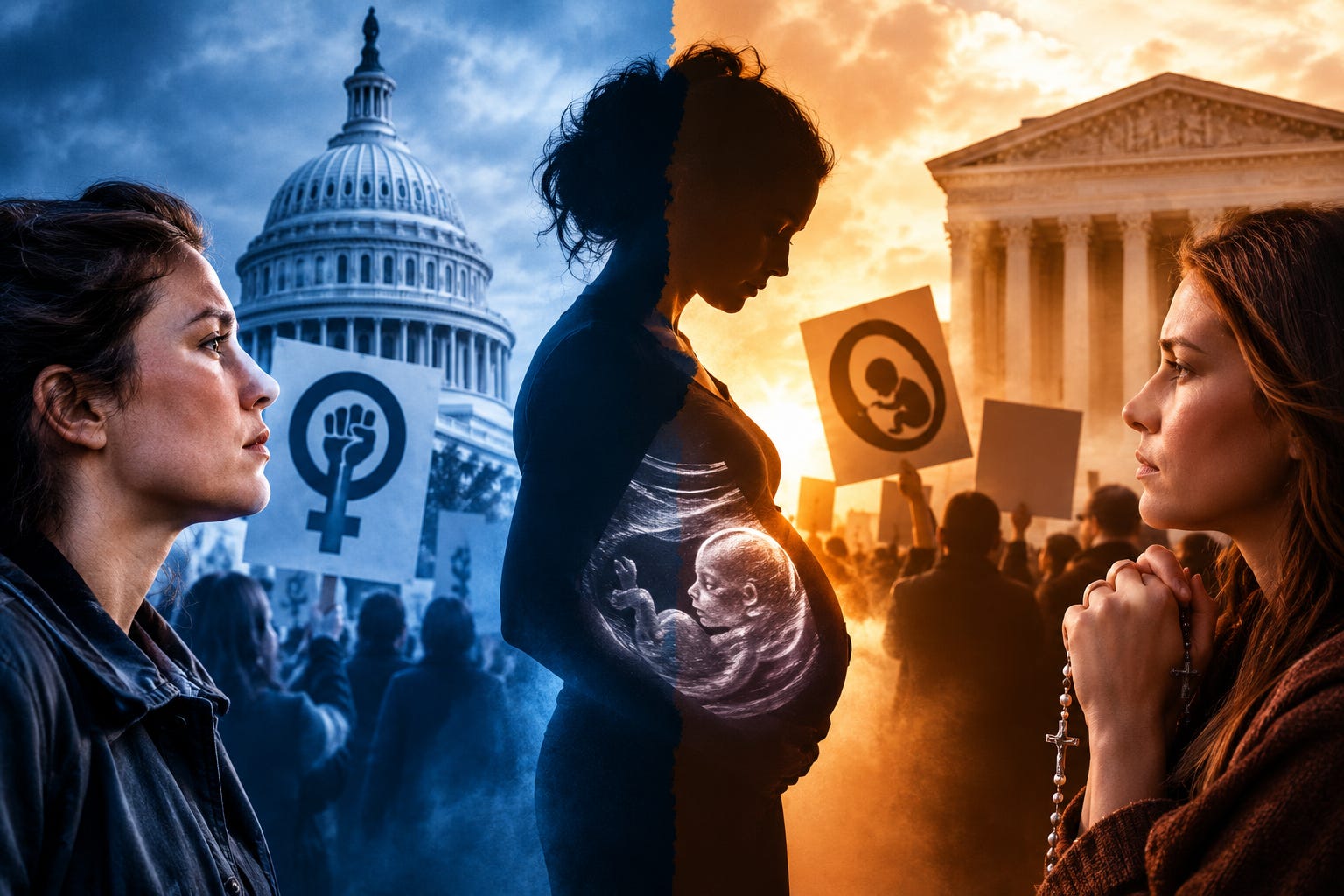
One of the first problems that emerged with my thinking was that electing candidates who spouted pro-life/anti-abortion rhetoric didn’t necessarily change things. Part of that was due to Supreme Court decisions that limited how restrictive anti-abortion states could be. Now, with the Dobbs decision as a legal precedent, the playing field is different, but that caveat remains.
What many pro-life people don’t understand is that the abortion rate was in a long-term decline for decades, regardless of which political party was in power or who was president. The abortion rate in the US peaked about 1990 and then declined under Presidents Clinton, Bush, and Obama. That long-term trend reversed itself under Donald Trump before the Dobbs decision and has continued to rise since. Pro-life political groups applaud Trump for his pro-life actions, but they won’t tell you that there were big declines in abortion under Democratic, pro-choice presidents or that abortions have been increasing under Trump for years.
There is an argument that these trends are related to other factors aside from the policies of individual presidents. I agree, but that also undercuts the argument for why voting for pro-life candidates is so important.
For example, one reason that the abortion rate is rising is probably because of the growth of pharmaceutical abortions, some of which can be delivered through the mail. Louisiana filed a lawsuit seeking to ban such deliveries, but the same Supreme Court that handed down Dobbs paused an injunction that would have suspended postal deliveries of mifepristone. The FDA is conducting a safety review of the drug, but the agency has said the study won’t be ready until March, long after the midterm elections.
The case involves the Comstock Act, an 1873 law that bans the transfer of “lewd” materials and drugs that could end a pregnancy by mail. The law also initially banned the shipment of birth control drugs, but that provision has been repealed.
Pro-life groups would like for the Administration to enforce the Comstock Act, and some parts of the Administration would like to do so. Attorney General Todd Blanche has indicated that he is open to the idea.
The rub is with democracy. In 2022, after the Dobbs decision was announced, Republicans faced a backlash from the voters. That was true even in red states.
Long-term polling shows that Americans became more prolife over the years, even reaching a small majority at times. Pro-life was slowly winning the ideological war until May 2021, when prolife identification took a nosedive. It’s probably not a coincidence that this was when the Supreme Court agreed to hear the Dobbs case. In the long view, it may be true that electing politicians who appointed pro-life justices actually set the pro-life movement back.
I think the explanation for this may be that pro-life groups forgot that they were in a democracy when they got a friendly president. They stopped trying to persuade and started trying to control.
There were probably other reasons as well. When the Supreme Court agreed to hear the case, the threat to abortion rights became real rather than theoretical. A lot of people who claimed to be pro-life suddenly realized that they didn’t want abortion bans after all. Or maybe they weren’t really anti-abortion to begin with.
I also would not be surprised if Donald Trump’s toxic personality caused a shift against the whole pro-life ideology. There might be some truth to the idea that some people don’t want to be seen as pro-life just because Trump claims to be as well.
The current situation is that anti-abortion groups probably have the political clout and legal arguments to enact some additional abortion restrictions, but if they do so, it will be very unpopular. That’s not a recipe for lasting success. That’s a recipe for another backlash.
In retrospect, it was a mistake for the pro-life groups to allow the issue to become divided along partisan lines. There were once pro-life Democrats. In fact, there still are. But part of the reason that these are such a rare breed now is that, in addition to facing strong pro-choice pressures from inside their own party, they are also targeted by Republican groups.
The partisan strategy is a recipe for long-term defeat, however. The problem is that it means that pro-life policies only have a chance of advancing when their party is in power, and as we’ve seen, that means there aren’t many successes. Growing a pro-life caucus in the Democratic Party would enable bipartisan agreement to actually get laws passed that would survive a transition of power.
I’d also like to take a moment to address the myth of abortion up to the point of birth. There are claims that some blue states, like Massachusetts, allow abortion up to the point of birth. The Massachusetts law, passed in August, still requires a doctor’s judgment that the abortion is necessary and did slightly relax earlier rules that allowed late-term abortion in certain circumstances, but the reality is that late-term abortions are rare, less than one percent, per the Kaiser Foundation.
Further, late-term abortions are rarely elective except in some cases where the mother lacked access to earlier-term abortions or found out about the pregancy late. A larger share of late-term abortions are due to learning new information about fetal abnormalities or health risks to the mother. As someone once said, it simply isn’t true that women are carrying babies nearly to term and then having elective abortions for reasons of convenience.
In my opinion, the pro-life movement needs to get back to its roots and start winning converts. The argument that an unborn fetus is a living human being that should not be killed is a strong one, and that’s especially true as technology advances and gives us compelling pictures of life inside the womb.
Pro-life activists should also adopt strategies that address the reasons that women choose to abort. A study by the Guttmacher Institute found that the typical abortion patient is young, poor, and unmarried. Seventy-seven percent are under 30, 72 percent were never married, and 60 percent were below 200 percent of the federal poverty line. Further, about 60 percent also had at least one additional child.
This data suggests that making it easier and less expensive to raise children could help more women to choose life. Government programs to help single mothers feed their kids, provide them with health insurance and medical care, and pay for clothes and daycare could save countless unborn lives. Unfortunately, these are the same programs that many Republican pro-lifers consider to be socialism.
Another alternative might be providing free or low-cost birth control. Again, however, this idea runs afoul of many pro-lifers on the right.
We have arrived at a fundamental problem. Conservative pro-lifers want to prevent abortions, but many don’t want to adopt the policies that could help to reduce the abortion rate. They just want to enact bans. This is why many consider Republicans to be pro-birth rather than pro-life. The charge isn’t entirely unfair.
I’m against abortion, which I see as a moral issue, but I also don’t see it as the only moral issue. Corruption is rampant within the MAGA Republican Party. That’s a moral issue. The president started an unnecessary war that is getting untold numbers of people killed. That’s a moral issue. The Administration is now siding with Russia as it kills Ukrainians and kidnaps Ukrainian children, exporting them to Russia. That’s a moral issue. DOGE incinerated food and medical aid rather than giving it to needy countries that depended on it. The abrupt termination of US aid led to hundreds of thousands of deaths from starvation and disease. That’s not only a moral issue. It’s a pro-life issue and an issue of poor stewardship. I could go on.
I’m against abortion, but speaking pro-life platitudes does not mean that politicians should be exempt from basic standards of competence, ethics, and decency. I’ve often said that people in public life who claim to be Christian should be held to a higher standard, not given passes when they abuse the public trust.
So yeah, it’s gotten more complicated than my original three-pronged political test. Life and politics have a way of becoming gray, but the bottom line is that abortion won’t be ended by top-down bans. That’s especially true since most Americans get more hesitant about restrictions as they become more onerous.
Only about 10 percent favor a full ban. An outright ban will never happen. Pro-life activists don’t want to hear that, but it’s true.
I believe the way to reduce abortions is to reduce the factors that make women feel like they need an abortion. That is an achievable goal, but it will require bipartisan cooperation, and both sides want to keep the issue as a wedge.
From the Racket News