Showing posts with label inspector general. Show all posts

Sunday, June 7, 2020

The Law And Order President


Earlier this week, President Trump declared himself “your president of law and order.” In the June 1 speech in the Rose Garden, the president sought to draw a distinction between himself and the rioters around the country, but, after three years of the Trump Administration, it may be too late to pivot to law and order. Thus far, the Trump presidency has been anything but a law and order administration.
Mr. Trump first got himself into legal trouble when he admitted firing FBI Director James Comey over “this Russia thing” on national television. The statement was tantamount to an admission that Trump had been attempting to interfere with a federal investigation.
When the Mueller report on the Russia investigation was completed two years later, it did not find conclusive evidence that the Trump campaign conspired with Russia, although it noted that members of the Trump campaign and Russian government agents did attempt to share information on several occasions. The report did, however, set out 10 separate counts of obstructive behavior by the president. Mueller could not indict the president due to longstanding Justice Department guidelines.
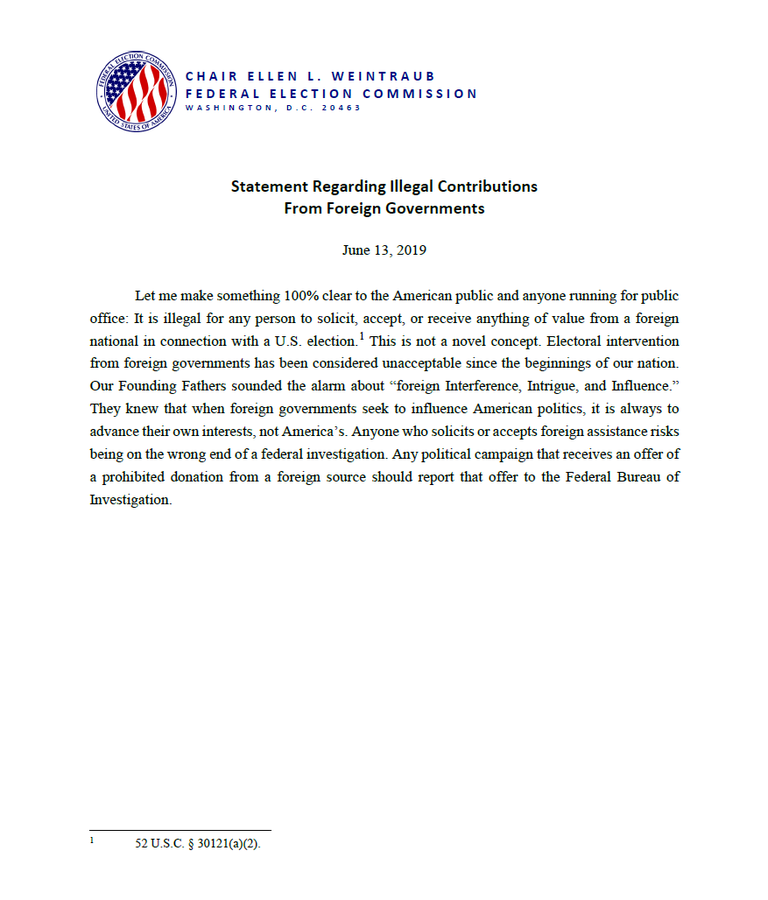
The ink was no sooner dry on the Mueller report than President Trump told ABC’s George Stephanopoulos “I think I’d want to hear it” if a foreign government offered information on an opponent to his campaign. The interview prompted FEC Chair Ellen Weintraub to tweet that it is “illegal for any person to solicit, accept, or receive anything of value from a foreign national in connection with a US election.”
Of course, we now know that Donald Trump was already actively soliciting help from another foreign government by that point. By June 2019 when the interview took place, Trump and his subordinates were already working to get dirt on Joe Biden from Ukraine. In the course of trying to use military aid to pressure the Ukrainian government, the Trump Administration violated the Impoundment Act, which regulates how money appropriated by Congress must be spent.
President Trump also played fast and loose with the law when Congress didn’t accede to his demands. In February 2019, the president declared an emergency in order to divert military funds toward building a border wall. A few months later in May 2019, the president declared another national emergency to enable the sale of $8.1 billion of military items to several countries, including Saudi Arabia and the United Arab Emirates. In both cases, the only emergency was the inability of Donald Trump to negotiate a favorable deal with Congress.
President Trump has also abused his authority to protect some of his loyal footsoldiers. Last month, the president persuaded the Justice Department to drop the charges against former National Security Advisor and longtime Trump friend, Mike Flynn, who had pled guilty to lying to the FBI. Just a few days ago, Trump signaled his intention to protect another longtime ally, Roger Stone. Stone was convicted of seven counts relating to obstructing the Russia investigation including witness tampering and lying to investigators. Trump retweeted a Charlie Kirk tweet calling for a pardon for Stone, who Trump said could “sleep well at night.”
Finally, the president has left a trail of destroyed careers in his attempts to cover his tracks and exact revenge on people who stood up for “law and order.” Most recently, President Trump has fired four inspectors general including the man who vetted the Ukraine whistleblower claim, the woman who revealed the Administration’s poor early response to the pandemic, the man who would chair the board providing oversight for the Administration’s disbursement of pandemic relief funds to businesses, and the man who was investigating both Secretary of State Pompeo’s use of government employees for private errands as well as the national emergency declaration relating to the Saudi arms sale. The common thread in all four cases was that the IGs were doing their jobs in ways that were embarrassing to Donald Trump.
Former Secretary of State Rex Tillerson said that Trump’s ideas often included violating the law.
“So often, the president would say, ‘Here’s what I want to do, and here’s how I want to do it,’ ” Tillerson said, according to the Houston Chronicle, “and I would have to say to him, ‘Mr. President, I understand what you want to do, but you can’t do it that way. It violates the law.’”
A major problem since 2018 is that people like Tillerson, John Kelly, and James Mattis are no longer in the White House. That trio had the intestinal fortitude and independence required to tell a president “no.” Now that these adults are gone, few have enough gumption to tell the president harsh truths and the result has been a long chain of catastrophically bad decisions.
Donald Trump wants to be the law and order president but, for many voters, it is too late for that. For the past four years, we have seen President Trump twisting the law and abusing his office to protect himself and his friends. Sending troops to put down riots won’t erase those abuses of power. In fact, as the president claimed to be “your president of law and order and an ally of all peaceful protesters,” park police were clearing peaceful protesters out of Lafayette Park for the president’s photo-op at St. John’s church in what turned out to be one of the great public relations disasters of the Trump Administration (of which there have been many),
Donald Trump obviously believes that law and order are ideas that apply to others, but not himself or his friends. It is unAmerican for presidents, elected officials, and, yes, police, to have the attitude that the law is for thee but not for me.
Originally published on The Resurgent

Tuesday, April 7, 2020

Trump Sacks Head Of Pandemic Oversight Committee


For the second time in less than a week, President Trump has removed an inspector general from his post. Glenn Fine, the Acting Inspector General for the Department of Defense was removed from his temporary post this afternoon. Fine was also the head of the Pandemic Response Accountability Committee.
Politico reported that Fine, who had been selected by a panel of inspectors general to head the oversight board, was being replaced by Sean W. O’Donnell. O’Donnell is the Acting IG for the Environmental Protection Agency and will now handle both roles.
At this point, it isn’t clear who will be selected to chair the oversight committee.
Fine is being returned to his permanent posting as principal deputy inspector general at the Pentagon. His removal from his role as the acting IG for the DOD makes him ineligible to head the oversight committee, however.
The White House has not given a reason for Fine’s removal.
Late Friday night, the president announced his intention to fire the IG for the intelligence community, Michael Atkinson. Atkinson had played a pivotal role in the Ukraine whistleblower scandal by vetting the initial whistleblower claim. Michael Horowitz, the DOJ inspector general, said on the weekend that Atkinson’s “actions in handling the Ukraine whistleblower complaint… [were] done ‘by the book’ and consistent with the law.”
The president has also attacked a third inspector general recently. Yesterday, Mr. Trump sharply criticized Christi Grimm, the Health and Human Services inspector general, who had issued a scathing report that showed that the government had sent out-of-date supplies to hospitals and issued confusing guidance to health workers.
The Pandemic Response Accountability Committee was created by the recent Coronavirus relief bill to provide oversight for $500 billion earmarked for business loans. The Trump Administration and Republicans had resisted oversight of what Democrats called a “slush fund” to be administered by Treasury Secretary Mnuchin.
Even as he signed the bill into law, President Trump attacked the oversight provisions in a signing statement, saying, “I do not understand, and my administration will not treat, this provision as permitting the [special inspector general for pandemic recovery (SIGPR)] to issue reports to the Congress without the presidential supervision.”
In other words, the president wanted an inspector general created to hold his administration accountable to report directly to him. Now, he has removed the person who was independently selected to head the oversight committee.
President Trump should face some hard questions about why he removed Fine as well as why he is so opposed to congressional oversight of half a trillion dollars of taxpayer funds. Republicans should also ask themselves hard questions about how they can continue to support a president who tries so hard to avoid being held accountable.

Originally published on The Resurgent

Saturday, April 4, 2020

Trump Fires Inspector General Involved In Ukraine Scandal


President Trump took time out from his response to the pandemic to fire Michael Atkinson, the inspector general of the intelligence community. Atkinson was responsible for vetting the whistleblower report that broke the Ukraine scandal. The Washington Post reported that Trump sent a letter to Congress Friday night informing legislators that he intends to fire Atkinson within 30 days.
“It is vital that I have the fullest confidence in the appointees serving as inspectors general,’’ Trump said in the letter. “That is no longer the case with regard to this inspector general.”
Trump hired Atkinson for the IG job in 2017 but has considered firing him several times since the news of President Trump’s controversial phone call with Ukrainian President Zelensky broke last September.
Presidents often announce controversial decisions on Friday afternoon to avoid bad press. In normal times, people don’t pay attention to political news n weekends. However, in the midst of a deadly pandemic with 95 percent of the country sheltering at home, many Americans will be watching the news on Saturday. Atkinson’s firing will likely bump the Coronavirus death toll from the top story spot at least temporarily.
Ironically, the pandemic had caused the Ukraine scandal and impeachment to fade from the public memory. Impeachment concluded with an acquittal for the president on February 5. It was only two months ago but it seems like a different lifetime.
Senate Majority Leader Mitch McConnell recently told radio talk show host Hugh Hewitt that the impeachment “diverted the attention of the government” from the looming threat of Coronavirus. However, the president is apparently able to multitask while steering the country’s response to the pandemic.
Even if no one else was thinking about Ukraine and impeachment, Mr. Trump was.

Originally published on The Resurgent

Tuesday, December 10, 2019

IG Report: No Political Bias But ‘Significant Problems’ In FBI Investigation Of Trump Campaign


The inspector general for the Justice Department, Michael Horowitz, has released his report on the origins of the Russia investigation and the FISA applications for surveillance of Carter Page. As expected, the report found that the investigation into whether members of the Trump campaign conspired with Russia, codenamed “Crossfire Hurricane,” was opened in good faith and that the surveillance of Page was carried out with a valid probable cause. Although the inspector general did not find a conspiracy biased against Donald Trump, he did find that there were 17 errors or omissions by the FBI in the four Page FISA applications.

In the report, which is available online here, the IG team found that Crossfire Hurricane was opened on July 31, 2016 and was based entirely upon information from a friendly foreign government (FFG) that detailed George Papadopoulos’ claims that “the Trump team had received some kind of suggestion from Russia that it could assist this process with the anonymous release of information during the campaign that would be damaging to Mrs. Clinton (and President Obama).”

“We did not find information in FBI or Department ECs, emails, or other documents, or through witness testimony, indicating that any information other than the FFG information was relied upon to predicate the opening of the Crossfire Hurricane investigation,” the report states.

The investigation found “that, under the AG Guidelines and the DIOG, the FBI had an authorized purpose when it opened Crossfire Hurricane to obtain information about, or protect against, a national security threat or federal crime, even though the investigation also had the potential to impact constitutionally protected activity.”

“Additionally,” the report continues, “given the low threshold for predication in the AG Guidelines and the DIOG, we concluded that the FFG information, provided by a government the United States Intelligence Community (USIC) deems trustworthy, and describing a first-hand account from an FFG employee of a conversation with Papadopoulos, was sufficient to predicate the investigation.”

The report cites Bill Priestap, then the FBI’s Counterintelligence Division (CD) Assistant Director, who said that the FBI considered notifying the Trump campaign that some of its staffers could be compromised. Priestap told the IG that he decided against the notification because “if someone on the campaign was engaged with the Russians, he/she would very likely change his/her tactics and/or otherwise seek to cover-up his/her activities, thereby preventing us from finding the truth.” The IG determined that this was a judgment call that was not addressed by FBI policy.

With respect to allegations of political bias in opening the investigation, the IG report says, “We did not find documentary or testimonial evidence that political bias or improper motivation influenced the decisions to open the four individual investigations.” Specifically, Lisa Page did not play a role in opening any of the investigations. While Peter Strzok was involved in the investigations, the report points out that Strzok “was not the sole, or even the highest-level, decision maker as to any of those matters.” The decision to open the investigation was “reached by consensus after multiple days of discussions and meetings that included Strzok and other leadership in CD, the FBI Deputy Director, the FBI General Counsel, and a FBI Deputy General Counsel.”

Regarding Christopher Steele, the IG found that the FBI use of Steele was based on five factors. These included “(1) Steele's prior work as an intelligence professional for [the FBI]; (2) his expertise on Russia; (3) his record as an FBI CHS [confidential human source]; ( 4) the assessment of Steele's handling agent that Steele was reliable and had provided helpful information to the FBI in the past; and (5) the themes of Steele's reporting were consistent with the FBI's knowledge at the time of Russian efforts to interfere in the 2016 U.S. elections.”

The report found that “the FBI's decision to rely upon Steele's election reporting to help establish probable cause that Page was an agent of Russia was a judgment reached initially by the case agents on the Crossfire Hurricane team. We further determined that FBI officials at every level concurred with this judgment, from the OGC attorneys assigned to the investigation to senior CD officials, then General Counsel James Baker, then Deputy Director Andrew McCabe, and then Director James Comey.”

However, the IG found that “FBI personnel fell far short of the requirement in FBI policy that they ensure that all factual statements in a FISA application are ‘scrupulously accurate.’” The report identifies “seven significant inaccuracies and omissions” in the first FISA application. These include:

1. Omitted information the FBI had obtained from another U.S. government agency detailing its prior relationship with Page, including that Page had been approved as an "operational contact" for the other agency from 2008 to 2013, and that Page had provided information to the other agency concerning his prior contacts with certain Russian intelligence officers, one of which overlapped with facts asserted in the FISA application;
2. Included a source characterization statement asserting that Steele's prior reporting had been "corroborated and used in criminal proceedings," which overstated the significance of Steele's past reporting and was not approved by Steele's handling agent, as required by the Woods Procedures [safeguards against abuse that went into effect in 2001];
3. Omitted information relevant to the reliability of Person 1, a key Steele sub-source (who was attributed with providing the information in Report 95 and some of the information in Reports 80 and 102 relied upon in the application), namely that (1) Steele himself told members of the Crossfire Hurricane team that Person 1 was a "boaster" and an "egoist" and "may engage in some embellishment" and (2) [redacted]
4. Asserted that the FBI had assessed that Steele did not directly provide to the press information in the September 23 Yahoo News article based on the premise that Steele had told the FBI that he only shared his election-related research with the FBI and Fusion GPS, his client; this premise was incorrect and contradicted by documentation in the Woods File- Steele had told the FBI that he also gave his information to the State Department;
5. Omitted Papadopoulos's consensually monitored statements to an FBI CHS in September 2016 denying that anyone associated with the Trump campaign was collaborating with Russia or with outside groups like Wikileaks in the release of emails;

6. Omitted Page's consensually monitored statements to an FBI CHS in August 2016 that Page had "literally never met" or "said one word to" Paul Manafort and that Manafort had not responded to any of Page's emails; if true, those statements were in tension with claims in Report 95 that Page was participating in a conspiracy with Russia by acting as an intermediary for Manafort on behalf of the Trump campaign; and

7. Included Page's consensually monitored statements to an FBI CHS in October 2016 that the FBI believed supported its theory that Page was an agent of Russia but omitted other statements Page made that were inconsistent with its theory, including denying having met with Sechin and Divyekin, or even knowing who Divyekin was; if true, those statements contradicted the claims in Report 94 that Page had met secretly with Sechin and Divyekin about future cooperation with Russia and shared derogatory information about candidate Clinton.

“None of these inaccuracies and omissions were brought to the attention of OI before the last FISA application was filed in June 2017,” the IG found. “Consequently, these failures were repeated in all three renewal applications.”

There were three subsequent FISA applications that contained an additional 10 errors. These errors were:
8. Omitted the fact that Steele’s Primary Subsource, who the FBI found credible, had made statements in January 2017 raising significant questions about the reliability of allegations included in the FISA applications, including, for example, that he/she had no discussion with Person 1 concerning WikiLeaks and there was “nothing bad" about the communications between the Kremlin and the Trump team, and that he/she did not report to Steele in July 2016 that Page had met with Sechin;

9. Omitted Page’s prior relationship with another US. government agency, despite being reminded by the other agency in June 2017, prior to the filing of the final renewal application, about Page's past status with that other agency; instead of including this information in the final renewal application, the OGC Attorney altered an email from the other agency so that the email stated that Page was “not a source" for the other agency, which the FBI affiant relied upon in signing the final renewal application;

10. Omitted information from persons who previously had professional contacts with Steele or had direct knowledge of his work-related performance, including statements that Steele had no history of reporting in bad faith but “[d]emonstrates lack of self-awareness, poor judgment,” “pursued people with political risk but no intelligence value,” “didn’t always exercise great judgment,” and it was “not clear what he would have done to validate” his reporting;

11. Omitted information obtained from Ohr about Steele and his election reporting, including that (1) Steele's reporting was going to Clinton’s presidential campaign and others, (2) Simpson was paying Steele to discuss his reporting with the media, and (3) Steele was “desperate that Donald Trump not get elected and was passionate about him not being the US. President";

12. Failed to update the description of Steele after information became known to the Crossfire Hurricane team, from Ohr and others, that provided greater clarity on the political origins and connections of Steele's reporting, including that Simpson was hired by someone associated with the Democratic Party and/or the DNC;

13. Failed to correct the assertion in the first FISA application that the FBI did not believe that Steele directly provided information to the reporter who wrote the September 23 Yahoo News article, even though there was no information in the Woods File to support this claim and even after certain Crossfire Hurricane officials learned in 2017, before the third renewal application, of an admission that Steele made in a court filing about his interactions with the news media in the late summer and early fall of 2016;

14. Omitted the finding from a FBI source validation report that Steele was suitable for continued operation but that his past contributions to the FBI's criminal program had been " minimally  corroborated," and instead continued to assert in the source characterization statement that Steele's prior reporting had been "corroborated and used in criminal proceedings";

15. Omitted Papadopoulos's statements to an FBI CHS in late October 2016 denying that the Trump campaign was involved in the circumstances of the DNC email hack;

16. Omitted Joseph Mifsud's denials to the FBI that he supplied Papadopoulos with the information Papadopoulos shared with the FFG (suggesting that the campaign received an offer or suggestion of assistance from Russia); and

17. Omitted information indicating that Page played no role in the Republican platform change on Russia's annexation of Ukraine as alleged in the Report 95, which was inconsistent with a factual assertion relied upon to support a probable cause in all four FISA applications.

While the 17 errors “represent serious performance failures by the supervisory and non-supervisory  agents with responsibility over the FISA applications” in the eyes of the IG, the report further states, “did not find documentary or testimonial evidence of intentional misconduct on the part of the case agents who assisted OI in preparing the applications, or the agents and supervisors who performed the Woods Procedures.” Nevertheless, the IG was not satisfied with explanations for the errors and omissions and believed that “case agents may have improperly substituted their own judgments in place of the judgment of OI [Office of Intelligence]” or the FISA court.

Regarding Bruce Ohr, who met separately with Steele, the IG “concluded that the federal ethics rules did not require Ohr to obtain Department ethics counsel approval before engaging with the FBI in connection with the Crossfire Hurricane matter because of Nellie Ohr's prior work for Fusion GPS. However, we found that, given the factual circumstances that existed, and the appearance that they created, Ohr displayed a lapse in judgment by not availing himself of the process described in the ethics rules to consult with the Department ethics official about his involvement in the investigation.”

While any significant error in such a high-profile investigation is troubling, the 17 errors and omissions identified by the inspector general are cause for concern. However, rather than a Deep State conspiracy, the IG report identified “an absence of sufficient policies to ensure appropriate Department oversight” as the probable cause of the problems with the FBI’s handling of the case. Despite years of claims to the contrary, the investigation “did not find documentary or testimonial evidence that political bias or improper motivation” in the investigations of Trump campaign aides. That should be cause for celebration.

Originally published on The Resurgent

Monday, November 25, 2019

Don’t Hold Your Breath For Deep State Bombshells In IG Report On FBI


The DOJ inspector general report on allegations of corruption in the investigations into members of the Trump campaign in 2016 is due out on December 9. The report by Inspector General Michael Horowitz has been eagerly anticipated by both sides in the debate over the origins of the Russia investigation, but the early signs indicate that proponents of the Deep State conspiracy theory may be disappointed.

Over the weekend, CNN reported the IG found evidence that an FBI employee altered a document connected with the surveillance warrant application for Carter Page, a former Trump campaign advisor. The CNN report did not detail what changes were made to the document and it is not known what role the document played in obtaining the warrant, but the alterations were reportedly significant enough to change the meaning of the document. The Washington Post cited US officials who said that the employee falsely claimed he had supporting evidence to back up the changes.

On the surface, the report seemed damning for the FBI, but, reading beyond the headline, the incident is much less sinister than it first appeared. The employee in question was a low-level attorney rather than an FBI agent or manager and, after the deception was discovered, the employee was forced out of the bureau. The incident became public as Horowitz turned over evidence of the alteration to federal prosecutor John Durham.

The Post reported that Horowitz found that the incident did not undermine the legal and factual basis of the federal investigation into Carter Page. The finding that the incident did not compromise the probable cause for the investigation undermines Republican claims that the counterintelligence investigations into members of the Trump campaign were begun in bad faith. Sources with knowledge of the report say that Horowitz found the FBI’s work to be sloppy but not indicative of a Deep State conspiracy against Trump.

Several Republicans have raised expectations for the IG report in recent weeks. President Trump, who said that he is “waiting for the report like everybody else,” told Fox News several weeks ago, “I predict you will see things that you don’t even believe, the level of corruption — whether it’s [James] Comey; whether it’s [Peter] Strzok and his lover [Lisa] Page; whether it’s so many other people — [Andrew] McCabe; whether it’s President Obama himself. Let’s see whether or not it’s President Obama. Let’s see whether or not they put that in.”

Likewise, Rep. John Ratcliffe (R-Texas) said, “It doesn’t take 500 pages to tell the inspector general that everything was done properly. The IG report is going to find that there were problems.”

The question is how big the problems were and whether there was intentional abuse. Some of the problems are discussed in an assessment by the IG released last week that found "numerous issues" with FBI handling of secret sources The Washington Times reported that that the issues including failing to vet sources in a timely manner and insufficiently clear guidance from FBI headquarters. The assessment made 16 recommendations which were reportedly being implemented by the FBI.

"Ineffective management and oversight of confidential sources can result in jeopardizing FBI operations and placing FBI agents, sources, subjects of investigation, and the public in harm's way," Horowitz said in a two-minute video accompanying release of the assessment.

In the wake of the assessment and revelation about the FBI lawyer, Carter Page is among those trying to tamp down expectations. In an interview with CNN’s Michael Smerconish over the weekend, Page said, “The keyword that you just said is sloppiness, right? And unfortunately, the way that this inspector general report has been assembled and completed over the last couple of years and particularly over the last few months, is completely sloppy. It’s only one side’s perspective.”

Indeed, the fact that the draft report was submitted to Attorney General Barr in September but the only hint of a prosecution is the unnamed former FBI lawyer is a strong indication that there was little unethical or criminal activity for Horowitz to find. The lack of criminal referrals to Durham or leaks trumpeting Obama-era FBI corruption is a strong hint that the conspiracy claims are duds.

While the report has not yet been released to the public, insiders say that the report paints an objective picture that is critical of the FBI but does not support the claim that there was a high-level conspiracy to undermine the Trump campaign. However, because the report does criticize the FBI, sources within the government say that it will give ammunition to both sides.

“You can see how the warring factions will seize on the various parts of this to advance their respective narratives,” a person familiar with the report told the Washington Post.

That will be particularly true for those who rely on cherry-picked passages cited by pundits without looking at the entire report.

Originally published on The Resurgent

Thursday, August 29, 2019

Inspector General Slams Comey For Release Of Memos


The Office of the Inspector General of the Department of Justice has released its findings with respect to former FBI Director James Comey. The just-released report (available to read here) concludes that Comey violated DOJ policy by releasing several memos about his conversations with President Trump. The DOJ declined to prosecute Comey over the releases earlier this month.

The conclusion of the report notes, “Even when these employees believe that their most strongly-held personal convictions might be served by an unauthorized disclosure, the FBI depends on them not to disclose sensitive information” and points out that “Comey set a dangerous example for the over 35,000 current FBI employees—and the many thousands more former FBI employees—who similarly have access to or knowledge of non-public information.”

The OIG found that Comey’s memos were official FBI documents rather than personal documents as he had claimed. Comey also violated FBI policy in not returning the documents and failing to disclose immediately that classified information had been released. One memo reportedly contained classified information, but the OIG found that Comey did not release any classified material to the media.

Comey responded by declaring victory on Twitter, saying, “I don’t need a public apology from those who defamed me, but a quick message with a ‘sorry we lied about you’ would be nice.”


Comey also sharply attacked his critics, tweeting, “And to all those who’ve spent two years talking about me ‘going to jail’ or being a ‘liar and a leaker’—ask yourselves why you still trust people who gave you bad info for so long, including the president.”


It is difficult to see the report as a victory for Comey except in that he was found to have only broken policies rather than laws and that he won’t face prosecutions. The report firmly condemns the former FBI director’s judgment in taking matters into his own hands but falls short of supporting all of the accusations made by his critics. The report is yet another in a series of such reports in which neither side is totally vindicated and the truth lies in the middle.

The OIG report released today was focused entirely on Comey’s actions. A subsequent report is expected soon that will detail the investigation into allegations that Department of Justice improperly spied on members of the Trump campaign.

Originally published on The Resurgent