Showing posts with label religious freedom. Show all posts

Tuesday, May 26, 2020

Praising God (In Person) In The Pandemic


On Sunday morning, my church had in-person services for the first time since March 15. After that service, shelter-in-place orders were imposed in Georgia and around much of the country. My church, along with many other places of worship, went to online, virtual services until the danger of the Coronavirus had subsided, if not totally passed.
Church leaders waited until the curve of virus cases in the two counties that the church primarily serves were well past the peak and there were few new cases. Combined, the two counties have had more than 600 confirmed COVID-19 cases and 21 deaths. Gov. Brian Kemp’s Executive Order has allowed churches to reopen for in-person services if they obey strict guidelines for several weeks now, but most churches in my area have elected to continue meeting online only.
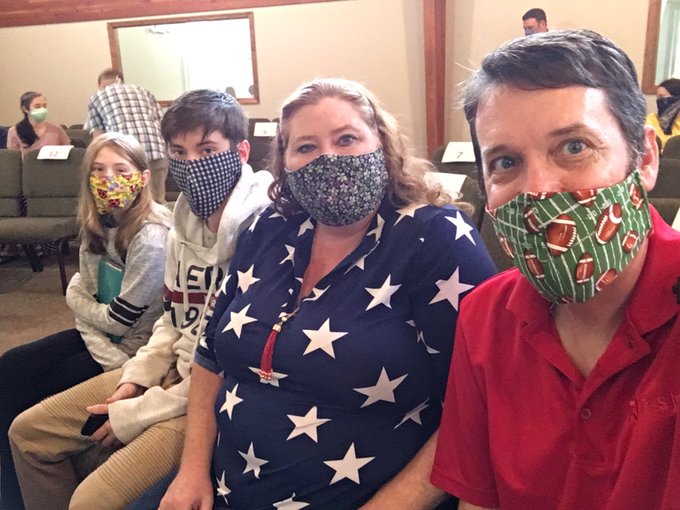
When the decision was made to hold in-person services, several changes were made to the normal routine. First, Sunday School was canceled and a second worship service was added to accommodate social distancing. The church sanctuary was disinfected between the two services. All attendees were required to wear masks and hand sanitizer dispensers were placed prominently at the single entrance being used.
The shortage of sanitizer in normal retail outlets was a problem for reopening. Ironically, the church was able to procure a bulk supply of hand sanitizer from a local microbrewery, Chattabrewchee, that temporarily exchanged beer production for selling gallon jugs of homebrew sanitizer. The company produces 600 gallons of the sanitizer each week and, in addition to helping the community fight the pandemic, the shift in production also keeps the brewery’s workers employed.
Another change to the normal routine was reserved seating. Rather than wandering in a finding a seat, attendees signed up online with the number of people in their group. The church assigned seats that allowed a six-foot distance between groups. Ushers guided families to their assigned seats and dismissed the congregation by rows after the service.
When it came to the service, it was definitely nice to be back to worshipping in person. We normally tuned in to the streaming services on the church’s Facebook page, but it just isn’t the same. There are more distractions when trying to listen to a sermon at home, especially for the kids. This morning’s service was streamed as well for those who preferred not to attend in person or who could not be there.
And lots of church members did elect to watch from a distance. With social distancing in place, the sanctuary’s capacity was about 60 people. There were about 30 in attendance at our service and even fewer in the earlier service. The small crowd enhanced the planned distancing.
The two trickiest parts of the service as an attendee were singing and communion. I discovered that masks tend to ride down when you sing. This requires an occasional adjustment.
Communion was a bit more complicated but it was handled ingeniously. Rather than selecting a wafer and a cup from trays as is the norm, communion wafers were placed in a cup about half the size of a shot glass that normally holds the communion juice. Another cup holding the juice was placed on top of the wafer in the first cup. Congregants only had to pick up one cup to be served the entire communion. Masks did have to come down briefly to partake of communion, but they went right back up afterward. The cups, which were made of plastic, were disposed of after use.
Since March, I’ve written several times about how churches were hotspots for Coronavirus spread and how it was not unconstitutional or an attack on the freedom of religion to close churches. I stand by those columns. The difference in what my church is doing is that my church is an area where the virus is at very low levels. We also followed our governor’s guidelines to conduct a safe gathering, including wearing masks.
Contrary to those who say that mask-wearers are living in fear, it was masks, along with other preventive measures, that enabled my church to meet safely today in the midst of a pandemic. For the foreseeable future, masks are going to be part of returning to a way of life that isn’t normal but resembles the pre-COVID status quo. Masks are one of the tools that will allow public gatherings to resume.
As I’ve said before, it doesn’t matter if the government allows businesses and churches to reopen if people don’t feel safe enough to venture out in public. The slim crowd of churchgoers this morning is further evidence that a lot of Georgians are not ready to resume business as usual and are voting with their feet.

Originally published on The Resurgent
If you would like to continue the discussion on social media, you can visit David Thornton’s Facebook page or follow him on Twitter.

Sunday, April 12, 2020

Kansas Supreme Court Upholds Ban On In-Person Religious Services

Amid the debate over whether it is legal and proper for governors to ban church services to stem the spread of COVID-19, the Kansas Supreme Court has weighed in and upheld the authority of the governor to prohibit services with more than 10 people in attendance.
Per Kansas’ KCUR news, Democratic Gov. Laura Kelly’s order was challenged by the Republican legislature. The state Supreme Court weighed in on the issue late Saturday night and handed the governor a victory hours before Easter sunrise services would have been held.
The expedited ruling was decided on a technical matter rather than the merits of the case. The judges decided that the plain language of Kansas law did not permit the Legislative Coordinating Council to overrule the governor’s Executive Order banning “mass gatherings.”
The Executive Order defined “mass gatherings” as “any planned or spontaneous, public or private event[s] or convening[s] that will bring together or [are] likely to bring together more than 10 people in a confined or enclosed space at the same time.” The order replaced an earlier order that contained an exception for “religious gatherings” and “funeral or memorial services or ceremonies.”
The opposing sides did not even gather in person to argue the case. Court proceedings were carried out via an internet video conference on Zoom.

Originally published on The Resurgent

Sunday, April 5, 2020

Don’t Go To Church Today. Don’t Go Anywhere.

sually, I write Sunday articles and post memes encouraging people to get up and go to church. Not this week. This week I’m telling you not to go to church. In fact, don’t go anywhere.
It seems that stay-at-home orders and bans on large crowds over the past few weeks have angered many would-be churchgoers. I’m not sure how many of them would normally be in church if no one had told them to stay home but I digress. Anyway, many people seem to feel that the fate of religious liberty in our Republic depends on whether they can go to church in the middle of a pandemic.
I’m here to tell you that it doesn’t.
The people raising Cain (to use a Southern expression) about closing churches make a couple of bad assumptions. Some believe that closing churches in the face of the virus shows a lack of faith. Others don’t believe that the government has the authority to close churches. Neither is true.
First of all, even the ancient Israelites understood that people infected with contagious diseases needed to be isolated from others to prevent a larger outbreak. Both Jewish and Christian sources agree that it is Biblical to separate people to prevent the transmission of disease.
Closing churches to prevent the spread of a communicable disease is not cowardice or lack of faith. It is an example of using our God-given brains and knowledge to help save lives. In this case, the lives that church members save by not meeting together may be their own as well as those of their families.
Second, quarantines have a long history in the US as well. Even before the US was a nation, colonial governments instituted quarantines for diseases such as yellow fever and smallpox. The practice continued after independence by state and local governments. In 1878, Congress passed the National Quarantine Act to give the federal government a role in quarantines under the Commerce Clause. Even today, state governments retain most of the control on the handling of public health crises. The National Conference of State Legislatures has a handy chart that describes different state laws.
There is well-established legal precedent that the government has the power to suspend public gatherings in the midst of a public health crisis. That does not mean, however, that governments can declare an emergency without an actual crisis to gain access to emergency powers. For example, in 1900 courts struck down a San Francisco quarantine of Chinese residents on the grounds that it was not justified.   
As the American Constitution Society points out, COVID-19 is lethal and can be spread by asymptomatic carriers in public places. Further, the restrictions were not enacted out of religious bias since they apply to secular gatherings as well. You can’t go to church but schools and bars are also closed.
Recent history has shown that church gatherings in a pandemic can be deadly. Sixty percent of known Korean cases of Coronavirus cases in March were traced to large church gatherings. On this side of the Pacific, an East Georgia church was the focal point for the spread of a cluster of cases near Augusta. Across the state in Albany, an infected person attending a funeral led to more than 500 cases and at least 29 deaths. Across the country, a California church that defied orders to close now has 71 cases and one death. The Sacramento Bee reported that members continued to meet in homes after the church canceled its formal services.
Finally, I must add a third unfortunate reason that some Christians insist on holding church services without interruption. Some Christians have been deceived by fake news and conspiracy theories to believe that what they are doing is a form of righteous resistance to some sort of new world order. The Florida pastor arrested last week for defying a legal and constitutional order to temporarily stop holding services fits right in among the “pandemic deniers” that I wrote about a few days ago.
“I have to do this to protect the congregation—not from the virus but from a tyrannical government,” Rodney Howard-Browne said on his internet radio show. “The World Health Organization has come in and is using a pandemic to take over not just America but the whole of the world.”
Crazy talk. And not the slightest bit Christian.
Right now, the way for Christians to show the love of Christ is to stay home. While God does want believers to meet and worship together, meeting under current circumstances is both dangerous and prideful. In fact, insisting that we must continue to meet when a temporary hiatus would save lives smacks of works righteousness, not faith. From a practical standpoint, after the pandemic is over, other members of the community are more likely to be willing to hear the Gospel from churches that didn’t actively try to kill them during the emergency.
If you want to worship – and I think prayer and worship is a great idea right now – it is well-established by now that many churches are using the internet to livestream services to their own congregations and beyond. One option is to watch the service at my church at 11:00 am Eastern time on its Facebook page (or you can go back and watch it later). We’d love to have you join us. I can promise the sermon won’t involve conspiracy theories about WHO.
For the next few weeks, one of the best ways to show your love for God and your fellow man is to stay home on Sunday. In a few weeks, it will be safe to return to church. Make sure you take your family then like you say you want to now.
Originally published on The Resurgent

Monday, March 30, 2020

De Blasio’s Church Threat Is Unconstitutional

There have been accusations of First Amendment violations in orders that prohibited church gatherings due to Coronavirus. Some have claimed that those orders violated religious freedoms because they included churches. Those people were wrong, but now New York Mayor Bill De Blasio has gone a step beyond what the law allows.
In a televised address, De Blasio told New Yorkers, “A small number of religious communities, specific churches and specific synagogues, are unfortunately not paying attention to this guidance even though it’s so widespread. I want to say to all those who are preparing for the potential of religious services this weekend: If you go to your synagogue, if you go to your church and attempt to hold services after having been told so often not to, our enforcement agents will have no choice but to shut down those services.”
De Blasio then said that law enforcement had been instructed “if they see worship services going on they will go to the officials of that congregation and they will inform them that they need to stop the services and disperse. If that does not happen, they will take additional action up to the point of fines and potentially closing the building permanently.”
To be clear, quarantines and orders limiting public gatherings are both legal and constitutional. The understanding of the need for quarantines goes back beyond the understanding of germ theory. The CDC notes on its site that the word “quarantine” dates back to the Middle Ages and literally means “40 days,” which coincidentally, is about how long it’s going to take to slow the spread of COVID-19.
In early American history, quarantines were instituted by both the colonial governments and the fledgling government of the United States. Federal action today is justifiable under the Interstate Commerce Clause, the General Welfare Clause and the Public Health Service Act. Though modern Americans have not had to deal with a situation like the Coronavirus pandemic, quarantines and other restrictions were common in our history as our forefathers fought diseases such as smallpox and yellow fever.
In the past, however, many quarantine actions were undertaken by state and local governments. In the current health crisis, we see a similar pattern as governors and city leaders take the lead on restricting movements to slow the infection. In fact, states have much broader quarantine powers than the federal government. Vox has a good explanation of quarantine law and a rundown on various state laws here.
New York Mayor Bill De Blasio is one of these local leaders. To be clear, De Blasio is within his authority and is doing the right thing to ban public gatherings. As David French and Sarah Isgur discussed on the Advisory Opinions podcast two weeks ago, if the government issues a blanket ban on public gatherings in an emergency that includes but does not single out religious gatherings, it is not a violation of the First Amendment or religious freedom.
A popular meme going around the internet says that quarantines only apply to sick people. This is also incorrect. Quarantines apply to people who might be infected. Sickness is not required.
Where De Blasio crosses the line is with his threat to permanently close churches and synagogues. Once the emergency is over, the city would have no authority to keep houses of worship open. If the City of New York tried to enforce such an unconstitutional order, it would lose.
Until the outbreak is stopped, however, De Blasio does have the authority to shut down religious services and fine those who flout the order. I hope that he does use these powers because the situation in New York is beyond the pale. Christians should have more consideration for their fellow man than to risk the deaths of thousands simply because they insist on meeting in person.
That does not mean that the faithful can’t continue to worship in small or virtual groups. Online services have become the norm around the country over the past few weeks as Chris Queen wrote two weeks ago.
When the plague has subsided, many Americans will rejoice and thank God in churches around the country. There will be more Americans alive to do so if churches and businesses don’t act stupidly in the meantime.

Originally published on The Resurgent

Friday, March 9, 2018

Trump's Stealth Appointment of Radical Lesbian To EEOC

President Trump has garnered much praise for his judicial nominations, but another nomination made by the president has largely escaped notice until now. Last December, in the midst of the fight over the tax reform bill, Donald Trump quietly renominated a radical Obama appointee to the Equal Opportunity Employment Commission.

Newsweek reported at the time that Trump's appointment of Chai Feldblum to a second term at the EEOC means that she will keep her job until 2023. Feldblum, a militant lesbian, was appointed to the agency that polices workplace discrimination by Barack Obama in 2010.

During her tenure so far, Feldblum has worked to expand homosexuality as a protected class at the expense of religious liberty. Bloomberg News once referred to her as “Washington’s strongest champion for the idea that anti-gay and anti-trans biases constitute discrimination ‘because of sex.’”

Ben Shapiro at Daily Wire compiled a list of quotes from Ms. Feldblum that should alarm anyone concerned about religious freedom:

  • When sexual orientation and religious freedom come into conflict, “I’m having a hard time coming up with any case in which religious liberty should win… Sexual liberty should win in most cases. There can be a conflict between religious liberty and sexual liberty, but in almost all cases the sexual liberty should win because that’s the only way that the dignity of gay people can be affirmed in any realistic manner.”
  • “Just as we do not tolerate private racial beliefs that adversely affect African-Americans in the commercial arena, even if such beliefs are based on religious views, we should similarly not tolerate private beliefs about sexual orientation and gender identity that adversely affect the ability of LGBT people to live in the world.”
  • “For all my sympathy for the evangelical Christian couple who may wish to run a bed and breakfast from which they can exclude unmarried straight couples and all gay couples, this is a point where I believe the ‘zero sum’ nature of the game inevitably comes into play. And in making the decision in this zero sum game, I am convinced society should come down on the side of protecting the liberty of LGBT people.”
  • “I believe granting liberty to gay people advances a compelling government interest, that such an interest cannot be adequately advanced if ‘pockets of resistance’ to a societal statement of equality are permitted to flourish, and hence that a law that permits no individual exceptions based on religious beliefs will be the least restrictive means of achieving the goal of liberty for gay people.”


Feldblum clearly believes that sexual freedom, which is not mentioned in the Constitution, should trump religious freedom, which is clearly defined in the First Amendment. The obvious question is why President Trump, who claims to be a proponent of religious liberty, would make an appointment that would set up such a clear conflict between two competing freedoms.


So far, there are no obvious answers to President Trump's reasons for keeping Feldblum on the job. The White House had no comment on the appointment in December and seems to have had none since.


Originally published on The Resurgent

Tuesday, January 3, 2017

Texas judge blocks Obama transgender rule


Once again, Obama Administration rulemaking has run afoul of a judge in the state of Texas. Judges in the Lone Star State have blocked Obama’s executive moves on immigration and transgender policy in the past and now a federal judge in Austin has issued a nationwide injunction to stop an Obama Administration order that expands protections of transgender students.

The current case hinges on whether the proposed rules violate the religious freedom of doctors. A coalition of medical organizations say that the rules could pressure medical workers to assist in transition procedures or abortions that conflict with their religious beliefs or medical judgment. The new injunction, which was issued on Saturday by Reed O’Connor, a federal judge of the North Texas District, prevents the Obama Administration rules from taking effect. The new policy would have become effective on Sunday, January 1.

As described by the Texas Tribune, plaintiffs in the current case, which was filed by Texas on behalf of the Franciscan Alliance hospital network and four other states, “are claiming that the federal government is redefining the term ‘sex’ to ‘thwart decades of settled precedent’ and impose ‘massive new obligations’ on health care providers.”

O’Connor agreed, saying in the ruling quoted by the Associated Press, “Plaintiffs will be forced to either violate their religious beliefs or maintain their current policies which seem to be in direct conflict with the Rule and risk the severe consequences of enforcement.” O’Connor also said that the rules place “substantial pressure on Plaintiffs to perform and cover transition and abortion procedures” without a religious exemption.

The Texas Tribune quotes the ruling further, “While this lawsuit involves many issues of great importance—state sovereignty, expanded healthcare coverage, anti-discrimination protections, and medical judgment—ultimately, the question before the Court is whether Defendants exceeded their authority under the ACA in the challenged regulations’ interpretation of sex discrimination and whether the regulation violates the Religious Freedom Restoration Act as applied to Private Plaintiffs.”

Last May, officials from the Departments of Justice and Education sent a letter to school districts nationwide that said, “a school may provide separate facilities on the basis of sex, but must allow transgender students access to such facilities consistent with their gender identity” according to ABC News. The policy did not permit schools to ask for a medical diagnosis or ask for documentation of the student’s gender identity before implementing the policy. The same judge issued an injunction on this separate case relating to school bathrooms last August.


With President Obama and his cabinet leaving office in less than three weeks, the future of the lawsuit and the Obama Administration policy is in doubt. Both President-elect Donald Trump and incoming Vice President Mike Pence are on record as supporting local solutions to the transgender issue rather than federal edicts. Trump’s position has been somewhat inconsistent though. He originally told Politico that transgender people should “use the bathroom that they feel is appropriate.”

Alison Kelley, a Fort Worth mom who opposed the Obama bathroom rules, summed up the opinion of many conservatives in a statement to Reuters. “I am not anti-transgender,” Kelley said. “I am anti big government getting into my backyard.”


Originally published on The Resurgent

Saturday, December 24, 2016

When Christians banned Christmas

publicdomainpictures.net
We hear a lot about the war on Christmas, but few remember that, once upon a time, Christmas was completely banned. This wasn’t in Nazi Germany or the Soviet Union. It happened right here in America. The story begins with the Pilgrims. Yes, those Pilgrims. The same ones that we celebrated a few weeks ago when we had Thanksgiving dinner.

Conventional wisdom has it that the Pilgrims came to the New World in search of religious freedom. That’s true to a certain extent. They left England originally to avoid persecution, but they first settled in Holland. In Holland, they had religious freedom, but they had several complaints about life there.

According to Christianity Today, the Pilgrims didn’t like living in Holland because it was a hard place to make a living. They also thought that Holland, with its permissive culture, was not a good place to raise their children. The Pilgrims left Holland for America because they want a more pure and holy society.

As we all know, the Pilgrims moved to America in 1620. What many don’t think about is that, once established in New England, the Pilgrims were absorbed into the larger Puritan movement. The Puritans were reformers in the Church of England who rejected many of the trappings of the English church.

As the Puritan colonies in New England were growing, Puritans in the mother country were actually revolting against the king. The English civil war was fought between the Royalists, also called Cavaliers, who supported Charles I, the Catholic king, and the pro-Puritan forces of Parliament called “Roundheads.” The Roundheads were led by Oliver Cromwell, a Puritan military leader. After the Roundhead victory in 1645, Cromwell became the military ruler of England and the Puritan Parliament canceled Christmas.

Puritans hated Christmas because, even then it was largely a secular holiday. Christmas was celebrated with raucous partying and drinking, two things that were very unpopular among the Puritans, who were literally “puritanical.” After all, the Pilgrims had left Holland a few years earlier to escape this sort of sinful culture. They didn’t want it follow them to Massachusetts.

The Puritans also noted that Christmas was not Biblical. The Bible didn’t mention when Jesus was born and there was no record of early Christians celebrating the Nativity.  Puritans associated Christmas with the pagan Roman festival of Saturnalia and the winter solstice. Puritans also viewed every day as holy and spurned the idea that holidays were more special than any other day.

In Puritan England and Massachusetts, work went on as normal on Christmas Day. People who openly celebrated Christmas could be fined. In England, the Christmas spirit was hard to break. Pastors who attempted to preach on Christmas Day were arrested. Pro-Christmas sentiment ran so high that Parliament ordered shops to stay open and ordered that they be protected from violence and intimidation by people offended that they were open on the holiday.  

After Cromwell’s death in 1658, Christmas returned to England in 1660 when the monarchy was restored. The ban on Christmas lasted much longer in Puritan Massachusetts. Royal pressure led to lifting of the Christmas ban in 1681, but the holiday still wasn’t popular. The royal governor of Massachusetts held a Christmas Day service in Boston under the protection of redcoat troops in 1686. Anti-Christmas sentiment flared up around the time of the American Revolution due to its association with the crown. While not banned, Christmas wasn’t widely celebrated in New England as late as the 1850s. Christmas became an official holiday in Massachusetts in 1856.

With the Christian concern today that secular forces are trying to eliminate Christmas, it’s ironic to think that it was Christians who once banned the celebration of the birth of Christ. Truth can definitely be stranger than fiction.

Originally published on The Resurgent


Sunday, August 21, 2016

Evan McMullin on the issues

EvanMcMullin.com
This is the second of a two-part series in which we present Evan McMullin's platform in his own words, drawn from a series of interviews. The interview sources are linked in part one, which we published yesterday. Today we present Evan McMullin on the issues and focus on domestic policy.

On the Second Amendment: On Now This, McMullin said, “I am a supporter of the Second Amendment. I think it is important to our freedoms and liberties here in the United States. I am a gun owner. I believe in responsible gun ownership. I think to own a weapon is to assume some very serious responsibilities I believe that we have to have a better, more constructive dialogue on this issue. I’m a supporter of the Second Amendment. I would like to decrease gun violence. I think there are many ways to do that while we still protect our rights.”

On judicial appointments: Louise Mensch of Heat Street asked whether McMullin would appoint Ted Cruz to the Supreme Court. “I’m not making any commitments about who I would or would not appoint,” McMullin replied, “but I will tell you that I will appoint originalists. In the question that involves what I think about Roe v. Wade, I will appoint pro-life justices.

On entitlements: “Entitlements are pushing us further and further into debt,” he said on Bloomberg. “Our debts are larger and larger. Our deficits are larger and larger. We have to do something to get them on a sustainable path. We have to keep our commitments to our elderly, our seniors today, but we have to phase in some reforms for future retirees.”

On religious freedom: “I believe in libertarian ideas in a sense that individuals need to be more empowered in our country. The power needs to be shifted back closer to the people. Those are consistent with libertarian ideas, but part of that is religious liberty. Our country was founded in part on that and we can’t have a president who doesn’t understand that, especially in this time when we really need to, I think, ensure that religious liberties are protected.”

When asked about his stance against religious persecution, McMullin said, “This is a driving principle for me. We’re a nation of 330 million people and geographically we are also very large. A lot of people have different ideas, they come from different countries, themselves or past generations. We are a diverse, pluralistic country and you must have tolerance as a result of that. E pluribus Unum. This was our original, unofficial motto until, I think, the ‘50s, that conveyed the idea that there are many of us with many differences among us, [but] that we are together still as one country. We need to go back to that and realize that we are not going to agree on everything, all of us on the right and left and center, but we need to respect everybody’s ability to live the way they want to live and to be one, united, in defense of those freedoms.”


On why people should vote for him: “I’ve spent my life avoiding the limelight and seeking opportunities to serve. Donald Trump has spent his life avoiding opportunities to serve and seeking the limelight.”

Monday, May 2, 2016

How I changed my mind about Donald Trump

  
Gage Skidmore/Wikimedia
Changing your mind is often viewed as a bad thing. People who change their minds are derided as flip-floppers or unprincipled. On the other hand, it isn’t always a good thing to dig in your heels and stick to your guns when you receive new information or the situation changes. As Winston Churchill said, “I’d rather be right than consistent.” Along these lines, I have recently changed my mind on Donald Trump.

I still don’t like Trump and have no intention of voting for him. Trump’s record and demeanor are both disturbing. As a conservative, it would be hard to vote for someone who supports higher taxes, universal government healthcare and is inconsistent on social issues like abortion and religious freedom. To an economic conservative and free trader, his desire for high tariffs is problematic. It was high tariffs like the ones proposed by Trump that turned a recession in 1929 into the Great Depression. As a lover of liberty, the threat of violence if Trump does not win should disqualify him from consideration for leadership of a country that prides itself on peaceful transfers of power.

On foreign policy, Trump’s much-touted erratic behavior and inconsistency could literally cause a war. On at least two occasions in US history, in Korea and Kuwait, failure to establish clear US policy led to shooting wars. Trump’s off-the-cuff foreign policy pronouncements could easily do the same in a world where Russia and China are already expanding their spheres of influence.

My change of mind regarding Trump involves his ability to win. For months, I have joined many others saying that “Trump can’t win.” I didn’t believe that Trump could win primaries. I didn’t believe that he could go above 50 percent. I didn’t believe that a liberal New Yorker could sweep the conservative Christian South and vanquish many more experienced and better candidates. I was wrong on those counts.

While I still believe that Trump would almost certainly lose to Hillary Clinton, I now feel compelled to add the qualifier, “almost.” It is not inconceivable that Donald Trump could beat Hillary Clinton.

The possibility of a Trump victory over Hillary is not a reflection of Donald Trump’s magnetic personality, his policy acumen or any positive quality that a prospective president might possess. It hinges entirely on two factors. The first is Hillary Clinton’s weakness as a candidate and the overwhelming aroma of scandal and corruption that permeates her campaign. The second is Donald Trump’s ability to destroy opponents.

Neither Trump nor Hillary is a likeable candidate. Hillary’s negatives are exceeded only those of Donald Trump and Ted Cruz. Likewise, neither candidate is trusted and both are believed to be corrupt. Even though Trump shares many of the same negative traits possessed by Hillary, he will still attack her in the same hypocritical manner in which he criticizes “Lying Ted” Cruz for his lack of honesty while at the same time Trump himself was recipient of the Lie of the Year award for his numerous truth-challenged pronouncements.

Furthermore, both parties are divided. The Never Trump movement makes up a large part of the Republican Party, but Bernie Sanders voters are also swearing off voting for Hillary. A recent Rasmussen poll found that almost a quarter of likely voters would not vote for either Trump or Hillary in a head to matchup. The race would likely have historically low turnout and historically high interest in third parties. This is where Trump’s long shot opportunity lies.

A Trump-Hillary campaign would be the dirtiest campaign that most of us have ever seen. Both candidates would viciously attack the other’s long list of weaknesses and character flaws. This is the kind of campaign where Donald Trump, the insult comic, excels.

While Trump stands little chance of winning voters with a positive vision for the future that, almost a year into his candidacy, he has yet to articulate, he does have a chance of destroying Hillary’s image to the point where many voters will just stay home and not vote for either of them. In an election with depressed turnout, the question becomes which fractured party can drive more of its remaining base to the polls. Donald Trump stands a much better chance in this sort of election than in a high turnout election where he has to compete for moderate and independent voters.

Trump would almost certainly still lose, but he has beaten the odds so far. Political betting sites now give him about a 30 percent chance of becoming president. It is possible, but far from likely.

In spite of his recent victories and his likely victory in Indiana tomorrow, Trump is not assured of winning the nomination. If Trump is the Republican nominee, he might conceivably win, but it is far from certain that President Trump would be good for the country.

Read it on Conservative Firing Line or Freedom Daily