Monday, May 4, 2026

Who killed Spirit?

 Over the weekend, an airline died. Spirit Airlines, 34, of Dania Beach, Florida, passed away suddenly on Saturday after a prolonged illness. Spirit was a true Florida company, quirky, rowdy, and sometimes tacky, but also beloved. (Like many Floridians, Spirit’s age is disputed. The company had its roots in 1964 as Clippert Trucking Company, but Spirit Airlines was formed in 1992.)

As with many sudden deaths, the focus quickly shifted from the life and legacy of the departed company to the question of “Whodunnit.” I’ve been doing Community Notes for a while now, and normally it’s difficult to get Notes published, but I noticed that a bevy of Notes were somehow approved with astonishing speed accusing Elizabeth Warren of orchestrating the carrier’s demise. While it’s true that Warren did oppose a proposed Spirit merger, that is not the full story of Spirit’s death.

Image by ChatGPT

Share

When I said that Spirit had suffered from a prolonged illness, I wasn’t kidding. The airline was a company that people loved to hate. Just 10 years ago, the company was very profitable as an ultra-low-fare carrier that introduced American travelers to a la carte pricing, but that business model was never very popular.

If you’ve never flown Spirit, here’s how it operated. When you booked a fare, you would see a really low base price, but that price would rise as you paid extra for services that other airlines included with their fares. Spirit was the first US airline to require passengers to pay for checked bags, but it didn’t stop there. You had to pay for snacks, you had to pay to pick a seat, you even had to pay for a boarding pass and to put a carry-on bag in the overhead bin. If you bought the extras, you might end up paying more to the low-fare airline than you would for a ticket on a more well-known competitor.

Spirit was a niche airline that specialized in flying a small number of routes with a small number of flights. It didn’t try to be everything to everyone. It mainly tried to get vacationers to tourist hot spots as cheaply as possible, not necessarily as conveniently as possible.

Spirit boomed in the 2010s with both profitability and a number of safety awards, but then came the pandemic and the havoc that it wreaked on the travel industry. Spirit’s niche of elective travel to leisure destinations was hard hit.

In 2022, the company was the subject of several takeover attempts. The first suitor was Frontier Airlines, another low-fare carrier, but Spirit shareholders rejected that offer in July. Shortly after, JetBlue came calling with another attempt to acquire rather than merge with Spirit. This is the deal that you’ve seen referenced on social media.

The Biden Adminstration’s Department of Justice sued to block the deal, saying “If allowed to proceed, this merger will limit choices and drive up ticket prices for passengers across the country” and “eliminate Spirit’s unique and disruptive role in the industry.” It was ultimately a federal judge appointed by Ronald Reagan, rather than Joe Biden or Merrick Garland, who blocked the deal. Elizabeth Warren, a senator at the time, opposed the deal but was not directly involved.

After the deal was blocked, Spirit’s stock value was halved and the company filed for bankruptcy in November 2024 amid mounting losses in the post-COVID world. The company reorganized to trim its costs and went on flying, emerging from bankruptcy in March 2025 after rejecting yet another offer from Frontier.

In August, it was back after posting losses and burning through much of its cash. Frontier tried to do what most airlines do at that point and cut costs, parking airplanes and furloughing (i.e., laying off) employees. The airline planned to reduce its workforce by about a third and its flights by 25 percent.

Then came the Iran war. After Donald Trump launched his attacks on Iran in February 2026, the Iranian regime blocked the Strait of Hormuz. The number of tankers carrying oil from the Persian Gulf dropped from thousands to a trickle.

Share The Racket News ™

Airlines have three main cost centers: Labor, aircraft, and fuel. The first two are relatively predictable. Fuel prices are not.

To address the volatility of fuel prices, airlines “hedge,” that is, they buy contracts for future fuel deliveries at a given price. These futures contracts are a gamble because the price can either go up or down, but at least the company has reduced an unknown variable to a known quantity.

The problem for Spirit was that an airline in bankruptcy has a difficult time getting the money or credit to hedge fuel. Spirit’s “shrink to shine” plan was undercut by the skyrocketing price of jet fuel that increased its operating costs and the fact that it did not have a fuel hedging program in place.

Patrick De Haan of GasBuddy pointed out that Spirit’s restructuring plan assumed jet fuel prices of $2.24 per gallon for 2026. Instead, they were faced with $4.51 per gallon and rising. The price of fuel was double what Spirit had planned for.

Why didn’t Spirit just raise its fares and pass along the higher costs to its passengers, you might ask. There are several reasons with the most obvious being that a low-fare carrier’s customers are very price sensitive. Further, the low-fare customers that were Spirit’s target market are also being squeezed by higher prices for gasoline, food, and other consumer items. They have less disposable income than they did a few years ago.

Finally, Spirit’s rising prices eroded its edge over airlines that were able to hedge their fuel prices. Delta Air Lines even owns its own refinery. If the price of the ticket is close, most passengers would fly one of the traditional airlines, especially considering Spirit’s added fees and more limited schedules.

So who killed Spirit? The answer is not as simple as either side would have you believe.

In aviation, we have a model called the accident chain. A crash rarely has one cause. In almost every crash, there is a chain of linked causes that contribute to the accident. If one or more of these links is broken, the chain is broken and the accident can be avoided. The same theory applies here.

Could the merger (acquisition) by JetBlue have prevented Spirit’s ultimate crash? Perhaps, but there is no way of knowing for sure. The failure of the deal definitely left Spirit weakened and vulnerable, but JetBlue is also on the verge of bankruptcy and may declare it by the end of the year. Combining the companies might have given them enough strength to carry on, but it might have only delayed the inevitable.

And it could also be true that the deal might have been good for the company, but not the country. I, along with many other Americans, am concerned about the steady growth of monolithic megacorporations that reduce our consumer choices. Merrick Garland may have been right that the merger would have reduced consumer options while driving up prices and making it harder for new companies to enter the airline marketplace.

Earlier this year, United and American discussed a possible merger as a way to better compete with foreign carriers. The combined company would have been twice the size of Delta, with 2,800 planes and about 40 percent of the US domestic market. How big is too big, and do consumers really benefit when “all restaurants are Taco Bell?”

One thing that the merger would not have done was save the Spirit we know. This would have been JetBlue acquiring the weaker company, and buyouts seldom go well for aviation employees. Many jobs would still have been lost from duplicated positions and the fact that the new company likely wouldn’t need as many pilots and flight attendants as the two separate companies had. Flight crews who kept their jobs would have likely lost seniority, which is very important at the airlines.

Whether the merger would have saved Spirit or not, it is indisputable that high fuel prices were the final nail in the company’s coffin. Even with the JetBlue deal, the new company might have failed anyway, but without the fuel price spike, Spirit would be flying today. Spirit specifically cited high fuel prices in its announcement that it was shutting down, while making no mention of failed mergers.

Spirit isn’t the first airline to be killed by high fuel prices. I don’t like to brag, but my career has lasted longer than three of the airlines that I worked for. One of those was Independence Air. Independence was a low-fare carrier that was formed in the wake of the airline bankruptcies of the 2000s. The company was an attempt to reinvent Atlantic Coast Airlines, a regional carrier that had operated as United Express and Delta Connection but lost its contracts as those companies restructured.

A major reason that Independence failed was that another fuel spike occurred in 2003 just as the company was taking off. Like Spirit, the newborn Independence was in a weak state, and like Spirit, fuel prices that were dramatically higher than expected killed it.

The point here is that a strong company can weather storms that a company in a weakened position cannot. A strong company can absorb the shock of unexpected higher costs that can be the death knell for a company with other problems. Spirit had problems.

Weak companies can also be a bellwether for stronger companies and the larger economy. The weak die first, but if the problems continue to mount, even companies perceived as strong can fail.

With oil and fuel prices continuing to rise and no relief in sight, Spirit is likely to be the first of many to suffer serious problems. As fuel prices rise, fares will rise, and demand will fall. There is already concern about a looming shortage of jet fuel, and many airlines, even big, strong ones, are cutting costs and reducing flights.

And the problems extend beyond the airline industry. Farmers are another sector that is perennially on the edge of failure, and farm bankruptcies are already rising sharply. In addition to last year’s tariffs and trade wars, farmers now face higher fuel costs and shortages of fertilizer, yet another commodity that is tied to the Persian Gulf.

The partisans on both sides are spinning their simplified versions of Spirit’s demise, and to a certain extent, they are both right. But a merger deal might have saved only one (maybe two) companies, while high energy prices threaten countless businesses and farms, the entire economy. And as the failures mount, it will be increasingly hard to blame Biden.

And as the sticker says, Donald Trump can point to all the “creative destruction” that his Iran policy has wrought and say, “I did that.”

Thanks for reading The Racket News ™! This post is public so feel free to share it.

Share

THE WAR IS OVER As I predicted last week, Donald Trump announced on Friday that the war with Iran was over. The announcement came as the conflict reached the 60-day deadline established by the War Powers Act.

LONG LIVE THE WAR But the US blockade of the Iranian blockade, an act of war, continues, and on Sunday, Trump announced that the US will escort ships through the Strait of Hormuz, following an Iranian attack on a cargo ship, also an act of war.

MAY THE FOURTH BE WITH YOU In celebration, enjoy the viral AI video of General Grievous appearing on Pawn Stars.

https://www.instagram.com/reel/DXmdFSTgnp-/


From the Racket News

Thursday, April 30, 2026

Not with bang but a whimper

One of the more memorable poems from my high school literature classes was “The Hollow Men” by T. S. Eliot. When I say the poem was memorable, it was really the last stanza that lodged itself in my teenage brain. The poem hauntingly closed: 

This is the way the world ends 

This is the way the world ends 

This is the way the world ends 

Not with a bang but a whimper.

That phrase resurfaced in my mind in recent weeks as the ceasefire with Iran was extended over and over again. The president has repeatedly renewed the ceasefire despite Iran's refusal to meet his demands and despite the continuing closure of the Strait of Hormuz. Indeed, the president seems more focused on his ballroom plans, which are now requiring taxpayer funding, and railroading James Comey than winning the Iran war. 

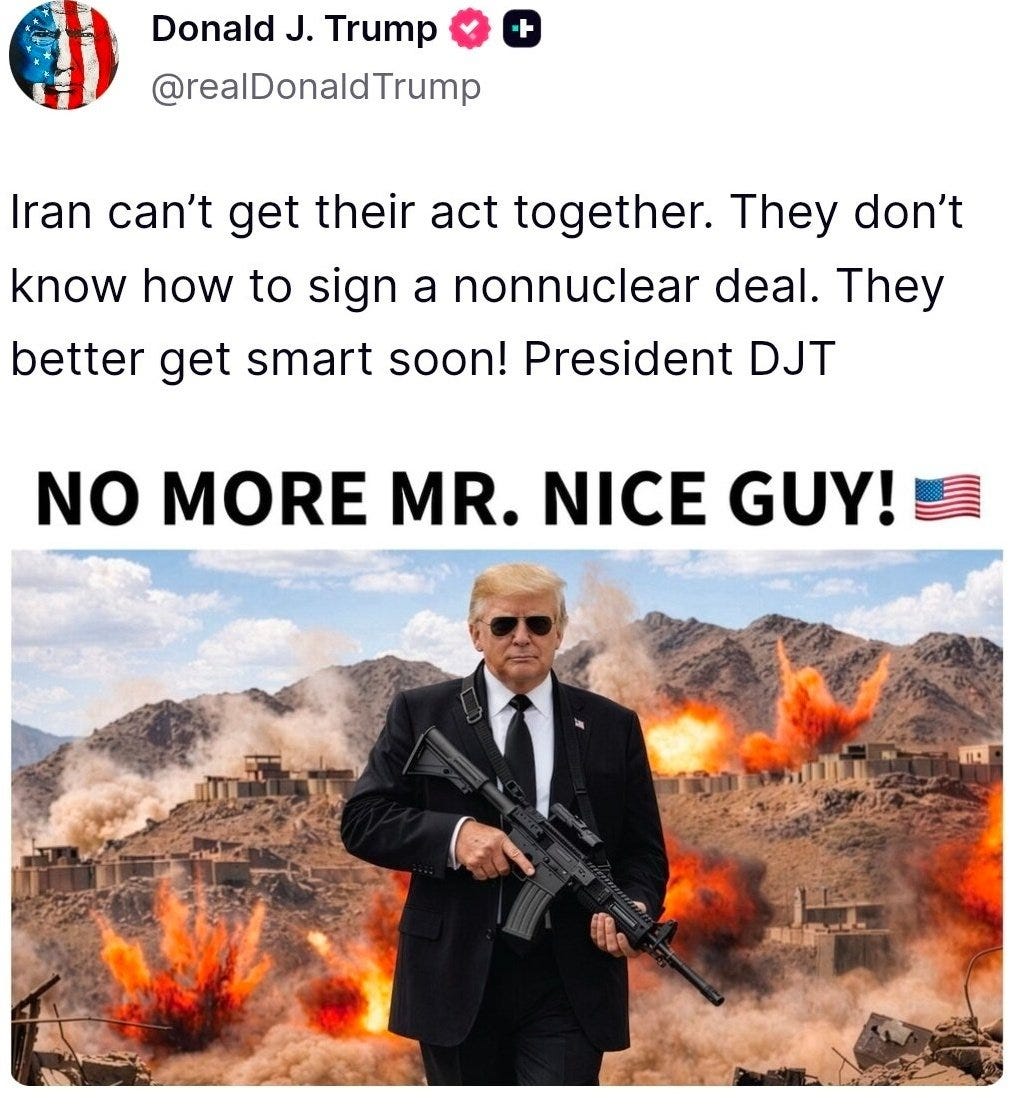
Trump’s Iran strategy seems to have devolved into making occasional vague threats, like this one on Truth Social that depicts Mr. Trump in another AI cosplay, this time seemingly as a Secret Service agent or a Man In Black (and I don’t mean Johnny Cash). Trump urged Iran to “get smart soon” and “sign a nonnuclear [sic] deal,” which presumably means a deal that would make them non-nuclear. The consequences if they don’t are unclear, but they would most likely face another empty ultimatum. 

Image
Screenshot of Trump Truth Social post from April 29

Share

Trump’s partisans call his tactics “the madman strategy.” They believe that Trump is not literally crazy; it’s just a role he plays to frighten opponents into submission. The problem with this theory, aside from the fact that Trump may have actual and literal mental problems, is that for the madman strategy to work, there has to be follow-through on his mad threats. So far, TACO has trumped the madman strategy. 

I do believe there is ample evidence that Donald Trump has age-related mental problems in addition to a general lack of intelligence and competence. I don’t think he’s mad, however. He has not only backed away from his threats to kill a “whole generation” of Iranians, possibly with nuclear weapons, and to attack the power plants that Iranian civilians depend on, but he has also retreated from apparent plans to invade portions of Iran such as Kharg Island. We moved Marines from the Far East to the Middle East early in the war, but so far, they are still sitting aboard their ships.

The problem with the madman strategy is that if other countries call your bluff and you back down, opponents don’t believe your future threats. The madman act doesn’t hold up if you only talk like a madman and don’t act like one. 

In truth, Trump is acting carefully towards Iran. He has to. He is hemmed in by competing and mutually exclusive goals. He wants Iran to back down, but he also does not want to stop the flow of oil. He wants to save face, but he does not want the stock market to crash. He wants to appear strong, but he knows the war is unpopular and does not want to fuel the opposition by committing ground forces. In addition, he is operating without congressional authorization and is nine months away from facing a much less friendly Congress.

When all this is taken into account, it seems almost certain that Trump will not expand the war. Further escalation runs the risk of upsetting oil and financial markets, as Iran could further tighten the screws on the “trickle” of ships currently transiting the Strait of Hormuz and have their Houthi allies close the Bab el-Mandeb strait that leads into the Red Sea towards the Suez Canal. 

On the other hand, Trump can’t back down and appear weak to either his MAGA base, his domestic opponents, or his international rivals. A clear Iranian victory would embolden others to ignore Trump’s madman act, as well as come at a political cost at home. 

Trump’s conundrum is reminiscent of the classic battle of wits scene from “The Princess Bride,” in which Fezzik reasons that he obviously cannot choose either of the poisoned goblets. Ironically, this scene also gives us the quote about falling “victim to one of the classic blunders, the most famous is never get involved in a land war in Asia,” in addition to another Man in Black reference. 

Trump obviously cannot continue to escalate the Iran war for political reasons, yet he clearly cannot de-escalate either. So, what is a cornered president to do? Probably nothing. Many animals, when cornered, will freeze and hope the predator doesn’t see them. I think that’s what we can expect in Iran. Trump’s Iran policy will be like a deer in headlights. 

Donald Trump’s war on Iran may end, not with the bang of a nuclear explosion or even the “rolling thunder” of another “shock-and-awe” air campaign. Like Douglas MacArthur and the Korean War, the Iran War may never die, but “just fade away.”

Continuing the blockade allows Trump to act like he’s still fighting, even as Iran defiantly calls upon the US to end hostilities in exchange for reopening the Strait. The war could continue this way indefinitely, from ceasefire to ceasefire, with both sides claiming to have the upper hand. 

There are downsides to the status quo, however. The price of oil is high and rising higher as markets realize that the Strait is not going to be fully open anytime soon. That will be a strain on the US and global economies, as well as weighing down Republican chances in this year’s midterms. In addition to energy prices, fertilizer also transits the Strait of Hormuz, and its shortage around the world could spark a food crisis in addition to the energy crisis. The status quo also means continuing expensive and morale-sapping deployments of US forces in the Persian Gulf region. 

For Iran, the status quo offers time to rebuild its defenses and prepare for a possible ground invasion, but the regime also faces the possibility of widespread unrest as millions of its citizens fall into poverty. Of course, the regime has few compunctions about murdering thousands of dissidents to maintain order, but a popular revolt would mean that the mullahs would be fighting a two-front war.

There are a few things that might break the logjam of the current status quo. One of those things is if the supply of oil to world markets is inadequate to keep the economy going. CNN reports that the number of tankers transiting the Strait went from about three thousand per month to 154 in March. While some oil is still moving through the Gulf and along alternate routes, inventories are dropping, and if stocks run low enough to become a security threat, Trump and/or others might be forced to roll the dice and invade to topple the regime or at least open the Strait.

For the moment, there seems to be enough oil reaching markets to keep the economy moving, albeit at greatly elevated prices. Nevertheless, some experts predict a “day of reckoning coming.” That day is more likely to arrive if the Iranian regime remains at the switch, controlling access to and from the Persian Gulf, but at the moment, there is no good way to change that reality. 

That’s especially true when the man in control of the effort against the Iranian regime is reminiscent of another reference from high school English lit, specifically William Shakespeare’s “Macbeth:” “… an idiot, full of sound and fury, signifying nothing.” 

Thanks for reading The Racket News ™! This post is public so feel free to share it.

Share

VRA GO BYEBYE? SCOTUS struck down a Louisiana congressional map that created two majority African-American districts. The Court did not strike down the Voting Rights Act, but effect of the decision will likely be felt across the South. Justice Alito wrote in the opinion, “The Constitution almost never permits the Federal Government or a State to discriminate on the basis of race.”

UAE GO BYEBYE The United Arab Emirates will leave OPEC on May 1. The move will further weaken the cartel’s control of oil prices and production.


from the Racket News

Tuesday, April 28, 2026

The assassination conspiracy (theory)

 Since the most recent foiled assassination attempt on Donald Trump, I’ve seen a lot of people from the left side of the political spectrum theorize that the attack was, for lack of a better word, and with apologies to Alex Jones, a false flag. That shouldn’t be surprising, but what is surprising is that it isn’t just Democrats who are arriving at this conclusion. While perusing coverage of the incident, I noticed a Wired article that opined, “MAGA Is Increasingly Convinced the Trump Assassination Attempt Was Staged.” The interesting thing about this is that, upon closer inspection, the article was published on April 17, a week before the attack at the White House Correspondents’ Association dinner. 

At this point, Trump has survived three assassination attempts as well as a number of other plots and security incidents. This has sparked online claims that Trump has survived more assassination threats than any other president and that Democratic presidents have not been subject to any attempts at all. The first claim depends on how you count, and the second is outright false, but it is true that Trump has had a number of close calls, particularly the Butler, Pennsylvania, attempt in 2024. It was the Butler attempt that was the focus of the Wired article, although there is a new one that deals with the WHCA attack.

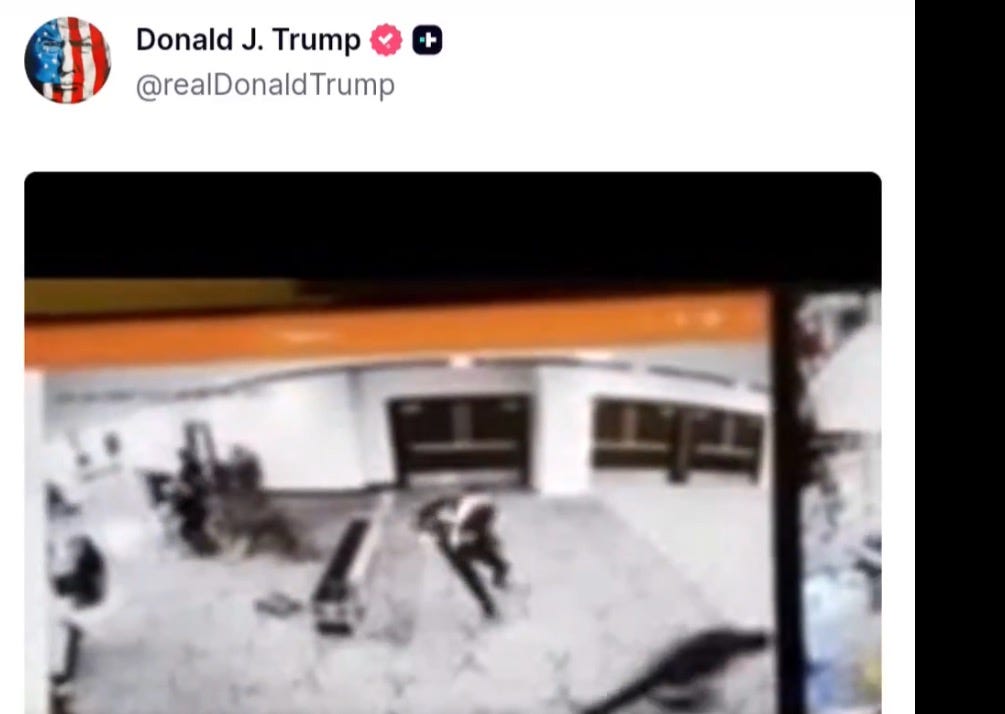
Screenshot of video posted by Donald Trump showing Cole Thomas Allen crashing through security checkpoint 

Share

At this point, I’ll make two statements. First, I am a political opponent of Donald Trump, but I don’t think assassination is justified, moral, or should be condoned. Further, I don’t think Trump’s death or injury would benefit the Trump opposition. The president is running the Republican Party into the ground. The GOP is at a very unpopular level and is about to get “shellacked” in the midterms. I don’t think most Democrats want to make him a martyr or a sympathetic figure. 

Second, I don’t think the attempts were fake. It would be very difficult to find patsies who would risk life and freedom so that Donald Trump could gain a few percentage points in the polls.

And these are real risks. Thomas Crooks was killed on top of a building in Butler, Pennsylvania, with an AR-15 that he used to shoot at Trump and with which he killed a rallygoer. Ryan Routh is serving life in prison for his attempt on Trump’s life in West Palm Beach in 2024. Cole Thomas Allen will probably spend the rest of his life behind bars as well. There are many reasons why someone might want to kill a president, this president in particular, but I can’t really think of a good reason why anyone would mortgage their future in a fake attack. 

Having said that, I do have a lot of questions about the attack last weekend. For starters, why was Trump there in the first place? Trump has never attended a White House Correspondents Association dinner as president. The last time he showed up to the event was in 2011 when he was roasted by Barack Obama. A theory that I have some sympathy for is that Trump was so humiliated by the incident that it inspired him to run for president as revenge against those who mocked him.

Further, why were so many members of the cabinet present? Of 16 people in the presidential line of succession, 11 have been confirmed in attendance at the dinner. This includes seven of the next 10 in line to be president, including Vice President Vance (first on the list of succession), Speaker Mike Johnson (second), and Secretary of State Marco Rubio (fourth). We very nearly experienced the emergency presidency of President Pro Tempore of the Senate Chuck Grassley (third). 

While it is not unheard of for cabinet members and congressmen to attend the dinner and there are no designated-survivor rules for the event, unlike the State of the Union, this seems like an extraordinarily top-heavy list of attendees. Of course, the simple explanation may be that this was Trump’s first time at the dinner as president, and the sycophants in the cabinet and congressional leadership know that Trump loves nothing more than to have his ego stroked. Not attending could have been viewed as professional suicide or at least a slap in the president’s face. 

The attempt also raises questions about security and the effectiveness of the Secret Service. This is especially true in light of security lapses that came to light following the Butler attempt, as well as older scandals about unprofessionalism, including partying and drunkenness of Secret Service agents. 

The dinner, which was not a state event, was being held at the Washington Hilton. Since it was not a state dinner, the argument that a gold-plated ballroom might have prevented the attack is a non sequitur, even though the White House was apparently pushing this pretty hard shortly after the incident. Trump himself plugged his ballroom project as a security solution in the aftermath of the attack. Ironically, the Washington Hilton was also the site of the 1981 assassination attempt on Ronald Reagan.

A dinner in a hotel ballroom can be a security nightmare. It would be difficult to screen every guest in the hotel, and Cole was reportedly checked into the Hilton as a guest. Much like the 2017 Las Vegas shooter, Cole probably took his weapons into the hotel several days before the attack. 

The BBC discusses the security measures at the hotel in detail, noting that the hotel was closed to the public hours before the event and that the heaviest security, including metal detectors, was around the ballroom where the banquet was to take place. Cole never penetrated the security cordon and never got close to the president. 

Nevertheless, there was criticism of the security plan. Gary O'Donoghue, a BBC correspondent at the dinner, said that security was not “particularly heavy” and noted, “The man on the door outside only took a cursory look at my ticket from what must have been six feet away.”

A newly unearthed clip of local Fox personalities talking on hot mics backs up that observation. They observe that “two random chicks” are holding the door open and joke that the Secret Service should “just get a doorstop.”

Former UK ambassador, Kim Darroch, criticized the lack of security in depth, noting, "If you were there [as a hotel guest] and you had bad intentions about breaking into this dinner, there's just one security thing you had to get past... and then you're in the ballroom.”

Even the perp criticized the lack of security in his manifesto, writing, “What the hell is the Secret Service doing… No damn security. Not in transport. Not in the hotel. Not in the event.”

Allen allegedly armed himself with a shotgun, pistol, and knives (no AR this time) and attempted to breach the security checkpoint going towards the hotel ballroom. He exchanged fire with law enforcement before being detained and captured without injury, but this brings up another question: With all the bullets that were flying, how did he survive without being hit? Did the Secret Service Agents attend the Star Wars Stormtrooper School of Marksmanship?

With Butler and the other recent plots against Trump, there are legitimate questions about whether security was too light or perhaps whether the Trump Administration’s lack of competence has infected the agency. The current director of the Secret Service is Sean Curran, who was appointed by Trump in January 2025 and has been with the agency since 2001. I don’t see any obvious red flags with Curran, but the investigation into what went wrong should include a look at the morale and culture within the Secret Service. 

One thing that has been mentioned that was demonstrably not a factor is the ongoing DHS shutdown. Secret Service agents are among the DHS employees who are being paid through Trump’s “Big Beautiful Bill.” ICE, CBP, Coast Guard, and TSA are also being paid. 

There are also questions about the alleged shooter. Cole Thomas Allen (maybe we should be suspicious of people named Thomas) is a 31-year-old resident of Torrance, California, near LA. Allen is reportedly very intelligent, graduating from Caltech with a bachelor’s degree in mechanical engineering in 2017 and a master’s in computer science from California State University, Dominguez Hills, in 2025. Per NBC News, he donated $25 to ActBlue, a Democratic organization, in 2024, and was a member of a Christian fellowship at Caltech. 

Prior to the attack, he sent a manifesto to members of his family (read it in full here), who forwarded it to police. Despite claims by Trump and others that the manifesto was “anti-Christian,” Allen specifically tried to explain and rationalize his actions to Christians in the manifesto, arguing that “Turning the other cheek when *someone else* is oppressed is not Christian behavior; it is complicity in the oppressor’s crimes,” citing “yield unto Caesar what is Caesar’s” as an objection to his plan, and thanking his church for its love. What little we know of his religious beliefs comes across like a liberal version of right-wing Christian Nationalism, although he probably sees himself more as a latter-day Dietrich Bonhoeffer. 

I suspect that we may eventually learn that Allen has a high-functioning form of some mental illness or disorder. The manifesto, in which Allen called himself “Friendly Federal Assassin,” presents a very odd picture of the shooter and his thought processes. 

Mental illness is a common factor in many similar cases, perhaps more so than the always-assumed trope that to shoot a political figure, you must be radically political from the opposite end of the spectrum. Often, there is no coherent political ideology or evidence of strong political views, although, in this case, the manifesto does allude to a “pedophile, rapist, and traitor” that even the president assumes to be a reference to Trump, an adjudicated rapist and friend of Jeffrey Epstein (463 days into Trump’s second term, the Epstein files have still not been released). The manifesto also notes that other cabinet members, “not including Mr. Patel,” for reasons unknown, were targets. 

Alternatively, it may be that Allen was influenced by both Trump’s corrupt and authoritarian behavior and the very online world we all inhabit. Again, I’m not going to justify or condone any act of political violence, but I think it is fair to point out that Trump’s rhetoric and actions have likely had the result of inciting violence against him. Again, that does not justify the violence, but it is an explanation. 

As to the possibility that Trump and MAGA manufactured the whole incident (or incidents) as a public relations stunt, while I wouldn’t say that Trump is ethically above such behavior (or above possibly wearing a bandage on his ear for far longer than was medically necessary), the logistics make it very unlikely. It is far more likely that the attempt was real and that the president will use it to his political advantage. That is one reason among many why there should be no more violence against Donald Trump. 

Thanks for reading The Racket News ™! This post is public so feel free to share it.

Share

LINKS YOU CAN USE A lot of pundits are claiming that the left is more accepting of political violence than the right. That claim does not stand up to scrutiny. Numerous polls, such this Marist poll from 2025 and this PRRI poll from January 2026, show that support for violence is higher among Republicans. Further, in recent years, deaths from right-wing political violence have exceeded those from left-wing violence. Both sides tend to blame the other for violence, but the good news is that majorities on both sides reject violence.


From the Racket News