Sunday, November 15, 2026

End times errors

 I’ve written about the Biblical theology of the end times, technically known as eschatology, in the past. In fact, if you look back at my blog, you’ll find that I used to write a lot about eschatology. I was an avid reader of the “Left Behind” series in my 20s and a 1970s comic book adaptation of The Revelation before that. As I’ve become more deeply immersed in the Bible and the context of these teachings, however, I’ve come to the conclusion that we get some big things wrong. 

A lot of the confusion about the Bible’s end-time teachings is due to the fact that not many people really sit down and read the Bible. There is a tendency to take the word of other people for what is in the Bible rather than seeing for ourselves. 

Image by ChatGPT

Share

For example, take the subject of implanted microchips. (Please!) A great many people think the Bible expressly teaches that people in the latter days will be forced to have microchips implanted in their bodies, and through this biocomputer connection, the government will control all buying and selling. The Bible does not say this. 

Here’s what the Bible says, from Revelation 13:16-17:

It also forced all people, great and small, rich and poor, free and slave, to receive a mark on their right hands or on their foreheads, so that they could not buy or sell unless they had the mark, which is the name of the beast or the number of its name.

That’s all it says on the subject. It says that people will be forced to get a “mark,” not an implant. What is being referred to here could be the scar that is left after an implant is inserted, or it could be a tattoo featuring barbed wire or Chinese characters. We don’t know. We only have theories, and the idea that this passage refers to microchips is that: a theory. 

It gets more absurd when some people label anything they don’t like as the “Mark of the Beast,” which is referenced in the verse immediately following the passage above. In recent years, we have seen some Christians call everything from masks to vaccines marks of the beast. I have the distinction of having been thrown out of a barber chair mid-haircut by a woman who would not accept even mild criticism of the idea that the COVID vaccine was not a precursor to the mark of the beast, but the truth is that the Bible tells us that the mark of the beast is a mark on the right hand or forehead. Vaccines and masks don’t fit the bill.

Subscribe now

We make a similar leap of faith and logic when it comes to the rapture. The word “rapture” does not appear in the English-language New Testament. In fact, the concept of the rapture is limited to a few verses, such as 1 Thessalonians 4:16-17 and 1 Corinthians 15:51-52. The Book of Revelation, closely associated with end-times theology, omits the rapture entirely. The paucity of passages discussing the rapture may be a clue that the event should not be central to Christian theology, although it certainly seems to be today. 

The term “rapture” comes from the Greek word that is translated as “caught up” in the 1 Thessalonians passage. The Bible does teach the basic tenet of the concept that Christian believers will meet Jesus in the air when he returns, but the devil, as they say, is in the details. 

There are three different theories about when the rapture takes place, although evangelical Christianity (of which I am a part) seems to have settled on one as doctrine. To make a long story short, Jesus, the prophet Daniel, and John the Apostle all talk about a period of “tribulation” that apparently lasts seven years. Various theologians take different views on whether the rapture and return of Jesus will take place at the beginning of the tribulation, after it, or somewhere in the middle. 

In their 1999 book, “Are We Living in the End Times?” Tim LaHaye and Jerry Jenkins, the authors of the “Left Behind” series, took the view that the rapture would occur in two phases: the rapture of believers before the tribulation and the second coming of Jesus. The pair give several reasons for this view, which is not explicit in Scripture, but it boils down to several verses such as Revelation 3:10, 1 Thessalonians 1:10, and 1 Thessalonians 5:9, as well as their interpretation that the church is absent from chapters four through 18 of Revelation. This seems to be the standard view throughout much of the evangelical world today, even though, as the authors admit, the pre-tribulation (pre-trib) rapture theory only dates back to the 1700s.

But it is entirely possible that pre-tribulation rapture adherents are misunderstanding these verses. Their context is not discussions of the end times, and they can be easily understood as verses that promise God’s deliverance of believers from eternal damnation, not the period of tribulation. The assumption that Christians won’t endure worldly trials and tribulation is easily undercut by real life, as well as the words of Jesus in John 16:33, when he said, “In this world you will have trouble. But take heart! I have overcome the world.”

Similarly, there is no scripture that tells us that the rapture and the second coming will be at different times. Paul’s teaching in the verses cited earlier seems to point to a single event. 

Despite this, LaHaye and Jenkins wrote, “Post-Tribs believe in a yo-yo type of rapture (snatched up to come right back down).”

When I read that decades ago, it made sense despite the very thin biblical case for a pre-tribulation rapture. But then, I learned a couple of things that changed my view. 

Over the past year or so, I became acquainted with the “Holy Post” podcast, featuring Phil Vischer, creator of “Veggie Tales.” The podcast deals with politics and culture from a Christian perspective and is a breath of fresh air in a country where “Christian” often means “MAGA.” That isn’t to say that “Holy Post” is Democrat or progressive. It isn’t, but they call balls and strikes objectively for both teams. As someone once pointed out, however, kids raised on “Veggie Tales” and the Christian virtues of love and mercy are probably among the young voters who rejected MAGA. 

Anyway, Skye Jethani, one of the hosts of “Holy Post,” has an interesting video about the rapture. Jethani, a Protestant pastor ordained by the Christian and Missionary Alliance, points out that other popular verses in which Jesus prophesied that some people would be “taken” and others “left” (Matthew 24:40-41, Luke 17:34-35) are not about the rapture at all. In context, it is clear that the passages refer to judgment like the “days of Noah” (Matthew 24:37-39) in which Noah and his family were left alive while others were taken to death and judgment. Jesus makes this clear in Luke 17:37 when he says those who disappear have gone to where the dead are taken. 

But the really interesting part of the video is when Jethani discusses the ancient custom of parousia. This term is sometimes associated with the second coming of Christ, but in the ancient world it had a particular meaning and custom. The word “parousia” refers to a royal visit by a monarch, and it was often customary for the people of a city to meet the royal visitor outside the gates and escort him back inside. This custom would have been familiar to the original readers of New Testament books.

In this context, the “yo-yo” rapture makes sense. Christians meet Christ in the air at his return, and then escort him back to earth. Jethani adds more support for his view, and I recommend watching the whole video, but the important concept to note is that biblical context undermines support for pre-trib rapture theory. 

Further, Jesus seems to explicitly state that the church will be present during the end times and not “raptured out.” In Matthew 24, Christ foretold persecution of believers (v. 9-3), and said, “If those days had not been cut short, no one would survive, but for the sake of the elect those days will be shortened” (v. 22).

This all might be very inside-baseball and theoretical if it weren’t for the fact that these beliefs are being trotted out as mainstream Christian doctrine when they aren’t. At least they aren’t outside the American evangelical church. Even worse, some Christians are celebrating events like the Iran War as an indication that the rapture is about to occur, which, aside from probably being bad theology, is reprehensible behavior when innocent people are suffering and dying. That definitely is not Christlike behavior.

Going further, if Christians assume that they’ll be “raptured out” before the tribulation and that turns out not to be the case, they won’t be equipped to deal with the horrors of the end times. At that point, bad theology about the rapture could become a salvation issue. 

In Bible days, the ancient Israelites had a lot of misinterpretations about what to look for in a messiah. Many expected a military and political leader to liberate them from Roman oppression and restore Israel’s independence. I think that the modern Christian church is making similar mistakes by reading our own biases, assumptions, and interpretations into biblical text. 

If we were meant to have all the answers about the end times, God would have included more specific verses in the Bible. As it is, speculation can be interesting (and almost unavoidable), but being dogmatic about spiritual ideas that are far from certain can be dangerous. 

What Jesus told us to do was to spread the Gospel and teach people to obey his commands, the greatest of which were (“anyone, anyone?”) to love God and love your neighbors, including enemies who might or might not be your neighbor.

We really don’t know when the rapture will occur, either in a point of time or in relation to the Great Tribulation, but the best bet is to be doing what Jesus told us to when he does come back. 

Friday, November 13, 2026

Republicans learned nothing

 It’s just over a week past the 2026 midterms, and the Republican strategy for the next two years is becoming apparent. If anyone's wondering, that strategy can be summed up as “more of the same.”

The first clue came with Trump’s appointment of Stephen Miller as White House Chief of Staff immediately after the election. Fox News reports that one of Miller’s first acts was to issue a memo giving the president more direct control over cabinet positions, “making it a more effective instrument for the President, whereas previously it was too constrained.”

Image created by ChatGPT

I haven’t seen any polling of voters that indicated the federal government being too constrained was a major issue that hurt Republicans. It seems to have been more the opposite.

A second indication that Republicans were doubling down was the selection of Jim Jordan as the incoming minority leader in the House. Jordan is a Freedom Caucus member and one of Trump’s most outspoken and combative supporters, indicating that House Republicans don’t intend to put much distance between their caucus and the president.

The flip side, however, is that John Thune will remain the top Republican in the Senate, much to the consternation of many MAGA supporters. About a third of Republican senators dissented against the choice, although the South Dakota Republican is generally respected, except by MAGA. But even if he is from the traditional wing of the GOP, Thune plans to push hard on Republican priorities in the lame-duck session.

These priorities include a slew of partisan bills such as the SAVE Act, a defense authorization bill, judicial confirmations, and a budget reconciliation, as well as a bipartisan permitting reform bill. Republicans never had the votes for the SAVE Act, and it’s unlikely that they have picked up additional support for the measure after their drubbing last week. Some outgoing Republicans are even becoming roadblocks to the expedited confirmations.

And then there’s Iran. As our friend, Stan Mitchell, pointed out on his podcast, there are signs that Trump might be about to renew the war on Iran, and the Administration has historically launched attacks after the close of markets on Friday. It’s very possible that we could see a resumption of hostilities over the weekend. Trump now says the US doesn’t need to make a deal to end the war, and he shifted Vice President Vance from his role as a peace negotiator to that of looking for corruption in Democrat-led cities.

If Trump does launch a new wave of attacks, he has about two months to do what he could not do over the previous 10. When the new Congress convenes in January, it will almost certainly have the votes to approve a War Powers Resolution. Although such a bill would still be subject to veto, it would be politically embarrassing to the Administration.

The new Democratic majority could also use its control of the federal purse strings to end appropriations for the war. Such an attempt would spark a major confrontation between Congress and the Executive Branch, and the outcome would depend largely on who was more stubborn in a shutdown fight.

Yet another indication that the Administration doesn’t take the midterm results seriously is that it is denying them. In a flashback to 2020, Trump and other prominent MAGA Republicans are posting claims that the election was stolen. So far, no lawsuits seeking to overturn results have been filed, and all of the losers seem to have conceded, but failing to acknowledge that voters rejected Republicans in large numbers is a tell that ruling Republicans don’t intend to address the root causes of the midterm disaster.

That failure to confront problems and make corrections does not bode well for 2028. If voters didn’t like what Republicans were selling in 2026, there seems to be little reason that they’ll like another warmed-over, minority version of it two years from now.

More bluntly, the MAGA GOP’s record of nominating horrible candidates, together with national Trump fatigue after four years of chaos, incompetence, and radicalism, makes it already doubtful that Republicans can win back their majorities and likely that Democrats can expand their hold on Congress. The 2028 Senate map includes several Republican seats in states where Democrats recently made gains, including Alaska, both Carolinas, Georgia, Iowa, Kansas, and Wisconsin, as well as others where they came close, such as Florida and Louisiana.

MAGA’s continued domination of the Republican Party will make it difficult for quality candidates to win the nomination in battleground states. For example, outgoing Governor Brian Kemp of Georgia is a likely Senate candidate, but Kemp, a popular figure, might face political headwinds against a MAGA candidate in the mold of Ken Paxton or Mike Collins. The same problem will apply to Republican presidential candidates, who must win over the Trump base and then face a general election electorate that is no fan of the president.

Ironically, even though Republicans don’t seem willing to give ground after the midterms, Donald Trump does. The president has indicated that he is open to making a deal with Democrats on immigration, saying that his own policy has been “too tough.”

The terms of such a deal remain to be seen, and it may never get that far. Those old enough to remember 2016 may recall that Trump considered a softer immigration policy 10 years ago and then abandoned the idea. I’m old enough to recall multiple attempts at immigration reform, and it’s almost always the Republican base that kills any deal. Core GOP voters are so indoctrinated against “amnesty,” which in context means any solution to the problem of illegal immigration that doesn’t include mass deportations, that they view any deal which includes lesser penalties as treasonous and a threat to the country.

Trump’s openness to an immigration deal may not last until next week, much less next year, but even with Democratic majorities, a workable deal would be a difficult reach. If Trump is serious, elevating Stephen Miller, a probable white nationalist, is an odd choice. In any case, the four Republican senators needed to overcome a filibuster may be difficult to find, even if the lame-duck Trump backs the deal.

It remains to be seen whether Democrats have learned anything since they lost power two years ago. Democrats won’t have the opportunity to affirmatively pass much legislation with Trump still in the White House. The next two years will be more about investigations and providing a check to Donald Trump.

One Democrat has at least learned a new tactic. Senator-elect Abdul El-Sayed has said that he would be willing to work with the president to pass a TrumpCare bill for universal healthcare. Playing to Trump’s desire for approval and a lasting legacy might be the key to moving the ball forward, rather than just running out the clock.

Things will be different in new Democratic state governments. Democrats will have the chance to show whether they can exercise power in a reasonable and practical manner in these laboratories of democracy. If Democrats prove that they can govern effectively, even in formerly red states, they can grow a new generation of potential candidates for federal offices. On the other hand, if Democrats go off the rails, their 2026 gains may prove to be ephemeral. These new blue gains make states purple, not reliably blue.

Again, ironically, the fact that Democrats are sharing power in a number of states may help them to succeed. For example, in Georgia, Republicans maintained control of the Senate and noted in an after-action report that Republicans can “stop any bill, but cannot lose a single vote.” The need for Republican votes will force compromise and moderate the Democratic agenda. Divided government is good.

Democrats should have no illusions that the midterms were an endorsement of radical progressive politics. The election was a rejection of Trumpism, not an embrace of the left. There is a growing body of evidence that Republicans stayed home in 2026. Democrats need to convert those disillusioned voters, not wake them up.

Newly elected Democrats should realize that voters just clicked on the free trial of their leadership. If the people aren’t happy with what they see over the next few years, it will be easy to cancel the subscription.


From the Racket News 

Thursday, November 12, 2026

After the Blunami

 It’s been a few days since the election, and things are starting to gel into a new reality. The country is coming to grips with MAGA’s crushing defeat and the fact that Donald Trump is a lame duck. The big question for both sides is where we go from here.

First, the good news is that the defeat was so YUGE that Trump isn’t contesting it. Although the Trump Administration tried to subvert the election in advance, its efforts were largely unsuccessful thanks to the courts. After the blue tsunami, the president has said he will accept the results, and then, as our friend Stan Mitchell noted on his podcast, went back to talking about his White House renovations.

Image created by Meta AI

Share

Rather than planning for his political future, Trump signed a presidential decree that attempts to preserve the changes that he has made to the White House and Oval Office. The president seems uninterested in governing and just wants to concentrate on redecorating. Hopefully, he will continue focusing on construction projects rather than Stop the Steal II.

There was some speculation that Trump might return to his natural environment and make common cause with the Democrats on issues like national healthcare. After all, Trump seems primarily concerned with his legacy, and he really doesn’t have any ideological principles other than loving tariffs and Russia and hating immigrants.

That speculation was put to rest quickly. On Friday, Trump fired his chief of staff, Susie Wiles, and named Stephen Miller as her replacement. The elevation of Miller, one of the most radical and dangerous members of the Administration, is hardly an olive branch. Rather, it reflects Trump’s intention to double down.

Similarly, a message from the White House to 3,000 right-wing groups that “We are monitoring statements, press releases, and media engagements from your organizations” is an indication that Trump is circling the wagons rather than becoming conciliatory. It is also an indication that the Trump Adminstration fears defections from its base in the wake of the blunami. (I just made that up.)

What I think we can expect from Trump over the next two years is more of the same. He rarely made use of Congress in his first two (or six) years. His style of leadership, what might be called “pen and phone” governance, won’t change much without Republican majorities. If you never legislate, you don’t need a legislature.

What will change is that Congress has been compliant. It won’t be next year. Democrats won’t be able to break a filibuster or override a veto, but they can investigate, and they can say “no.” I wouldn’t be surprised if there are more showdowns over spending bills to continue funding the government, possibly resulting in government shutdowns, as Democrats try to use appropriations to rein in ICE and other out-of-control organizations.

The Democrats also won’t have the numbers to remove Trump from office. They can impeach him again, but what’s the point if they can’t find enough Republican votes to convict him?

As a refresher on impeachment, the House can impeach with a simple majority vote, but it takes two-thirds of the senators present to convict and remove him from office. It looks like Democrats will have 56 senators after Alaska and Mississippi are decided, so that would mean that the magic number of Republicans crossing the aisle would be 11 if everybody showed up.

That shortfall might not be true of other members of the Administration. The impeachment of Pete Hegseth might even happen before the new Congress is seated. Both parties are unhappy with the Secretary of Defense, who identifies as a Secretary of War but can’t seem to win one.

RFKJR is another likely impeachment target. The deeply weird Secretary of Health and Human Services is unpopular even among congressional Republicans. Senator Bill Cassidy of Louisiana is a medical doctor who pressed Kennedy on vaccines at his confirmation and has been critical since, but the problem is that Cassidy is one of the relatively moderate Republicans who won’t be returning next year.

He finished third in the primary this year after Trump endorsed a challenger. Louisiana Republican Julia Letlow eked out a win with 50.8 percent last week, and the new senator probably won’t be as amenable to standing up to Trump, even though Cassidy was no beacon of moral courage himself.

This brings up another question. One might think that surviving Republicans would be ready to break with Trump after the midterm disaster, but that ain’t necessarily so. Many of the outgoing Republican senators were the ones who might have flipped on Trump, but like Cassidy, if they haven’t been replaced by Democrats, they have been replaced by MAGA stalwarts like Ashley Moody in Florida or Barry Moore in Alabama. The remaining Republican senators might be fewer in number, but they are likely to be Trump uber loyalists.

Over the next two years, expect Trump to roll out a plethora of Executive Orders. His only path, other than working with Congress, is trying to bypass it. Most of these orders won’t be legal, but they may be hard to stop nonetheless. Trump still has his veto, and it takes time for the courts to act.

The president also still has control of the military and could restart the war with Iran or unilaterally invade Greenland, but he would run the risk of having Congress cut off funds with a War Powers vote. This might even be a potential strategy to try to swing voters against Democrats for not supporting the troops.

With respect to the Supreme Court, Alito and Thomas show no signs of giving Trump a last-minute pick with their retirements, but that hasn’t stopped MAGA from scheming to get another seat on the Court. Sarah Isgur of the Advisory Opinions podcast addressed the notion that Trump and the lame-duck Senate could try to confirm a new Supreme Court justice this year even if no one retires. That justice-in-waiting would then step in at the next retirement. Apparently, the plan would be lawful, but it would also be spitting in the face of the voters. Trump might go along with such a plan, but it would probably be a bridge too far for surviving Republican senators.

Such a plan would also guarantee that Democrats would expand the Supreme Court at the first opportunity. That’s not unlawful either.

As it is, Democrats just have to play the waiting game. It’s extremely unlikely that the new Senate will act on any Trump appointees to the Court. Schumer will follow the Mitch McConnell Rule for lame-duck nominations.

There is virtually no chance of a Republican winning the presidency in 2028 (so I’m telling y’all now to register as a Democrat, and pick the most moderate and centrist option). That means that the next president is likely to get to pick replacements for Alito and Thomas.

As the Advisory Opinions crew noted, the original sin that put Trump in power was the panic prompted by the death of Antonin Scalia in 2016. The fear of a Supreme Court dominated 5-4 by liberal justices moved Republicans to embrace Donald Trump. Now, 10 years later, we are once again facing the prospect of a 5-4 liberal Court.

Republicans sold the soul of their party when they rallied behind Trump, and now the bills for the three Supreme Court justices he appointed are coming due. (I consider those appointments to be the best thing about his presidencies.) As Lindsey Graham predicted, the Republican Party has been destroyed, and even if Marco Rubio jumps ship, as he is rumored to be considering, the American people are not going to hire another Republican after four years of Trump. If you doubt me, refer back to last Tuesday.

The good news for Republicans is that the filibuster is safe for now. There is no reason to nuke the filibuster with Trump still in the White House. If you can’t break a filibuster, you can’t override a veto.

The bad news for Republicans is that the damage they’ve done to their party may be long-term. While most probably consider the new Democratic politicians in formerly red states and districts to be one-termers, that also ain’t necessarily so. The two Democratic Georgia senators elected in 2020 have now both been re-elected, even though they were widely assumed to be temporary occupants of Georgia’s Senate seats.

Back in 1994, California was a purple state. That year, voters approved Proposition 187, which denied social services to illegal immigrants. The measure was ruled unconstitutional on the grounds that California could not enact its own immigration policy, but it changed the political landscape of the state. Republican support for the proposition (along with a couple of others) shifted Hispanic and pro-immigrant voters towards the Democrats. Republicans lost control of both houses of the state legislature and haven’t had a majority to this day. Arnold Schwarzenegger is the only Republican elected governor in the 30 years since Pete Wilson, who advanced Proposition 187, left office.

The question voters will answer over the next few decades is whether minorities will ever trust Republicans again after Trump’s expansion of the police state and racial profiling of suspected illegal immigrants. Hispanics helped put Trump over the top in 2024, but the demographic shifted towards Democrats by double-digit margins in 2026. The Trump Administration may have driven them permanently away from the GOP.

For years, Texas has been an anomaly. The state had a large share of Hispanic voters, about 40 percent of the population, but they were relatively conservative. That helped keep the state red, despite the long Republican hostility towards immigration reform and illegal immigrants. Donald Trump’s heavy-handed immigration policies cranked up that hostility by several hundred notches and may have permanently broken the trust of conservative Hispanics, many of whom had friends or relatives (who may have been US citizens or legal immigrants) who were targeted by ICE.

The bottom line here is Donald Trump is going to be like a dangerous animal for the next two years. The danger is not over, and it won’t be until he leaves office. The experience is sure to leave a bad taste in the mouth of most Americans, and how Republicans handle Trump’s last two years will affect how the country views them going forward.

How the next Democratic Administration acts will also play a role in how long Republicans are banished into the wilderness. If the Democrats give influence to the radical progressives and democratic socialists, voters might forgive Republicans quickly. On the other hand, if 2026 teaches Democrats that moderation is the key to majorities, Republicans might be a minority for a very long time.

For a long time, there has been a meme that says, “All they had to do was not be crazy.” Sadly, both parties have shown an inability to meet that low standard.


From the Racket News

Tuesday, November 3, 2026

Red is the color of the bloodbath

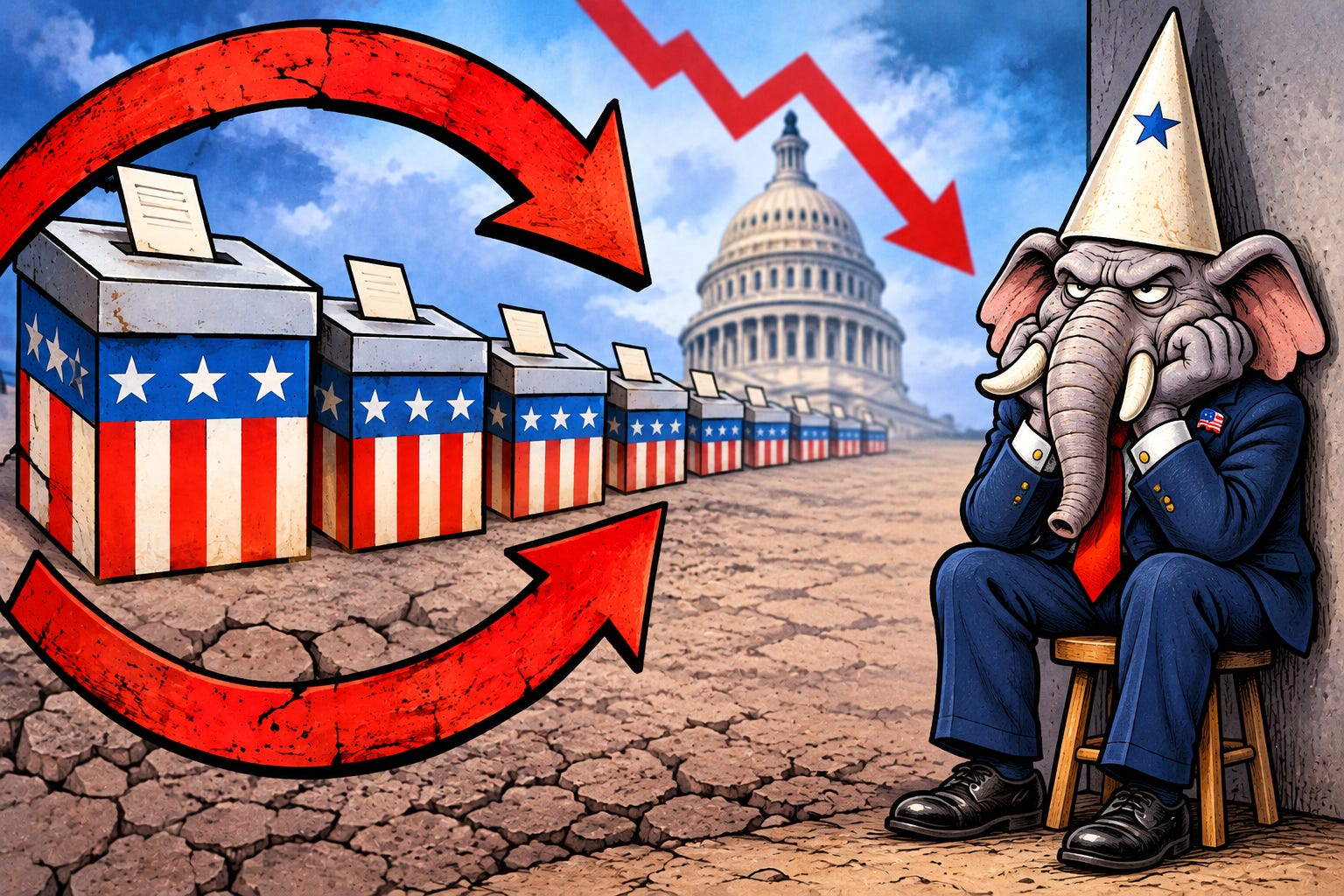
As I write this on Tuesday, the election results are still pouring in, but early indications are that the night will be a Republican bloodbath. I’ll leave it to our readers to look at the results of individual races and see where the chips have landed, but unless things take a dramatic return late in the evening, Democrats have taken the House and Senate and a number of governorships. Let me be among the first to say, “I told you so.” 

There will be a lot of Monday-morning quarterbacking over the results, and one thing I’m sure of is that Donald Trump will not accept any responsibility whatsoever for the disaster. Fingers will be pointed by Republicans, and Democrats will be ecstatic.

Image by ChatGPT

Share

As an independent voter, let me lay this out for both parties on behalf of independent voters e everywhere. We did not vote for socialism. We did not vote for communism. We did not vote for progressivism or Sharia law.

We voted against Trump and MAGA. We voted against authoritarianism, corruption, and incompetence. We voted against the weaponization of the Justice Department and the construction of a police state in which masked officers terrorize our streets with impunity. We voted against racist policies in which people are judged by the color of their skin rather than the content of their character. We voted against a president that betrays and threatens our allies, even as it cozies up to dictators. We voted against one man’s unilateral decision to embroil the US in an unnecessary war… and then lose that war.

We voted against a do-nothing Republican Party that not only fails to hold Trump and his cronies accountable for their abuses of power, but actively cheers them on. We voted against Republicans who think this is all fine.

Democrats should not assume that their newfound voters will be any more loyal than the swing voters who put Trump in office were if the Democrats follow the DSA lead off the deep end. We want sanity, stability, and a return to normalcy, not equal-and-opposite insanity.

Election Night does not end the job of holding Trump accountable. It’s only the beginning. The country will hold its breath in nervous anticipation of the possibility that the Trump Administration will fight the results as it did in 2020. There may well be a (hopefully rhetorical) fight to seat the new Congress. 

The new Congress next year will have the primary job of saying “no” to Donald Trump and blocking his attempts to usurp the Constitution, our laws, and norms. It will have to find a way to end the new endless war while preserving some shred of American honor and prestige and without destabilizing the entire Persian Gulf any more than has already been done. 

This election is not the end. It’s just the beginning, but it is appropriate to celebrate the fact that when liberty was threatened, the American people showed up in record numbers. 

True patriotism and love for democracy and the Constitution are not dead. 

(And I’m desperately hoping that this piece does not take on a “Dewey Defeats Truman” quality by tomorrow morning.) 

Posting at 8:50 pm on Election Night, and hoping that the best is yet to come. May God bless and keep America.


From the Racket News