Wednesday, September 15, 2021

Can Joe Manchin save the Democrats?

 Going into 2022 and 2024, the Democrats have at least two things going for them. The first is the fact that the Republicans have embraced their crazies and the second is Joe Manchin. In the coming election cycles, it may take both of these advantages to preserve the Democratic majority, especially if Joe Biden’s popularity continues to decline.

As we saw in 2020, Republican craziness and bad behavior don’t give Democrats an automatic win. As the election neared, Democrats started talking about expanding the Supreme Court, massive spending projects, and a “woke” agenda seemed to spook voters and narrowed Democratic chances of taking Congress. If it had not been for Donald Trump’s war on the election driving up Democratic turnout in Georgia (while suppressing the Republican vote), the Democrats would have lost the Senate.
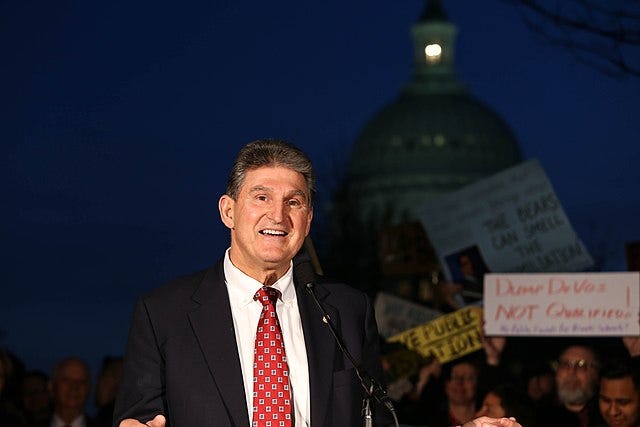
Photo credit: Senate Democrats/wikimedia

Share The Racket News

As go into 2022, Joe Manchin could be likened to a rudder on the ship of the Democratic Party. If you don’t like him, he could be considered an anchor.

Manchin, a conservative Democrat in a red state, can’t afford to go all-in on Democratic progressivism. I don’t know what Manchin’s true convictions are, but it is almost axiomatic that any politician’s most cherished principle is that his job must be protected. I do believe that Manchin shares that conviction.

The West Virginia senator’s latest escapade is putting the brakes on the Democrats’ “human infrastructure” bill. Manchin demanded a “strategic pause” in an op-ed in the Wall Street Journal titled “Why I Won’t Support Spending Another $3.5 Trillion.” In the piece, he added the qualifier, “without greater clarity about why Congress chooses to ignore the serious effects inflation and debt have on existing government programs."

Whatever his reasons, Manchin has raised the ire of the progressive wing of the party. While many on the left think that Manchin, along with the other half of the Dynamic Democratic Duo, Kyrsten Sinema, are killing their chances in the upcoming elections, it is more likely that the opposite is true.

Both parties have a problem in that they cater too much to their radical fringes. The assumption by the wingnuts is that the majority of the country agrees with them. After all, everyone on Twitter and Facebook and probably even in their personal circles believes the same things they do. Therefore, why wouldn’t the majority of the voters just love the most extreme package that can be rammed through Congress?

You can look back through history and see both parties making the same mistake. When the Democrats took both houses of Congress and the White House in 2008, they promptly pushed through several pieces of unpopular legislation that included the stimulus, the Affordable Care Act, and the Dodd-Frank financial reform. These bills passed mostly along party lines at a time when the Democrats held a supermajority in the Senate and their unpopularity figured prominently in the Republican wave of 2010.

The Republicans were no better. When the GOP finally cobbled together control of all three branches of government in 2016, their focus was on a reform/replace attempt to gut Obamacare, tax reform, tightening immigration laws, and building a border wall. Some of these policies became law and some did not, but they were all unpopular outside the GOP.

In the last years of the Trump Administration, the president, like Barack Obama before him, focused on preaching to the choir rather than making converts. However, Trump’s fundamental problem was that he started with a smaller base than Obama, having lost the popular vote in 2016. It was almost impossible for Trump to win an election based on turning out his base. While Trump did find lots of new voters, even more new voters flocked to the Democrats, fueled by Trump’s erratic and offensive behavior.

While Barack Obama won re-election, his tendency to pursue partisan policies rather than reach across the aisle hobbled his second term. Republicans took both the House and the Senate, which limited Obama to Executive Orders. This further deepened the partisan divide.

Despite running as a moderate, Joe Biden has followed the pattern of edging toward extremism once in office. Biden’s COVID relief bill was popular, but again, was a mostly partisan vote. The infrastructure bills will be his next big legislative test.

It has been a while since I wrote about the infrastructure bill, but the package cleared a Senate vote after 19 Republicans crossed the aisle. Ironically, it is now the progressive left that threatens the passage of the bill.

To understand why, we have to consider that there are two infrastructure bills. These are typically referred to as the “bipartisan infrastructure bill” and the “human infrastructure bill.” The bipartisan bill contains the traditional infrastructure items and the human infrastructure bill contains a progressive wish list. Republicans don’t want the human infrastructure bill to pass and the progressives don’t want the bipartisan bill to pass unless the human bill does. This is almost a stalemate.

Almost, but not quite. Because the Democrats have a Senate majority, they only need 51 votes to pass the human infrastructure bill as part of a budget resolution. But without Joe Manchin and/or Kyrsten Sinema, the Democrats don’t have the 51 votes they need.

The Democrats have the same problem that the Republicans had under Trump. If they go too far toward the fringe, they lose moderates at the center like Manchin and Sinema. If they move too far to the center, they lose the progressives on the fringe. It’s a delicate balancing act.

There is a third way, however. Some of the lost progressive votes can be replaced with Republicans if Democratic leaders reach across the aisle. This approach comes with some problems of its own, however.

The progressive left doesn’t like it when Democrats reach out to Republicans any more than the Republican right likes “RINOs.” The push from the left is to get everything they can before they lose their majority.

The rub is that Democrats don’t have to lose power, at least not right away. If they don’t push too hard to the left and anger voters, it isn’t impossible that they could hang on to their majority for a few cycles rather than losing it only two years in. However, if the progressive left gets its way, laws like the human infrastructure bill could make warnings about losing the majority become a self-fulfilling prophecy.

However, Joe Manchin might help the Democrats to break this cycle. The West Virginia senator may be able to throw a roadblock in front of the most radical of the progressive wishes and, in the process, keep the party from angering and frightening the moderate and independent voters that decide elections.

It’s a catch-22 that both parties face. Do they go for quick, radical change, knowing that doing so will invigorate the opposition, or play toward the middle in an attempt to keep their majority, hoping that long-term control of Congress will yield larger results? In recent years, both parties have elected to shoot for the moon, pander to the base, and hope for the best with varying results.

But there’s another factor that Democrats need to consider this time. Even after his 2020 loss and his reprehensible attempt to steal the election by having his supporters interfere with the Electoral College, the Republicans are still stuck on Trump. I’ll be pleasantly surprised if The Former Guy doesn’t make a comeback attempt in 2024.

Democrats made the mistake of underestimating Trump once before. For the good of the country, they should not repeat that error.

If Joe Manchin can keep the Democratic Party from veering too far left, he may also be instrumental in sparing America from a second Trump Administration. That is a possibility that Democrats should keep in mind as they seek to bend Manchin to their will.

Share


Preliminary results are in on the California recall election. At this point, it appears that Gavin Newsom easily survived the attempt to kick him out of the governor’s mansion.

The current tally on the Secretary of State website shows that recall proponents trail opponents by more than 2.5 million votes. On a percentage basis, the vote stands at 36.1 for to 63.9 percent against. As I wrote yesterday, it wasn’t close.

The ballot requested that all voters select a replacement candidate for governor regardless of how they voted on the recall question. In that portion of the election, Larry Elder handily led the pack with 46.9 percent of the vote. No other candidate reached double digits, but this discrepancy is explained by the fact that Democrats went all-in on saying no to the recall and did not rally behind a Plan B candidate.


The Racketeers recorded our first podcast in a long while last night. Be on the lookout for the episode to drop in coming days!

From the Racket

Monday, September 13, 2021

If the shoe fits

One of the highlights of the September 11 observances over the weekend was a speech by former President George W. Bush at Shanksville, Pennsylvania, the site of the crash of United Flight 93. Bush extolled the virtues of the crew and passengers of Flight 93, but then said something that got quite a few people up in arms.

white Air Jordan 4 shoe
Photo credit: Nicholas Bui/Unsplash.com

Steve Berman has more extensive coverage of the speech, which you can read here (and a full transcript of the speech is here), but I wanted to concentrate on the passage that was most controversial:

And we have seen growing evidence that the dangers to our country can come not only across borders but from violence that gathers within.

There's little cultural overlap between violent extremists abroad and violent extremists at home. But in their disdain for pluralism, in their disregard of human life, in their determination to defile national symbols, they are children of the same foul spirit, and it is our continuing duty to confront them.

A lot of Trump supporters are offended by this portion of the speech because they think he was talking about January 6 and the MAGA movement. Quite a few are attacking the former president because they claim that he called them “a terrorist threat.”

Others, like Jesse Kelly, were more circumspect.

The fact is that Bush did not say that MAGA was a terrorist group, even if that is what some heard. As Geoffrey Chaucer said, “The guilty think all talk is of themselves.” Or to put it another way, “If the shoe fits, wear it.”

What President Bush did was to denounce “violent extremists” and there are violent extremists on both sides. When people like Jesse Kelly and Kurt Schlichter take offense at a general condemnation of domestic violence and extremism, they are betraying their guilt.

Bush did not distinguish between the January 6 insurrectionists and the BLM rioters and the Proud Boys and Antifa. And for good reason, all of these people are two sides of the same coin. They are all violent extremists and they are all a stain on America’s tradition of peaceful democracy. Furthermore, they are all threats to our Republic and the Constitution.

A lot of Republicans don’t want to recognize this. In fact, there is a transparent movement in the party to whitewash the January 6 insurrection and minimize its importance. Some are calling the insurrectionists arrested for their roles in the riot “political prisoners” and “nonviolent trespassers.” This is a blatant attempt to rewrite history.

None of the insurrectionists are political prisoners, although some were nonviolent trespassers. The people arrested run the gamut from people engaged in conspiracies to attack the Capitol, such as the members of the Oath Keepers who have pled guilty to the conspiracy charge, to useful idiots who were at the Stop the Steal rally and just wandered in during the attack. Just last week, Cleveland Meredith, Jr. of Colorado pled guilty to illegally bringing guns into the District of Columbia and threatening to go “over to Pelosi [expletive] speech and putting a bullet in her noggin on Live TV.”

This sounds like violent extremism to me.

The September 11 weekend also brought examples of comparisons between January 6 and September 11. While there are differences between the two, both represent attacks on America. It’s true that September 11 had a far higher death toll, but January 6 is the more dangerous of the two. My Twitter friend, Atticus Finch, put it well.

September 11 united us against a common threat, but January 6 was an attack from within that continues to divide us. We fought two wars against foreign terrorist groups and their backers, but today many Americans are shrugging off the direct assault on the Constitution and the foundation of our system of government.

That division and the fact that not a few people on the right would like to put the January 6 faction in charge is the single greatest threat that America faces today. For almost 250 years, America has survived both external and internal threats, but it is by no means certain that our country and Constitution will survive the threat that we face today from the radicalism that has infected one of our two major parties. This radicalism explicitly seeks to overturn and destroy faith in elections, the most fundamental process of our democracy.

As I wrote last week, it was the events of September 11 that put us on this course. Without the horrific attacks on New York and Washington, I don’t think that we would have ever come to this point. Donald Trump would never have become president and would have never gained his almost hypnotic hold over the Republican Party.

At the end of that piece, I wrote, “Twenty years later, I’m left to suspect that the terrorists may yet win after all.” I think a lot of people had different ideas as to what I meant by that. It can be understood in different ways, but here is my view.

The terrorists launched the attacks that started the sequence of events that ultimately led to where we are now. We are near the brink of a civil war thanks to a party that does not accept the outcome of the election, has decided to live in an alternate reality, and has become a personality cult for a would-be authoritarian who values his personal power more than the wellbeing of the country. There are violent extremists on both sides and I denounce them both, but at the moment, only one party is threatening the core of our Constitutional Republic.

If the January 6 faction persists and, God forbid, drags America into civil war or topples our constitutional system, then the terrorists will have accomplished more than they ever dreamed of.

Share

From time to time, I get accused of being a liberal. I’m not. I’m also not a Democrat. Or a Republican.

My failure to embrace either side of the duopoly confuses a lot of people, but at this point in time, I’m a conservative who is anti-Republican. If that statement makes your mental processes short-circuit, you aren’t alone. I can almost see smoke pouring from the ears of a significant portion of my readership.

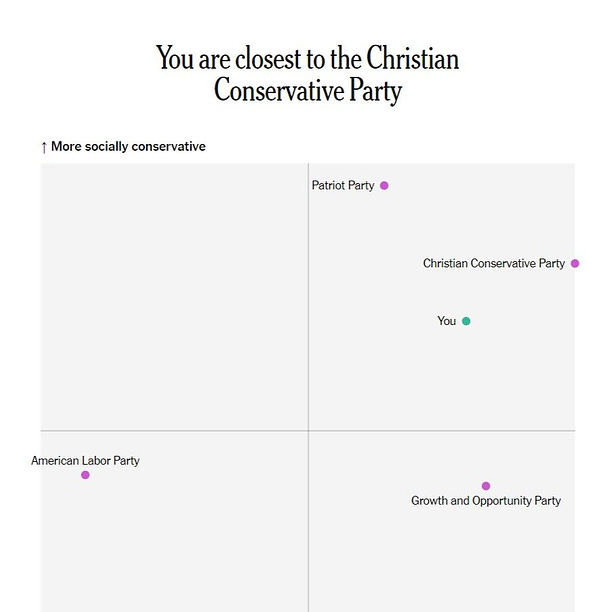
I bring this up today because I recently took the political quiz going around Twitter. (If you’d like to take the quiz, you can do so here.) Being the open and honest guy that I am, I thought I’d share my results.

The quiz put me right where I thought I’d be. I’m in the sweet spot between social and economic conservatism. I was closest to the Christian Conservative Party in my results.

In the past, I’d accept that. I’m a Christian and a conservative, after all.

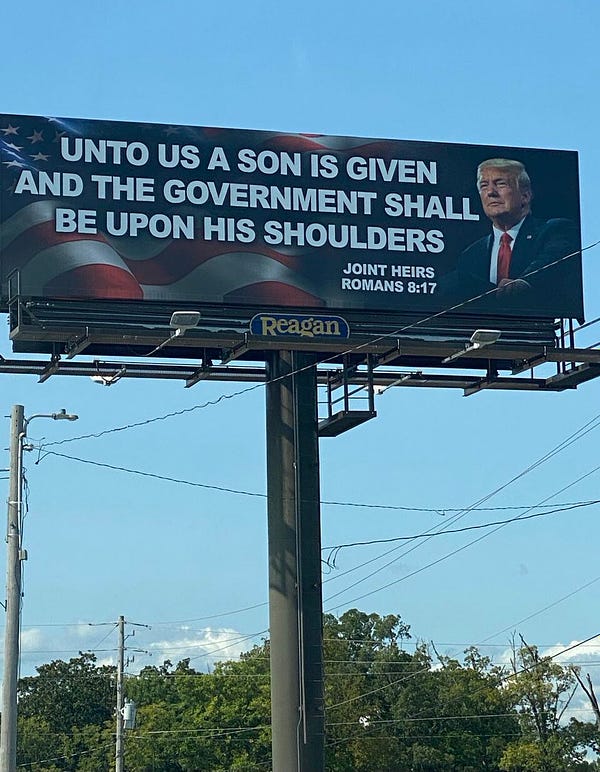
The problem is Trump. I agree with this faction on a great many issues, but the Christian Conservative embrace of Donald Trump is a dealbreaker for me. For whatever reason, the Christian right is enamored with the man, but I can’t bring myself to support the most incompetent and corrupt president of my lifetime, if not of American history. The tweet below is an example of why I reject this categorization. (The “Reagan” label on the billboard is sadly ironic since Reagan would have been outraged at this claim.)

Long before Trump, I often said that I’d remain a Republican as long as the party represented my principles and values. Well, that day came in 2016 and I chose to honor my beliefs over my party. Events since then have only confirmed that I made the right choice.

So, I’m a Christian and conservative but not a Christian Conservative and definitely not a Republican. I’ll remain politically homeless until a party develops that shares my core principles. Sorry Democrats and Libertarians, but that ain’t y’all.


From the Racket

Friday, September 10, 2021

How September 11 led to Trump and Biden

 Imagine yourself on September 10, 2001. The world was at peace, America was prosperous. Things seemed… normal. Few of us could have predicted the tectonic shift in the course of history that would occur the next day. Fewer still could imagine the chain of events that the terrorist attacks would set off, a sequence that would eventually lead to Donald Trump and then Joe Biden in the White House and a country that has moved from United We Stand to the brink of civil war in two short decades.

Ground Zero (David W. Thornton)

The most immediate and obvious reaction to the events of September 11 was that the US went to war. By November 2001, we were fighting in Afghanistan, but that was not the only short-term response. Many people don’t remember that, after financial markets reopened, the stock market experienced what was then the largest single-day drop in history, although the 684 points lost by the Dow has been eclipsed many times since then.

The stock market crash led to fears of recession. The Fed’s reaction to the tanking economy was, as it often is, to cut interest rates further. The Fed had already been lowering rates that year as the country dealt with the fallout of the Dot Com Bubble, but after September 11, interest rates went as low as two percent.

The easy money policies of the Fed, together with a bipartisan push to encourage homeownership regardless of financial status, led to the next crisis. In 2008, the real estate bubble, fed by government-backed subprime loans, burst. The contagion of “toxic assets” throughout the financial system threatened to grind the entire economy to a halt.

The combination of two wars and a looming economic meltdown led to the election of Barack Obama. I have serious doubts that Obama would have been elected without the financial crisis, but in the midst of the panic, he couldn’t lose. The junior senator from Illinois, who had not even served a full term in the Senate and had been a state senator only four years earlier, was charismatic and projected calm assurance to a nation that was ready for “change.” Obama and the Democrats were swept into office in a wave.

Obama wasn’t a great president. As a very inexperienced politician, he sounded good but lacked the core competencies necessary to lead the federal government. Since he didn’t need Republican votes due to the Democratic supermajority, Obama alienated the GOP and locked them out, pushing through his agenda on a partisan basis. This worked at first, but after Republicans won back the House in 2010, the well was poisoned for cooperation.

Still, Obama was able to eke out a re-election victory in 2012. It wasn’t long after that when Republicans went insane.

A big part of the Republican mental problem was Obama’s embrace of executive actions paired with Senate filibuster rules. Obama discovered that he could act with his “pen and phone” and, as long as Democrats united behind him to filibuster Republican attempts to rein him in, he could get away with it. The Republican failure to hold Obama accountable and to repeal Obamacare, both due to the filibuster, played into the sense of betrayal felt by the Republican base.

Obama opponents had already started embracing conspiracy theories, claiming that Obama was not a US citizen and that he was secretly a Muslim, but the paranoia really took off after 2012. Not only were many Republicans convinced that Obama planned to invoke martial law (remember Jade Helm?) and would refuse to leave the White House at the end of his term, Ted Cruz and his ilk undermined faith in the leaders of the Republican Party itself, claiming that the GOP establishment was secretly in league with the Democrats. When Cruz’s ill-advised government shutdown predictably failed in 2013, the upstart senator didn’t blame the Democrats who had numerical superiority, the only thing that matters in a congressional vote, but on his own party.

Cruz’s goal was to make a name for himself as the populist conservative outsider who could save the country in 2016. Unfortunately for him, Donald Trump jumped into the race and, as an amateur politician, was more of an outsider than Cruz. In a crowded field, Trump was not popular with most Republicans, but he was more popular than any other individual candidate.

Personally, I don’t believe that Donald Trump could ever have been elected without September 11, Barack Obama, and Ted Cruz. Even with all these factors working for him, he still lost the popular vote and only won through an Electoral College fluke.

However Trump won, his election took the United States further off track and deepened the divisions between the two parties. Trump made few pretenses of trying to unite the country and instead focused on “owning the libs” and preaching to the choir of his own base. If President Obama abused his executive authority, President Trump took the abuse to a whole new level.

The next step in the chain is more tenuous, but without Donald Trump as president, I don’t believe that Joe Biden, a two-time loser in presidential primaries, would have been elected at age 78. It took a competitor as bad as Donald Trump in the midst of a global pandemic to put Biden in the White House. Similarly, it took Barack Obama to give us Donald Trump and it took two wars and the Great Recession to give us Obama.

Now that Biden is here, it seems less and less likely that the country will heal. The pandemic and partisan rancor, much of it fueled by grifters who peddle outlandish conspiracy theories, continue to push us further and further apart. The Republicans double down on crazy at every opportunity and the Democrats are beholden to the leftist, progressive wing of their party. If there is a path back to unity, I have trouble seeing it from here.

Counterfactuals are impossible to prove, but I don’t believe that we would have - or could have - ended up where we are without the terrorist attacks on September 11. The attacks set in motion a chain of events that have thrown the United States off-kilter and left us deeply divided and suspicious of each other. Twenty years later, I’m left to suspect that the terrorists may yet win after all.

From the Racket

Can he do that? Biden's new vaccine mandates

 In a speech on Thursday, President Biden unveiled a series of new federal actions designed to encourage vaccine skeptics to just get the shot already! While there is widespread support for vaccine requirements, the obvious question is whether Biden and the federal government have the authority to make the changes that he proposes.

Biden’s plan, the “Path Out of the Pandemic,” includes several new policies aimed at encouraging and requiring vaccinations. These are:

  • Requiring all employees of companies with more than 100 workers to be vaccinated or tested weekly

  • Requiring vaccinations for federal workers and contractors

  • Requiring vaccinations for healthcare workers

  • Calling on entertainment venues to require proof of vaccination or testing

  • Requiring employers to provide paid time off for vaccinations

While I am sympathetic to the need to persuade the unvaccinated to get their shots, I am also an opponent of government overreach. If the government acts illegally to do a good thing, it is still an overreach and that makes it a bad thing overall.

As I pointed out several months ago, vaccine mandates are not new. Neither are they unconstitutional. The Supreme Court has upheld the concept of vaccine requirements going back more than a hundred years and several recent decisions have affirmed the right of private employers to require vaccines for their employees. But, with most of the statutory authority for fighting epidemics and pandemics resting with the states, federal authority is limited. So, where does Biden get the authority to make these mandates?

There are several answers to that question so let’s start with the easy ones first. The part of the plan that addresses entertainment venues is a request, not a mandate. Since nothing is being mandated, there is obviously nothing illegal here.

Almost as easy is the mandate for federal workers. The president is the head of the executive branch so Joe Biden can set standards for federal workers by Executive Order as long as those standards don’t violate other laws. The president also has the authority to set standards for federal contractors as well.

Other presidents have taken similar actions to impose requirements on federal workers and contractors in the past. For example, several presidents have signed Executive Orders that raised the minimum pay for federal contractors. President Obama also used an Executive Order to require that federal contractors report compensation data by sex and race, a measure aimed at boosting the pay of women and ethnic minorities.

The mandates for private employers are a little more tricky, but the Biden plan tells us exactly how they intend to enact the requirements. The mandate for companies of more than 100 workers and the requirement for paid time off will be enacted by the Occupational Safety and Health Administration through Emergency Temporary Standards (ETS). OSHA has issued emergency temporary standards for the COVID-19 pandemic in the past.

Federal paychecks and contracts can be lucrative, but they do come with strings attached. The government can impose requirements and recipients of federal money have to comply to keep those dollars coming.

The first Coronavirus ETS became effective when it was published in the Federal Register on June 21, 2021. A second ETS issued on July 13, 2021 explains the authority for making such temporary rules in its introduction, saying, “The Occupational Safety and Health Act of 1970 (OSH Act) gives OSHA the ability to promulgate an ETS that would remain in effect for up to six months without going through the normal review and comment process of rulemaking. OSHA, however, has rarely used this authority in the past—not since the courts struck down its ETS on asbestos in 1983.”

The Coronavirus vaccine mandate will not be the first OSHA vaccine requirement. The federal agency has mandated inoculations for hepatitis B for certain workers for years so there is a precedent for both emergency health standards for the workplace and federal vaccination mandates for workers,. There has never been an emergency vaccine requirement for so many workers by the federal agency, however.

It is important to remember that there is relief for workers who don’t want to get vaccinated. Per the White House plan, “any workers who remain unvaccinated” must “produce a negative test result on at least a weekly basis before coming to work.” As a federal judge noted in a ruling back in July, the EEOC permits vaccine requirements if allowances are made for disabilities and deeply-held religious beliefs. The testing alternative is an example of this sort of allowance.

The requirement that healthcare workers be vaccinated is slightly different. This requirement will be published by the Centers for Medicare & Medicaid Services (CMS) and will apply to “most health care settings that receive Medicare or Medicaid reimbursement, including but not limited to hospitals, dialysis facilities, ambulatory surgical settings, and home health agencies.”

As with federal employees and contractors, it is federal dollars that give the government the authority to mandate vaccinations for healthcare workers. The CMS regulates healthcare facilities that receive Medicare and Medicaid funds. If facilities don’t meet the standards set forth by the CMS, the federal funds can be cut off.

It is a virtual certainty that the federal actions will be challenged with lawsuits. Georgia Gov. Brian Kemp has already threatened to “pursue every legal option” to oppose the new requirements and he probably won’t be the only one. The obvious course would be for opponents of the plan to seek an injunction in federal court to stop the requirements from going into effect.

While the rationale and the legal basis for the mandates seem to be firm ground, there is a possibility that the courts could see the mandates as going beyond the scope of federal authority. It is not unlikely that we could be hearing a Supreme Court ruling on such a request relatively soon.

Personally, I’d put my money on the courts upholding the mandates since the law seems to allow the measures and there is a clear need to nudge more Americans to get the vaccinations. It isn’t a sure thing, however. In the early days of the pandemic, the courts were deferential to state and local government emergency powers, but as the emergency became more normal, the courts often struck down restrictions that went too far, especially those that singled out places of worship.

A bigger concern is the possibility that government mandates will lead to more resistance and possibly provoke violence on the part of vaccine resisters. Many of these people are convinced that the vaccines are dangerous or are part of some sort of dystopian plot. They don’t understand the law and precedent and are being whipped into a frenzy by conspiracy-peddling pundits and politicians. The nation is already a tinderbox and the vaccination requirements could be the spark that ignites it.

In the end, to call President Biden’s plan a vaccine mandate is a bit of a misnomer. Most workers will have the option of being tested weekly as an alternative. If workers don’t want to be tested or if they are federal workers and contractors, people for whom the testing alternative was not mentioned in preliminary reports, they have the option to refuse to comply and find another job. No one is being forced to take the vaccine against their will.

I am unabashedly pro-vaccine. I also acknowledge that various levels of government have the authority to enforce public health regulations that include mandating vaccinations. The really sad part is that so many people are afraid of vaccines that have been proven to be safe and effective that a mandate is necessary.

Share


As an addendum, some people are under the impression that postal workers are exempt from the vaccine mandates. While it is true that the Postal Service is exempt from the mandate for federal workers, it is not exempt from the OSHA mandate.

The New York Post reports that an Administration official clarified the point, saying, “USPS is strongly encouraged to comply. Also, [the Labor Department’s Occupational Safety and Health Administration] will cover USPS through the [emergency temporary standards], meaning that postal workers will be subject to the vaccination or testing policy announced today.”


California’s gubernatorial recall is next Tuesday and it occurred to me that I don’t think either Steve or I have written about it. It may be because we are both in Georgia and California is all the way across the country. It may be because I never really thought Californians would dump Gavin Newsom for Larry Elder. The very idea is too farfetched for me to take seriously.

At any rate, polling that was tight back in August has shifted to favor the incumbent governor. We’ll find out for sure next week (or whenever all the votes get counted), but my money is on Newsom retaining his office.


From the Racket