Thursday, April 9, 2026

Peace in our time?


On Tuesday, the world’s emotions ran hot. The day started with a threat by Donald Trump to destroy Iran’s civilization and culminated with a ceasefire deal. As more information emerges about the ceasefire, it seems that the entire incident was an entirely predictable TACO scenario in which Trump went to the brink of what many interpreted as a threat of nuclear attack and then backed down.

Interestingly, a tweet by the prime minister of Pakistan calling for peace originally began with the phrase, “Draft – Pakistan’s PM Message on X.” This led to immediate suspicion that the message was not composed by the prime minister or anyone in Pakistan. The header was removed a few minutes later, but the incident smacks of fake “black Trump supporter” posts that originated from white accounts. There is much speculation that the Trump Administration fed the prime minister his lines. It would be really ironic if the prime minister’s call for an end to the war wins the Nobel Peace Prize.
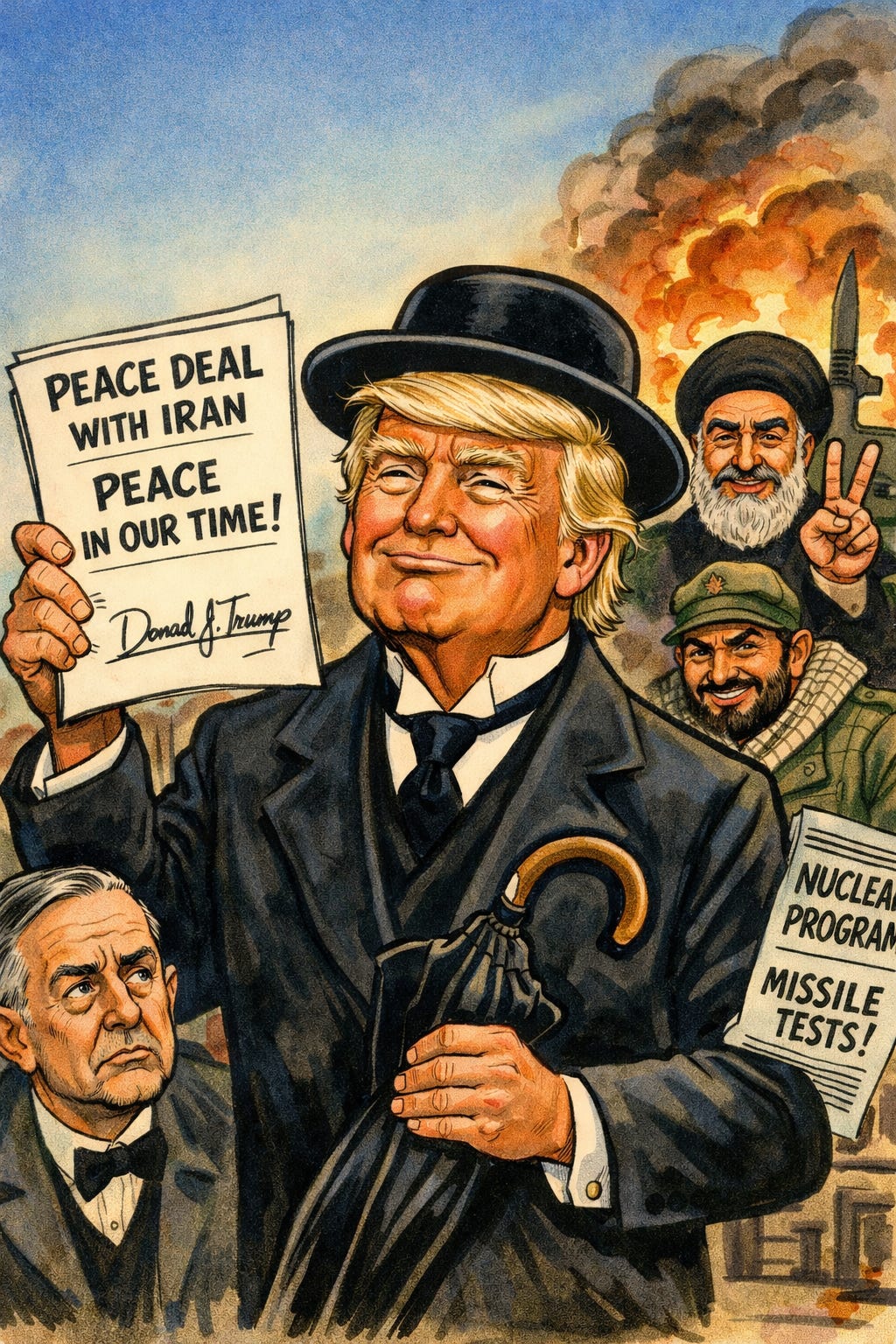
Image created by ChatGPT

Share

Iran dismissed Trump’s 15-point plan to end the war and submitted its own 10-point proposal that Trump called “workable.” That’s surprising because the Iranian plan includes the removal of sanctions, Iranian control of the Strait of Hormuz, reparations for the war, acceptance of Iran’s right to enrich uranium, and the cessation of hostilities against both Iran and its militant allies in the Middle East, as well as the withdrawal of American forces in the region. The Iranian plan amounts to a call for America’s unconditional surrender of the Middle East.

It’s hard to see how Iran would have even thought their proposal would be seriously considered when Trump and Netanyahu’s original war aim, disabling Iran’s nuclear program, would be totally discarded by the plan. And then there’s the Strait of Hormuz, which was free to navigate before the war and is now controlled by Iran.

The Iranian plan reminds me of nothing so much as Austria-Hungary’s 1914 ultimatum to Serbia. The deliberately over-the-top demands were designed to be rejected by Serbia. Austria was like the dog that caught the car when Serbia accepted all but one of the conditions.

And like the conditions accepted by Germany at the other end of WWI, acceptance of Iran’s proposal would guarantee a future war (which would also violate the plan). Leaving Iran in control of the Strait of Hormuz, with an intact nuclear program, and with an angry grudge against the United States and Israel would mean that Iran could enrich itself with shipping tolls and oil revenues and resume the war at a time of its own choosing.

It’s hard to see how Iran would have even thought their proposal would be seriously considered, especially in light of subsequent Administration claims that they threw the Iranian proposal directly into the garbage, but it’s also difficult to see what the Trump Administration thought that it was agreeing to if it wasn’t agreeing to the Iranian proposal. To be fair, it’s a bit hard to tell what the terms of the ceasefire are since there doesn’t seem to be a written agreement, but Trump did repost an Iranian message claiming he had accepted their 10 points.

The full 10 points are unlikely to be accepted in a permanent agreement, but It seems likely that the Iran war will end in a worst-of-all-worlds scenario. Iran’s nuclear program is damaged but likely intact. The regime is also not only intact but emboldened and in control of the Strait. We’re arguably in a worse spot than we were pre-war. Even Fox News is acknowledging that Trump’s war aims have not been met.

That’s also true when it comes to dealing with China and Russia. Make no mistake: Xi and Putin were watching. They saw not only the skill and effectiveness of the US military but the indecisiveness and sheer incompetence of the national command authority.

Odds are good that the ceasefire won’t hold. By the time you read this, the truce may have already broken down, and as I write this on Wednesday, I’m wondering how much I’ll have to rewrite before posting on Thursday. [Indeed, by Thursday afternoon, it seems that the US is the only country that has ceased firing.]

The most immediate problem is that Trump agreed to the ceasefire; Israel did not, and to the extent that they are honoring it, they are only doing so in Iran. The Israelis have hit targets in Lebanon. There are also reports of an attack on an Iranian refinery, probably by Israel, and retaliatory Iranian strikes on Kuwait, Bahrain, and the UAE. Initially, Iran said the Strait was still closed and that ships transiting without permission would be destroyed, but by Thursday afternoon, the regime was saying that a limited number of ships would be allowed passage after paying tolls.

Iran was earning $50 billion annually under sanctions before the war. By David Stockman’s estimate, they are currently taking in an estimated $100 billion annually without sanctions, with the potential to add another $90 billion for tolls through the Strait at $2 million per ship under normal traffic flows.

I think that Iran is performing a balancing act. They want to limit passage through the Strait to exercise control over the world economy and refill their coffers. If they completely shut down the Strait indefinitely, however, they run the risk that a coalition will emerge to move in and reopen the waterway by force, possibly destroying the regime in the process.

Assuming the ceasefire holds, Trump has indicated that the pause will only last for two weeks. That means the war may resume about the same time that we get the Republican healthcare plan and Trump kicks off infrastructure week. A Pentagon assessment found that approximately 80 percent of Iran’s air defenses have been destroyed, but the hiatus should give them time to import new systems from China (since Russia is also running short due to Ukraine) and dig in against a possible ground invasion before hostilities resume. Trump’s micromanagement of the campaign is reminiscent of LBJ during the Vietnam War.

No matter what happens next, all signs point to the idea that Trump is tired of the war and looking for a way out, even to the point of suggesting a joint venture between the US and Iran to control the Strait of Hormuz, calling the idea “a beautiful thing.” A war can’t be won without the political will to do so, and it seems that no one, not even Donald Trump, the man who started the war, has the will to win this one.

As Robert Pape, the airpower expert that I quoted at the beginning of this war, points out, “The US used overwhelming force—and still could not control the outcome. That’s a structural shift in power.”

Donald Trump came to a crossroads between choosing to go all-in with a ground war and accepting a loss. He chose to lose. The shooting and killing may continue, but this war is as good as over unless he reconsiders.

Thanks for reading The Racket News ™! This post is public so feel free to share it.

Share

IRAN DISCOVERS TACO TUESDAY I haven’t been sharing Iran’s propaganda videos, but the regime is definitely winning the meme war. The newest video lampoons Trump’s “Taco Tuesday” reversals. The worst part is that it’s impossible to refute because it’s true.

CHINESE DETENTE Taiwan’s opposition leader, a favorite in upcoming elections, is going to China on a peace mission. I’d be surprised if the trip wasn’t a response to the lack of trust that many of our allies are probably feeling right now.

ELECTIONS UPDATE Special elections this week provided more encouragement for Democrats. The Donks picked up a Supreme Court seat in Wisconsin, a mayoral win in Missouri, and a state legislative flip in Oklahoma. Although they didn’t win the main event, Marjorie Taylor Greene’s old seat, as Steve Berman wrote, that was always a tough lift in that deep-red district, but the swing was impressive. Jamie Dupree, Georgia reporter extraordinaire, reported that the average shift in the nine counties that make up the district was 25.5 points towards the Democrats from 2004.

From the Racket News

Friday, April 3, 2026

Are we losing?

 It doesn’t take much expertise to see that the US and Israel are dominating Iran militarily in the month-long war. The coalition of two has bombed Iran with impunity with no losses of combat aircraft over hostile territory. The only aircraft losses known are to friendly fire or drone attacks on US bases. Iran’s leadership has been decapitated, and its military is in a shambles.

So why is it then that there is a wide perception that Iran is winning the war?

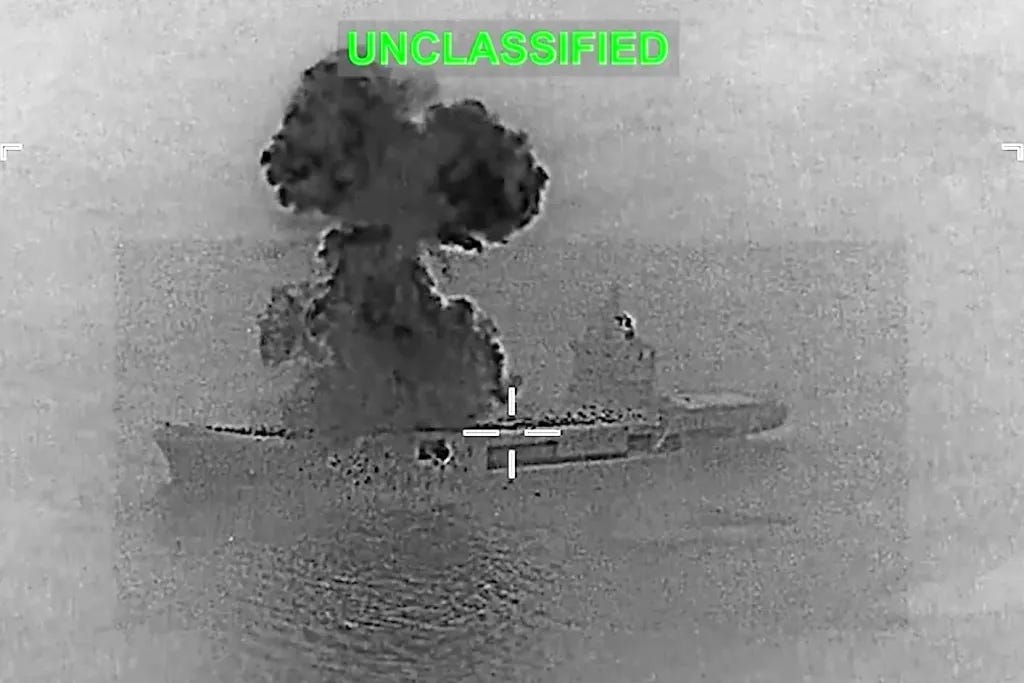
A photo of Iranian warship Shahid Bagheri during US strikes on 2 March 2026. Photo: DOD/Wikimedia

Share

The most obvious explanation is that the war is continuing after four weeks when it was originally estimated to be winding down by now. Not only is the regime still in control of the country and continuing to fire missiles and drones at its neighbors, but Iran is exercising control over the Strait of Hormuz and holding world energy markets - and the world economy by extension - hostage.

Iran’s successes at surviving and leveraging its limited capabilities are compounded by the confused response from Washington. The president’s response on the closure of the Strait of Hormuz has been to issue ultimatums and then extend the deadlines, to issue calls for help from the international community and then to say that he doesn’t need help, and finally to speculate that the Hormuz crisis will end because the strait will “automatically open” when the war ends.

The overall image projected is of a military force that dominates the battlefield, paired with strategic leadership that is uncertain about where to go from the current position and that offers contradictory assessments of the state of affairs. How many times can the Iranian regime, its military, and its nuclear program be “obliterated” yet continue to offer resistance and control access to the Persian Gulf?

In his speech on Wednesday, Trump said, “Regime change was not our goal. We never said regime change, but regime change has occurred because of all of their original leaders’ death [sic].”

“The new group is less radical and much more reasonable,” he added.

I’m not sure if Trump himself is deluded on this or if he simply hopes that America and the world will forget that he told Iranians at the onset of the war, “The hour of your freedom is at hand.” Trump may not have used the words “regime change,” but he and his cabinet officials made clear that was a goal.

Regime change, which the president simultaneously denies was a goal and claims has already occurred, has not happened. The regime is still in power with different leaders, none of whom seem any less radical and more reasonable than the old leaders, despite Trump’s claims to the contrary.

There seems to be no good explanation for the failure of Trump and Netanyahu to consider the possibility that Iran would respond to the joint attacks by bombarding its neighbors and closing the Strait of Hormuz. Many deny that the attackers did not foresee the possibility of these responses, but the evidence is there for all to see in the lack of preparation for such contingencies.

Despite the long military buildup prior to the war justified by an allegedly unforeseen imminent Iranian attack, State Department employees and dependents were not evacuated, there was a shortage of bunkers for US troops in the region, and ground forces had to be moved from the US and Japan to prepare for a possible ground war. Many US aircraft losses were from planes parked in the open. Further, Trump’s own statements (for what they are worth), indicate that Iran’s response was unexpected.

But maybe there is an explanation for the lack of preparation. An Alert Reader sent me a video in which Carrick Ryan, who I am not familiar with, explains that the Venezuela operation was so successful because the US was apparently working with Delcy Rodriguez prior to the raid that captured Maduro. Ryan theorizes that there was a similar arrangement in Iran, but the leader that the US had chosen to replace the ayatollah was accidentally killed in the decapitation strikes, something that Trump alluded to early on. When the kill-and-replace option failed, there seems to have been no Plan B. It is impossible to say for sure whether Ryan’s theory is correct, but it does fit much of the available evidence.

Whether Ryan is correct or not, we are at a critical juncture in the war. Down one road is escalation and sending ground forces to reopen the Strait of Hormuz. The other fork leads to a TACO strategy of declaring victory, ending the war, and hoping that “reasonable” elements in the Iranian regime allowing shipping to once again transit to and from the Persian Gulf.

Both options come with limited upsides and YUGE potential downsides. Escalation would mean a massive commitment in terms of American troops, treasure, and time. We would be in Iran indefinitely with all that would entail. Standing down would mean a strategic victory for Iran that leaves the regime in power and with increased stature as the de facto controller of access to the Persian Gulf.

The US military has done everything asked of it, but it seems increasingly likely that we may lose the war strategically because of massive incompetence and failure to seriously consider alternatives if the plan of Iran’s regime falling quickly did not come to fruition. What makes this even worse was that such a Hail Mary scenario was always unlikely.

This was a major reason that Carter, Reagan, Bush, Clinton, Bush again, Obama, and Biden did not order a war against Iran (which they probably would have done with congressional input, if they had). It wasn’t that previous presidents didn’t have the intestinal fortitude to issue order that would result in thousands of deaths, many of them American, it was that they understood the risks were very high relative to the likely rewards.

At a fork in the road with two bad choices, the most rational choice now may be to escalate and push for regime change in order to keep the world economy afloat and prevent the mullahs from returning with a nuclear weapon in the future, because if the regime survives, it will definitely see becoming a nuclear power as the only way to keep from being the target of another US-Israeli war. Make no mistake, this is not a good option, but it does seem to be the least bad option.

The problem for the Trump Administration is that it got this far without congressional buy-in and now we are in the midst of an unpopular war that is rapidly turning into the tar baby scenario that I wrote about a month ago. Trump will need congressional authorization and appropriations to continue the fight, but there is no guarantee he will get them. If he does, it is likely to boost the level of the shellacking that Republicans are about to receive in the midterms. There is an even-money chance that Trump TACOs for political reasons.

I wouldn’t say the US is losing at the moment, but time is on the side of the Iranian regime. The mullahs just have to hang on while public support for the war continues to plummet. The pressure is on Trump to either poop or get off the pot. Everyone knows by this point that the war isn’t going to be won in the air.

As I have said in the past, I’m tired of America winning battles and losing wars, yet it seems we are headed down that road once again, whether we leave the Gulf this week or fight for 20 years and then leave. We have the greatest military in the world, but our politicians have the habit of putting our soldiers into unwinnable situations.

This war is solely due to Donald Trump’s hubris and ineffectiveness as a leader. As many of us warned, allowing the president to do whatever he wanted with no accountability was bound to land him in trouble. Now, he is out of the frying pan and into the fire, taking America and the world with him.

Iran’s regime was a legitimate, though not imminent, threat. The irony is that the war is more likely to bring regime change in the US than Iran.

Thanks for reading The Racket News ™! This post is public so feel free to share it.

Share

THE THURSDAY MASSACRE Heads figuratively rolled on Thursday. Trump fired AG Pam Bondi while Defense Secretary Hegseth fired Gen. Randy George, the Army’s chief of staff and highest ranking officer, along with the heads of Army’s Training and Transformation Command and chaplain corps.

From the Racket News