Thursday, November 20, 2025

How the turn tables

 Sometimes the world can change quickly. That’s been the case lately. 

It seems like only a few weeks ago I was reading stories about the dysfunctional Democratic Party. The Democratic Party isn’t necessarily less dysfunctional than it was last month, but the high level of dysfunction in the Republican Party has rapidly become more apparent. The shutdown has only been over for a few days, but it has already been forgotten. I seriously almost forgot to mention it here.

The depth of the Republican problem became apparent with the trouncing that Republicans received in the off-year elections two weeks ago, but Trump and the Republicans have had a bad week this week. Donald Trump was forced to back off from his tariff war amid a slowing economy and rising prices, effectively admitting what most of us knew all along: Trump tariffs are taxes and are being paid by Americans. The trade war is not over but Trump - and by extension, America - is losing.

Image created by ChatGPT

Share

Trump’s lawfare campaign was also dealt an embarrassing setback when the Justice Department admitted that the full grand jury did not rushed indictment against former FBI director James Comey. After one indictment was rejected by the grand jury, a second, edited version was signed by the foreman without being reviewed by the full panel. Because the statute of limitations has now elapsed, the revelation dramatically increases the chances that the Comey prosecution, which was on shaky ground from the beginning, will die before it ever gets near a trial.

The error is yet another example of the amateurish behavior of Trump Administration officials. What we are seeing with everything from the Comey prosecution to DOGE to the remaking of the military to economic policy is what happens when a president staffs the executive branch with loyalists rather than hiring the best people.

It is telling that the most positive Trump story of the week was his diplomatic entreaties to Saudi Arabia, which involved feting Crown Prince Mohammed bin Salman, a Saudi royal behind the brutal murder of journalist Jamal Khashoggi during Trump’s first term. That was it. The high point of Trump’s week 

The capstone of the week was the collapse of congressional resistance to releasing the Epstein files (which still have not been released 304 days into Trump’s presidency). The rout came after two developments.

First, after weeks of delays, Mike Johnson was finally forced to allow Adelita Grijalva of Arizona to be sworn in after winning a special election way back in September. Together with most Democrats and a few brave Republicans, Grijalva tipped the scales on a discharge position that required a vote on releasing the files

The second development was the release of a trove of Jeffrey Epstein’s emails by Democrats on the House Oversight Committee. Trump figured prominently in the emails (although others, including Democrats, were also implicated), with Epstein writing, Trump “knew about the girls.

With passage of the House bill a fait accompli, Trump, fresh from accusing Marjorie Taylor Greene of treason for supporting the discharge petition, made a quick and shameless about face and urged Republicans to support the bill. The bill quickly passed both houses with more support than is usually seen for naming post offices or proclaiming national days of this or that. It was nearly unanimous.

Don’t expect the files to be released any time soon. 

If Trump really wanted to make the files public, he could order the DOJ to redact and release them at any time. (Unlike the separate grand jury files, which are under a judicial seal). He has not done so and won’t. As much as he would like to veto the bill, he can’t.

Trump’s game is this: He wants to keep the files secret while not appearing to be keeping the files secret. He has been getting hammered for his handling of the files and is smart enough to know that they are political kryptonite. 

Look for Trump to try to shift the focus to Democrats mentioned in the files like Bill Clinton, Larry Summers, and Stacy Plaskett, a delegate to Congress from the US Virgin Islands, who was revealed to be texting with Epstein during the 2019 congressional testimony of Michael Cohen. It should be noted that none of these people, including Donald Trump, have been shown to have broken laws by the emails.

One possible strategy of delay for Trump is to use his newly-ordered investigation of Epstein’s Democrat friends as a rationale for clamping down on the files. A loophole in the bill allows the DOJ to withhold information that pertains to active investigations.

Can he do that? Probably. Electing a corrupt president has consequences. But there will be a political price to pay.

For a long time, I thought that Trump and Epstein had an old and distant relationship. That belief has already been rendered obsolete by evidence that includes both the emails and Trump’s infamous birthday drawing, which Trump denied existed until it turned up. The drawing can be seen as either a poor caricature of a naked woman or an intentional representation of a young girl. 

We don’t know what revelations are hidden within the Epstein files, but Trump probably does and he acts as though their release would be devastating. The Epstein files are not going to go away, and Trump is not going to voluntarily release them. For Democrats, they will be the gift that keeps on giving for as long as Trump remains a public figure. 

Dick Morris used to say that the coverup is often worse than the scandal. In this case, Trump is damned if he does and damned if he doesn’t.

It is by no means a certainty, but for the first time, I’m wondering if Trump will complete his second term. As the Epstein files scandal grows, the economy slows, and Trump and his Administration become increasingly lawless and corrupt, the possibility grows that he will be forced to resign or that enough Republicans will desert him to make impeachment number three and removal a real threat.

As the Trump Administration collapses under the weight of its own incompetence and deceit, Democrats should remember that the country dislikes them nearly as much as it does MAGA. If the Democrats make the same mistake they made under Biden, namely assuming that a rejection of Republicans is an embrace of progressivism, their impending majority is likely to be short-lived. 

The lesson that Democrats should take from the recent elections is not that America craves Zohran Mamdani, but that different candidates are needed in different places. A Mamdani might win in New York, especially when facing two other bad candidates, but New Jersey and Virginia need their own candidates that fit their own electorates. 

That’s especially true in the South and Midwest. If Democrats want to make inroads into red, rural areas, they need to find moderates. The party needs to give red-state candidates room to run to the center on wedge issues like guns and abortion. As the saying goes, don’t be crazy.

I’ve suspected for a long time that first party that can control its fringe, rather than catering to it, could have a long-term majority. The Biden Democrats didn’t learn that. MAGA hasn’t learned it through two Trump Administrations. The current iteration of Trump government is far crazier than the first.

Will the next Democrat majority learn the lesson? My guess is probably not. The political landscape can change quickly, especially when politicians believe their own BS.

As Michael Scott famously pondered, “How the turn tables.”

Thanks for reading The Racket News ™! This post is public so feel free to share it.

Share

UKRAINE STABBED IN BACK…AGAIN Anyone who thought that Trump had been won over to the side of the Ukrainian defenders was clearly not cynical enough. The Trump Administration dropped a figurative bomb with a new 28-point plan to end the war that reportedly involves [wait for it] Ukraine giving up territory and weapons. Ukraine and it’s supporters were reportedly surprised by the plan, but I’ll bet the Russians weren’t.


From the Racket News

Monday, November 10, 2025

Am I my brother’s keeper?


I woke up Sunday morning and was perusing the internet with my coffee, as I am wont to do on days when I don’t have to wake up and hit the ground running. One of the first articles I saw was a New Yorker story about how the dissolution of US AID had impacted the world. 

The money quote from the story was, “As of November 5th, it [is] estimated that US AID’s dismantling has already caused the deaths of six hundred thousand people, two-thirds of them children.”

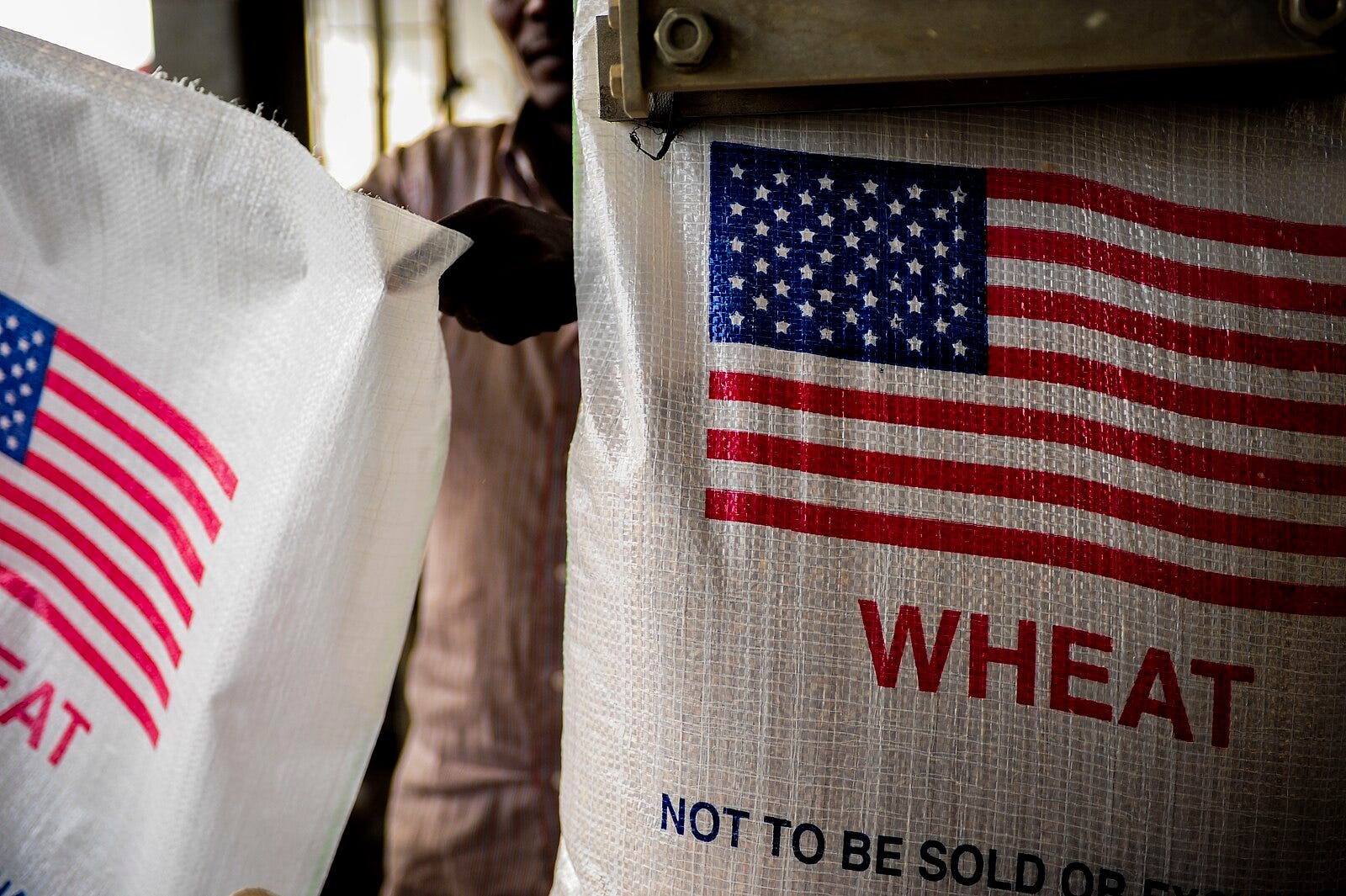
Photo credit: Djiboutian workers fill bags with wheat destined for Ethiopia, provided by the United States Agency for International Development (USAID), at the Port of Djibouti, Africa, Jan. 7, 2013. USAID has provided humanitarian help to developing countries for over 50 years. (U.S. Air Force photo by Airman 1st Class Nicholas Byers/Public Domain/Wikimedia)

Thanks for reading The Racket News ™! This post is public so feel free to share it.

Share

I knew that the sudden termination of foreign aid to people that are already on the brink of starvation would be catastrophic, but seeing it in black and white was jarring. As I’ve noted in previous articles, can we really consider ourselves pro-life if we stand idly by and allow such widespread preventable and needless deaths? 

Policy differences are one thing, but a policy that results in 600,000 needless deaths in 10 months is about as destructive as dropping a nuclear weapon. To those who are starving or dying of disease while food and medicine sit and rot in government warehouses, it doesn’t matter whether the famine is an unintended result of bad policy or an intentional genocide like the Stalin-induced Holodomor in 1930s Ukraine. You’re just as dead either way.

MAGA would argue America First! and that we can’t afford to send money to other countries, but US AID was a bargain on multiple levels. America got a propaganda and soft power victory that distinguished us from countries like China and Russia on a humanitarian level, and poor countries around the world got a way to help feed and care for their people. US AID provided assistance to 130 countries for about what the Trump Administration is now spending on ICE. American farmers and companies got buyers for their products, which made up the aid.

In terms of cost, taxpayers got a lot of bang for their buck. US AID operated on a budget of about $24 per taxpayer out of a total of $15,000 in tax revenues per capita. For that money, the medical journal, The Lancet, estimated that agency had saved about 92 million lives over two decades. That is a powerful impact.

When I read this and pondered MAGA’s America-first objection, I thought, “Am I my brother’s keeper?” 

For those who may not know or remember, Genesis 4 tells the story of Cain and Abel, two sons of Adam and Eve. In history’s first act of criminal violence, Cain murdered Abel in a fit of jealousy. When God asked Cain where his brother was, Cain asked the rhetorical question, “Am I my brother’s keeper?”

The answer is that, at least to some extent, we are our brothers’ keepers. In the New Testament, Jesus also unequivocally told his followers to help the poor

Growing up as a conservative Christian Republican, there were caveats. There was concern about enabling people to cheat the system and the negative effects of entitlements on both the work ethic and the economy. I think those are legitimate concerns. 

When I drive the same route in a city for a while, I see the same people on the same corners day after day. Government programs are too often structured so that they trap people in poverty because boosting their income can be a net negative when losing benefits are considered. 

But still, Jesus told us to give. The biblical command to help the poor was to individuals, not governments, but I don’t think that lets us off the hook for either US AID or programs such as SNAP. The harsh truth is that only the government has the necessary resources to fund and administer such programs, even though the cost is minuscule in terms of the federal budget. And as I alluded earlier, funding charity is also in the national interest. 

That does not leave the individual off the hook either. There are a great many worthwhile programs and charities that aren’t funded (either fully or partially) by the government. Giving of your money as well as time and effort helps both the recipients of the charity as well as ourselves. 

And right now, there are a lot of people in need, both in America and abroad. The government shutdown has not only interrupted SNAP benefits but left thousands of federal workers without paychecks. Many government employees who aren’t highly paid to begin with, and that includes military personnel, are being forced to rely on food banks and charity. Both private and government employees are being laid off in the highest numbers in two decades as a result of a combination of the shutdown, the AI tech boom, and the slowing economy.

I have been gratified to see Americans stepping up to help where government is failing. People around the world donated almost $200,000 to a Portland coffee shop that gave free breakfast to SNAP recipients. Others have donated to food banks that help their neighbors.

In all this, I was reminded of a friend and former coworker who was a professed atheist but one of the most generous people I have ever known. I remember walking with him in Texas when we saw a vagrant sleeping on the street. My friend reached down and left a few dollars in the man’s sleeping bag. 

They’ll probably just use the money for drugs, you might argue. They’re probably just scammers. I’ve said and thought the same thing myself. I still do. 

If they do, that’s on them, but as an alternative to giving cash, you can give food. I had another friend who used to take leftover food from restaurant meals and give it to street people. Keep some snacks in the car to give to people on street corners. Instead of giving cash to the person who claims to need gas, pay at the pump to put a few gallons in their car. If you get cheated, you may need to fall back on the instruction to turn the other cheek.

On a personal note, I have been the beneficiary of government charity. When I was starting out as a regional airline pilot, the probationary pay was so low that we qualified for WIC with our new baby. My first layoff came a few months later with a 10-month-old to provide for. I’ve seen the other side of the coin.

Ultimately, if someone is preying on charitable people, that’s between them and God. If we look for excuses not to help the needy, that’s between us and God. 

The Bible does teach us to be good stewards of our resources, however. Giving to organizations that have the experience and know-how to vet their recipients and that operate efficiently is a good strategy, although that doesn’t help the person asking you for food or money on the street. Organizations like Charity NavigatorCharity Watch, and the Evangelical Council for Financial Accountability can help to screen out charity scams and groups that skim too much donor money for overhead. 

I need to do better at giving. My plan this week is to buy a load of groceries and then go volunteer at our local food bank. I also want to pick a good international charity and start making donations to help offset the shortfall in federal foreign aid. I challenge you to do the same, if you are able.

There is no way that we, as individuals, can replace even the small part of the federal budget that funded US AID. We can’t save everyone, but we can save someone. We are our brothers’ keeper if we are able to help.


Originally published on Racket News