Wednesday, November 17, 2021

Kyle Rittenhouse is no hero

 There are two extremes to the Rittenhouse case in Kenosha. I have seen people on the left claiming that the teen is a demented killer who went to Kenosha with the idea of killing protesters and I’ve seen people on the right make the claim that Rittenhouse did nothing wrong. As with many issues, both extremes are wrong. I don’t know whether Kyle Rittenhouse will go to jail or walk away from the courthouse a free man, but I do know that Mr. Rittenhouse is no hero.

Photo by Esteban Lopez on Unsplash

There’s an old saying in aviation that a superior pilot uses his superior judgment to avoid having to rely on his superior skill. That’s where Rittenhouse was lacking. Judgment.

Rittenhouse took part in a straw purchase in order to get his rifle, which was itself an example of bad judgment. Since the judge dismissed the charges of illegal possession of a firearm earlier this week, I’ll stipulate that he wasn’t in the wrong to carry his gun to a riot (even though the dismissal hinged on the technicality of a poorly-written state law), but it was still an exercise in poor judgment. I took a deeper dive into Wisconsin’s self-defense law last week. As I noted then, there are confusing wordings and seeming contradictions in this section as well that may give the jury a reason to find him not guilty on some or all of the charges.

Whatever the jury’s decision, however, it is not a good thing for self-styled civilian protectors to flock to riots to patrol the streets. A Rittenhouse acquittal could have the unintended consequences of making other would-be “citizens on patrol” think that it is okay to lock and load and head downtown when the protests start. It isn’t.

If Rittenhouse is acquitted, it will likely be because of the details of Wisconsin law. Self-defense laws vary from state to state and the loopholes that provide the potential for Rittenhouse to escape punishment won’t be replicated elsewhere.

For example, the gun possession charge was dismissed because of a 1991 change that singled out short-barreled rifles. That is a peculiarity of Wisconsin law, but in many other states, there would be no question that it would be illegal for a 17-year-old to carry a loaded rifle on downtown streets without a permit.

Likewise, many other states also have laws against acting provocatively. I have not done a survey of every state’s self-defense law, but I would bet that most, if not all, would nullify the self-defense claim of someone who provokes an attack. I know that Georgia’s law does. Whether parading in front of an angry mob with a rifle is considered a provocation may be left up to the subjective whims of a jury in cases where provocations are not spelled out by statute.

In the case of Rittenhouse, a lot will depend on how the jury views the facts. Did the teen provoke the attack? Was Rosenbaum attacking him or merely chasing him? Did Rittenhouse have a valid reason to fear for his life? Was he reckless in quickly turning to shoot an unarmed man? What of the random gunshot? If Rittenhouse feared for his life because of the shot, was he still justified in shooting the unarmed Rosenbaum? Is it reasonable to shoot someone who chases you? If you hear a gunshot, does that mean you can shoot everyone and let God sort them out?

I don’t know how the jury will rule, but I do believe that Rittenhouse showed poor judgment that night. His poor judgment began with fraudulently obtaining a firearm and continued when he appointed himself to patrol Kenosha. It continued further when he left his appointed post to wander among the crowd. He may have had good intentions, but he had neither the training nor the judgment to accomplish his task.

One of the most damaging moments for Rittenhouse in the trial was when the prosecutor asked on the cross-examination why the teen didn’t go home after police pushed the protesters away from the car dealership that he was supposed to be protecting. Rittenhouse had no answer and the viewer is left with the implication that he was looking for adventure if not trouble.

That’s my fear if Rittenhouse is acquitted. There will be more armed people looking for trouble in close proximity to mobs that are looking for trouble. More people in mobs may start arming themselves as protection against people like Rittenhouse. We could end up with a much higher death toll on the streets.

And I’d like to point out that I’m not condoning the mob’s violence. The protesters have a right to protest peacefully, but there is no right to riot or engage in the destruction of property. However, I’m in favor of a strong police reaction rather than having civilian vigilantes do the job.

If we want to avoid the spiral of political violence in this country, we need to draw a line against vigilantism. Part of the solution is going to be to have police act swiftly to contain riots. Part of the solution is going to be police reform to minimize questionable shootings and killings that are often the inspiration for these riots. We may also need to rewrite laws to make it clear that citizens cannot deputize themselves to quell riots.

Kyle Rittenhouse’s trial is not about these bigger issues, however. It is only about whether Rittenhouse followed the law and was justified in his actions, but his trial does have deeper implications for the country at large. Whatever the verdict, we have issues with which to deal.

Share


I think the verdicts could go either way for Rittenhouse. If I had to guess, I’d say that he is not convicted on the first-degree homicide charges but possibly on a lesser charge for the killings. I would not be surprised at a conviction for reckless endangerment.

From the Racket

Sunday, November 14, 2021

Are the experts always wrong?

 One of the more disturbing trends that we see in today’s society is the rise of anti-intellectualism. The bias against experts is not new, but it has grown exponentially during the pandemic years with the result of hundreds of thousands of needless deaths. Even now, the pandemic is continuing in the US despite the ready availability of vaccines largely because of a backlash against experts.

I remember one Twitter exchange that I had a while back in which another user wanted me to stipulate that the experts were always wrong. What? Of course, I won’t stipulate that because it’s an idiotic statement. If experts are always wrong, then they aren’t really experts, are they?

Photo by Kyle Glenn on Unsplash

That isn’t to say that experts are always right, either. Experts are human and therefore fallible, but they do have a deeper knowledge on a given subject than a layman. That’s what makes them experts. It also makes what they have to say worth listening to, but it doesn’t mean that they shouldn’t be questioned.

In fact, one of the most useful techniques for determining truth is by questioning people and having them defend their ideas. This is especially true when experts have to defend their ideas to other experts. This peer-review process is part of the scientific method in which a hypothesis is tested and refined.

A lot of people assume that all experts are on the same page and in total agreement. That is rarely true. We can see from conflicting studies that each side cites in the pandemic that there are disagreements. Not all the data lines up in a nice, neat row.

And that’s one of the reasons for confusion. One study reaches one conclusion on a subject, masks for instance, while a different study reaches a different conclusion. People trying to make a point latch onto the study that reaches the conclusion that they want and discard contradictory information as “fake news.”

But that is not an honest way to do business. If you want to find the truth, rather than just hear a study that tickles your ears, you have to look at the big picture.

I’ve frequently written that you shouldn’t look at one poll in isolation. You should follow polling trends and look at the average of polls, discarding the outliers, to get a better sense of what is happening. It’s the same with scientific studies.

When considering the science of a subject, don’t stop at one study. Look for the preponderance of the data and discard the outliers. If a couple of studies say masks are useless but a lot of other studies say that they are effective, the odds are pretty good that they help. And that’s the reason why doctors have been wearing them for more than 100 years.

Most of us don’t have the time and many of us don’t have the background to parse all these data points. It’s easy to be overwhelmed and misled by technobabble if you aren’t well versed in the field. That’s where trusted experts come in handy.

And I do mean trusted. The problem that we have today is not that we don’t have enough information but that we have too much bad information. The internet has made it cheap and easy to broadcast to millions of people, even if you have absolutely no idea what you are talking about. A high school dropout broadcasting a rant from behind the wheel of his car can carry just as much weight among internet users as a scientist. Actually, the dropout probably carries more weight because he’s more entertaining.

Well-intentioned but uninformed people can misinterpret even good data. One common error is to focus on one aspect of a study without considering the larger context.

There’s also the fact that, as Mark Twain said, “A lie can travel around the world and back again while the truth is lacing up its boots.” That’s even more true today because a snappy soundbite or a sharply worded meme can spread like wildfire, regardless of whether it is true or not.

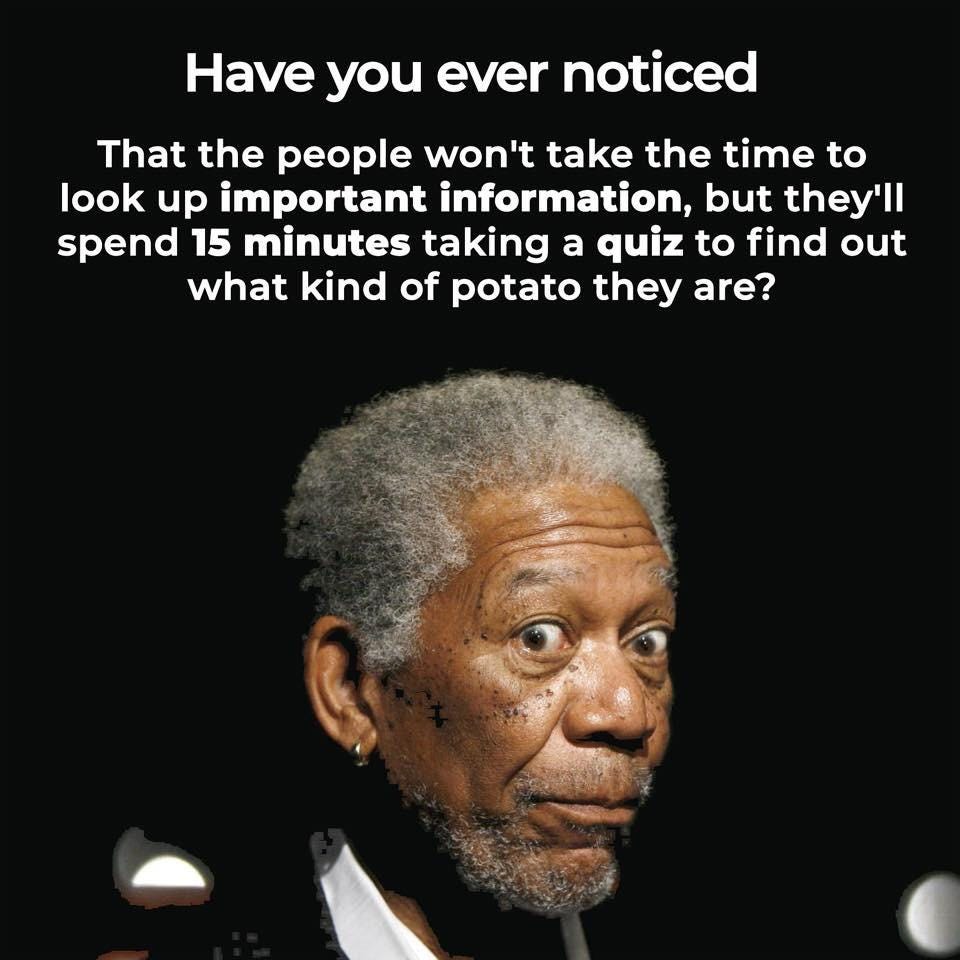
However, not all memes are bad. I happen to be a fan of the genre. Some, like the one below, make valid and truthful points in a memorable way.

r/im14andthisisdeep - Potato quiz bad, important information good.

People really should take a few minutes to look up information before believing it or passing it along. In another recent Twitter exchange, a user claimed that vaccinated individuals had turned out to be “superspreaders” in some areas.

“Name one,” I challenged, and she answered that Vermont had the highest vaccination rate and also the highest COVID numbers at the moment.

The key here is that we have two data points, but is there a causative relationship? I didn’t look to see whether Vermont had the highest vaccination rate, but I did determine that the state has about 80 percent of its population with at least one dose and 71 percent with two doses. Whether the state has the highest vaccination rate or not, that leaves about 20-30 percent of the population not completely vaccinated, which provides ample room for the virus to run amok.

But is that what happened? It took a little searching to find statistics on breakthrough infections, but the Vermont Department of Public Health does publish them. The most recent data set shows that breakthrough infections have affected only about 1.3 percent of Vermonters. (Of that number, only one percent have died and three percent were hospitalized.) That means the vaccines are tremendously effective but leaves the question of who is getting sick to bump the state’s case rate up so high.

That answer is also in the DPH report. Overall, 20-29 year-olds have had the highest rate of COVID-19 infections in Vermont, but the report shows that the current rate is highest among children 11 and younger. This is interesting because, up until last week, this age group was not approved for COVID vaccinations.

Huh. The unvaccinated are getting infected. Imagine that.

If you’ve stuck with me this long, you can see how the meme-style tweet was technically correct but fundamentally flawed in the information that it presented. Not many people are going to dig to resolve that sort of discrepancy, unfortunately. At first, digging up data can seem daunting, but it gets easier with practice. And a lot of the time, an internet search will show that someone has already done it for you.

And this sort of thing comes up a lot. A recent article that I wrote debunked similar claims about Israel that took highly specific data and tried to draw a general rule from it. The old saying that “figures lie and liars figure” is still true and when someone focuses on one small area to the exclusion of all else, it should be a red flag.

Oftentimes, the problem isn’t that the experts are wrong, it’s that we just don’t want to hear the message. You can attack people like Dr. Fauci and be tired of pandemic mitigations, but that won’t stop the relentless march of the virus across your community. Facts don’t care about your feelings.

And I’m not saying that Fauci is never wrong. As I said above, he’s human and he and the other medical experts were dealing with a completely new and unknown pathogen when it first hit the US back in the spring of 2020. They made some bad calls, such as when Fauci said in January 2020, “Even if there's a rare asymptomatic person that might transmit, an epidemic is not driven by asymptomatic carriers."

That line is an example of how people claim that Fauci and other experts lie. The problem is that it was not a lie at the time. It was historically true but was subsequently shown not to be true in the case of COVID-19 by new research. There’s that scientific method again.

The liars are the people who keep trotting out these debunked claims in order to undermine faith in institutions and science. These people are either ignorant of the facts or are maliciously deceiving their readers.

What should a savvy consumer of information do? Look for objective sources rather than partisan rage sites for one. Keep a mental note of a source’s track record on whether their predictions and claims come true for another. Read the fine print and look at the big picture.

Don’t believe the experts just because they are experts (or because they claim to be). But don’t disbelieve them because they have expertise in an area either. Do your homework with legitimate sources and find the objective truth.

Share

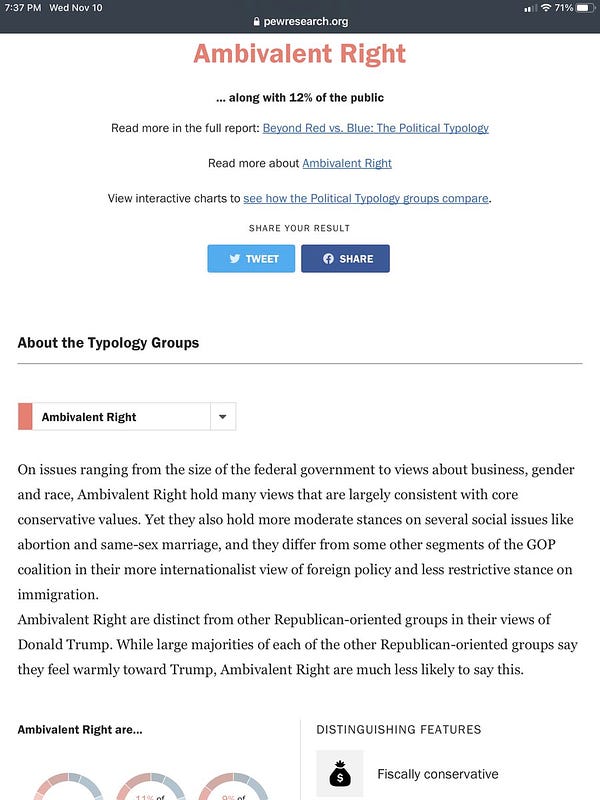
I’m sharing my conservative bona fides once again. A new political quiz has been going around and I came up as Ambivalent Right. If you’d like to take the quiz, you can do so here.

How do I feel about being part of the Ambivalent Right? Frankly, I’m ambivalent. It seems like a stupid label. It reminds me a lot of Futurama’s episode about the Neutral Planet, which is definitely worth watching if you haven’t seen it.

Unlike the Neutral leader, I do have strong feelings, but I’m definitely ambivalent about the options on the table.

From the Racket

Wednesday, November 10, 2021

A tale of two shootings

 There are two big trials going on right now. The trials are across the country from each other, but there are common themes that echo in both cases. Despite the similarities, the cases are very different and may well have different outcomes.

The two cases are those of Kyle Rittenhouse, the then-17-year-old who shot three people during rioting in Kenosha, Wisconsin last August, and the three men who shot and killed Ahmaud Arbery in Glynn County, Georgia in February 2020. The cases don’t seem very similar on the surface, but there are some disturbing common threads that are woven through both cases.

Photo by David von Diemar on Unsplash

I’m going to stop right here and note that I am not a lawyer. Nor do I play one on tv. I’m just a layman who can google relevant laws and apply them to the details of the cases as I understand them. I don’t claim to be an expert on the law or to have all the facts in the cases at hand.

I wrote about Arbery’s death last January after the details of the killing had emerged. Originally, the killers claimed that Arbery, who was black, attacked them after the three local men, who were all white, had chased him down in a pickup truck and tried to ask him questions about a string of local robberies per the Brunswick News.

No charges were originally filed against the men, one of whom, Greg McMichael, was a former Glynn County police officer. McMichael’s son, Travis, and their neighbor, William “Roddy” Bryan, were also involved in the incident. Travis was carrying a shotgun and struggled with Arbery before firing the fatal shots.

Arbery’s death would have been written off as a case of self-defense had a defense attorney not released a video that Bryan, driving a second vehicle, had made of the incident in May 2020. The video contradicted the account of the killing that had been self-defense because it showed that the McMichaels, with Greg riding in the pickup bed and carrying a pistol, had attempted to interdict Arbery, who was jogging. Travis gets out of the truck with a shotgun, struggles with Arbery, and gunshots are heard.

The subject of a citizen’s arrest has been raised in the case, but the responding officer’s testimony at the trial this week indicated that there was no mention of a citizen’s arrest at the time. Officer Ricky Minshew said that Bryan told him that they had "blocked," "cornered" and "cut off" Arbery. It isn’t clear what reason the men gave Minshew for their actions, but they were allowed to leave.

What is clear is that Waycross Judicial Circuit District Attorney George Barnhill made a recommendation on February 24, before he was assigned to the case, that no arrests be made since Arbery initiated the fight and that the McMichaels’ actions were justified under Georgia’s citizen’s arrest law (which has since been changed). Barnhill later recused himself since his son worked in the Glynn County prosecutor’s office, but the Georgia Attorney General is investigating his actions.

The First Coast News reports that Jackie Johnson, the Glynn County DA who reached out to Barnhill and who allegedly intervened to prevent the arrest of the McMichaels, has since lost re-election and been indicted on charges of violation of the oath of a public officer and obstruction of law enforcement officers. So far, no charges have been made against Barnhill.

The McMichaels ran into two problems in their defense. The first is that Georgia’s old citizens’ arrest law required “immediate knowledge” of an offense. The McMichaels did not meet this standard since they only saw a jogger that they considered suspicious.

Arbery had entered a home under construction and was caught on surveillance video, but the McMicheals did not know this at the time. Further, entering a building under construction is not a crime in Georgia. There is no evidence that Arbery took anything or damaged the house. Police reported that he did not even have identification when they examined his body. He was identified by his fingerprints.

The second problem is that self-defense does not apply if the person claiming self-defense was “the aggressor.” Self-defense also does not apply if a person provokes an attack or if the violence occurs in the commission of a crime… such as attempting to illegally detain an innocent man. In other words, you can’t create a dangerous or illegal situation and then claim self-defense.

And that brings us to Kyle Rittenhouse. Like the McMichaels, Rittenhouse is claiming self-defense in his triple shooting that left two people dead and a third wounded, but is that the case under the law?

For starters, Rittenhouse was 17 years old at the time of the shooting. That means that his possession of the rifle was probably not legal in the first place.

Rittenhouse was a resident of Illinois, where firearms purchases are contingent on the ability to obtain a Firearms Owner’s Identification Card (FOID). Illinois law stipulates that the minimum age for a FOID is 21 unless the applicant is sponsored by a parent or legal guardian.

Rittenhouse apparently did not have a FOID. In an interview last year, he told the Washington Post that he bought the gun with money from his COVID unemployment payments. Since he couldn’t buy the gun himself, he gave the money to a friend who purchased it for him. This is called a “straw purchase” and it is illegal, but in a twist, the friend was in Wisconsin and Illinois prosecutors could find no evidence that Rittenhouse possessed the gun in that state. (The then-19-year-old Wisconsin man that bought Rittenhouse’s gun is being charged in the straw purchase and has admitted that the pair knew they were breaking the law.)

So what about Wisconsin law? Wisconsin law follows federal law in prohibiting the possession of firearms by people under 18 with certain exceptions. These exceptions include target shooting under adult supervision, military service, and hunting. The hunting exception bears further scrutiny since Wisconsin law does allow 17-year-olds to hunt with a gun without being under adult supervision. However, the state requires a hunting license and hunter safety course. Rittenhouse seems to have not met these requirements and a defense that his gun was legal under hunting laws would beg the question of exactly what he was hunting that night.

So Rittenhouse apparently broke the law simply by possessing his gun and carrying it on the streets of Kenosha, but the shootings are a different matter. Like Georgia, Wisconsin does allow for the use of deadly force in self-defense, but there are restrictions on the claim.

You can read Wisconsin’s full statute here, but there are some exceptions that might be relevant. First, self-defense does not apply if “the actor [person claiming self-defense] was engaged in a criminal activity.” The fact that Rittenhouse was carrying his gun illegally means that he was engaged in criminal activity. This alone may be enough to sink his self-defense claims.

A second exception states, “A person who engages in unlawful conduct of a type likely to provoke others to attack him or her and thereby does provoke an attack is not entitled to claim the privilege of self-defense against such attack, except when the attack which ensues is of a type causing the person engaging in the unlawful conduct to reasonably believe that he or she is in imminent danger of death or great bodily harm.” So, Rittenhouse is not entitled to claim self-defense unless he reasonably believed that he was in imminent danger. This is a very subjective qualifier.

Third, “A person who provokes an attack, whether by lawful or unlawful conduct, with intent to use such an attack as an excuse to cause death or great bodily harm to his or her assailant is not entitled to claim the privilege of self-defense.” Again, this is subjective, but Rittenhouse does not seem to have been out for blood. The teen appeared in videos before the shooting that would probably rule out this exception without further evidence.

The self-defense tests have to be applied to all three shootings, however. The case may hinge on the first killing, that of Joseph Rosenbaum, which was captured on drone camera footage and a cell phone video. The videos show Rosenbaum running after Rittenhouse and throwing what appears to be a plastic bag before Rittenhouse turns and fires four times. ABC News has put together the best timeline that I can find of the events that night, but there are still large gaps and it is unclear what started the initial confrontation or why Rosenbaum was chasing Rittenhouse.

Richie McGinniss, a reporter from the conservative Daily Caller, testified that Rosenbaum tried to grab Rittenhouse’s gun per the News Observer, and Ryan Balch, a former army soldier patrolling with Rittenhouse, said that Rosenbaum was “hyperaggressive and acting out in a violent manner” as well as starting fires and throwing rocks. The defense has also suggested that a shot fired by someone else, just before Rosenbaum was shot, made Rittenhouse believe he was being attacked.

This matters because if the shooting of Rosenbaum was justified, then Rittenhouse can claim self-defense in the other two shootings. However, if Rittenhouse did not legally shoot Rosenbaum then self-defense would not apply in the killing of Anthony Huber and the wounding of Gaige Grosskreutz under the exception for criminal activity. The pair, along with others chasing Rittenhouse, may well have been operating under the belief that they were attempting to stop an active shooting or prevent a murderer from escaping.

The entire matter is confused and encompasses quite a few gray areas. Both sides could have reasonably believed that they were acting within the law (except for the fact that Rittenhouse knew that his gun was illegal) and the outcome of the trial will almost certainly depend on which point of view the jurors give more weight.

Taken together, the cases show how dangerous it can be to try to take the law into your own hands. Both Arbery’s killers and the self-appointed defenders of Kenosha were attempting to take the law into their own hands and ended up breaking laws themselves in the process. Defending yourself and your property is one thing, but what these people were doing is more akin to vigilantism than self-defense.

My personal opinion is that Kyle Rittenhouse should never have been on the street that night. Going to a neighboring state with an illegally purchased gun to patrol businesses to which he had no connection is a long string of bad judgments. (If a business owner really hired Rittenhouse, a minor with an illegal gun, to help protect his property, that was a bad decision as well and one for which the business might have legal liability.) I don’t believe that it would serve the best interests of anyone to let Rittenhouse get away scot-free, a verdict that would undoubtedly encourage future vigilante activity.

This isn’t to say that Rittenhouse is the only one to blame, however. The protesters who became violent and drew the armed militias into the area are also responsible. So are the police, who touched off the riot by killing Jacob Blake in a questionable shooting and encouraged the presence of Rittenhouse and his fellow paramilitaries. For that matter, the lax rules governing officer-involved shootings and qualified immunity for police also contributed to the environment that became explosive.

It is notoriously difficult to predict the outcome of jury trials in complicated cases. Even in cases that aren’t complicated, juries can go their own way and hand down surprising verdicts. Having said that, the case against Arbery’s killers seems tighter than the murder case against Rittenhouse. Prosecutors may have overreached with the charge of first-degree homicide Jurors might find a middle ground between acquittal and first-degree murder by finding Rittenhouse guilty of a lesser crime such as second-degree intentional homicide, which does not carry a mandatory life sentence per the Journal-Sentinel. At the very least, Rittenhouse should be convicted on the weapons charges.

The case against the McMichaels seems more cut and dried. Again, however, there can be surprises in jury trials, especially those that involve racially-charged cases.

The bottom line here is that if you are using a gun to defend yourself or your property in the course of normal events, you are probably within your rights. However, if you take it upon yourself to do the job of the police, you can quickly find yourself in legal trouble in the midst of a life-altering tragedy.

If you are going to carry a gun, it is your responsibility to know the laws of your state (or other states that you might visit) to ensure that you don’t inadvertently become the criminal. In any case, if lives aren’t in danger, it’s best to let the police do the jobs that they are trained and deputized to do.

From the Racket

Monday, November 8, 2021

Biden notches a win

 Maybe American democracy is not irretrievably broken after all. Over the weekend, Congress worked as it was supposed to, even including a bipartisan coalition. The focus of this constitutional miracle was the much-touted, long-awaited, frequently maligned infrastructure bill.

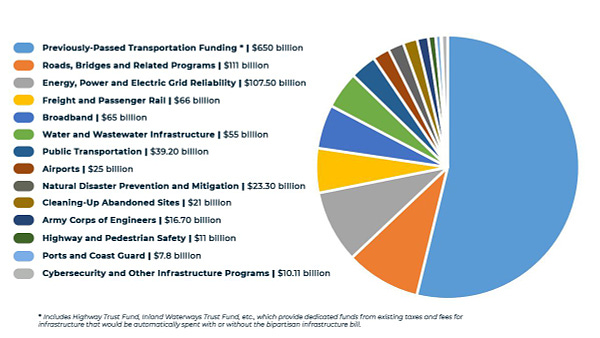
To be clear, this was the real infrastructure bill, not the “human infrastructure” bill that progressives have spent months pushing. As a White House fact sheet details, the 10-year bill contains money for items like roads, bridges, airports, clean water infrastructure, expanded access to high-speed internet, electric vehicle chargers, and of course, passenger rail.

Photo by Jared Murray on Unsplash

The biggest threat to the infrastructure bill came from the progressive left rather than the Republican right. Progressives wanted to tie passage of the infrastructure bill to the partisan “human infrastructure” bill. The problem was that neither bill had the support necessary to break a Republican filibuster so they had to be incorporated into the annual budget reconciliation, which only requires a simple majority and is not subject to filibuster.

Contrary to claims that the Democrats are a monolithic bloc that votes in lockstep for socialism, the party couldn’t get its members together to pass the partisan Christmas list. Joe Manchin (D-W.V.) and Kyrsten Sinema (D-Ariz.) were the public faces of the Democratic moderates, but others were likely hesitant in their support for the larger, partisan bill as well. It was Manchin and Sinema who put the brakes on the progressive spending spree and it was the progressives who almost killed the bipartisan bill.

Indeed, the list of six Democrat “nays” on the bill is essentially a list of the infamous Squad led by Alexandria Ocasio-Cortez (D-N.Y.). In addition to AOC, there were Cori Bush (D-Mo.), Ilhan Omar (D-Minn.), Ayanna Pressley (D-Mass.), and Rashida Tlaib (D-Mich.). Jamaal Bowman of New York was the sole male Democrat to vote no.

In contrast, it was Republican “yeas” that saved infrastructure. A total of 13 Republicans, many of them from blue states, voted to pass the bill.

Many Republicans weren’t too happy with the 13 aisle-crossers. Matt Gaetz (R-Fla.) unironically complained on Twitter that “Republicans just gave the Democrats their socialism bill,” without noting that the actual socialists within the Democratic Party voted against the bill.

Gaetz might not be able to believe that Republicans would sign onto a “socialism” bill because his allegation is not true. As we have already seen, the infrastructure bill is not a “socialism” bill. Most of the provisions in the bill are typical items of infrastructure funding. This bill was Congress doing the business of government, which is something that has been all too rare in recent years.

The funny thing here is that opposition to the infrastructure bill has put Republicans like Gaetz on the same side as the socialist Squad. Gaetz doesn’t mention that.

In fact, New York Rep. Nicole Malliotakis, one of the Republicans who voted for the bill, framed her vote as opposing the Squad, saying, “I weakened their hand. They have no leverage now. I voted against AOC and the squad tonight.”

Rep. Peter Meijer (R-Mich.), an opponent of the bill, pointed out on Twitter that the bill does indeed contain infrastructure spending as well as that the price tag is less than typically assumed since a large part of the appropriation already existed as part of the Highway Trust Fund. While it’s right to be skeptical of any new spending, this bill won’t add as much to the deficit as the totals of its spending would lead you to believe.

And the icing on the cake is that the wasteful, partisan bill is now dead in the water. The only chance for passage of that bill was in tying it to the bipartisan bill. Now that the bipartisan infrastructure bill is becoming law on its own, the “human infrastructure” is doomed.

The system still works. At least it does when people who understand the system and have the ability to reach across the aisle are in charge. Even if you don’t support the bill and its contents, the confirmation that Congress can still come together to get bills passed in a constitutional way (at least once a year with a budget reconciliation) is something to celebrate.

Share


After quite a few losses, opponents of vaccine mandates finally got a win in court. The Fifth Circuit Court of Appeals issued an emergency stay for the Biden Administration’s new OSHA rules, which were issued last Thursday, citing “grave statutory and constitutional issues.”

The injunction does not mean that the mandate for vaccinations or testing is dead. The case is likely to end up at the Supreme Court.

As I noted back in September, the OSHA mandate stands on the weakest ground of any of President Biden’s pandemic mandates. While the Occupational Safety and Health Act of 1970 permits OSHA to enact emergency temporary standards to combat both injuries and illnesses, several of these ETSs have been struck down in the past.

If the OSHA mandate fails, it may be because of the lack of urgency on behalf of the Biden Administration. It took more than a month after Biden announced the OSHA mandate to publish the policy and it took the president about eight months in office and a year and a half into the pandemic to decide that a workplace mandate was necessary. It may be difficult to convince a court that a six-month ETS is necessary at this stage of the pandemic and the Biden Administration was acting in response to an ongoing emergency.

There are quite a few legal questions to answer regarding the OSHA mandate and the Fifth Circuit injunction won’t be the last word. The Biden Administration should be filing a response this afternoon. This case is far from over.

From the Racket