Wednesday, November 3, 2021

Virginia is for Youngkin

 The polls seemed to be pretty accurate in the Virginia gubernatorial race. I’m writing this on Tuesday night as I scan some election returns while watching the Braves and the Astros in the World Series. I wrote earlier this week that the state was too close to call and that the outcome was a coin flip. At this point, that statement seems pretty accurate.

The counting is not yet complete, but it looks as though Republicans will take the lieutenant governor and attorney general races and take control of the House of Delegates as well. Official state election results can be found here. (At 11:00 am on Wednesday, Youngkin holds a lead of about two points, which is very close to pre-election polling, but absentee ballots will be accepted until Friday.)
By Kellis7 - Own work, CC BY-SA 4.0, https://commons.wikimedia.org/w/index.php?curid=110148429

There will be a lot of post-mortems but there are a couple of important takeaways. First, Republicans should realize that they can win in purple states without Trump. And since they’re going to win the red states anyway, isn’t winning the purple states what it’s really all about? The purple states are what you need to win the whole enchilada and not have to make up excuses about stolen elections.

In fact, it may well be that they can only win purple states without Trump at this point. As I pointed out for several years prior to the 2020 election, Trump’s negatives were so high that re-election would take a miracle. Now, with Trump out of the limelight and off social media, Trump may seem comparatively more popular, but this would likely change once he started campaigning and reminding people of why they didn’t vote for him last time.

Back to current events though. This year in Virginia, Glenn Youngkin kept Trump at arm’s length. When the former president made a late appearance at a “tele rally” shortly before the election, the gubernatorial candidate wasn’t even a part of the event. It was Democrats, rather than Republicans, who kept invoking Trump’s name.

Another lesson is that Republicans seem to have found an issue that resonates with both independents and their base in education and critical race theory. This is true even though most people, like the guy interviewed below, can’t even explain what critical race theory is. They just know they don’t like it.

There was more going on in Virginia than just talking about CRT however. It’s an open question as to whether the education issue will work in other areas that haven’t had a scandal involving a transexual high school rapist or that have different demographics. Would different facts on the ground have yielded a different result? We’ll probably find out next year.

For the Democrats, the lessons are a little tougher to put into practice than the Republican strategy of keeping Trump under wraps, which is no mean feat in itself. The early exit polls show that the economy and education were the two big issues (33 and 24 percent respectively), followed by taxes and the pandemic in a statistical tie (15 and 14 percent). Ending the pandemic and getting the economy - and the supply chains - moving again will help Democrats next year.

The pandemic is winding down. Sixty-seven percent of the US population now has at least one shot and 59 percent are fully vaccinated. The mandates are working and they are mostly popular (including in a Washington Post exit poll from Virginia). The CDC is now recommending the pediatric COVID vaccine for children aged 5 to 11. Barring another surge from a vaccine-dodging variant, the pandemic probably won’t be much of an issue next year, at least in pro-vaccine states. Merck’s new COVID pill could even help to make up for vaccine resisters in other states.

As the pandemic fades, a lot of the economic woes will fade as well. The supply line problems that are a result of the pandemic disruptions should be returning to normal. Ports will be unclogged, ships will be unloaded, and trucks will be rolling.

The big economic question will be whether inflation lingers until election season. Treasury Secretary Janet Yellen expects inflation to ease in the second half of 2022, possibly just in time for the election, but has also said that the reciprocal removal of the tariffs instituted by Donald Trump and maintained by Joe Biden could help to ease inflation earlier. After all, tariffs are taxes that make products more expensive. Personally, I expect inflation to ease as supply problems go away since a lot of the price increases can be traced to shortages.

Ending a pandemic and getting the economy moving again are tall orders, but now, on top of all that, Democrats have to counter the Republican charges about racist school curriculums and sexual deviants in the bathrooms. And they have to do it better than Terry McAuliffe did with his “I don’t think parents should be telling schools what they should teach” soundbite. The early exit poll shows that this issue was one of the most damaging to McAuliffe and Democrats need to find an answer that does not sound elitist or statist.

Terry McAuliffe fared worse than his fellow Democrats in statewide races, but the blame cannot be pinned squarely on his gaffes and lackluster campaigning. With losses up and down the ballot as well as a shift toward Republicans in other states, not all of the blame can be pinned on the guy at the top of the ticket. Part of the explanation may be that Democrats took some of their constituencies for granted, as Brent Scher of the Washington Free Beacon noted below.


I wouldn’t say that Virginia is a red state now, but it did take a step back from being blue. In the end, Virginia Democrats made the same mistake that both parties tend to make. They got greedy and overreached while taking their voters for granted.

There is also a possibility that the Virginia results reflect a reversion to the mean. Democrats fared extraordinarily well in suburban districts during the Trump years. Now that Trump is off the ballot and out of sight, some of those districts that normally lean Republican are falling back into the GOP orbit. Likewise, the big margins that Biden saw in deep blue districts are returning to a normal level.

The tendency from many Democratic partisans will be to take the wrong lesson and say that the party must go further left to save itself. They’ll blame Joe Manchin and Kirsten Sinema for this week’s losses when the holdouts are actually the key to avoiding disaster. Democrats need to pivot to the middle. That’s why Joe Biden was nominated.

As another Twitter user pointed out, the most reliable voters are white suburbanites. Pick your candidates and policy with not scaring them in mind. I’d add to that the fact that black moderates are some of the most reliable Democratic voters. They need to be careful not to alienate this demographic or take them for granted.

One final note is that off-year elections have a very different electorate from presidential elections or even mid-term elections. A big part of the Republican success was an engaged base that turned out while Democrats did not. Even then, the victory was still a close thing. The GOP may not keep that edge over the next cycle of elections.

Even though the Democrats have a list of obstacles to overcome, the Republicans could throw it all away by renominating one of the most unpopular presidents in American history. Running Donald Trump a third time would almost certainly allow the party to once again snatch defeat from the jaws of victory. It’s tough to keep Trump out of the public eye when he’s at the top of the ticket.

Share

In an election night surprise, the New Jersey gubernatorial race turned out to be a close one. Polling mostly showed Democrat Gov. Phil Murphy with a comfortable lead over Republican challenger Jack Ciattarelli. The race has not yet been called (as of noon on Wednesday) and the candidates are deadlocked with the most recent counts giving Murphy a slight edge.

I expect Murphy to eventually come out on top as absentee ballots are counted, but it may be be several days before a winner is declared. Nevertheless, a close race in New Jersey may bode even worse for Democrats than the loss in Virginia.


In other news, if you thought QAnon was gone, you were wrong. Hundreds of Q devotees turned out at Dealey Plaza in Dallas yesterday claiming to see dead celebrities. The crowd reportedly expected JFK Jr. to reveal himself at a Rolling Stones concert and then join the Trump 2024 ticket.


If you remember hearing about the jet pack man spotted by pilots flying into Los Angeles, there is an update. Authorities think that they have identified the culprit as Jack Skellington. Or more accurately, a balloon that resembles the character from “The Nightmare Before the Christmas.”


Last, but not least, congratulations to the Atlanta Braves. The Braves closed out the World Series in six games with a 7-0 shutout over the Houston Astros. Among the tributes to the Braves was this tweet from an actual astro(naut). [Insert tomahawk chop here.]


From the Racket

Tuesday, November 2, 2021

Our 'deeply, darkly spiritual' politics


My old boss, Erick Erickson, got into a bit of a kerfuffle on the interwebs over the weekend. Erick, the founder of The Resurgent, where Steve and I used to contribute and where we met, tweeted the sentiment below that drew the rebuke of Jim Swift of the Bulwark.

I don’t think this hurt Erick’s feelings because I first saw the exchange after Erick posted the screenshot Jim’s retweet on his Facebook wall with his response. That response is shown below.

If you aren’t familiar with the concept of being “woke,” just think back to the 90s and political correctness, because wokism is basically an outgrowth of that. Urban Dictionary defines the term simply as “an active awareness of systemic injustices and prejudices, especially those related to civil and human rights.” It’s political correctness.

I don’t disagree with Erick that wokism is “deeply, darkly spiritual.” Quite a bit of the woke movement is contrary to Christianity from its pro-choice leanings to its embrace of transgenderism and homosexuality to those woke activists who lean towards anarchism or socialism. There is a lot of truth in what critics of the “woke phenomenon” like Erickson say about many of its adherents.

But part of the problem is that that a common response to woke political correctness is not just to be politically incorrect but to be a jerk. It is a misconception that being woke is being inoffensive and polite. A lot of people compensate for the belief that being woke means not offending people by being what they perceive to be the opposite of being inoffensive, i.e. being rude and bigoted. For example, if being woke is about anti-racism, then for some people it follows that being anti-woke is about being at least quasi-racist.

In reality, boorish behavior is not the opposite of being woke. You can be polite while being politically incorrect and you can be rude while adhering to the tenets of political correctness.

One of Erickson’s tropes comes to mind. He occasionally uses the term “Woko Haram” when discussing the woke movement. The name never really took off, maybe because it’s a kind of obscure reference. Boko Haram is a Nigerian terrorist group that is most well known for kidnapping 276 schoolgirls in 2014. So, to be clear, Erickson is saying that the woke scolds are the equivalent of murderous Islamic terrorists.

Erickson’s use of this trope is a good example of what I’m talking about. It goes screeching past being anti-woke and into jerkdom. The nickname feeds into the erroneous belief held by both sides of the political spectrum that The Other Party Is Evil and Wants to Kill Me and Destroy America.

Another way that the anti-woke forces veer into jerkdom is with the “Let’s go, Brandon” meme. If you aren’t familiar with the phrase, you can read about the backstory here. In short, the phrase is code for “F- Joe Biden.” It doesn’t offer a critique of Biden’s policies or presidency, intelligent or otherwise, it’s just an epithet.

I’m not a fan of the woke movement, but as a threat, it ranks pretty far down my list. The woke threat is way out of proportion to the attention paid to it by the right. If you don’t work in entertainment or politics, the chances are that the only places you’ll encounter wokism are while watching television news or surfing social media.

Erickson also says, “You will be made to care,” but the truth is that they can’t make you care. The woke scolds only have power over most of us if we let them. People talk about being canceled, but the truth is that the wokes don’t have that power over most of us. About the worst that will happen is we lose a social media account and the truth is that closing your social media account would probably be doing most of us a favor.

In contrast, the response to woke activism is having more of a broad effect. The poorly considered anti-CRT law in Texas that requires “diverse and contending perspectives” on controversial topics “without giving deference to any one perspective” is just one example. We’ve also already seen assaults on the First Amendment rights of online platforms in an attempt to enforce government “fairness.” These new laws are intended to combat aspects of woke activism like CRT and “cancel culture” but erode rights more than the wokes do. The cure is worse than the disease.

And then there’s the embrace of anti-woke politicians like Donald Trump. The resistance to woke politics pushed the Republican Party to the anti-woke extreme when it embraced Trump. Trump is not necessarily ideologically anti-woke. Far from it. He was pro-choice until a convenient conversion prior to becoming a Republican and he continues to be at least somewhat pro-gay rights. The thrice-married politician has also been largely silent on the redefinition of marriage, one of the most impactful moral issues of our time.

If we are going to talk about “deeply, darkly spiritual” politics, we can’t really avoid discussing how quickly and completely the evangelical church has been corrupted by Trumpism. Back in 2016, I watched as my Republican friends boarded the Trump Train one by one. Almost to a person, they said that they didn’t like Trump but felt they needed to vote for him to counter Hillary. I can understand that.

But once the switch was flipped, it was like “Invasion of the Body Snatchers.“ Afterward, they couldn’t even acknowledge Trump’s faults or criticize his obvious mistakes, errors, and wrongheaded thinking. Trump became George Washington, Abraham Lincoln, and Ronald Reagan all rolled up into one and heaven help you if you speak ill of the man that God sent to save us from Hillary!

I have never seen such unwavering, unquestioning loyalty to an American politician and I am going to suggest that it too is “deeply, darkly, spiritual.” This seems especially evident from how the emphasis of the church has shifted from adhering to Biblical principles and the belief that character matters to the belief that the Supreme Court matters more than anything else.

If I ask myself what Satan would want to do to bring down America, introducing a Great Awokening is only part of the answer. Satan would also want to distract the church and shift its focus away from its first love. If I were Satan, I’d put a false messiah in front of the church and tell the elect that he was sent by God.

That supposition is confirmed by the deceitfulness of the Trump wing of the Republican Party. Conspiracy theories, a modern version of Biblical Gnosticism, fueled a large part of the GOP even before the nomination of Trump, who is probably the most dishonest politician that we’ve ever had on the national stage. For the past year, Trump has pushed the Big Lie of the stolen election, a lie that brought the country to the brink of civil war on January 6. The GOP is now replete with false prophets who say that God told them that Trump would be re-elected and/or reinstated. (See Deuteronomy 18:20-22.)

The fraudulent calls to violence and lying prophecies are more evidence that dark spirits have taken control of a large part of the Republican Party. Jesus is truth and does not base his church on lies. Speaking frankly, the deification of Trump within the church has done more to damage the Gospel than anything the wokes could do.

By embracing a man who is neither conservative nor Christlike, Christian Republicans have contributed to the decline of America rather than making it great again. It’s reminiscent of a spiritual version of Ayn Rand’s point about how statists enact government policies to fix problems, but government intervention causes more problems that require more government fixes. In the spiritual battle, Christians drafted a false messiah to fight the wokes and were then surprised when the wokes won. Now, the Trumpists are doubling down on the false messiah again as the only way to save America from the problems that they were instrumental in causing.

Let me say here that I realize that Erick is a radio host and part of showmanship is pushing the envelope. I don’t think he’s a jerk in real life and I agree with a lot of what he says. What I have trouble understanding is how Erickson and a great many other Christian conservatives can myopically focus on the woke movement while endorsing the Trumpist plank within the eye of the GOP.

I’m not suggesting that wokism is not darkly spiritual, but what I am suggesting is that it is not the only darkly spiritual political force out there. We are in the midst of a spiritual battle and neither political party is the side of goodness and light. In fact, large elements of one party could be described as a spiritual fifth column or false flag operation. Our political landscape is not a battle of good versus evil as much as it is a battle of Kodos versus Kang.

If we are between a spiritual rock and a hard place when it comes to the political landscape, what are we to do? Charles Spurgeon famously said, “Of two evils, choose neither,” and that’s the key. If it comes down to choosing the lesser evil, then we’ve already lost the battle.

Christians should invoke a spiritual version of the Buckley Rule in the primaries and vote for the most godly candidate who can win. That’s going to require prayer and insight and a determination to clean up our own house before we start criticizing the neighbors for their poor housekeeping.

Share


Today is Election Day in Virginia. If you missed my discussion of the Youngkin-McAuliffe title fight yesterday you can find it here. Steve Berman added his opinions on the race this morning.

Chris Karr had an excellent point in the comments yesterday that losing may be a blessing in disguise. The party that wins will probably take the wrong lessons from its victory and may get a comeuppance in 2022.

While this could apply to both parties, I think losing would probably help the Democrats more. The party needs to be shaken if it wants to prevent Donald Trump from rising like a phoenix in 2024. Democrats took the 2020 win to mean that they had a blank check to enact their agenda and the undying loyalty of voters across the land. Spoiler alert: They don’t.

On the other hand, since Youngkin has kept Trump at arm’s length, a Republican loss might well be taken to mean that more Trump would have dragged Youngkin across the finish line. In reality, I don’t think Youngkin would be this close if he ran a trumpy campaign in what is becoming a blue state. Youngkin is competitive despite Trump, not because of him.

I singled out Chris, but we have a lot of good and smart commenters here at Racket News. I encourage readers to peruse the comment section for their thoughts and input. I can’t think of any other site where I’d make that recommendation.

From the Racket

Monday, November 1, 2021

Virginia is a nail-biter!

 Tomorrow is the big day in Virginia. To be honest, I wasn’t paying much attention to this race until the last couple of weeks. It wasn’t supposed to be close and it wasn’t close until all of a sudden it was.

Over the past couple of months, Republican Glenn Youngkin has steadily closed in the polls to the point where he has taken the lead in the polling averages for the first time. With election day tomorrow, his timing is impeccable. This won’t be a case of peaking too early or peaking too late. It’s only a question whether the peak is high enough.

Share

Right now, both the FiveThirtyEight and Real Clear Politics polling averages show Youngkin with a lead, but both average leads are less than two points. It’s fair to consider Youngkin the frontrunner at this point, but we need to remember some of the lessons that we have learned about polling over the past few years.

First, polling is not an exact science. By their very nature, they include estimates and extrapolations. Within the polling average, there is variation in recent polls that shows Youngkin up by as much as eight points (Fox News) or McAuliffe up by a much as four (Washington Post/George Mason University). They can’t all be right, but they could all be wrong.

Second, polls are not predictive. They can be used to make predictions, but the polls themselves are snapshots of a moment in time. Polls are most useful, not when looking at a two-point race on the eve of Election Day, but when watching trends over time. The trend does show that Youngkin has closed the gap, but they don’t necessarily tell us if his support will put him over the top.

Finally, we know that state-level polling has been problematic for the last several election cycles, especially in close races. Nevertheless, many people who normally consider polls to be nothing more than propaganda are getting excited because the polls now show something that they want to see, the possibility of an upset.

We could go back and compare the 2020 polling with the actual results in Virginia, but that wouldn’t necessarily shed much light on the current contest. Off-year elections have a very different pool of voters from presidential elections and a lot of the magic in the art of polling is figuring out who is going to show up to cast a ballot this time. The one certainty is that it will be far fewer than the number of voters who showed up last year.

One of Youngkin’s advantages is that school issues have motivated Republican voters to turn out. Allegations of Critical Race Theory and the Loudon County sexual assault scandal have stirred the base into a frenzy. When the Lincoln Party sent volunteers to a Youngkin rally last week decked out in regalia that was meant to remind Virginians of the Charlottesville race riots, it may have backfired by creating even more determination among Youngkin’s supporters.

No matter how the election turns out, but especially if Youngkin wins, there will be lessons to learn on both sides. For the Republicans, the biggest point should be that Youngkin distanced himself from Donald Trump and focused on local issues rather than national politics. When the former president staged a rally for the Virginia Republican today, Glenn Youngkin did not participate.

The flip side is that he also has not staked himself out as an anti-Trump candidate. Youngkin seems to have run a fairly traditional campaign that was based on his own ideas and personality, not that of Donald Trump. A novel concept!

For Democrats, the lesson should be don’t take anything for granted. In the gubernatorial campaign, it was the Democrats who tried to tie the Republican candidate to Trump. The problem is that if Democrats control the state legislature and executive branch, not to mention Congress and the White House, and voters are not happy, even quasi-Trumpists start to sound appealing.

When a party is in the majority, it will run into problems unless they listen to the voters as well as to their base. When the voters think you aren’t listening to them, they start looking for other options.

And that brings us to one of the seminal moments in the campaign. At a debate back in September, Terry McAuliffe said, “I don’t think parents should be telling schools what they should teach.”

Although inartfully expressed, McAuliffe wasn’t wrong. Parents do not and should not have control over school curriculums. Voters, some of whom are parents and some of whom are not, delegate that authority to school boards, administrators, and teachers.

Parental control over curriculums is indirect at best. Parents and other voters can lobby school officials and make their voices heard at meetings (preferably peacefully). They can remove their children and put them into private schools or homeschools. But they do not have the right to veto curriculum that has been established by state and local educational authorities. This is as it should be since curriculums cannot be tailored to the approval of every set of parents.

Nevertheless, McAuliffe gave Youngkin a gift with that soundbite that will never be repaid. The clip has been played and discussed ad infinitum ad nauseam. If McAuliffe loses, this will be seen as a defining moment of the campaign.

Youngkin has a lot going for him, but so does McAuliffe. Virginia has been trending more and more blue in recent elections. The state has not voted for a Republican president since 2004 and three Republican House seats have been lost since 2016. Just two years ago, Democrats took full control of Virginia’s legislature for the first time since 1996. Four of the last five governors have been Democrats (including McAuliffe who served a term from 2014 through 2018).

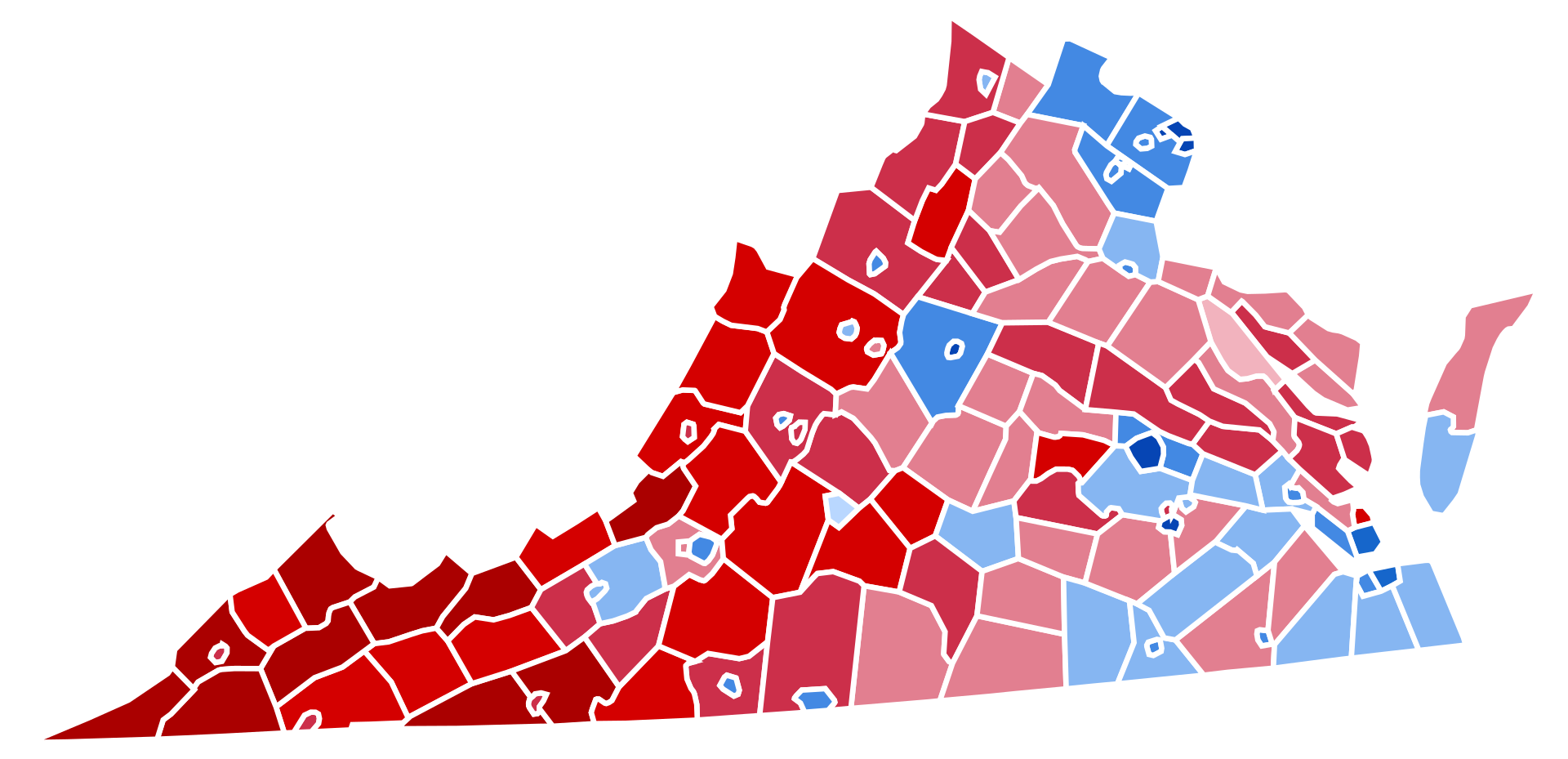
A big reason for the blue shift is Virginia’s growing metropolitan areas in the northeast and southeast. As the map of 2020 results below shows, Donald Trump won most of the geographic area of the state, but Joe Biden won the heavily populated areas around the District of Columbia, Richmond, Norfolk, Charlottesville, and Blacksburg. These urban areas hold enough voters to offset the GOP’s advantage among rural counties. In the end, Biden won the state by 10 points.

Virginia Presidential Election Results 2020.svg
By TylerKutschbach - Own work, CC BY-SA 4.0, https://commons.wikimedia.org/w/index.php?curid=96128781

The thing to watch tomorrow night will be whether McAuliffe can hold the large Democratic margins in these urban and suburban strongholds. Republicans suffered in the suburbs during the Trump years. Now Virginia is one of the first tests on whether they can make inroads back into those lost suburban districts.

If I had to make a guess as to the outcome of the election, I’d say that I think [flips coin] McAuliffe will eke out a victory. A much more sure bet than betting on either candidate would be to put your money on the possibility that both sides will take the wrong message from whatever the outcome happens to be.

Share

I mentioned over the weekend that I got my Moderna booster last Friday. I fully expected to feel sick over the weekend, but only had some soreness in my arm at the injection site. I did have some neck pain, but I attribute that more to sleeping wrong than to an adverse reaction from the vaccine. It wasn’t the first time I’ve had that sort of pain, although it isn’t frequent. In any case, it was almost completely gone by Sunday.

I knew that J&J is typically considered to be the least effective of the Big Three vaccines, but it worked for me. Back in July, I was exposed when my wife, also a J&J recipient, got a breakthrough infection. Neither I nor my kids, both of whom got Pfizer vaccinations, got infected. Debi is better now, but still has some lingering effects with her sense of smell and “COVID brain.”

After I got my booster, I saw statistics from clinical trials that showed a booster can increase J&J’s effectiveness from 74 percent to 94 percent. Granted, neither is 100 percent effective, but it is well worth getting the shot, even if you are a COVID survivor. A growing number of studies indicate that “natural” antibodies to COVID can fade quickly and are best supplemented with a vaccine.

Don’t be afraid of the vaccines. Get vaccinated so we can end the pandemic and get back to normal.


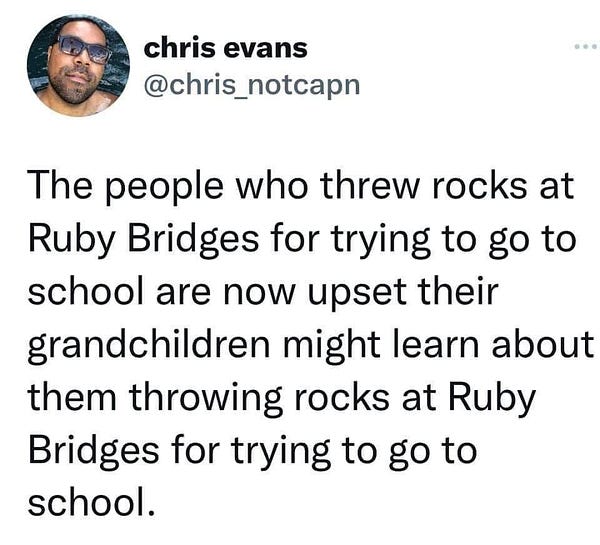
Regarding the critical race theory debate, I thought this photographic retweet by a Twitter friend was worthy of sharing. Melvin Edwards is an excellent Twitter follow even if he does prefer the Astros to the Braves.

From the Racket

What about Israel?


Like many Americans, I still engage people about politics on social media. I know, I know. It’s stupid and a time-waster and it only leads to frustration, but sometimes I just feel compelled to try to counter misinformation that crosses my path.

One of the hot topics for misinformation these days is vaccinations. Specifically, the COVID-19 vaccines, which are subject to a lot of conspiracy theories and cherry-picked data. When I talk to people about COVID-19 vaccines, a frequent response is, “Oh yeah? Well, if vaccines are so great, what about Israel?”

Well, what about Israel?

Photo by Taylor Brandon on Unsplash

The questions about Israel stem from several sources. In August, Israel did have a surge of Delta infections despite being what many sources called “highly vaccinated.” Further, at about the same time, a study of Israeli infections purported to show that people who had survived COVID were less likely to get infected again than people who were vaccinated but who had never had the virus. Neither claim shows the lack of vaccine effectiveness.

First, even though reports such as this one from NPR called Israel “highly vaccinated,” the term is a relative one. Reading past the headline from August 20, we find that “78% of eligible Israelis over 12 years old” were vaccinated, but reading further, it turns out that this meant that only 58 percent of the country was totally vaccinated. The second number is starkly different from the headline claim and nowhere near close to what would be needed for herd immunity. (At this point, only 62 percent of Israel’s population is fully vaccinated while 67 percent have one shot.)

Even though Israel was highly vaccinated compared with other countries, there were not nearly enough vaccinated Israelis to curb the spread of COVID-19, especially against the more transmissible Delta variant. While the 78 percent number sounds impressive, the 42 percent of the country that was not vaccinated gave Delta ample room to breed and spread.

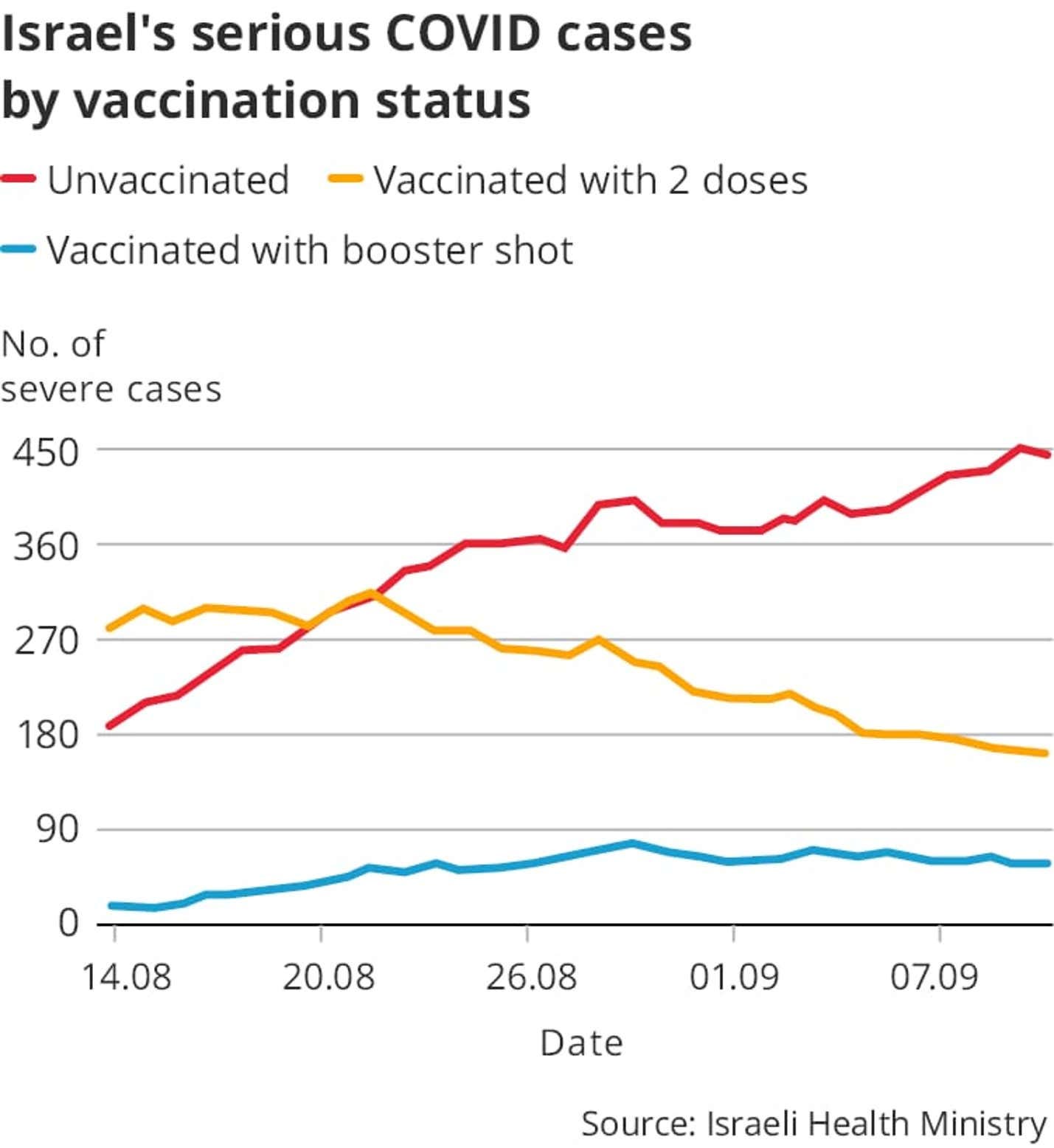
In September, Haaretz reported that only 17 percent of eligible Israelis had not received a single shot of any COVID-19 vaccine yet this small share of the population accounted for 65 percent of serious COVID cases. This was up from August when the 20 percent of eligible Israelis who were completely unvaccinated accounted for half of serious COVID cases. These statistics are not included in the articles claiming the failure of vaccines in Israel. The article also shares the chart below from the Israeli Health Ministry, which shows the stark difference in the populations of the unvaccinated, vaccinated, and vaccinated with a booster.

Nevertheless, there is a curious part of the chart in early August. Until August 20 (the dates are reversed from US format), there are more serious cases among the vaccinated than unvaccinated. What can be the explanation for this?

The key is to look at the big picture of infections and deaths. In late July and early August, there were relatively few COVID cases and deaths compared to last winter. Among Israelis under 50, only 11 were hospitalized for COVID-19 per the Washington Post. This works out to about 3 per million. In contrast, there were 43 unvaccinated Israelis under 50 even though only about a quarter of that age group had not received the vaccine. That’s about 39 per million, a huge statistical increase.

Overall, the data was skewed by older Israelis, however. Less than nine percent of Israelis over 50 were unvaccinated but that group had a much larger share of hospitalized COVID cases. There were 290 vaccinated older Israelis in the hospital compared to 171 who were unvaccinated. On a per-capita basis, that works out to a staggering 919 unvaccinated hospital cases per million compared to only 136 per million vaccinated.

So there are two factors at play here. First, we see that breakthrough infections are more common among older people. Second, the large raw number of cases among vaccinated older Israelis offset the larger share of unvaccinated cases among younger Israelis.

These two factors skewed the data until the Delta variant started spreading throughout the unvaccinated younger population. When COVID began to spread widely among unvaccinated young adults, the number of infections took off and exceeded the winter surge.

A tell taht something is wrong is the way the anti-vaccination crowd concentrates on the Israeli statistics. The statistical flukes in the data from Israel make the point that they want to make, but such anomalies are not found elsewhere. In most populations, the vast majority of COVID cases (and especially serious cases) are among the unvaccinated.

There are also problems with the Israeli study that purported to show that vaccinated people were at greater risk from COVID-19 than those who had survived the virus. As FactCheck.org points out, one red flag is that the study has not been peer-reviewed. As FactCheck noted, the study did not factor in COVID testing and so the authors admit that they may have undercounted asymptomatic and mild infections. This is a serious omission because vaccinations have been shown to limit the severity of COVID infections. Further, the study did not control for mask-wearing, social distancing, and other mitigation strategies. The study also only tested the Pfizer vaccine, so the results can’t necessarily be extrapolated to other drugs.

Even if we accept the paper as authoritative, the results still show that vaccination in addition to “natural” antibodies provides even stronger protection. This “hybrid” immunity seems to be more effective than either vaccination or natural immunity alone.

There is also a big negative to natural antibodies. That is the fact that many people who contract COVID-19 die rather than developing immunity. Vaccines confer much of the protection of natural antibodies without the high risk of serious complications such as premature death.

The study’s findings are not authoritative, however. A different Israeli study reported in the New England Journal of Medicine found an astonishingly low breakthrough rate of only 0.4 percent with the majority of these cases being mild or asymptomatic. A UK study (also not peer-reviewed) found the Pfizer vaccine slightly outperformed natural immunity and a Kentucky study found that unvaccinated COVID survivors were more than twice as likely to be infected again as those who got the vaccine. The jury is still out on natural immunity, but the vaccines are proven to be effective and lower risk than contracting the virus.

If vaccines were really failing, the Israeli anomalies should be replicated elsewhere. They wouldn’t be anomalies and there would be equal shares of vaccinated and unvaccinated individuals getting sick everywhere. We don’t see that. The anti-vax “case studies” are very specific and cherry-picked because they are aberrations, not the rule.

When it comes to COVID-19 and vaccine data, look at the big picture and don’t have a myopic focus on statistical flukes. The majority of the data shows that vaccines are safe and effective, even at resisting the Delta variant.

Share


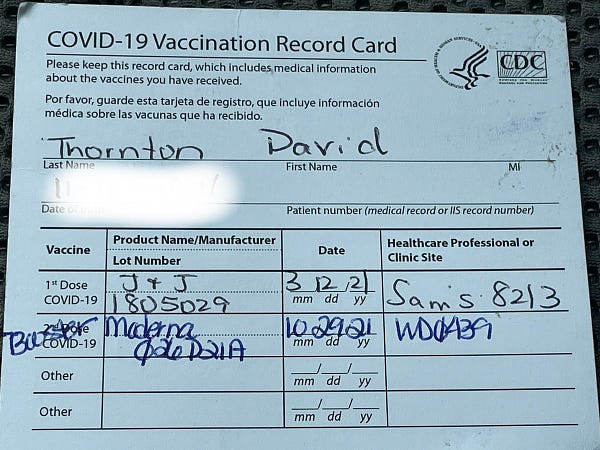
As a Johnson & Johnson vaccine recipient back in March, I was anxious to get a booster. On Friday, I added a Moderna booster to my original vaccine. As I write this on Friday night, I’m happy to report no side effects other than a barely noticeable soreness at the injection site. I fully expect to have some problems as my body reacts to the vaccine, but I view it as short-term pain for long-term gain. Whatever reaction I may or may not have will be preferable to rolling the dice with the virus.