Tuesday, September 28, 2021

Sidney Powell's shocking allegations about January 6

 Sidney Powell can’t stop talking. Recently she was interviewed by Stew Peters, a right-wing pundit with an internet talk show, and what she had to say was shocking.

In a clip posted to Twitter by Ron Filipkowski, Powell describes what was allegedly happening behind the scenes on January 6, saying, “We were filing a 12th Amendment constitutional challenge to the process that the Congress was about to use under the Electoral Act provisions that simply don’t jibe with the 12th Amendment of the United States Constitution.”

She went on, “And Justice Alito was our circuit justice for that. Louis Gohmert (R-Texas) was the plaintiff in our lawsuit. And we were suing the vice president to follow the 12th Amendment as opposed to the [Electoral Count Act].”

“That was the main point,” Powell continued, “And Nancy Pelosi had finagled to file an amicus brief in it. There had been inside goings-on in Congress whereby, I believe it was Steve Scalise (R-La.) and [House Minority Leader Kevin] McCarthy (R-Calif.) that kept her from being an actual party. She wanted to work her way into the case as a party, but somehow politically that didn’t happen.”

“So,” Powell went on, “She got notice when we made our filing because she wanted to file an amicus brief or had filed an amicus brief. Then everything broke loose and she had to really speed up reconvening Congress to get the vote going before Justice Alito might have issued an injunction to stop it all, which is what should have happened.”

Powell’s revelations may or may not be true. They could be the ramblings of a habitual liar who has spent the past year spinning tall tales about voter fraud, stolen elections, and Krakens. But she might be telling the truth.

In fact, several details of Powell’s statement do check out. There was a lawsuit called Gohmert v. Pence that was dismissed by a federal judge in the Eastern District of Texas for lack of standing on January 1. Speaker Pelosi did file an amicus brief in the case. Trump’s legal team did apply to Justice Alito, the Supreme Court justice responsible for emergency petitions from Texas, for an injunction “directing respondent Vice President of the United States to refrain from invoking the dispute-resolution provisions of the Electoral Count Act of 1887” until the Court could decide whether to act on the question of whether the “ECA violates the Electors Clause, the Twelfth Amendment, and the Constitution’s structural protections of liberty.” This application was filed on [wait for it] January 6, 2021. Justice Alito denied the request the next day.

Ever since January 6, there have been questions about the end game of the Trump campaign’s strategy to deny Joe Biden the victory that he won. In recent weeks, the strategy has begun to come to light. Last week, I wrote about Trump campaign lawyer John Eastman’s memo detailing a proposed strategy for Vice President Pence to unilaterally throw out the electoral votes of seven battleground states, coincidentally all lost by Trump, and crown a new victor based on the lower number of electors.

The legal action that Powell describes sounds a lot like it was designed to force Mike Pence into following the plan laid out in Eastman’s memo. Both Powell and Eastman refer to the 12th Amendment and the Electoral Count Act and their belief that the two laws conflict. On a recent episode of Advisory Opinions, David French and Sarah Isgur took a deep dive into the clumsily written Electoral Count Act and why Eastman’s solution is even more problematic. If you’re interested in the details, I recommend that podcast but suffice it to say that even if the Act is unconstitutional, Eastman’s solution of simply choosing not to count several cherry-picked states has no basis in law at all.

So, what does all this mean? Well, first off it means that Gohmert, Scalise, and McCarthy can expect to be in the second tranche of subpoenas issued by the January 6 commission. If Powell is telling the truth, the trio may be hip-deep in the violence that erupted on January 6 as well. It also goes a long way toward explaining McCarthy’s attempts to kill and then sabotage the commission.

I don’t think that Alito is to be included in the plotters. Supreme Court justices are assigned to different judicial circuits to act on emergency requests. Justice Alito happens to be the circuit justice for Texas, the state where Gohmert v. Pence was filed. In other words, Alito was the circuit justice for Powell’s lawsuit because he had jurisdiction and not necessarily because they considered him to be sympathetic. At this point, there is no evidence that Alito conspired with the insurrection plotters.

Powell’s story also explains why Congress didn’t delay the counting of the Electoral College votes after the attack on the Capitol. I remember that, at the time, I thought it was unlikely that the process would be completed due to the damage done by the rioters and security concerns. There were many reasons not to delay the certification of the electoral votes, but the pending lawsuit and the possibility of a Supreme Court injunction would have added even more urgency.

Powell’s revelations are further illustrations of why the January 6 commission was needed. The Trump supporters, especially those in the Republican Party who could be implicated in Trump’s attempt to steal the election, would very much like to sweep the matter under the rug and move on (to use a Democratic phrase from the Clinton years), but our democracy cannot afford to let the insurrectionists get away their failed coup attempt. All too often, failed coups are followed by successful ones.

Trump’s clumsy attempt to steal the election had little chance of success, but as I’ve said in the past, it did pose a very real threat of plunging the country into civil war. The millions of Americans who supported Joe Biden - as well as millions of honest Trump supporters who did not condone the president’s attempt to overturn the will of the voters - would not have stood idly by as Trump stole the White House.

It’s important to keep pulling at the various threads hanging from the unraveled insurrection attempt to see where they lead. The people who were involved in trying to twist the Constitution for their own nefarious purposes need to be held accountable and voters need to ensure that they are never trusted with power again.

Share


You may have noticed that I was kind of quiet last week. Work took me to San Francisco for a few days and my fellow pilot and I spent a lot of our free time sightseeing. These days it’s rare for me to make it to the Left Coast, especially for a stay that gives us time to enjoy ourselves and play tourist.

I’m pleased to report that California is cool, both in personality and temperature. I’m glad I took my jacket, but the people were nice and I saw no signs of discarded needles or homeless people defecating in the streets. Crime in San Francisco seemed almost nonexistent. In one memorable moment, I saw a cop with his car stopped in the street, lights flashing, as he seemed to be having a good time talking with some children in Chinatown. That was a great example of community policing.

I will say that San Francisco was the first place where I’ve been asked to show my COVID vaccination card. Masks are almost uniformly required inside and about half the people wear them while walking on the sidewalks outside. This system seems to be working. California’s summer COVID surge was much smaller than Florida’s even though its population is almost twice as big as the Sunshine State’s.

California does have its downside. If you cross over to Oakland, it reminds me of the line from “Ghostbusters” about the neighborhood being like a demilitarized zone. It’s also expensive (when I filled up the rental car, gas was $4.25 per gallon for regular) and there are lots of homeless, but it’s a beautiful state. At one point, I remarked to my friend that the fog-shrouded cliffs overlooking the ocean made me feel like I was in a Scooby-Doo cartoon.

My point here is that when you hear people talking about how California is a basket case you should probably take it with a grain of salt. California is no more monolithic than anywhere else and there are plenty of good, friendly people there. I saw the crowd at a baseball game stand for the National Anthem and even saw a few “F- Biden” signs and an anti-vax banner on a freeway overpass.

I love to travel and, if you get the chance, you should go see places like this for yourself. Talk to people when you do and you’ll find that a lot of them are not so different from you. However blue California is, many Californians are still good, patriotic Americans.

Tuesday, September 21, 2021

Checking my assumptions on Afghanistan

 There is a lot to be said for having consistent principles. On the contrary, principles and opinions should be rooted in fact. If you want to be honest with yourself, and if you have the personal strength to question your core beliefs, you can read stories from sources outside your political bubble to check your assumptions and make sure that your beliefs are grounded in reality.

The kicker here is that you have to be willing to adjust your worldview if you find that your beliefs are inconsistent with the facts on the ground. Some people can’t handle this. In some cases, these people never look outside their comfort zone. In other cases, they just disregard information that conflicts with their preconceived ideas as if they never heard it or it never happened.

mari lezhava/unsplash.com

Share The Racket News

I like to think that most of my opinions are pretty grounded in reality, but from time to time, things don’t work out as I expected. If I’m demonstrably wrong, I generally try to be a big enough man to admit that I was wrong. That has been the case over the past couple of weeks.

When the US evacuation effort ended on August 31, like many others, I thought that the Taliban would take advantage of the fact that not all of the Americans who tried to leave had been able to do so. It seemed to me we might be facing a situation akin to the 1979 Iranian hostage crisis in which the Taliban leveraged its captives to embarrass the United States and horrify the world. That has not proven to be the case.

While the pace of evacuation flights has slowed, they have not stopped since Afghanistan returned to the control of the extremist group. On Sunday, the fourth evacuation flight containing Americans left Afghanistan since flights resumed on September 10. The flight contained 28 US citizens and 11 permanent residents and came a week after another flight with 19 Americans.

Per the State Department, 85 Americans and 79 legal residents have left Afghanistan since the US military departed the country. At that point, the Biden Administration had said that about 100 Americans were still in the country. Simple math tells us that most Americans known to be stranded have been able to leave the country, but without knowing the exact number left behind, we can’t say for sure how many remain.

While it certainly appeared that the Taliban had us over a barrel, they did not press their advantage. The question is why. For that, I don’t have a definitive answer, but I do have theories. One is that the Taliban has changed its stripes and mended its ways. I think we can discard that theory since Amnesty International is already documenting the group’s abuses of human rights.

It’s more likely that the Taliban wants something in return. Or two somethings. First, the new rulers of Afghanistan want the legitimacy that comes from being internationally recognized as the country’s legitimate government. Second, Western nations have frozen about $10 billion in Afghan government assets. The Taliban would love to have those funds back. When in doubt, follow the money.

It isn’t clear how certain the Biden Administration could have been that evacuations would continue, but there was an inherent risk in trusting the Taliban. It’s still unlikely that thousands of Afghans who worked alongside Americans over the past two decades will be able to get out, but the hostage situation involving Americans that many of us feared has not developed, and at this point, it seems unlikely that it will.

Check your beliefs against reality. If the two don’t match up, check your assumptions. You may need to adjust your worldview. It’s not necessarily a good thing to stand by your beliefs and principles if the evidence shows that they are wrong.

Share


The Texas abortion law might be about to meet an untimely end. The state law that bans most abortions escaped being aborted itself by the Supreme Court earlier this month after the Court allowed it to be born on a technicality. The law, which is enforced by civil action by private citizens rather than by the government, was not enjoined in large part because pro-abortion groups couldn’t figure out who to sue. They seem to have resolved that problem.

On Monday, a test case was filed against Alan Braid, a doctor in San Antonio who performed an abortion after the law took effect. The Washington Post reports the lawsuit was filed by a federal prisoner in Arkansas who was enticed by the possibility of a $10,000 payday rather than any strong feelings about abortion rights. Another suit was filed by a Chicago man who is asking courts to strike down the law.

This may be the point where Texas’s experiment in deputizing basically everyone in the country to police abortion clinics comes to an end. The doctor’s lawyers will undoubtedly be requesting an injunction to suspend further enforcement of the law until the Supreme Court rules on the merits of the case. They may well get it this time.

Personally, I don’t think the Texas law will survive the courts. The big question is how the Supremes will strike it down. Will they uphold the current abortion jurisprudence from Planned Parenthood v. Casey or will they establish a new precedent? An abortion case from Mississippi is ahead of the Texas law on the docket and would be a better vehicle for overturning Casey, but the Court needs to quash Texas’s unprecedented attempt to evade judicial review by shifting enforcement to frivolous lawsuits by out-of-state inmates.


Finally, the US passed a grim milestone this week when the number of deaths from COVID-19 exceeded the 675,000 dead from the 1918 Spanish flu pandemic. We can quibble about the importance of the number. On one hand, the Spanish flu killed a larger percentage of Americans since the population of the US was about 103 million at the time compared to 330 million in 2020. It’s also true that the COVID death toll would have been much higher without a hundred years of advances in medical technology. Ventilators have saved a lot of lives over the past 18 months.

Regardless of the significance of the milestone, there have been too many deaths from COVID-19. There have especially been too many preventable deaths since the vaccines became available for widespread use.

I think it’s going to be difficult for people to look back at this pandemic 50 years from now (if we haven’t killed ourselves by then) and understand why so many chose to risk the virus rather than take a safe and effective vaccine.

We may be technologically savvy, but we are definitely lacking in common sense.

From the Racket

New financial crises are looming

 A funny thing happened on the way to the recovery. The recovering economy has already taken one hit from the Delta variant surge and now there are at least two more looming crises on the horizon.

Battling over the debt ceiling seems sooo 2013, but like deja vu all over again or a bad penny, it’s back. There was a whiff of this impending crisis back in July when I wrote that Congress had to act by August 2 to keep the Treasury Department from being forced to resort to extreme measures. Astute readers will notice that it is now the middle of September.

Photo by Hans Veth on Unsplash

Share The Racket News

One major development in the story is that Minority Leader Mitch McConnell said in an interview with Punchbowl News last week that, although he does not want a default, he is leaving it up to Democrats to raise the debt limit.

"It's their obligation. They should step up. It's hard being in the majority. They are the ones who will raise the debt limit," McConnell said, adding, "Do you guys think I'm bluffing?"

McConnell’s statement may be more an acknowledgment of reality than a policy position. Raising the debt ceiling has long been a hot-button issue with Republicans, who almost let the federal government default during the government shutdown of 2013, although they happily suspended the debt ceiling for two years under President TrumpForty-six Republicans signed a letter in August promising not to vote with Democrats to raise the debt ceiling this time.

"So the only issue is, whose responsibility is it to do it? A Democratic president, a Democratic House, a Democratic Senate," McConnell said.

McConnell’s stance that "America must never default" and "the debt ceiling needs to be raised" to avoid a default, but Republicans won’t lift a finger to help is a risky one. On the one hand, it will help to cement the GOP base into place, but on the other hand, if the federal government does default, Republicans are setting themselves up to take the blame.

What would a federal default look like? No one really knows for sure, but the consensus is that it would really, catastrophically bad. That’s probably especially true at a time when the economy is weak after fighting off a global pandemic for 18 months.

In a letter to Congress last week, Treasury Secretary Janet Yellen wrote, "A delay that calls into question the federal government's ability to meet all its obligations would likely cause irreparable damage to the U.S. economy and global financial markets. At a time when American families, communities, and businesses are still suffering from the effects of the ongoing global pandemic, it would be particularly irresponsible to put the full faith and credit of the United States at risk."

Previous brinksmanship over the debt ceiling resulted in Standard and Poors downgrading the federal government’s bond rating in 2011. A default would lead to more downgrades and the effects would ripple throughout the economy. Aside from other economic impacts, the crisis would almost certainly invigorate America’s rivals in seeking to replace the dollar as the world’s reserve currency. That could have lasting implications for the US economy.

Among Republicans, however, cooler heads are unlikely to prevail. Now that the GOP is out of power, its fiscal conservatism has reappeared and with it, a hard line toward increasing the national debt. Some Republicans may also speculate that a financial crisis that reins in the stock market could hurt President Biden and the Democrats.

Since Democrats hold majorities in both the House and Senate, it is likely that they will be able to raise the debt ceiling without Republican help, but there is little room to spare. The measure might have to be included in the upcoming budget resolution that Democrats want to use for their “human infrastructure” bill to avoid a Republican filibuster. The House is set to vote this week on a standalone bill to keep the government operating past the end of the fiscal year on September 30.

At this point, Treasury has not established a default date or a date for when parts of the government will have to be shut down. The guidance issued in July estimated that extreme measures could get the government to some point in October. Per MarketWatch, economists currently rate the risk of default at about 20 percent.

If the debt ceiling is a slow-moving crisis, the other looming financial problem is a newly breaking story. Evergrande, a Chinese real estate development company, is in an even worse position than the federal government. The company is in the process of defaulting on more than $100 million of payments due Thursday.

While this crisis is still new, there is a possibility that the problem of overleveraged Chinese companies could lead to more defaults and that the contagion could spread in a manner similar to the 2008 financial crisis. Due to the interconnected global economy, stock markets beyond China, including the US, are already sinking because of the Evergrande crisis. The question is whether the Chinese government will be able to stop the bleeding and stem the panic.

If the prospect of two financial crises is bad news, there is at least a silver lining. The prospect of financial problems may help to stifle inflationary pressures being felt here in the US. It’s tough to have inflation if worldwide prices and demand are falling due to recession fears.

At this point, no one is predicting a financial or economic calamity, but there are some headwinds and hints of brewing storms. These stories bear watching closely in the coming weeks.

From the Racket

Saturday, September 18, 2021

Is Gen. Milley a hero or a traitor?

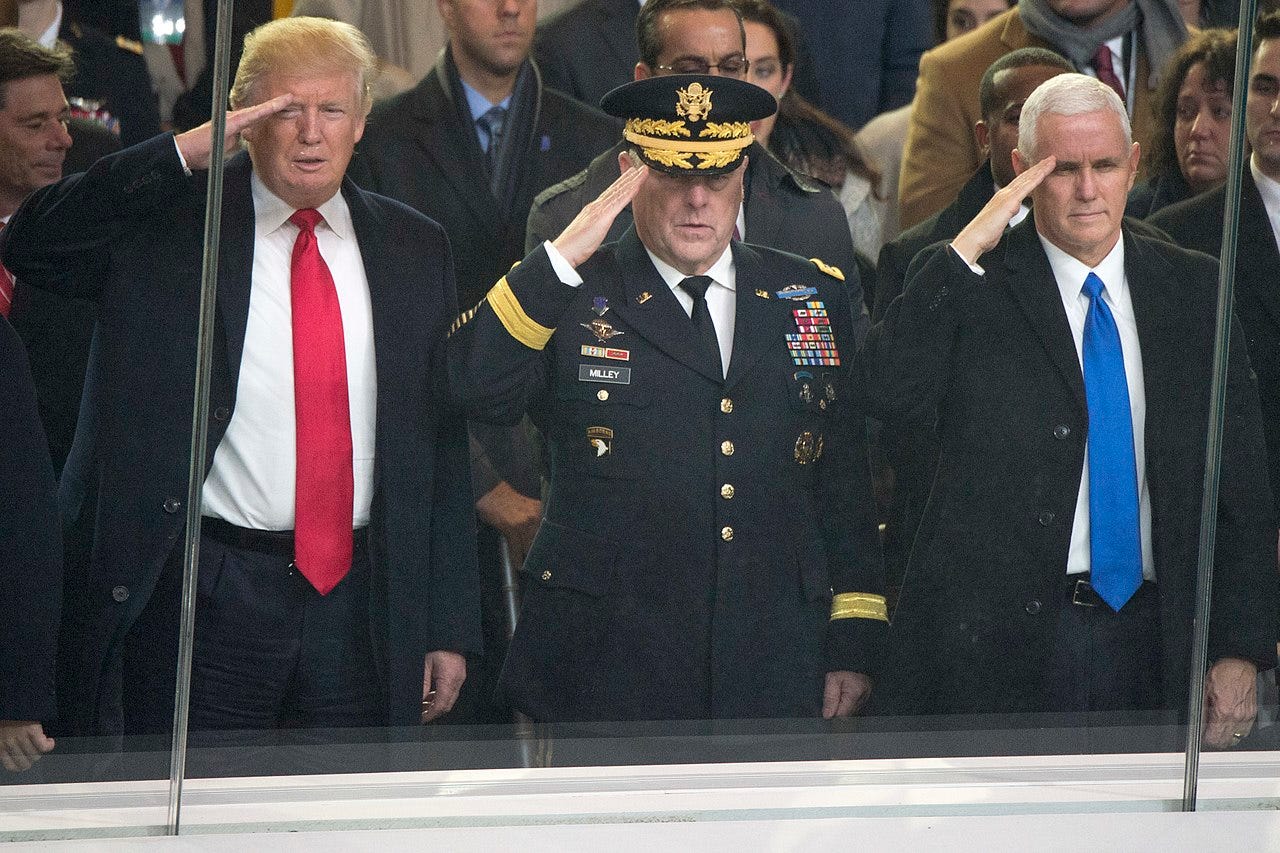
 Gen. Mark Milley, the chairman of the Joint Chiefs of Staff, is back in the news. An upcoming Bob Woodward book, “Peril,” details how Gen. Milley made two contacts with his Chinese counterpart, Gen. Li Zuocheng of the People’s Liberation Army, to assure the Chinese that the US was not about to launch an attack. Republicans are seizing on the news to call for Milley’s resignation and some are declaring him a traitor.

Per the report, which is detailed in the Washington Post, one call took place on Oct. 30, 2020, four days before the election, and the other took place on January 8, 2021, two days after the attack on the Capitol. The first call was reportedly prompted by Chinese concerns that the US was preparing to attack, a belief based on President Trump’s anti-Chinese rhetoric and military exercises in the South China Sea.

By DoD Photo by Navy Petty Officer 2nd Class Dominique A. Pineiro/Released - https://www.dvidshub.net/image/3114225/58th-presidential-inauguration, Public Domain, https://commons.wikimedia.org/w/index.php?curid=55221915

In Woodward’s retelling, Milley said, “General Li, I want to assure you that the American government is stable and everything is going to be okay. We are not going to attack or conduct any kinetic operations against you.”

Milley allegedly added, “General Li, you and I have known each other for now five years. If we’re going to attack, I’m going to call you ahead of time. It’s not going to be a surprise.”

The second call was due to Chinese concerns about the insurrection. Milley tried to allay Li’s fears, saying, “We are 100 percent steady. Everything’s fine. But democracy can be sloppy sometimes.”

When I read these reports, a couple of questions come to mind. What is the protocol for an officer in Milley’s position? Is this sort of contact normal? Did he do it secretly? What made the Chinese concerned about Trump’s behavior? Did other countries and government officials get the same vibe? And finally, does General Li command a rebel Chinese army? (Obviously, I’m kidding about the last one.)

The Pentagon has pushed back and attempted to answer some of these questions. Col. Dave Butler, Milley’s spokesman, told reporters that the general’s calls were not revealed to Trump but were coordinated with the Department of Defense and other relevant agencies.

“His calls with the Chinese and others in October and January were in keeping with these duties and responsibilities conveying reassurance in order to maintain strategic stability,” Butler said, adding that Milley also spoke with Nancy Pelosi to reassure the Speaker that safeguards were in place to prevent a lame-duck Trump from launching nuclear weapons or attempting to use the military to maintain power.

A report in Politico went further, citing sources who said that Milley asked permission from Defense Secretary Chris Miller before making the call, but it is not specific as to whether this includes both calls. The report also states that Milley briefed Miller’s office after his contact with Gen. Li.

The problem for Pentagon - not to mention Gen. Milley - is that Pentagon credibility is at a pretty low point after the recent revelations about the drone strike in Afghanistan that killed an aid worker and his family rather than ISIS terrorists. It’s not unreasonable to question what military briefers say.

In the call with Pelosi, which took place following the attack on the Capitol by Trump’s supporters, Milley said “there’s not a snowball’s chance in hell this president, or any president can launch nuclear weapons illegally, immorally, unethically without proper certification.”

The Woodward account then goes on to say that Milley “felt no absolute certainty that the military could control or trust Trump” and convened a meeting with military leaders to review nuclear launch procedures. In particular, Milley reminded commanders that he was involved in the launch chain of command as well and that the president did not have sole authority.

This refers back to the question of protocol. A little online research makes me wonder if Gen. Milley’s assertion that he was in the chain of command for a launch was correct. A Harvard article from 2017 discussing American nuclear launch protocols notes, “the secretary of defense does not confirm the president’s decision, nor does he or she have a right to veto it, nor does anyone else have the authority to override the decision. This is what Elaine Scarry has identified as, in effect, a ‘thermonuclear monarchy,’ which gives the US president almost carte blanche command over the nuclear forces.”

In other words, the process would not stop an illegal, unethical, and immoral launch because the president would have the proper certification. If such a launch was to be stopped, it would be put to people like Milley who have to do so at the risk of losing their careers and possibly their lives.

Although the two calls have been lumped together, they seem to be very different. The October call seems to have been of a more routine diplomatic nature. The reason for the first call was explained by a Washington Post reporter who has read Woodward’s entire book in an interview with NPR:

"Milley had reviewed intelligence suggesting that the Chinese believed the US was preparing to attack at that time, and he feared a hair-trigger situation in which there could be miscalculation, or a preemptive strike by China in an attempt to fend this off or get ahead of it.

"And at the time, there were tensions over military exercises in the South China Sea; these tensions were deepened by Trump's belligerent rhetoric toward China on the campaign trail. So [Milley] tried to assuage these fears by saying the U.S. was stable and was not preparing to lash out at China."

Milley’s assertion that he would tell Li if the US was going to attack is the strangest thing about the call. To me, that seems to be salesmanship rather than a serious promise to inform the Chinese about any surprise attack.

The January call was different. It’s easy to see why the Chinese were concerned after hordes of rioters and just sacked the Capitol. Nancy Pelosi and many other Americans were concerned as well. The Washington Post quotes Gina Haspel as lamenting, “We are on the way to a right-wing coup.”

Haspel is no liberal squish. She was President Trump’s own pick to head the CIA and a career CIA officer. To reiterate, the woman that Donald Trump appointed to the CIA thought he was launching a coup.

So, what we are left with on the January call is a general who inserted himself into the chain of command with the intention of pre-empting a possible order from President Trump to launch nuclear weapons. I’m going to add here that there is no evidence that Donald Trump planned to or even thought about a nuclear launch. As far as we know.

In normal circumstances, it would be wrong for a general to prepare to intercept a nuclear launch order. However, in this case, the president committed the greater wrong by interfering with the peaceful transfer of power and losing the trust and faith of his commanders. It was the president who was off the reservation.

Milley was playing a bad hand and had the best interests of the United States in mind. The general’s oath was to “defend the Constitution of the United States against all enemies, foreign and domestic,” not to be loyal to the president. Milley’s first loyalty, appropriately, was to the United States, not to a president who has already shown his willingness to flout the Constitution. (As an aside, I’m going to note that many of Trump’s defenders excuse the president’s unconstitutional actions while nitpicking everyone else’s. It seems to be straight out of Saul Alinsky’s rule number four.)

If Trump had ordered an attack in the wake of his election loss or the failure of his Stop the Steal coup attempt, Milley would be considered a hero. As it is, I think Milley should still be considered a hero for doing what he had to do, what was best for America and the rest of the world.

Some people still have faith in Trump. Others don’t believe that The Former Guy would have crossed the line in starting a war in his last days in office. I have learned over the past few years that Trump’s depravity has no bounds. Would Donald Trump, cornered in the White House and a national pariah after the failed insurrection, have taken revenge on the country that rejected him by starting a war? I can’t say that he wouldn’t have.

Most of the people taking the position that Trump would not have launched a rogue war also said that he would accept the results of the election. Ten months later, he still has not.

I remember a memorable piece by Steve Berman from our Resurgent days in which he likened the Trump presidency to a stress test on America’s institutions. Looking at the Milley phone call from that perspective, America held up under the stress test, but something had to give to keep everything from breaking. That “something” was Milley’s decision to insert himself in the chain of command for nuclear strikes. Under other circumstances, the general’s actions would be inappropriate but under these circumstances, it was the right thing to do.

For those who are upset by Gen. Milley’s action, I’m going to suggest that the real problem was not a general who bent the rules but the president who made it necessary. America’s military commanders are generally honorable and trustworthy, the Afghan drone strike notwithstanding. Donald Trump is not.

I’d say that if we don’t want our generals to be put in the position of violating the law or allowing corrupt and vindictive presidents to run rampant, our best bet is not to elect another madman.

From the Racket

Wednesday, September 15, 2021

Can Joe Manchin save the Democrats?

 Going into 2022 and 2024, the Democrats have at least two things going for them. The first is the fact that the Republicans have embraced their crazies and the second is Joe Manchin. In the coming election cycles, it may take both of these advantages to preserve the Democratic majority, especially if Joe Biden’s popularity continues to decline.

As we saw in 2020, Republican craziness and bad behavior don’t give Democrats an automatic win. As the election neared, Democrats started talking about expanding the Supreme Court, massive spending projects, and a “woke” agenda seemed to spook voters and narrowed Democratic chances of taking Congress. If it had not been for Donald Trump’s war on the election driving up Democratic turnout in Georgia (while suppressing the Republican vote), the Democrats would have lost the Senate.

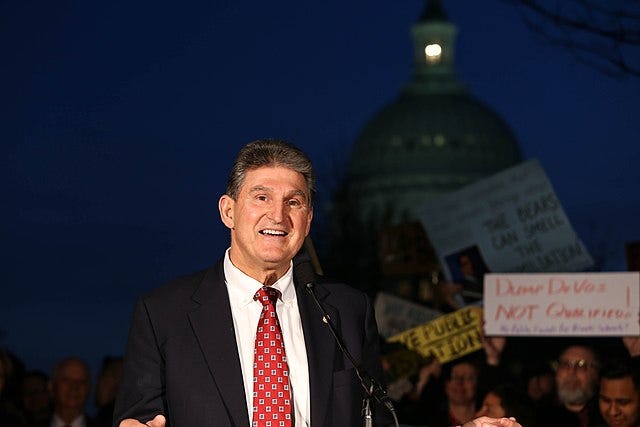
Photo credit: Senate Democrats/wikimedia

Share The Racket News

As go into 2022, Joe Manchin could be likened to a rudder on the ship of the Democratic Party. If you don’t like him, he could be considered an anchor.

Manchin, a conservative Democrat in a red state, can’t afford to go all-in on Democratic progressivism. I don’t know what Manchin’s true convictions are, but it is almost axiomatic that any politician’s most cherished principle is that his job must be protected. I do believe that Manchin shares that conviction.

The West Virginia senator’s latest escapade is putting the brakes on the Democrats’ “human infrastructure” bill. Manchin demanded a “strategic pause” in an op-ed in the Wall Street Journal titled “Why I Won’t Support Spending Another $3.5 Trillion.” In the piece, he added the qualifier, “without greater clarity about why Congress chooses to ignore the serious effects inflation and debt have on existing government programs."

Whatever his reasons, Manchin has raised the ire of the progressive wing of the party. While many on the left think that Manchin, along with the other half of the Dynamic Democratic Duo, Kyrsten Sinema, are killing their chances in the upcoming elections, it is more likely that the opposite is true.

Both parties have a problem in that they cater too much to their radical fringes. The assumption by the wingnuts is that the majority of the country agrees with them. After all, everyone on Twitter and Facebook and probably even in their personal circles believes the same things they do. Therefore, why wouldn’t the majority of the voters just love the most extreme package that can be rammed through Congress?

You can look back through history and see both parties making the same mistake. When the Democrats took both houses of Congress and the White House in 2008, they promptly pushed through several pieces of unpopular legislation that included the stimulus, the Affordable Care Act, and the Dodd-Frank financial reform. These bills passed mostly along party lines at a time when the Democrats held a supermajority in the Senate and their unpopularity figured prominently in the Republican wave of 2010.

The Republicans were no better. When the GOP finally cobbled together control of all three branches of government in 2016, their focus was on a reform/replace attempt to gut Obamacare, tax reform, tightening immigration laws, and building a border wall. Some of these policies became law and some did not, but they were all unpopular outside the GOP.

In the last years of the Trump Administration, the president, like Barack Obama before him, focused on preaching to the choir rather than making converts. However, Trump’s fundamental problem was that he started with a smaller base than Obama, having lost the popular vote in 2016. It was almost impossible for Trump to win an election based on turning out his base. While Trump did find lots of new voters, even more new voters flocked to the Democrats, fueled by Trump’s erratic and offensive behavior.

While Barack Obama won re-election, his tendency to pursue partisan policies rather than reach across the aisle hobbled his second term. Republicans took both the House and the Senate, which limited Obama to Executive Orders. This further deepened the partisan divide.

Despite running as a moderate, Joe Biden has followed the pattern of edging toward extremism once in office. Biden’s COVID relief bill was popular, but again, was a mostly partisan vote. The infrastructure bills will be his next big legislative test.

It has been a while since I wrote about the infrastructure bill, but the package cleared a Senate vote after 19 Republicans crossed the aisle. Ironically, it is now the progressive left that threatens the passage of the bill.

To understand why, we have to consider that there are two infrastructure bills. These are typically referred to as the “bipartisan infrastructure bill” and the “human infrastructure bill.” The bipartisan bill contains the traditional infrastructure items and the human infrastructure bill contains a progressive wish list. Republicans don’t want the human infrastructure bill to pass and the progressives don’t want the bipartisan bill to pass unless the human bill does. This is almost a stalemate.

Almost, but not quite. Because the Democrats have a Senate majority, they only need 51 votes to pass the human infrastructure bill as part of a budget resolution. But without Joe Manchin and/or Kyrsten Sinema, the Democrats don’t have the 51 votes they need.

The Democrats have the same problem that the Republicans had under Trump. If they go too far toward the fringe, they lose moderates at the center like Manchin and Sinema. If they move too far to the center, they lose the progressives on the fringe. It’s a delicate balancing act.

There is a third way, however. Some of the lost progressive votes can be replaced with Republicans if Democratic leaders reach across the aisle. This approach comes with some problems of its own, however.

The progressive left doesn’t like it when Democrats reach out to Republicans any more than the Republican right likes “RINOs.” The push from the left is to get everything they can before they lose their majority.

The rub is that Democrats don’t have to lose power, at least not right away. If they don’t push too hard to the left and anger voters, it isn’t impossible that they could hang on to their majority for a few cycles rather than losing it only two years in. However, if the progressive left gets its way, laws like the human infrastructure bill could make warnings about losing the majority become a self-fulfilling prophecy.

However, Joe Manchin might help the Democrats to break this cycle. The West Virginia senator may be able to throw a roadblock in front of the most radical of the progressive wishes and, in the process, keep the party from angering and frightening the moderate and independent voters that decide elections.

It’s a catch-22 that both parties face. Do they go for quick, radical change, knowing that doing so will invigorate the opposition, or play toward the middle in an attempt to keep their majority, hoping that long-term control of Congress will yield larger results? In recent years, both parties have elected to shoot for the moon, pander to the base, and hope for the best with varying results.

But there’s another factor that Democrats need to consider this time. Even after his 2020 loss and his reprehensible attempt to steal the election by having his supporters interfere with the Electoral College, the Republicans are still stuck on Trump. I’ll be pleasantly surprised if The Former Guy doesn’t make a comeback attempt in 2024.

Democrats made the mistake of underestimating Trump once before. For the good of the country, they should not repeat that error.

If Joe Manchin can keep the Democratic Party from veering too far left, he may also be instrumental in sparing America from a second Trump Administration. That is a possibility that Democrats should keep in mind as they seek to bend Manchin to their will.

Share


Preliminary results are in on the California recall election. At this point, it appears that Gavin Newsom easily survived the attempt to kick him out of the governor’s mansion.

The current tally on the Secretary of State website shows that recall proponents trail opponents by more than 2.5 million votes. On a percentage basis, the vote stands at 36.1 for to 63.9 percent against. As I wrote yesterday, it wasn’t close.

The ballot requested that all voters select a replacement candidate for governor regardless of how they voted on the recall question. In that portion of the election, Larry Elder handily led the pack with 46.9 percent of the vote. No other candidate reached double digits, but this discrepancy is explained by the fact that Democrats went all-in on saying no to the recall and did not rally behind a Plan B candidate.


The Racketeers recorded our first podcast in a long while last night. Be on the lookout for the episode to drop in coming days!

From the Racket