Monday, September 13, 2021

If the shoe fits

One of the highlights of the September 11 observances over the weekend was a speech by former President George W. Bush at Shanksville, Pennsylvania, the site of the crash of United Flight 93. Bush extolled the virtues of the crew and passengers of Flight 93, but then said something that got quite a few people up in arms.

white Air Jordan 4 shoe
Photo credit: Nicholas Bui/Unsplash.com

Steve Berman has more extensive coverage of the speech, which you can read here (and a full transcript of the speech is here), but I wanted to concentrate on the passage that was most controversial:

And we have seen growing evidence that the dangers to our country can come not only across borders but from violence that gathers within.

There's little cultural overlap between violent extremists abroad and violent extremists at home. But in their disdain for pluralism, in their disregard of human life, in their determination to defile national symbols, they are children of the same foul spirit, and it is our continuing duty to confront them.

A lot of Trump supporters are offended by this portion of the speech because they think he was talking about January 6 and the MAGA movement. Quite a few are attacking the former president because they claim that he called them “a terrorist threat.”

Others, like Jesse Kelly, were more circumspect.

The fact is that Bush did not say that MAGA was a terrorist group, even if that is what some heard. As Geoffrey Chaucer said, “The guilty think all talk is of themselves.” Or to put it another way, “If the shoe fits, wear it.”

What President Bush did was to denounce “violent extremists” and there are violent extremists on both sides. When people like Jesse Kelly and Kurt Schlichter take offense at a general condemnation of domestic violence and extremism, they are betraying their guilt.

Bush did not distinguish between the January 6 insurrectionists and the BLM rioters and the Proud Boys and Antifa. And for good reason, all of these people are two sides of the same coin. They are all violent extremists and they are all a stain on America’s tradition of peaceful democracy. Furthermore, they are all threats to our Republic and the Constitution.

A lot of Republicans don’t want to recognize this. In fact, there is a transparent movement in the party to whitewash the January 6 insurrection and minimize its importance. Some are calling the insurrectionists arrested for their roles in the riot “political prisoners” and “nonviolent trespassers.” This is a blatant attempt to rewrite history.

None of the insurrectionists are political prisoners, although some were nonviolent trespassers. The people arrested run the gamut from people engaged in conspiracies to attack the Capitol, such as the members of the Oath Keepers who have pled guilty to the conspiracy charge, to useful idiots who were at the Stop the Steal rally and just wandered in during the attack. Just last week, Cleveland Meredith, Jr. of Colorado pled guilty to illegally bringing guns into the District of Columbia and threatening to go “over to Pelosi [expletive] speech and putting a bullet in her noggin on Live TV.”

This sounds like violent extremism to me.

The September 11 weekend also brought examples of comparisons between January 6 and September 11. While there are differences between the two, both represent attacks on America. It’s true that September 11 had a far higher death toll, but January 6 is the more dangerous of the two. My Twitter friend, Atticus Finch, put it well.

September 11 united us against a common threat, but January 6 was an attack from within that continues to divide us. We fought two wars against foreign terrorist groups and their backers, but today many Americans are shrugging off the direct assault on the Constitution and the foundation of our system of government.

That division and the fact that not a few people on the right would like to put the January 6 faction in charge is the single greatest threat that America faces today. For almost 250 years, America has survived both external and internal threats, but it is by no means certain that our country and Constitution will survive the threat that we face today from the radicalism that has infected one of our two major parties. This radicalism explicitly seeks to overturn and destroy faith in elections, the most fundamental process of our democracy.

As I wrote last week, it was the events of September 11 that put us on this course. Without the horrific attacks on New York and Washington, I don’t think that we would have ever come to this point. Donald Trump would never have become president and would have never gained his almost hypnotic hold over the Republican Party.

At the end of that piece, I wrote, “Twenty years later, I’m left to suspect that the terrorists may yet win after all.” I think a lot of people had different ideas as to what I meant by that. It can be understood in different ways, but here is my view.

The terrorists launched the attacks that started the sequence of events that ultimately led to where we are now. We are near the brink of a civil war thanks to a party that does not accept the outcome of the election, has decided to live in an alternate reality, and has become a personality cult for a would-be authoritarian who values his personal power more than the wellbeing of the country. There are violent extremists on both sides and I denounce them both, but at the moment, only one party is threatening the core of our Constitutional Republic.

If the January 6 faction persists and, God forbid, drags America into civil war or topples our constitutional system, then the terrorists will have accomplished more than they ever dreamed of.

Share

From time to time, I get accused of being a liberal. I’m not. I’m also not a Democrat. Or a Republican.

My failure to embrace either side of the duopoly confuses a lot of people, but at this point in time, I’m a conservative who is anti-Republican. If that statement makes your mental processes short-circuit, you aren’t alone. I can almost see smoke pouring from the ears of a significant portion of my readership.

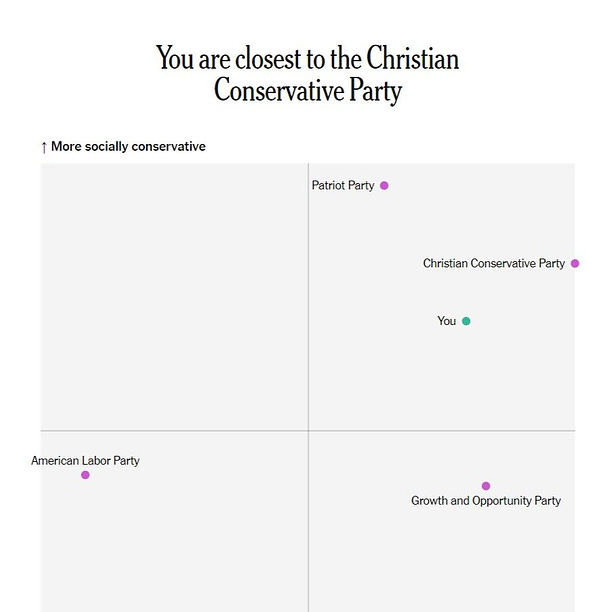
I bring this up today because I recently took the political quiz going around Twitter. (If you’d like to take the quiz, you can do so here.) Being the open and honest guy that I am, I thought I’d share my results.

The quiz put me right where I thought I’d be. I’m in the sweet spot between social and economic conservatism. I was closest to the Christian Conservative Party in my results.

In the past, I’d accept that. I’m a Christian and a conservative, after all.

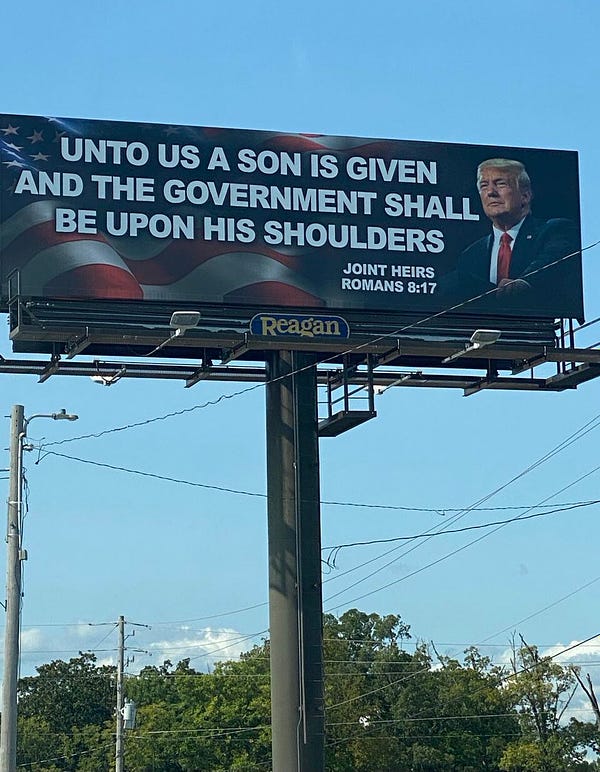
The problem is Trump. I agree with this faction on a great many issues, but the Christian Conservative embrace of Donald Trump is a dealbreaker for me. For whatever reason, the Christian right is enamored with the man, but I can’t bring myself to support the most incompetent and corrupt president of my lifetime, if not of American history. The tweet below is an example of why I reject this categorization. (The “Reagan” label on the billboard is sadly ironic since Reagan would have been outraged at this claim.)

Long before Trump, I often said that I’d remain a Republican as long as the party represented my principles and values. Well, that day came in 2016 and I chose to honor my beliefs over my party. Events since then have only confirmed that I made the right choice.

So, I’m a Christian and conservative but not a Christian Conservative and definitely not a Republican. I’ll remain politically homeless until a party develops that shares my core principles. Sorry Democrats and Libertarians, but that ain’t y’all.



From the Racket

Friday, September 10, 2021

How September 11 led to Trump and Biden

 Imagine yourself on September 10, 2001. The world was at peace, America was prosperous. Things seemed… normal. Few of us could have predicted the tectonic shift in the course of history that would occur the next day. Fewer still could imagine the chain of events that the terrorist attacks would set off, a sequence that would eventually lead to Donald Trump and then Joe Biden in the White House and a country that has moved from United We Stand to the brink of civil war in two short decades.

Ground Zero (David W. Thornton)

The most immediate and obvious reaction to the events of September 11 was that the US went to war. By November 2001, we were fighting in Afghanistan, but that was not the only short-term response. Many people don’t remember that, after financial markets reopened, the stock market experienced what was then the largest single-day drop in history, although the 684 points lost by the Dow has been eclipsed many times since then.

The stock market crash led to fears of recession. The Fed’s reaction to the tanking economy was, as it often is, to cut interest rates further. The Fed had already been lowering rates that year as the country dealt with the fallout of the Dot Com Bubble, but after September 11, interest rates went as low as two percent.

The easy money policies of the Fed, together with a bipartisan push to encourage homeownership regardless of financial status, led to the next crisis. In 2008, the real estate bubble, fed by government-backed subprime loans, burst. The contagion of “toxic assets” throughout the financial system threatened to grind the entire economy to a halt.

The combination of two wars and a looming economic meltdown led to the election of Barack Obama. I have serious doubts that Obama would have been elected without the financial crisis, but in the midst of the panic, he couldn’t lose. The junior senator from Illinois, who had not even served a full term in the Senate and had been a state senator only four years earlier, was charismatic and projected calm assurance to a nation that was ready for “change.” Obama and the Democrats were swept into office in a wave.

Obama wasn’t a great president. As a very inexperienced politician, he sounded good but lacked the core competencies necessary to lead the federal government. Since he didn’t need Republican votes due to the Democratic supermajority, Obama alienated the GOP and locked them out, pushing through his agenda on a partisan basis. This worked at first, but after Republicans won back the House in 2010, the well was poisoned for cooperation.

Still, Obama was able to eke out a re-election victory in 2012. It wasn’t long after that when Republicans went insane.

A big part of the Republican mental problem was Obama’s embrace of executive actions paired with Senate filibuster rules. Obama discovered that he could act with his “pen and phone” and, as long as Democrats united behind him to filibuster Republican attempts to rein him in, he could get away with it. The Republican failure to hold Obama accountable and to repeal Obamacare, both due to the filibuster, played into the sense of betrayal felt by the Republican base.

Obama opponents had already started embracing conspiracy theories, claiming that Obama was not a US citizen and that he was secretly a Muslim, but the paranoia really took off after 2012. Not only were many Republicans convinced that Obama planned to invoke martial law (remember Jade Helm?) and would refuse to leave the White House at the end of his term, Ted Cruz and his ilk undermined faith in the leaders of the Republican Party itself, claiming that the GOP establishment was secretly in league with the Democrats. When Cruz’s ill-advised government shutdown predictably failed in 2013, the upstart senator didn’t blame the Democrats who had numerical superiority, the only thing that matters in a congressional vote, but on his own party.

Cruz’s goal was to make a name for himself as the populist conservative outsider who could save the country in 2016. Unfortunately for him, Donald Trump jumped into the race and, as an amateur politician, was more of an outsider than Cruz. In a crowded field, Trump was not popular with most Republicans, but he was more popular than any other individual candidate.

Personally, I don’t believe that Donald Trump could ever have been elected without September 11, Barack Obama, and Ted Cruz. Even with all these factors working for him, he still lost the popular vote and only won through an Electoral College fluke.

However Trump won, his election took the United States further off track and deepened the divisions between the two parties. Trump made few pretenses of trying to unite the country and instead focused on “owning the libs” and preaching to the choir of his own base. If President Obama abused his executive authority, President Trump took the abuse to a whole new level.

The next step in the chain is more tenuous, but without Donald Trump as president, I don’t believe that Joe Biden, a two-time loser in presidential primaries, would have been elected at age 78. It took a competitor as bad as Donald Trump in the midst of a global pandemic to put Biden in the White House. Similarly, it took Barack Obama to give us Donald Trump and it took two wars and the Great Recession to give us Obama.

Now that Biden is here, it seems less and less likely that the country will heal. The pandemic and partisan rancor, much of it fueled by grifters who peddle outlandish conspiracy theories, continue to push us further and further apart. The Republicans double down on crazy at every opportunity and the Democrats are beholden to the leftist, progressive wing of their party. If there is a path back to unity, I have trouble seeing it from here.

Counterfactuals are impossible to prove, but I don’t believe that we would have - or could have - ended up where we are without the terrorist attacks on September 11. The attacks set in motion a chain of events that have thrown the United States off-kilter and left us deeply divided and suspicious of each other. Twenty years later, I’m left to suspect that the terrorists may yet win after all.

From the Racket

Can he do that? Biden's new vaccine mandates

 In a speech on Thursday, President Biden unveiled a series of new federal actions designed to encourage vaccine skeptics to just get the shot already! While there is widespread support for vaccine requirements, the obvious question is whether Biden and the federal government have the authority to make the changes that he proposes.

Biden’s plan, the “Path Out of the Pandemic,” includes several new policies aimed at encouraging and requiring vaccinations. These are:

  • Requiring all employees of companies with more than 100 workers to be vaccinated or tested weekly

  • Requiring vaccinations for federal workers and contractors

  • Requiring vaccinations for healthcare workers

  • Calling on entertainment venues to require proof of vaccination or testing

  • Requiring employers to provide paid time off for vaccinations

While I am sympathetic to the need to persuade the unvaccinated to get their shots, I am also an opponent of government overreach. If the government acts illegally to do a good thing, it is still an overreach and that makes it a bad thing overall.

As I pointed out several months ago, vaccine mandates are not new. Neither are they unconstitutional. The Supreme Court has upheld the concept of vaccine requirements going back more than a hundred years and several recent decisions have affirmed the right of private employers to require vaccines for their employees. But, with most of the statutory authority for fighting epidemics and pandemics resting with the states, federal authority is limited. So, where does Biden get the authority to make these mandates?

There are several answers to that question so let’s start with the easy ones first. The part of the plan that addresses entertainment venues is a request, not a mandate. Since nothing is being mandated, there is obviously nothing illegal here.

Almost as easy is the mandate for federal workers. The president is the head of the executive branch so Joe Biden can set standards for federal workers by Executive Order as long as those standards don’t violate other laws. The president also has the authority to set standards for federal contractors as well.

Other presidents have taken similar actions to impose requirements on federal workers and contractors in the past. For example, several presidents have signed Executive Orders that raised the minimum pay for federal contractors. President Obama also used an Executive Order to require that federal contractors report compensation data by sex and race, a measure aimed at boosting the pay of women and ethnic minorities.

The mandates for private employers are a little more tricky, but the Biden plan tells us exactly how they intend to enact the requirements. The mandate for companies of more than 100 workers and the requirement for paid time off will be enacted by the Occupational Safety and Health Administration through Emergency Temporary Standards (ETS). OSHA has issued emergency temporary standards for the COVID-19 pandemic in the past.

Federal paychecks and contracts can be lucrative, but they do come with strings attached. The government can impose requirements and recipients of federal money have to comply to keep those dollars coming.

The first Coronavirus ETS became effective when it was published in the Federal Register on June 21, 2021. A second ETS issued on July 13, 2021 explains the authority for making such temporary rules in its introduction, saying, “The Occupational Safety and Health Act of 1970 (OSH Act) gives OSHA the ability to promulgate an ETS that would remain in effect for up to six months without going through the normal review and comment process of rulemaking. OSHA, however, has rarely used this authority in the past—not since the courts struck down its ETS on asbestos in 1983.”

The Coronavirus vaccine mandate will not be the first OSHA vaccine requirement. The federal agency has mandated inoculations for hepatitis B for certain workers for years so there is a precedent for both emergency health standards for the workplace and federal vaccination mandates for workers,. There has never been an emergency vaccine requirement for so many workers by the federal agency, however.

It is important to remember that there is relief for workers who don’t want to get vaccinated. Per the White House plan, “any workers who remain unvaccinated” must “produce a negative test result on at least a weekly basis before coming to work.” As a federal judge noted in a ruling back in July, the EEOC permits vaccine requirements if allowances are made for disabilities and deeply-held religious beliefs. The testing alternative is an example of this sort of allowance.

The requirement that healthcare workers be vaccinated is slightly different. This requirement will be published by the Centers for Medicare & Medicaid Services (CMS) and will apply to “most health care settings that receive Medicare or Medicaid reimbursement, including but not limited to hospitals, dialysis facilities, ambulatory surgical settings, and home health agencies.”

As with federal employees and contractors, it is federal dollars that give the government the authority to mandate vaccinations for healthcare workers. The CMS regulates healthcare facilities that receive Medicare and Medicaid funds. If facilities don’t meet the standards set forth by the CMS, the federal funds can be cut off.

It is a virtual certainty that the federal actions will be challenged with lawsuits. Georgia Gov. Brian Kemp has already threatened to “pursue every legal option” to oppose the new requirements and he probably won’t be the only one. The obvious course would be for opponents of the plan to seek an injunction in federal court to stop the requirements from going into effect.

While the rationale and the legal basis for the mandates seem to be firm ground, there is a possibility that the courts could see the mandates as going beyond the scope of federal authority. It is not unlikely that we could be hearing a Supreme Court ruling on such a request relatively soon.

Personally, I’d put my money on the courts upholding the mandates since the law seems to allow the measures and there is a clear need to nudge more Americans to get the vaccinations. It isn’t a sure thing, however. In the early days of the pandemic, the courts were deferential to state and local government emergency powers, but as the emergency became more normal, the courts often struck down restrictions that went too far, especially those that singled out places of worship.

A bigger concern is the possibility that government mandates will lead to more resistance and possibly provoke violence on the part of vaccine resisters. Many of these people are convinced that the vaccines are dangerous or are part of some sort of dystopian plot. They don’t understand the law and precedent and are being whipped into a frenzy by conspiracy-peddling pundits and politicians. The nation is already a tinderbox and the vaccination requirements could be the spark that ignites it.

In the end, to call President Biden’s plan a vaccine mandate is a bit of a misnomer. Most workers will have the option of being tested weekly as an alternative. If workers don’t want to be tested or if they are federal workers and contractors, people for whom the testing alternative was not mentioned in preliminary reports, they have the option to refuse to comply and find another job. No one is being forced to take the vaccine against their will.

I am unabashedly pro-vaccine. I also acknowledge that various levels of government have the authority to enforce public health regulations that include mandating vaccinations. The really sad part is that so many people are afraid of vaccines that have been proven to be safe and effective that a mandate is necessary.

Share


As an addendum, some people are under the impression that postal workers are exempt from the vaccine mandates. While it is true that the Postal Service is exempt from the mandate for federal workers, it is not exempt from the OSHA mandate.

The New York Post reports that an Administration official clarified the point, saying, “USPS is strongly encouraged to comply. Also, [the Labor Department’s Occupational Safety and Health Administration] will cover USPS through the [emergency temporary standards], meaning that postal workers will be subject to the vaccination or testing policy announced today.”


California’s gubernatorial recall is next Tuesday and it occurred to me that I don’t think either Steve or I have written about it. It may be because we are both in Georgia and California is all the way across the country. It may be because I never really thought Californians would dump Gavin Newsom for Larry Elder. The very idea is too farfetched for me to take seriously.

At any rate, polling that was tight back in August has shifted to favor the incumbent governor. We’ll find out for sure next week (or whenever all the votes get counted), but my money is on Newsom retaining his office.


From the Racket

Thursday, September 9, 2021

Whitewashing Confederate history

 Roe v. Wade was decided in 1973 and the Civil Rights Era is often assumed to have ended in 1968. That puts those two landmark years 48 and 53 years behind us respectively. Yet those events still define our political landscape in many ways.

I often hear my friends on the right say that minorities should just let the past go since Jim Crow and segregation have been consigned to the ash heap of history for more than a half-century at this point. But then you get a week like this week which shows that another event in our shared history that is more than 150 years old can still sharply divide us.

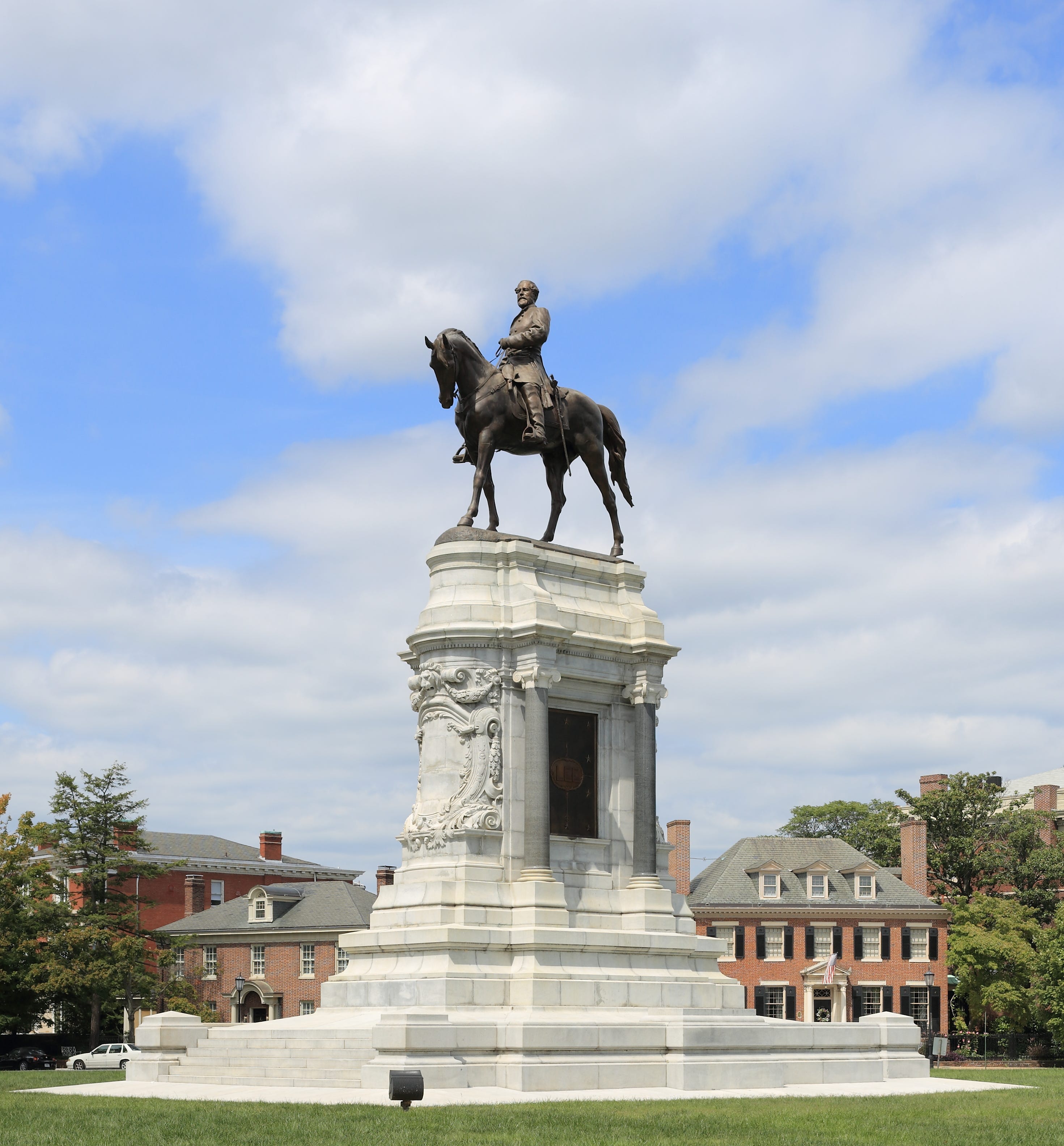
Yesterday, a prominent statue of Gen. Robert E. Lee in Richmond, Virginia was removed. CNN reports that the statue, which has been vandalized in the past, will be placed in secure storage until the state decides what to do with it.

Photo credit: Martin Falbisoner/Wikimedia https://commons.wikimedia.org/wiki/File:Statue_Robert_E._Lee_Richmond.JPG

One day earlier, The Hill had reported that a congressionally mandated commission tasked with making recommendations for new names for military bases and ships that were named for Confederate soldiers was seeking public input. The unwieldily-but-accurately named Commission on the Naming of Items of the Department of Defense that Commemorate the Confederate States of America or Any Person Who Served Voluntarily with the Confederate States of America, which is colloquially known as “the Naming Commission,” was created over President Trump’s veto threat.

I’m a native Southerner. A few years ago, I described how my great-grandfather was a Confederate soldier who was captured at the Battle of Spotsylvania and then remanded to “Hell-mira,” the infamous Northern POW camp at Elmira, New York. As a boy, I grew up visiting Civil War battlefields and playing Blue and Gray army games. I’m still a fan of Civil War history and I think that many of the Southern leaders, including Lee, were good men when viewed in the context of their time. It’s easy for me to understand why so many people feel like their heritage is being tromped on when the statues come down.

In terms of heritage, ancestors of Confederates are much farther removed from their kin’s short-lived rebellion than are black Americans from the segregation and racial persecution of their families. Many living Americans can remember unjust racial discrimination personally and not from history books.

But it is not only a question of the heritage of the sons and daughters of the South. The United States has changed a lot in the past 150 years. In many ways, that’s for the best.

The Jim Crow segregation that followed the Civil War was an affront to the Constitution and the lives lost to preserve the Union and free the slaves. It took another hundred years to rectify this wrong, but we were finally able to put this ugly part of our history behind us.

And yes, the Civil War was about slavery. I’ve heard the “state’s rights” argument and I’m somewhat sympathetic to the idea of constitutional overreach by the federal government into areas where the states reserved power for themselves, but the state right in question was the right to slavery. If you doubt this, you need only peruse the Declarations of Causes of the seceding states to see that the Confederates themselves give prominent “reference to the subject of African slavery” in their rationales for leaving the Union. You can argue that the federal government did not have the right to ban slavery (which Lincoln had not done and didn’t believe he had the authority to do), but you cannot make an honest argument that slavery was not the prime issue that stoked the fires of war.

So, the forces that are labeling the Confederates as people who fought a war to preserve a racist institution are not rewriting history. In fact, if anything, the situation is the opposite where the defenders of the Confederacy are whitewashing (pun intended) the legacy of the Southern Lost Cause.

While I don’t doubt that many history buffs fly the Confederate flag for purely sentimental and historical reasons, the fact is that the flag has a much more recent and darker past (and being darker than representing the wrong side in the bloodiest war in American history is no mean feat) as a banner of the Ku Klux Klan during the Civil Rights Era. As Neal Boortz, used to say, if you value the Confederate flag as a banner of Southern heritage, you should have been out there protesting its use by the Klan.

Another way that America has changed in the past 150 years is that we are much more homogenous and less geographically rooted than we used to be. The South is not as white as it used to be and many Southern whites are transplants who don’t feel the connection to the Confederate flag that the old Southern families feel. Even a great many native Southern whites see the flag as a racist symbol rather than a Southern one.

Over the years, my opinion on Confederate monuments has changed and it has been largely because I put myself in the shoes of others. How would I feel when I look at the Confederate flag or statue of a Confederate general if, rather than a Confederate veteran, my great-grandfather had been a slave or a Union soldier? What if my family had come to the US after the war from a country where they had escaped a rigid class system? I can almost guarantee you that, even in the South, there will be more people from an anti-Confederate background than a pro-Confederate one.

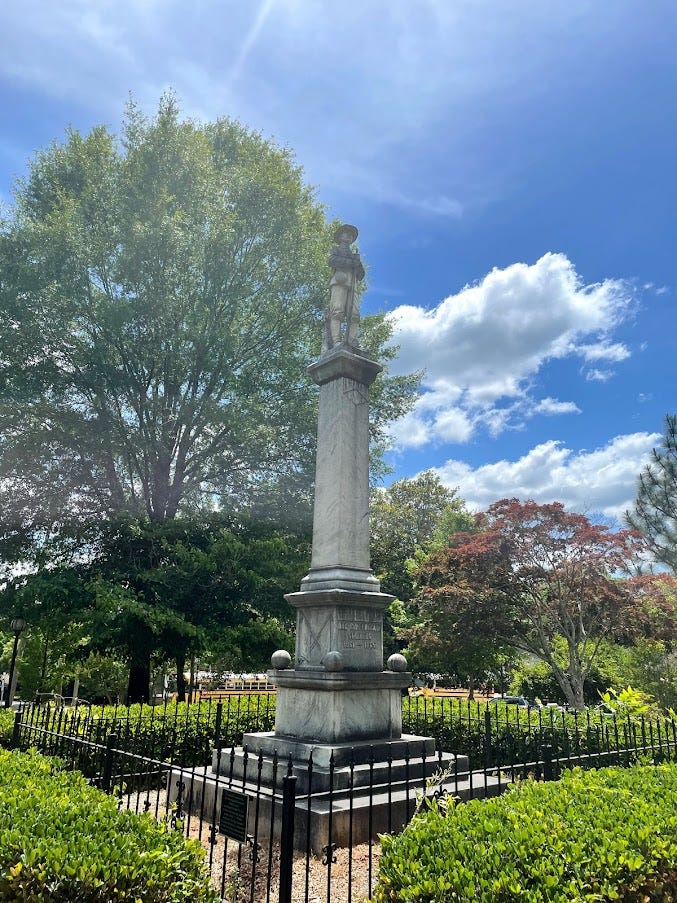
I’ve thought for a long time that the disposition of Confederate monuments should be a local issue. I don’t have any problem with the Confederate memorials that dot Southern towns, especially where there are other memorials to the dead of other wars. Statues of Confederate leaders in prominent places are harder to defend.

Monument to Confederate war dead in my county (David W. Thornton)

Removing these monuments isn’t necessarily erasing history. It is more a matter of placing history in its proper perspective. Patriots need to remember that Confederate leaders fought to dissolve the Union and overturn the Constitution, making a mockery of the sentiment of the Founders that “all men are created equal.”

Removing the monuments that laud the leaders of the secessionist movement should also be a reminder that provoking an insurrection when you cannot achieve your aims through the ballot box is not honorable but rather is a bloody, destructive, and ultimately futile business. One that will be judged harshly by history when in the service of an evil cause.

But if a local community decides that its Confederate memorials and statues should be removed, they should not be destroyed. There are many museums where it would be appropriate to display the statue of Gen. Lee where history can be preserved. This should be objective history that reminds us that even good men can make horrible, destructive choices. The history of the Confederates and the Union is not as clear-cut and simple as either side would like to make it.

The problem is a little different for military bases. These federal lands are not subject to local public opinion and are representative of the United States as a whole. As such, these names need to go.

That’s going to cause a lot of consternation. I live near Fort Benning. Its namesake, Henry Benning, wasn’t a particularly good general or statesman, but he was an inveterate secessionist and defender of slavery who was one of the loudest voices in Georgia’s debate over secession. More than a century later, it is inappropriate that many new army recruits train at a base that memorializes a racist traitor.

Changing the base names is not a matter of attacking Southern heritage or erasing history. It is about not honoring men who fought to destroy the country that our current military is sworn to protect and defend. We should be ashamed of some parts of our heritage and fighting a bloody war to preserve slavery is one of them. Our Confederate past should not be purged, but it also should not be glorified.

These bases should be renamed for unifying American heroes. A suitable replacement name for Fort Benning would be Fort Patton, after Gen. George Patton. Patton was one of the great American generals of World War II, a war where America was unified against racist authoritarians, and a genuine hero. A tidbit of trivia that would be relevant to the name change is that Patton, then commander of the 2nd Armored Division, was stationed at Fort Benning at the outbreak of WWII.

America’s changing demographics likely mean that the days are numbered for many Confederate shrines, but it is unlikely that they will go gentle into the good night. The Republican Party’s core in the deep South, which is represented increasingly by white voters, will make sure of that. In so doing, they will do damage to the GOP’s national brand and further cement the party’s reputation for white nationalism. Fighting to preserve monuments that honor people who enslaved the ancestors of a large part of the electorate is a self-inflicted wound.

It is time to put the Civil War behind us and acknowledge that the Confederates were on the wrong side. In so doing, maybe we will come a little closer to healing the divisions left by segregation as well. Choosing not to defend monuments honoring racists might also help Republicans with minority voters, but ultimately Confederate monuments and names should be removed because it is the right and decent thing to do.

From the Racket

Thursday, September 2, 2021

Texas bans abortion

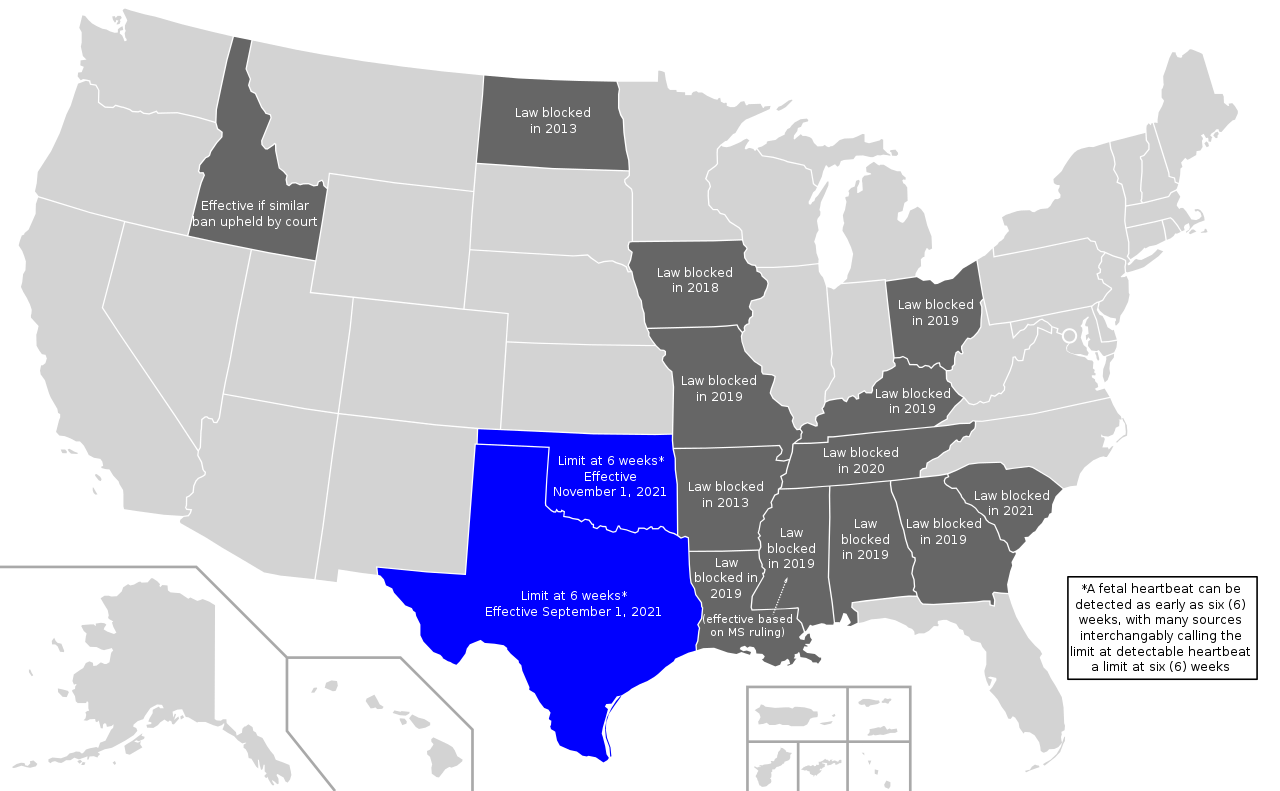
 On Wednesday, Texas became the latest red state to push the bounds of anti-abortion legislation. Following a host of other states, particularly in the South, Texas passed a fetal heartbeat bill. While the Texas law goes further than those of other states, the real interesting aspect of the Lone Star legal situation is that the Supreme Court declined to block the new law from taking effect.

A fetal heartbeat law blocks abortion in most instances if the baby’s heartbeat can be detected. In practical terms, this means that abortion is illegal after about six weeks into the pregnancy. The new Texas law contains an exception for medical emergencies but not for cases of rape or incest.

Photo by Enrique Macias on Unsplash

Share The Racket News

The Texas law also contains something new, a civil liability clause. In Texas, “any person” except government employees now has standing to file a lawsuit against “any person” who performs an illegal abortion or “knowingly engages in conduct that aids or abets the performance or inducement of an abortion, including paying for or reimbursing the costs of an abortion through insurance or otherwise.” People can even sue if they believe someone “intends to engage” in prohibited conduct. The law awards $10,000 in statutory damages for a successful suit in addition to costs and attorney fees.

Passing heartbeat bills is not new. At least 13 states have passed similar laws, but what usually happens is that they are immediately blocked by the courts. That did not happen this time.

By Nice4What - Own work, CC BY-SA 4.0, https://commons.wikimedia.org/w/index.php?curid=79100945

This time, abortion proponents filed suit and petitioned the Court for emergency relief to prevent the law from taking effect. The petition in Whole Woman’s Health v. Jackson was rejected by the Court in a 5-4 ruling which meant that the law could take effect while the case is being decided.

There are a couple of ways to look at this. One is to assume that the same justices that voted to reject the emergency injunction would also vote to uphold the law. That would, of course, pit Justices Alito, Barrett, Gorsuch, Kavanaugh, and Thomas against Chief Justice Roberts and Justices Breyer, Kagan, and Sotomayor in an epic battle royale that would eviscerate Roe v. Wade (or more accurately, Planned Parenthood v. Casey) once and for all.

It may not be that simple, however. There are a number of different ways that the Court could go if and when it finally decides the case. I say “if” because a Mississippi law is already on the docket for the upcoming term. The resolution of that case may settle the Texas question as well. (By way of comparison, the Mississippi law bans most abortions after 15 weeks.)

In any event, the Court could simply strike down the laws or it could uphold them as written. Neither of these outcomes will probably come to pass. Instead, we are more likely to see a split decision that chips away at the 1992 Casey decision which established pre- and post-viability tests for the constitutionality of abortion.

Even though the Court upheld the Texas law in the short term, it is unlikely that there are enough votes to overturn Roe completely. We’ve already seen Chief Justice Roberts, a pro-life judge, shift toward the center on the issue. It is widely believed that Roberts's more recent jurisprudence is focused on preserving the integrity and independence of the Supreme Court for the long term, rather than pushing a particular ideological agenda. There are valid concerns that an unpopular decision could energize Democratic proponents of expanding the Court.

Likewise, Brett Kavanaugh is not generally considered to be an advocate for radical change. A FiveThirtyEight analysis of ideological voting patterns of Supreme Court justices placed Kavanaugh at about the same level as Chief Justice Roberts. Neal Gorsuch was only slightly farther to the right.

Perhaps surprisingly for many, President Trump’s first two justices turned out to be relative moderates. In replacing two liberal justices, they did shift the Court to the right, but they are far less reliably conservative votes than old hands like Thomas and Alito.

Even if the Court strikes down Roe, the effect might be smaller than you think. Depending on what the Court actually said in the ruling, the country would probably revert to the pre-1973 situation in which some states banned abortion and others allowed it.

States like Texas might effectively shut down abortion providers within their borders, but more than likely, that would shift the procedures to states that were more welcoming of the practice. Planned Parenthood and other organizations might book trips to New York or California that would include a visit to an abortion clinic.

As I’ve pointed out in the past, the rate of abortions in the US has been falling for decades. By 2012, the US was performing fewer abortions than in 1973, despite a much larger population. Ironically, this milestone was achieved during the Obama presidency.

The abortion rate will probably continue to drop with or without the Supreme Court upholding the constitutionality of heartbeat bills. Personally, I believe this trend is due to the increased availability of birth control as well as technological advances that support the idea that babies are alive in the womb.

https://www.statista.com/chart/19490/us-abortion-rate-guttmacher-institute/

The outcome in the states would probably run the gamut from total bans to nearly unfettered access. Numerous polls throughout the years show that most Americans oppose abortion bans, but they also want some restrictions. The farther into the pregnancy, the more people tend to be supportive of restrictions. On average, the national landscape would probably reflect these attitudes as would the fact that, as Erick Erickson recently opined, that a lot of pro-life and pro-choice legislators aren’t really as dogmatic as they appear. In the current climate, they can say and pass anything and expect the Supreme Court to play the foil.

Beyond the abortion question, the civil lawsuit provision in the Texas law is also turning heads. The expansive definition of who can sue, which technically is not even limited to Texans, is so broad that it would be ripe for abuse. The $10,000 statutory damage award would be a tempting enticement to file a frivolous lawsuit. It’s likely that this was the Texas legislature’s goal.

I would be surprised if this provision survives legal challenges unscathed. No matter what Texans might think, they don’t have jurisdiction over other states as the Supreme Court drily noted last December when Texas attempted to sue to overturn election results in Georgia, Pennsylvania, Michigan, and Wisconsin

It is almost certain that some court at some level will agree to an injunction to allow abortions to continue in Texas, but the Supreme Court did deny the pro-abortion forces the quick victory to which they have become accustomed. When the dust settles, the Texas law probably won’t look the way it does today, but I won’t be surprised if parts of it are allowed to stand.

On a personal level, I am opposed to abortion and would ban the practice if I were king, but at the same time, it seems that winning hearts and minds has been a more successful strategy than passing top-down edicts. I’d argue that we need to focus more on funding pro-life alternatives such as crisis pregnancy centers and adoption rather than issuing controversial bans. The grassroots work doesn’t make headlines or fire up the base, but it seems to be making a bigger difference when it comes to actually changing attitudes and reducing the number of abortions.

And, if the day ever comes when abortion can be outlawed, the grassroots activists who work with frightened, upset pregnant women will help to prevent a resurgence in back-alley abortions as well as making inroads to restricting the practice in pro-choice states.


From the Racket