Friday, August 13, 2021

A tale of two corrupt leaders

 America got a break this week when one of the most despised people in politics threw in the towel. New York Governor Andrew Cuomo announced his resignation amid a widening sexual harassment scandal.

The entire country breathed a collective sigh of relief and said, “Good riddance.”

person in black knit cap and gray sweater
Photo credit: Sammy Williams/unsplash.com

While many on the right are casting aspersions on the Democratic Party for covering for Cuomo, in reality, it was the Democrats who forced him out. The list of Democrats who called for Cuomo’s resignation in the wake of the attorney general’s findings is long but includes President Biden and Nancy Pelosi. Pelosi and Alexandria Ocasio-Cortez also called for an investigation into the allegations against Cuomo back in February.

Ultimately, however, it was the Democrats in the New York state legislature who sealed Cuomo’s fate. Democrats in the legislature were ready to impeach the “love gov” after the report was released. At that point, Cuomo had to know the jig was up.

In fact, in a nod to Donald Trump’s precedent, New York may still impeach Cuomo after he leaves office. New York Assemblyman Ron Kim (D) told The Hill that the Cuomo Administration’s withholding of Coronavirus data from nursing homes last year merits impeachment even after resignation.

The legislative case against Cuomo should be continued so "we can get to the truth about whether he was motivated to defraud the public to chase down a $5.1 million book deal," Kim said.

And speaking of Donald Trump, the former president emerged from his undisclosed location on Wednesday to release a non-tweet slandering the Capitol Police officer who shot and killed Ashli Babbitt on January 6, saying the unnamed officer “murdered” Babbitt.

This latest incendiary missive has drawn no apparent response from most Republicans, some of whom, like Arizona’s Paul Gosar, have voiced similar opinions. Rep. Liz Cheney (R-Wy.), one of the few Republicans to speak out against Trump’s statement, is herself on the verge of being drummed out of the GOP.

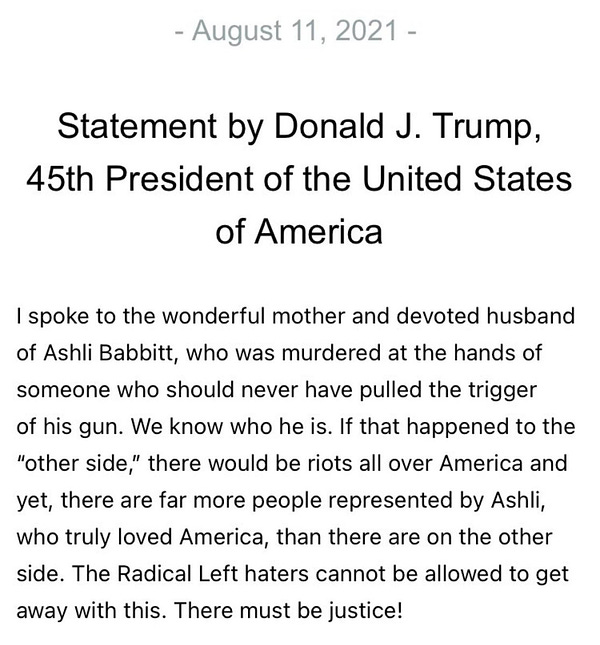
If we look at his record, Donald Trump has credible accusations against him of precisely the same sort that got Andrew Cuomo in trouble In both cases, the two men had numerous women accusing them of sexual misconduct. In both cases, the two men are accused of providing deceptive information about the pandemic for personal gain.

So, why is Cuomo a persona non grata while Donald Trump is still feted by the Republican Party? Maybe it’s because Cuomo is an Italian.

Or maybe not. Maybe it’s because Donald Trump is the Republican Party these days while Cuomo was merely a cog in the Democratic wheel.

One way to look at it is that Democrats considered Cuomo expendable because New York has a Democratic majority and a Democratic lieutenant governor. When the Trump “Access Hollywood” video story broke, Trump was facing Hillary Clinton in a presidential election that many presumed to be a “Flight 93” election on which the future of the American Republic would turn.

But wait! Mike Pence was a seasoned Republican governor who was ready to stand in the gap during the 2016 election, Trump’s 2020 impeachment, the pandemic, and everything else. Pence would have been much more palatable to independent voters and much more capable of leading the country. Plus he didn’t have the baggage of personal corruption and a growing personality cult.

And that was the problem with Pence. Republicans didn’t want a decent, competent candidate. They wanted Donald Trump. Even after the insurrection when many Republicans continued their objections to the Electoral College. And they still do.

Now everything is permissible because every election is a “Flight 93” election. The fate of American liberty hangs in the balance every time voters go to the polls because if the Democrats ever gain power then it’s all over. (Except that they won last year.)

And it doesn’t matter if Donald Trump is the sort of man who will slander a police officer who was defending members of Congress, staffers, and even Vice President Pence from an angry mob. In fact, everything I have seen suggests to me that Trump would have preferred that Pence had been killed on January 6 rather than Ashli Babbitt.

Honestly, the same goes for a great many Republicans. GOP radicals are attempting to turn Babbitt into a martyr. She wasn’t. She was a useful idiot. Babbitt probably believed that she was defending the Constitution, but in actuality, she was fighting to shred it in support of a coup attempt. Babbitt died because Donald Trump did not accept the results of a free and fair election.

Trump and the Republicans who continue to push these lies are playing with fire. They very nearly started a civil war last January. They may do so yet.

While Mr. Trump claims to want to make America great again, his actions show an utter disregard for what is best for America. The current Republican course risks tearing down innumerable institutions from the Electoral College to the FBI to the Constitution itself. You can’t make America great again if you destroy its foundation.

Voters are unlikely to give power to a party that acts crazy or that nominates crazy people. (At least not twice.) If Donald Trump is nominated again, he will likely lose again. And claim the election was stolen again.

Only this time his allies will be prepared. The fight, both in the courts and in the streets, will be much tougher. We could see widespread political violence in just a few years.

Traditional Republicans need to find their voice (and their cojones) and speak up to stop this. The time for humoring Trump’s ravings is long past.

If Republicans want to make America great again, they need to reject Donald Trump and his propaganda as the Democrats rejected Andrew Cuomo. I’m not used to looking to the Democrats for moral guidance, but here we are. It just shows how far the Republicans have strayed in a few short years.

Share


An Alert Reader sent me an article about a Republican House of Delegates candidate in Virginia. Although we don’t delve into state-level politics a lot at The Racket, this was interesting and thought-provoking.

The Virginian-Pilot reports that Tim Anderson, who won the Republican primary this year by only 28 votes, has mounted a strong campaign against COVID relief funds. Anderson would like to see businesses return an estimated $4 billion that Virginia wants to dole out to businesses.

“We should give it back,” Anderson said. “We don’t need it.”

So far, so good. You don’t have to approve of the COVID relief and criticism of government spending, even spending intended to keep the economy going in a global pandemic, is up for debate.

The problem is that Anderson benefitted from the COVID relief bills to the tune of $742,000. The newspaper reports that Anderson’s three businesses, an attorney’s office, a real estate company, and a gun shop, received payroll money under the Paycheck Protection Program and loans through the COVID-19 Economic Injury Disaster Loan program. The PPP loans can be forgiven if businesses meet certain requirements.

The newspaper report does specify that the money Anderson received is from separate programs than what he now opposes. The $4 billion seems to be a reference to the American Rescue Plan’s State and Local Fiscal Recovery Fund. The money is intended “to continue to support the public health response and lay the foundation for a strong and equitable economic recovery.”

Whether critics of government programs should accept money from the same or similar programs is an age-old question. I’m sympathetic to the argument that individuals and companies can benefit from current law even as they try to change it, but it will be up to voters to decide whether Anderson’s position is hypocritical when they go to the polls this November. Anderson could head off some of the criticism by having his businesses repay the government funds as quickly as possible, even if he doesn’t have to.

It also makes me wonder how many other elected officials and candidates profited handsomely from COVID relief.

Share The Racket News


The mask debate is among us again. The debate over vaccines and mandates will only intensify after Justice Amy Coney Barrett’s decision to reject a bid by Indiana University students to block the school’s vaccine mandate. The policy includes an exemption for religious and medical reasons that requires unvaccinated students to wear a mask and be tested twice daily.

Republicans have lined up against mask mandates, but I was curious to see where the public at large stood on the issue. A brief search found three polls taken in the past few weeks. These polls are taken randomly from internet search results.

Kaiser Family Foundation (KFF) - August 11, 2021 - Sixty-three percent favor masks for unvaccinated students and school staff, but 54 percent oppose vaccine mandates.

Gallup - August 3, 2021 - Sixty-seven percent favor masks for unvaccinated teachers and staff while 64 percent favor masks for unvaccinated students.

Hill-HarrisX - July 16-17, 2021 - Seventy-four percent favor mask mandates if their area experiences a rise in cases.

The Republican Party has staked down a deeply unpopular position in supporting an unfettered right to spread disease. While the public is not sold on the vaccines, as Steve pointed out yesterday, the benefits of masks are clearly understood by a broad majority. Acceptance of vaccines will hopefully increase as the public is educated on the subject and the shots get full FDA approval.

After 16 months of pandemic, Republicans may be miscalculating how the public will react to policies that prolong the crisis. While there is fury among the anti-mask and anti-vaccine factions, there is also palpable anger growing among people who are vaccinated yet who are still being subjected to restrictions and the danger of infection by those who are listening to the anti-mitigation zealots and fearmongers.

In bellwether polling for the GOP, both Ron DeSantis and Gregg Abbott have seen their approval ratings decline sharply during the pandemic. With Florida’s recent spike in new cases and deaths, DeSantis’s approval is now underwater while Abbott breaks even but is down from a net 24-point positive in April 2020.

But the worst problem for Republicans is that they are killing off many of their own voters since it is the unvaccinated who are subjected to the worst outcomes from COVID-19’s Delta variant. Republicans would do well to conserve their voters. They aren’t making many more these days.

Have a good weekend everybody! Stay safe!

From the Racket

Wednesday, August 11, 2021

What is the COVID endgame?

 Way back before the pandemic ever started, my kids introduced me to a game called “Plague Inc.” on our phones. This is a single-player game in which the player is a pathogen whose goal is to wipe out humanity. The user can control mutations and the like to help ensure that your disease goes viral. Fun times.

It actually was - and is - a really fun game. I pulled it out in the early days of the pandemic when I was traveling by airline. As I was enjoying my in-flight snack and trying to destroy the world, I remember a flight attendant commenting to me about the viral spread on my iPad. Fortunately, she recognized the game and had played it herself.

Photo credit : Fusion Medical Animation/unsplash.com

Anyway, I got to thinking about Plague, Inc. recently as I heard people talk about how the pandemic would likely end. In the game, there are only two possible concluding scenarios. One is that the disease infects and kills the entire global population. The other is that scientists develop a cure and the disease is eradicated. It doesn’t look like the end of the COVID-19 pandemic is going to be so cut-and-dried.

Quite a few of the people I’ve spoken with online lately think that it is a foregone conclusion that everyone is going to get COVID at some point. As this theory goes, even the vaccinated will probably be infected at some point, even though they’ll have mild cases that may even go unnoticed. Eventually, with everyone infected, we’ll all have antibodies and COVID will be so rare that it won’t be a factor.

There’s a problem with this theory. These people assume that vaccinations cannot stop a COVID infection, but that assumption seems to be in error. While there are some breakthrough infections, statistics show that these cases are rare.

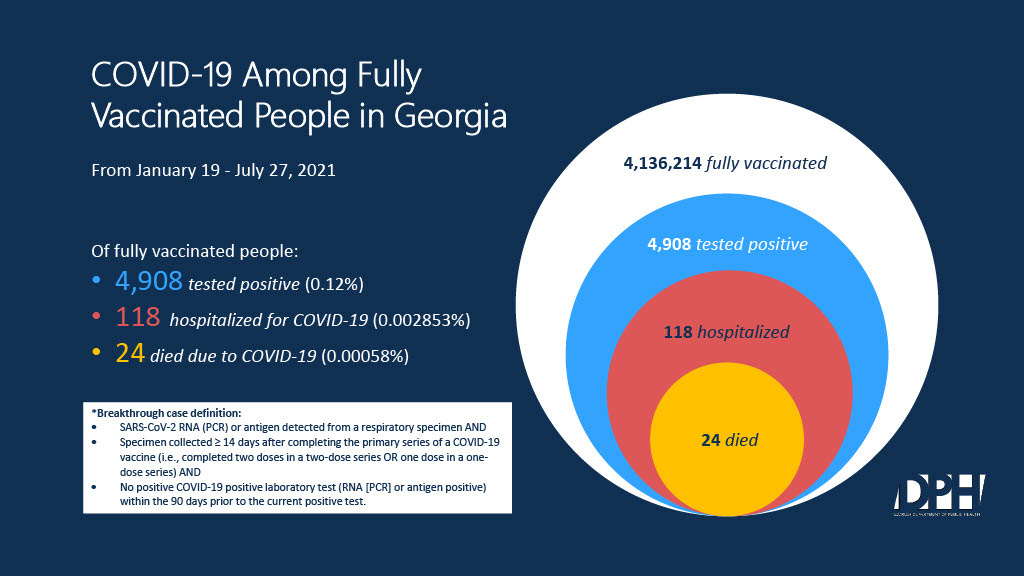
For instance, the Georgia Department of Health published a graphic that shows statistics about COVID-19 in vaccinated individuals. From January through July, only 0.12 percent of vaccinated individuals tested positive for COVID. There might have been other very mild cases where people never got tested, but the evidence is that the vaccines protect the majority of individuals from getting infected, not just from severe symptoms.

Photo credit: https://dph.georgia.gov/covid-19-daily-status-report

My own experience is additional evidence of this theory. I wrote back in July about how my wife experienced a breakthrough infection at church. Even though my kids and I were exposed before she showed symptoms, none of us were infected. And it isn’t just that we didn’t show symptoms. We were tested and got negative results.

Contrast this to my brother’s family, which was unvaccinated. His daughter was infected at work by her boss and took the virus home. At this point, the virus has spread throughout his whole family.

There’s a similar situation in my church. Since my wife was infected about two and a half weeks ago, the disease has spread like wildfire. A woman who tested positive on the same day as my wife is now on a ventilator with double pneumonia and low oxygen levels. (Please pray for Beth and her family.) I’ve lost track of how many new cases have popped up in the church since then but the number includes at least half a dozen since last Sunday, including a pregnant youth leader and a young family with a one-year-old. The baby is also among the positives.

I haven’t done a complete survey of who was vaccinated and who isn’t, but my wife is the only breakthrough case that I know of in the church. I know several of the sick are not vaccinated and I know of several people who are vaccinated who were not among those to fall ill.

I’ve chased a rabbit here, but the point is that if you’re vaccinated, there is a good chance that you will never get COVID. The vaccines are very effective, even against Delta, but they are not and never were intended to be 100 percent effective. That doesn’t mean they are worthless, however.

So what about the other extreme? If COVID-19 isn’t going to infect everyone, can it be eradicated and wiped from the face of the planet?

This is also unlikely. Throughout world history, only two diseases and been officially declared to be eradicated. These are smallpox caused by variola virus (VARV) and rinderpest caused by the rinderpest virus (RPV). Even these two diseases are not totally eradicated since scientific samples do still exist. The important thing, however, is that these diseases no longer occur in nature.

In addition to the two diseases that have been eradicated, there are about a dozen others that are now very rare and almost nonexistent. These include polio, which hasn’t existed in the US since 1979 but is still present in Afghanistan and Pakistan, tetanus, for which the US experiences about 30 cases per year, whooping cough, with less than 20 US cases per year, chickenpox, which has declined by 90 percent since 1995, mumps, which has declined by 99 percent, and measles, which had been declared eliminated in the US in 2000 but began making a resurgence in 2017 as the anti-vax movement began to grow.

The common thread among all these dying diseases is vaccines. They have all been hounded nearly out of existence because of safe, effective vaccinations that not only protect against the symptoms but against infection and transmission as well. This is how we achieve herd immunity.

And this is how the COVID-19 pandemic will likely play out. We have safe, effective vaccines that are currently being distributed around the world. This process is going to take some time, but given the high level of protection that the vaccines convey, once we have a high vaccination level it will be very difficult for the virus to find a host. This will be true on local, national, and global levels.

Once the hysteria over the vaccine has ended and cooler heads prevail, the Coronavirus vaccine will be probably be mandated for public school attendance. It is already being required by many private businesses and state and local governments for their employees. The US military just announced that its members must be vaccinated by mid-September. These steps have been taken for many other diseases in the past.

The scenario would allow for occasional future outbreaks of COVID-19 in the future. This would be especially likely in areas where there is a large unvaccinated population, as we’ve seen with measles. Some of these outbreaks might be severe enough to require local quarantine and lockdown orders.

In reality, no one really knows what the future holds, however. The virus may mutate into a less infectious and deadly strain that presents less of a threat to humans. Many scholars believe that this is how the 1918 Spanish flu pandemic ended. The H1N1 virus that caused that outbreak still pops up occasionally and has caused other pandemics.

The reverse could also be true. The virus might continue to mutate enough to evade the protections created by vaccines and natural antibodies. We might end up playing Whack-a-mole with the virus for the foreseeable future. In that case, not only might everyone catch COVID-19 at some point, we might catch it repeatedly.

A variation on that scenario is the theory that the virus will become endemic among the young. If the adult population is vaccinated, babies and young children might catch COVID at an early age and then develop immunity that will last for the rest of their lives. This would be similar to how chickenpox was long a childhood disease that was relatively mild. If an adult caught it, however, it could be very serious.

The good news is that we’ve learned how to mitigate viruses if we choose to do so. No one wants to keep the precautions in place indefinitely, but the best way to get back to normal is to embrace the mitigations in the short term.

If things get really bad, I do have my Plague Inc. experience to fall back on. I’m tentatively planning to retreat to either Iceland, Madagascar, or New Zealand as a fallback plan. If you’ve played the game, you know what I mean.

From the Racket

Florida's Delta death spike

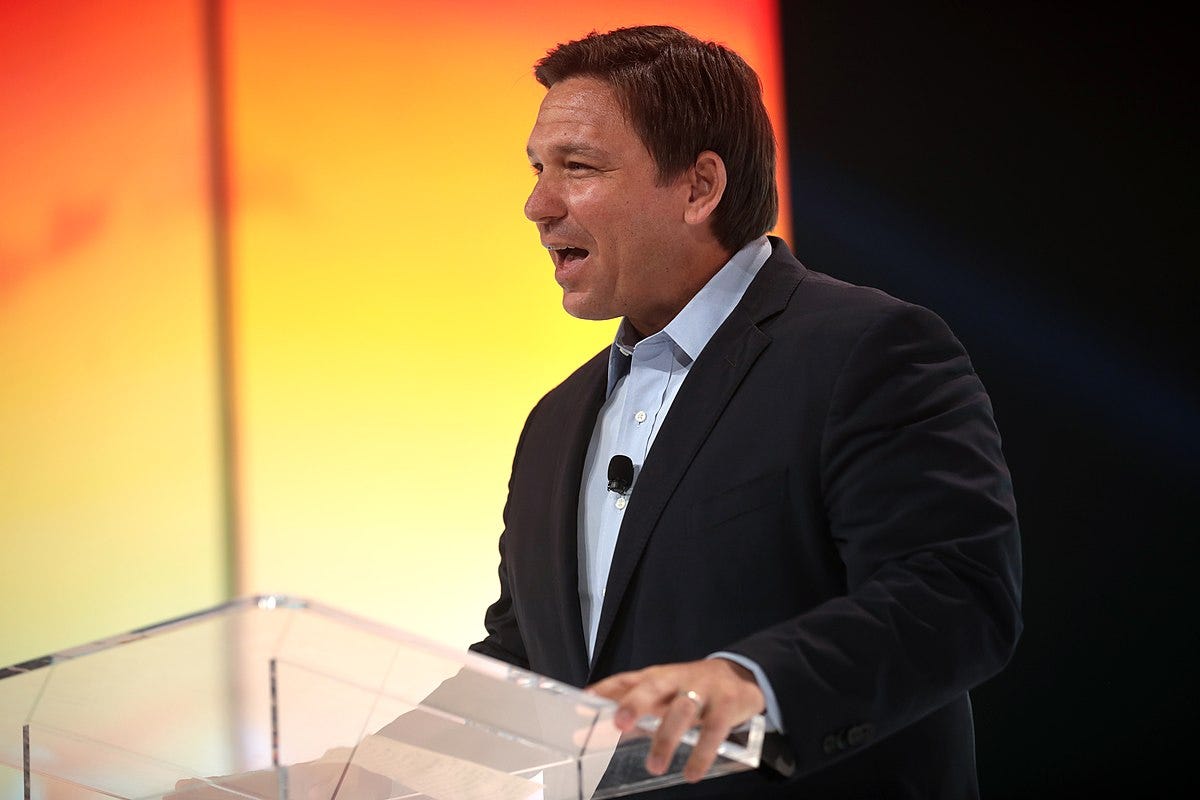
 Gov. Ron DeSantis has made resisting virtually all pandemic mitigation strategies his signature move. For a while, it seemed that Florida’s laissez-faire approach to the pandemic was working about as well as any other strategy… then came Delta.

DeSantis has been a large figure in the news since the early days of the pandemic when he told people from hard-hit areas like New York, “Don’t come here,” and set up roadblocks on I-95 and other roads leading from COVID hotspots. Only a month later, DeSantis shifted from extreme caution to pushing Florida to be one of the first states to reopen after the March 2020 “lockdown.” Since then, he has been at the forefront of the anti-mitigation crowd.

Photo credit: Gage Skidmore/wikimedia

Share The Racket News

DeSantis’s methods were controversial and whether they worked depends a lot on which metric you use. Looking at Worldmeters comparison of state COVID data, Florida ranks third in total Coronavirus cases behind California and Texas. In terms of per capita cases, Florida ranks ninth and the state is fourth in active cases. If we look at the number of cases, DeSantis’s gamble seems to have backfired.

But wait, there’s more. If we shift the focus to deaths, Florida still ranks fourth overall behind California, New York, and Texas, but when we look at per capita deaths, the Sunshine state slips all the way down to number 26, almost exactly average. (For comparison, Texas was 25 and California was 32 on that list.)

An obvious question here is why Florida’s death rate is so much lower than states such as California and Texas. There seems to be no clear answer why Florida’s death rate would be so much lower than similar states but a paper from August 2020 offered several suggestions that included possible overcounting of cases, slow tabulating of deaths, DeSantis’s early lockdown, and early intervention and prevention strategies implemented by the state Department of Health, such as limiting access to nursing homes, widespread testing, and the distribution of 75 million PPEs and $318 million in CARES Act funds to fight the outbreak.

But whatever Florida was doing right last summer, it seems to have abandoned. In the spring of 2021, DeSantis declared victory over COVID-19 and issued a series of orders attacking mitigation strategies. In May, the governor prohibited government agencies from issuing “vaccine passports” and canceled all local emergency orders. He also attempted to bar private companies, such as cruise lines that visit the state, from requiring proof of immunization. A federal judge struck down that rule on Monday. In July, DeSantis threatened to call a special session to prevent schools from mandating masks. When some schools resisted the governor’s wishes that students go unmasked, DeSantis threatened to cut their funding even as Florida’s pediatric hospitals begin to overflow with young COVID patients.

The changes came just in time for the Delta variant to exploit Florida’s new weaknesses. The government’s attempts to make reducing viral spread more difficult, together with vaccine resistance that has just over 50 percent of the state not fully vaccinated, left the door wide open for the new, more infectious strain.

DeSantis did endorse vaccines in June as cases began to spike once again, but this has not been a strong and consistent message. DeSantis’s hesitance to strongly support vaccines is likely due to his presidential aspirations and the backlash from the anti-vax right, voters he needs to secure the Republican nomination and who have called him a “sellout” for his statement that “vaccines are saving lives.”

For much of 2021, DeSantis’s policies have focused on stripping Florida’s cities, counties, schools, and businesses of the tools that they used to successfully minimize Florida’s death toll over the past year. As a result, Florida’s case count and death toll are both spiking once again. Mayo Clinic’s data shows that Florida’s average daily new case count is the second highest in the country. Only Louisiana is marginally higher. Florida’s current case count is above 20,000 per day, which is higher than during the winter surge.

And it isn’t just cases that are spiking. The death rate is increasing once again as well. Florida’s current seven-day average of deaths is 88 and trending upward. Deaths are a lagging indicator since it usually takes COVID-19 about three weeks to kill someone. The spike in deaths that we are seeing now began in early July, following the surge of cases that Florida experienced in June.

There is good news, however. I said earlier that Florida was slightly less than half fully vaccinated. To look at that statistic from a glass-is-half-full perspective, that means that about half the state is fully vaccinated. Some of those new cases will be breakthrough infections, but those cases should almost all recover. The bad news is that there are very few breakthrough cases so the majority of the cases will be among the unvaccinated.

Further bad news is that other states where COVID is once again spiking due to the Delta variant may be seeing surges in their daily death totals soon as well. In some cases, such as Louisiana, this is already happening. Georgia, Maryland, Tennessee, and Texas are only a few of the other states where COVID is surging.

From the beginning of the pandemic, there has been a question of which mitigations work and which do not. That has often been hard to quantify for comparisons. For instance, people living under mask mandates still might not wear them if the mandates aren’t enforced while people can voluntarily wear (or businesses can require) masks even if they aren’t required by the government.

With vaccines, it is different. We have good records on who is vaccinated and which states have high shares of their populations vaccinated. The large anti-vax populations in red states have unwittingly set up a large scientific experiment in which vaccine effectiveness can be accurately gauged by the number of cases and deaths that states with different vaccination levels experience. At this point, it does not look as if DeSantis and Florida will fare well when that comparison is made.

It probably won’t matter to Republicans. At this point, the party seems sold on DeSantis, who is the odds-on favorite for the 2024 GOP nominee if Trump doesn’t run.

It might matter to the rest of the country, however. DeSantis’s war on COVID mitigations will cost thousands of lives before the before the wave burns out. His anti-mask and anti-proof of immunization policies may be popular with Republicans, but they may be less so with moderates and independents, especially if they do end up killing large numbers of Floridians.

And the worst part will be that almost all of those deaths were preventable.

Share


Barack Obama’s birthday party made big news over the weekend. Many outlets accused the former president of flouting COVID restrictions to have a 500-person party replete with celebrities and featuring Pearl Jam as the entertainment.

A closer look at the party shows that things are not what they seem. At the time of the party, Martha’s Vineyard was in an area of “sustained transmission.” However, the CDC recommendation is that vaccinated people should “wear a mask indoors in public if you are in an area of substantial or high transmission.”

Additionally, the Chicago Sun-Times reported that guests were asked to be fully vaccinated and, per a source familiar with the event’s planning, “Guests at this outdoor event will follow all CDC public health protocols, including a testing regimen managed by (a) COVID coordinator.”

So, in summary, the event was in an area of reduced transmission, guests were to be vaccinated and tested, and the event was going to be outdoors. In other words, the event was in keeping with CDC guidelines. It may be that many of the critics were not familiar with the details of the event, what the CDC is actually recommending, or both.

Rather than the story being that elites are flouting COVID guidelines (which they sometimes do), the lesson here should be that if people get vaccinated and take steps to party safely, we can get back to normal.

After all, it isn’t as if many of Obama’s critics are locked away waiting for the signal to return to society anyway.

From the Racket

Tuesday, August 10, 2021

Is it time to impeach Joe Biden?

 Now, I’m hearing people say that Biden’s action was both unconstitutional and impeachable. Some Republicans, who are still smarting over President Trump’s twin impeachments, are anxious to take revenge and jump at the chance to impeach Biden.

There are several questions to be addressed here, starting with whether Biden’s move was unconstitutional. If so, the second question would be whether it rises to the level of being impeachable. Then lastly, there is the question of whether it would be politically possible to do so.

First, let’s look at the applicable law. The CDC eviction moratorium cited Section 361 of the Public Health Service Act (42 USC 264). If we look at that section of law, we see that:

The Surgeon General, with the approval of the Secretary, is authorized to make and enforce such regulations as in his judgment are necessary to prevent the introduction, transmission, or spread of communicable diseases from foreign countries into the States or possessions, or from one State or possession into any other State or possession.

As David French and Sarah Isgur pointed out on their Advisory Opinions podcast, Justice Kavanaugh wrote in his concurrence on the Alabama Association of Realtors case that the CDC “exceeded its existing statutory authority by issuing a nationwide eviction moratorium.” In reality, although the statute might be unconstitutionally broad or vague, the authority conveyed to the Surgeon General and the Secretary of Health and Human Services by the law is limited only by their judgment. There might be other applicable laws that the CDC order violates, but it would up to the plaintiffs to prove this point.

So, there are competing forces at work. There is a vague law and a divided Supreme Court that previously left the eviction ban in place, but a swing justice, Kavanaugh, has signaled that he would not uphold future extensions of the ban without congressional approval. The legal situation here is a lot more gray than many pundits on the right would have us believe, but is it impeachable?

As most of us know from Donald Trump’s impeachments, both of which I supported, the Constitution says that the president can be impeached and removed from office for “Treason, Bribery, or other high Crimes and Misdemeanors.” As most of us also learned from Trump’s experience, the phrase “high crimes and misdemeanors” is much more complex and broad than it sounds.

The Constitution itself does not define “high crimes and misdemeanors,” the Framers would have understood the term as a familiar one from English common law. What most scholars, such as those at the American Enterprise Institute and the Federalist Society, agree on is that the phrase includes both criminal and civil actions. Impeachment does not require a president to commit a crime but could include breaches of trust, incompetence, abuses of office, and the like. In reality, the modern basis for impeachment is whatever the majority party deems to be a “high crime or misdemeanor” as well treason and bribery.

In the case of President Trump, he did commit abuses of power similar to what President Biden action last week. For example, Trump declared a national emergency in order to bypass a Congress that had refused to pass his immigration and border policies. Many constitutional scholars argued that Trump’s action was an unconstitutional abuse of power.

But that was not what Trump was impeached for. Either time. In his first impeachment, Trump was charged with abuses of power relating to the Ukraine quid pro quo (i.e. bribery) scandal. In his second impeachment, he was charged with incitement of insurrection. So, Biden’s actions were similar to some of Trump’s abuses of power but were totally different from the actions that got Trump impeached.

What happened with Trump’s national emergency on the border? The answer is that people filed suit to stop what they saw as an unconstitutional abuse of power. There were several cases pending when Trump lost his re-election bid, but none of them ever made it to the Supreme Court. An appeals court in December 2020 overturned a Ninth Circuit ruling and okayed Trump’s use of $3.6 billion in military funds for the border wall, but the Supreme Court had agreed in October 2020 to hear a separate case on Trump’s wall funding. The Court recently remanded Trump v. Sierra Club, now Biden v. Sierra Club, back to the Ninth Circuit to be reconsidered in light of the change of administrations and Biden’s cancellation of the wall project so there was never a definitive ruling.

And, as with Trump’s end-run around Congress, lawsuits are the appropriate answer to Biden’s abuse of authority over evictions. In fact, suits have already been filed to stop the new moratorium. However, unless the Biden Administration tries to enact yet another extension to the eviction ban, it seems likely that the clock will run out and the issue will be moot before the courts can decide the issue.

The final question involves the political realities of impeachment, which after all, is a political process rather than a judicial one. Republicans have two major hurdles to impeaching Biden that have little to do with the legal realities of the case. First, the Democrats control both houses of Congress so any impeachment bill would be dead on arrival. To have any chance of a successful impeachment, Republicans would first need to take back both the House and the Senate in 2022.

Second, public opinion does not support impeaching Biden. There doesn’t seem to be any polling yet on a Biden impeachment, but I think it’s safe to say that the idea is limited to the fringes of the Republican Party. What we do know is that, even though Biden’s approval has declined in recent weeks as the Delta variant spread, his net average approval is still above 50 percent.

On the other hand, a slim plurality supported Donald Trump’s first impeachment per the FiveThirtyEight average of polls, but “only” about 47 percent wanted him removed from office. For Trump’s second impeachment, FiveThirtyEight’s average showed that more than 52 percent wanted Trump removed. With support for Biden’s impeachment likely in the single digits, the president probably doesn’t have much to worry about, even if the Republicans take Congress.

Even though I supported the impeachments of Donald Trump, I don’t support an impeachment of Joe Biden at this time, even though I disagree with his decision to extend the eviction ban as I made clear a few days ago. There is a fundamental difference between Biden’s action and Trump’s actions that led to his impeachments.

There is also an established course of checks and balances to deal with Biden’s overreach. The appropriate venue to challenge an unconstitutional order is through the courts, although there are problems with this course. For example, many of the Trump Administration’s legal victories stemmed from the plaintiff’s lack of standing rather than from the merits of the case. It is troubling that blatant abuses of power can be upheld because it’s difficult to show direct damages and standing to sue. There is also the possibility that a split decision by the Court could rekindle the pack-the-Court movement on the left.

But Trump’s impeachable offenses were outside the scope of the judicial system. While holding foreign aid hostage in order to force the investigation of a political rival is unethical and abusive conduct, as even some Republicans admitted at the time, it isn’t necessarily illegal. Likewise, legal incitement is a high bar. Trump’s instigation of the movement to overturn the election and the riot itself may not have been illegal per se but were unethical abuses of power that were deeply damaging to American democracy. There is a long tradition of impeaching officials for abusing their office, even if their actions were not criminal.

Without impeachment, offenses like these would be unpunishable until the official had to stand for election again. In the case of judges appointed for life, officials would be untouchable without the ability of Congress to impeach for noncriminal but unethical abuses of power.

If Joe Biden follows in Donald Trump’s footsteps and starts abusing his office for personal gain, refuses to comply with congressional investigations of his behavior, and then attempts to undermine faith in elections and toss out the Constitution to stay in power, I’ll definitely be calling for his impeachment. We are not anywhere near that point yet, however, and I doubt we ever will be.

Until then, let the courts and Congress do their job in holding the executive branch accountable. Hopefully, both will be more effective at reining in Biden than they were keeping Donald Trump in line.


As a footnote, I’ll add that, in a perfect world, the Supreme Court would strike down the entire law as unconstitutionally vague and broad. Kavanaugh’s concurrence seems to indicate that the Court is more likely to substitute its own judgment for that of President Biden, the surgeon general, and the HHS secretary.

Share

From the Racket