Friday, August 6, 2021

Is Trump's fundraising 'irresistible?'

 Steve Carell is a funny guy. I first started really paying attention to him when I was watching “The Office,” but I’ve enjoyed him in other roles as well, such as the mentally challenged weatherman from the “Anchorman” movies.

Not all of Carell’s roles have been winners. “Welcome to Marwen” was a bit weird for me, for example, but when I was channel surfing one night and saw Carell in a movie that I hadn’t heard of, I stopped to check it out.
Share The Racket News

The movie turned out to be pretty good. It was called “Irresistible” and Carell played a Democratic operative who gets involved in a small-town mayoral race. I’ll try to avoid spoilers, but the movie does poke fun at both sides. If you don’t like to see your sacred cow skewered, don’t watch it, but if you can laugh at yourself as well as the other side you might enjoy it.

The movie came back to me this week when I saw Donald Trump’s most recent fundraising numbers come out. Politico reports that the former guy raised more than $80 million in the first half of 2021 and spent almost none of it. Expenditures included administrative costs like salaries, $8 million in legal fees from Impeachment II (electric boogaloo), and a donation to the America First Policy Institute, a think tank formed by former Trump aides.

What money was not spent on was interesting. There was no funding for the Arizona ballot audit, the lawsuit seeking an audit in Fulton County, Georgia, or other attempts to dispute the election. Trump also isn’t sharing his money, which amounts to a total of about $102 million on hand, with the Republican Party or other Republican candidates. It probably goes without saying that no movers or redecorators are being hired to aid in Trump’s supposed move back into the White House.

The more than three million small contributions seem to have gone mostly to Trump’s network of PACs, rather than to his campaign. When I go to the campaign website at DonaldJTrump.com and click the “contribute” button, I am taken to a site for the Save America Joint Fundraising Committee, which describes itself thusly in the fine print:

Save America JFC is a joint fundraising committee on behalf of Save America and Make America Great Again PAC (“MAGAPac”). Joint fundraising proceeds shall be allocated among the committees as follows: 90% to Save America, 10% to MAGAPac.

The Politico report indicates that the Save America leadership PAC was formed shortly after Trump’s defeat in the 2020 election. The Make America Great Again PAC is Trump’s old campaign account, which has now been converted to a PAC as well. The joint fundraising committee steers the donations to the two respective groups.

The world of PACs is a complex one and I’m no election lawyer, but the curious thing, as noted in the Politico piece is this: There are “few restrictions” on how PACs can spend their money, but one big one is that “leadership PAC funds cannot be used to finance a presidential campaign.”

The obvious question here is that if Donald Trump has the bulk of his campaign war chest in a fund that cannot be used to finance a presidential campaign, what the heck is he going to do with it?

One possibility is that money will be used to make Trump a kingmaker with endorsements and financial support for Republican candidates. In the past, however, Trump has mainly been interested in supporting candidates who could either benefit him or help him to exact revenge on his enemies. On that score, Liz Cheney and Adam Kinzinger might find themselves facing a Trump-funded challenger next year.

There might be a way to transfer the money to a fund that could support another presidential campaign. PAC money can be moved and I’m no expert on the intricacies of campaign finance. The question is, if Trump was planning another run for president, why he didn’t put the money in a PAC appropriate for that plan?

Another possibility, the one that “Irresistible” made me think of, was that the leadership PAC money could become a slush fund. [SPOILER ALERT] A key moment in the movie is when a character says that PAC money does not have to be accounted for.

Again, I’m no expert, but this seems to be an oversimplification. There is some truth to it, however. When Duncan Hunter (R-Calif.) was indicted in 2018 on charges of using campaign funds for personal expenses, the Washington Post wrote, “Had the money for Hunter’s vacations come out of his leadership PAC rather than his personal campaign committee funds, there probably would be no scandal” since leadership PAC money lacks most of the restrictions of campaign funds.

“The result is that leadership PACs have essentially become slush funds, and almost every member of Congress has one,” the Post continued.

Likewise, a New York Times article from 2010 detailed how retiring lawmakers used leadership PAC money for everything from travel expenses to Christmas parties. Some even doled out leftover funds to their colleagues to pave the way for new careers as lobbyists. Maybe, just maybe, Donald Trump has something like this in mind for his PAC money.

Now, I’m not against money in politics, but I do acknowledge that there is the possibility of corruption wherever you find piles and piles of loosely regulated money. If you can find a politician or an activist group that you like well enough to want to send them your hard-earned cash, then you should have that right. But by the same token, the politicians and groups should be spending the donations they receive on campaigns and legislative priorities, not on personal items. (NRA, I’m looking in your direction.) My recommendation would be that if you want to donate money to a political cause, do not send it to a leadership PAC.

Maybe I’m wrong about Trump’s plans for his money. I’m not making a prediction as much as considering a possibility, but my spidey senses are tingling. The PACs are proving to be cash cows and the temptation to take the money and run (away, not for office) might be irresistible.

Share


I wrote recently that the GOP has a race problem. That came to the forefront again as the governor of Missouri pardoned Mark and Patricia McCloskey, the white couple who went viral (I have specify that they did not literally go viral due to the pandemic) after pointing guns at BLM protesters last year. The pair ended up pleading guilty to misdemeanor charges and paying fines. Later, they were featured at the Republican National Convention and Mark is even running for Senate.

The problem is this: The McCloskeys are lionized in the Republican Party for one thing and one thing only. They pointed guns at black people marching down the street. In this case, the demonstrators were peaceful and posed no threat to the couple so the McCloskeys ended up in legal trouble.

The McCloskeys were originally charged with unlawful use of a weapon and tampering with evidence while the demonstrators were cited for trespassing on the private drive. The couple pled guilty to lesser charges. Patricia was fined $2,000 for harassment while Mark was fined $740 for fourth-degree assault. Under the deal, they were allowed to keep their guns and law licenses. The city did not pursue the trespassing charges against the demonstrators.

There are two lessons here. One is that gun owners need to become familiar with laws governing their use. This is especially true if you take your gun outside of your home and off your property.

Second, the GOP needs to find better heroes. The McCloskeys are only the latest in a stream of Republicans who behave badly and then receive pardons because they are popular with the base. The list includes Joe Arpaio, Mike Flynn, and Roger Stone.

If you’re a Republican and wonder why minorities are voting Democrat in larger and larger numbers, just think of Mark and Patricia McCloskey.


From the Racket

Support good cops

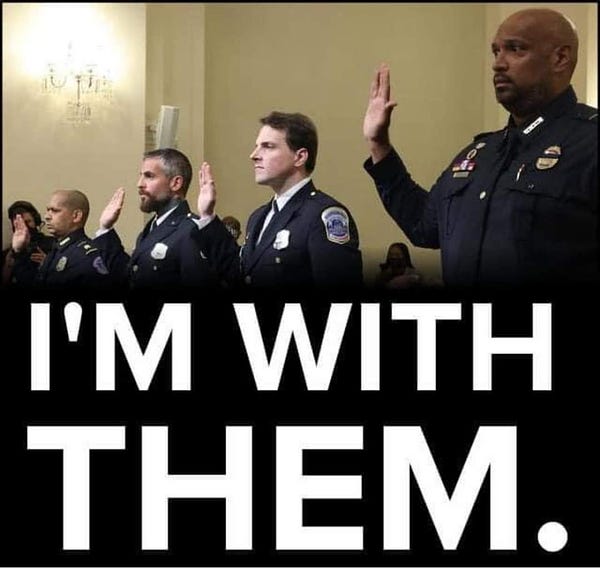
 A short while ago, one of my longtime Facebook friends criticized the Racket News for a meme that we ran on Facebook and Twitter. The meme, repeated below, was not intended to be offensive. It simply featured the Capitol Police officers who testified before the January 6 commission and stated, “I’m with them.”

The poster was critical of the Racket and asked if we had posted a similar meme in support of police during the BLM riots in the summer of 2020. Well, I have to confess that we actually did not. The Racket debuted on December 7, 2020, so we weren’t around then to post such memes. (To be fair, he did retract this criticism.)

But that doesn’t mean that we didn’t support the police during the riots. Those of you who followed me at The Resurgent may remember that I wrote a number of articles condemning the riots and supporting good cops who opposed them. But I also was openly critical of bad cops like the officers who killed George Floyd and set off the riots.

Now, I’ll agree that police officers deserve some accolades and respect simply for having the courage and dedication to put on the uniform. I’ll even agree that officers deserve some benefit of the doubt since they are often in tough situations that require split-second decisions.

But the flip side is that some cops abuse the power that is delegated to them. Some use their authority to bully citizens and commit crimes. Some just aren’t up to the very difficult task of community policing.

While I strongly opposed the actions of the rioters, I also believe that a police response that was too heavy-handed in some areas was also inappropriate. For example, using tear gas against peaceful demonstrators was both ironic and counterproductive considering the fact that the protests, many of which really were nonviolent, were in opposition to police brutality.

A low point was when police in Buffalo were videotaped roughly pushing a 75-year-old man to the ground. The man was injured in the fall, but assault charges against the cops were ultimately dropped.

This incident was bad, but it was far from the only instance of police brutality across the country last summer. Indianapolis police tear-gassed a peaceful prayer rally in June. This incident led to a lawsuit in which the Indianapolis Metro Police Department changed its policy to prohibit the use of “riot control agents” against passive resistance and peaceful protests.

In another example of what seems to be a clear Fourth Amendment violation, Minneapolis police in riot gear fired paintballs at residents sitting peacefully on the porch of their own home to force them inside. The examples of police heavy-handedness are too numerous to mention, but Greg Doucette collected many of them in a Twitter thread with more than 1,200 comments, many of which are videos of alleged brutality.

There was also good policing last summer. Many police defused potentially explosive situations by showing sympathy for the protesters. Some even marched with them. Sometimes force is needed and sometimes force is counterproductive.

I’m not saying that all cops are bad any more than I’m saying, “Believe all women,” but neither are all cops good. The appropriate way to handle both claims of police brutality and claims of sexual assault is to look at the evidence and decide what the truth is in that particular case.

Cameras help us determine what the truth is. For most of our history, it was the word of police against the word of citizens. Most often the police would win. Now video is an objective measure of who is telling the truth. I’m a firm believer that cops who act reasonably have nothing to fear from cameras. It is the bad cops - or good cops who make bad decisions such as the Minneapolis officer who accidentally shot Daunte Wright - who are being outed by videos.

There were a lot of good cops during the BLM riots, but there were also some really bad ones. The cops who did their jobs honorably deserve to be applauded, but there should be consequences for the ones who stepped over the line. I won’t go into qualified immunity here, but the doctrine is a judge-created travesty that needs to be reformed so that bad officers and departments can be held accountable and a higher standard of behavior can be set.

There were also bad cops on the Capitol Police force on January 6. At least six Capitol Police officers were suspended for their actions during the insurrection. This was not for being too harsh on the rioters but for joining them. These actions included taking selfies with rioters, putting on a MAGA hat, and giving the attackers directions inside the Capitol.

But the four officers who testified before the congressional hearings were good cops. They did their jobs honorably and then were snubbed by the party that claims to “Back the Blue.” This snub wasn’t because they did their jobs poorly but because…

I don’t think there really is one reason. Some of the radical MAGA crowd hate them because they didn’t join the mob. I think a lot of people on the right expected the police to join the revolution. When they failed to do so, the mob became vicious.

Even more than that, however, I think that the Capitol Police who are speaking out about the insurrection are an embarrassment to the Republican Party. They are a reminder that elements of the GOP led by Donald Trump tried to stage a coup and overthrow the constitutional order. Republicans would like to forget about January 6 and the Capitol Police won’t let them.

So, yes. I stand with the Capitol Police and with good cops everywhere. Proudly.

From the Racket 

Share

Wednesday, August 4, 2021

The eviction moratorium is an idea whose time has come... and gone

 The eviction moratorium is a good example of a pandemic emergency order that was justifiable at one point, but that now needs to fade away. As the country emerges from the pandemic, part of the return to normalcy is allowing markets to work. A fundamental concept of rental markets is that property owners must be compensated for and exercise control over the use of their property. This is both a moral and an economic imperative.

The eviction moratorium was originally passed by Congress and then extended by the CDC in September 2020 under the Public Health Act. The CDC moratorium was originally slated to end on December 31 of that year but was ultimately extended through July 31, 2021. The purpose was to help limit the spread of COVID-19 by keeping people, many of whom had been out of work for months, from being thrown into the streets. It is likely that many people who were evicted would have gone from one household or shelter to another, spreading the virus as they went.

Photo by Aaron Sousa on Unsplash

Share The Racket News

As it turned out, the fall and winter surge of Coronavirus cases was a viral inferno around the country. It’s probably too early to say whether the eviction moratorium had any measurable effect on reducing cases or deaths, but there was a logical intent in the program.

Now, however, even though case numbers are once again rising, we have effective vaccines to slow the spread and minimize the impact of the virus. It’s time to start returning to normal and phase out emergency orders.

The Supreme Court agrees. In the early days of the pandemic, the Court gave a lot of deference to emergency rules. This was appropriate based on longstanding precedent. However, more recently, the Court has started to apply a stricter scrutiny to pandemic rules, especially those that single out religious activities for tighter restrictions. One of the secular restrictions that the Court put an end to was the eviction moratorium.

In truth, it didn’t take the Supreme Court to put an end to the eviction moratorium. The justices just stamped the order with their seal of approval. A lower court had already struck down the moratorium in Alabama Association of Realtors v. Department of Health and Human Services but issued a stay pending appeal. The Supreme Court let this ruling stand and allowed the moratorium to expire at the end of July. In a one-page opinion, Justice Kavanaugh wrote, “Clear and specific congressional authorization (via new legislation) would be necessary for the CDC to extend the moratorium past July 31.”

The AP reports that as the moratorium ended, more than seven million Americans are behind on their rent. In some cases, this is due to no fault of their own. One example is Luis Vertentes, a 43-year-old landscaper from Providence, Rhode Island, who was hospitalized due to COVID-19, causing him to fall behind in his financial obligations. Others have simply seen their jobs disappear during the pandemic.

Until yesterday, the government said it had no plans to extend the moratorium again, but many Democrats wanted to see evictions curtailed once again. CNN reports that progressive Democrats are upset with Joe Biden for referring the matter to Congress at the last minute, even though a bill extending the moratorium at this point would have almost no chance of becoming law.

"I don't think this means this President is going to give up," said Gene Sperling, coordinator of the American Rescue Plan for the White House. "I think he's going to keep looking, keep pushing."

Sperling said that the White House focus would likely be on rent assistance or state moratoriums rather than a federal ban because the president lacked the authority to institute a new moratorium on his own. (It’s refreshing to have a president who acknowledges that Executive Orders can’t do everything.)

[Record scratch]

After I wrote the above paragraph, the Biden Administration unveiled a new, more limited eviction moratorium. CNN reports that the new policy will not be nationwide but will be limited to areas of widespread transmission. As such, “only” 80 percent of US counties and 90 percent of the population will be included.

Biden said that he had been in touch with constitutional scholars on the plan, the “bulk” of whom told him that the moratorium was “not likely to pass constitutional muster," but on the other hand "several key scholars" said it might.

So what we have is a Hail Mary that the Biden Administration acknowledges will probably be shot down by the courts. The key, however, is that the moratorium ends in October, which will probably be before the courts have time to act. Mootness will save the Biden Administration from a judicial defeat if all goes according to plan.

I take back what I said about Biden and Executive Orders. Now back to my previously written rant…

And that’s actually been the other half of the old eviction moratorium as well. It wasn’t just a matter of telling landlords, “Tough toenails [as one of my junior high teachers liked to say], if they don’t pay, you can’t evict them.”

A fact sheet from the National Low Income Housing Coalition gives an overview of the (old) program. There was an income qualifier ($99,000 annually) and requirements that tenants were “making their best efforts to make timely partial payments as close to the full rental/housing payment as possible” and have no other housing options. Tenants were also required to have “used best efforts to obtain all available government assistance for rent or housing,” funding for which was included in the various COVID relief bills.

However, the AP notes that much of the federal aid is still unspent. Landlord Gabe Imondi, 74, finally took his tenants to court when the moratorium expired after waiting months for federal rental assistance funds that never came.  

The moratorium also did not include rent forgiveness. Renters who benefit from the moratorium are still required to pay back rent and fees associated with their late payments.

Further, the moratorium did allow for certain evictions. Among the infractions that could get you evicted even during the moratorium were criminal activity, damaging the property, and threatening the health and safety of other residents.

So, the eviction moratorium had a plausible purpose and wasn’t necessarily as disastrous for landlords as is frequently assumed, but it’s still time to end it, not least because the CDC apparently exceeded its authority in extending the congressional ban.

Ultimately, the eviction moratorium needs to give way to private property rights. Landlords need to have more control over their property, including the ability to evict tenants who aren’t paying so that they can lease to someone who will. A landlord’s bills don’t stop coming just because the tenant’s rent payments do.

At this point, evicting tenants who can’t pay may be merciful for the tenant as well. If they are staying month-to-month and still incurring charges, the hole is getting deeper and it becomes more and more unlikely that they will be able to climb out. One of the first rules of debt (and one that our government has yet to learn) is that when you are in a hole, you should stop digging.

An end to the moratorium may also be the incentive that some tenants need to get back into the job market. The economy has been adding jobs but many employers can’t find enough workers to fill needed slots. That may be at least partly because some workers are purposely staying out of the job market for various reasons.

I’m reminded of the early days of the 2008 recession when being jobless meant a vacation for many people. The term at the time was “funemployed.” I don’t know how many people that would apply to today, but it does seem obvious that some workers are going to need a nudge to push them back into the working world. Ending the eviction moratorium may do that.


Giving credit where credit is due, President Biden and Speaker Pelosi were among the Democrats who called on Andrew Cuomo to resign yesterday. With both Democrats and Republicans lining up against him and the specter of impeachment hanging over his head, Cuomo is unlikely last long.

From the Racket

Tuesday, August 3, 2021

The SS Andrew Cuomo is a sinking ship

 New York Governor Andrew Cuomo is suddenly back in the news. New York Attorney General Letitia James has released the report of her office’s investigation into allegations of Cuomo’s sexual harassment and the results, as Donald Trump once said in defense of similar charges, are not pretty.

Photo: Metropolitan Transportation Authority / Patrick Cashin / Wikimedia

Share

The conclusion of the 165-page report is damning:

Upon completion of our independent investigation into allegations of sexual harassment brought against Governor Andrew Cuomo and the surrounding circumstances, we have reached the conclusion that the Governor sexually harassed a number of State employees through unwelcome and unwanted touching, as well as by making numerous offensive and sexually suggestive comments. We find that such conduct was part of a pattern of behavior that extended to his interactions with others outside of State government.

We also find the Executive Chamber’s response to allegations of sexual harassment violated its internal policies and that the Executive Chamber’s response to one complainant’s allegations constituted unlawful retaliation. In addition, we conclude that the culture of fear and intimidation, the normalization of inappropriate comments and interactions, and the poor enforcement of the policies and safeguards, contributed to the sexual harassment, retaliation, and an overall hostile work environment in the Executive Chamber.

Gov. Cuomo responded to the report in Trumpian style by denying everything. In a televised statement, the governor responded, “I am 63 years old. I’ve lived my entire adult life in public view. That is just not who I am, and that’s not who I have ever been.”

Who are you going to believe, me or your lying eyes?

While it was predictable that Republicans would “pounce” on the governor’s bad news, Democrats are also joining in calls for Cuomo to resign or be impeached. New York Senate Majority Leader Andrea Stewart-Cousins (D) released a statement quoted in The Hill that called Cuomo’s behavior “unacceptable.” Stewart-Cousins said that Cuomo “can no longer serve as Governor” and should step down “for the good of the state.”

Cuomo, who was the darling of media during the early days of the pandemic, has maintained a low profile since the sexual harassment scandal broke last December. Prior to that, Cuomo had come under fire for his controversial and tragic decision to force nursing homes to accept Coronavirus patients in the early days of the outbreak. His rapid reversal shows how quickly political fortunes can rise and fall.

Andrew Cuomo’s days are numbered. He was elected to his third four-year term in 2018 and it will be nothing short of a miracle if he can hang on to finish his term. If the Democrat is forced out of office in a heavily Democratic state, the party will rightly deserve kudos for holding one of their own to account.

Perhaps the best thing that can be said about the Cuomo scandal is that, for once, there is bipartisan condemnation of blatantly bad behavior. That’s a beautiful thing. Holding one’s own side accountable for abuses of power and potentially illegal activity is a novel concept these days but one that should return to popularity.

From the Racket

An equal and opposite overreaction

 I was in a Twitter conversation over the weekend that made me think. We were talking about the pandemic, the vaccines, and mitigations when the guy that I was talking with, whose account is now deleted, mentioned that he wasn’t afraid of COVID because he had already had it and had not had any symptoms at all.

I responded that COVID with no symptoms meant that he was an asymptomatic spreader. While that was good news for him, it wasn’t so good for people who were around him if he didn’t isolate himself. I won’t quote his answer since his account is gone and I couldn’t do it accurately, but my next reply was, “I take it you aren't pro-life.” His answer to that was that he opposed the murder of unborn babies.

“So am I,” I answered, “But I’m also against needlessly killing and sickening adults as well.”

Photo by Nadir sYzYgY on Unsplash

The exchange made me wonder why so many people seem to assume that the terms “pro-life” and “anti-abortion” mean the same thing. There is overlap, but the two phrases have specific and different meanings.

“Pro-life” is a general term that could have the synonym “anti-death.” On the other hand, “anti-abortion” states opposition to one specific form of ending lives. Life may begin at conception, but it does not end at birth so why should pro-life actions and beliefs end when the unborn baby is born?

If you look at the issue this way, then both sides can claim to be pro-life, at least in part. The Republican Party is staunchly pro-life when it comes to not killing the unborn, a position that I agree with. Democrats can claim to be pro-life when it comes to not causing needless pandemic deaths. That’s a position that I also agree with. So both parties can legitimately claim to be pro-life and I am more pro-life than either party.

That made me think that there are quite a few other areas in which the two parties can make similar arguments against each other. One that is ripped from recent headlines is the decision to cut and run in Afghanistan. Both Donald Trump’s and Joe Biden’s fingerprints are the decision to withdraw American soldiers and abandon our Afghan allies to the Taliban.

Another is example popped up Sunday night when Rep. Elise Stefanik (R-N.Y.) tweeted, “Inflation is taxation.”

Well, no, it isn’t, even if inflation’s effects on our bank accounts can be compared to taxation. Inflation may be a metaphor for taxation, but do you know what is literally a form of taxation? Tariffs. To her credit, Rep. Stefanik did oppose President Trump’s taxes on trade.

Many Democrats opposed Trump’s tax increases as well. Those same Democrats opposed Republican tax reforms and would like to see increases on at least some taxes under Joe Biden. Once again, very few of us were right on both issues, but we can claim to be more fiscally conservative than either party (especially since both parties also spend like drunken sailors).

As I thought about it, there was another example of an incident where the parties acted similarly. The right’s reaction to the death of Ashli Babbitt has a lot of parallels to the left’s reaction to the death of Michael Brown.

You may not have thought about Michael Brown for a while. There has been a lot of water under the bridge since 2014 when the 18-year-old was shot and killed by a white police officer in Ferguson, Missouri after he had allegedly robbed a convenience store.

What does Michael Brown have to do with Ashli Babbitt? The left jumped on reports that Brown was shot by the officer as he tried to surrender and that he was shot in the back. If you think about it, those claims are somewhat mutually exclusive since someone giving himself up would probably not have his back turned to the officer.

The phrase, “Hands up, don’t shoot,” became the mantra of protests and riots that followed, but as it turned out, forensic evidence, as well as a number of eyewitness reports, indicated that Brown was the aggressor. The sum total of the evidence showed that Brown attacked the officer and tried to take his gun. The officer fired, hitting Brown who initially ran away but then turned and attacked the officer again. The officer fired more shots, ultimately killing Brown.

So how is the case of Brown like Ashli Babbitt? Babbitt was also confronted by police while she was committing a crime. Also like Brown, she was the aggressor.

DOJ report on the Babbitt shooting, backed up by video from several different angles, details how she was part of a mob that was trying to break into the House of Represenatives. The rioters were breaking windows in doors inside the Capitol and Babbitt was trying to jump through one of these windows when she was shot.

Neither Brown nor Babbitt was armed, but both were criminals involved in attacking police officers. In both cases, the officers involved acted reasonably, but in both cases partisans rejected the obvious truth.

Many on the left still believe that Michael Brown was executed in the street and many on the right believe that the death of Babbitt, a woman who was part of a mob that was attempting to attack Congress - and any police who stood in their way - was unjustified. In truth, the lesson in the two cases is the same: Play stupid games, win stupid prizes. What we end up with is two tragic but justified shootings and political activists that are engaged in an equal and opposite overreaction.

The most shocking thing about Babbit’s death is that she was the only rioter killed that day. The officers defending the Capitol would have been clearly justified under federal law in using deadly force against the attackers and I am sympathetic to the argument that a mob comprised of people of different ideologies or hues might well have been given a hotter reception.

Neither party has a lock on morality or even good policy ideas, just as neither is uniformly pro-life. More and more I see both parties as deeply flawed and unworthy of leading the country. We need an alternative.

Share

Can I ask you something straight up?

Will you subscribe if you’re reading this and would like to see more? If you are a subscriber, can I ask you to share The Racket News with your friends? We have the distinction of being totally independent, and therefore we can annoy everyone without fear of losing advertising dollars or backers. We speak our minds. We encourage you to speak yours.

Share The Racket News

Thanks to everyone who has asked about and prayed for my wife during her bout with COVID-19. Debi has had a relatively mild case with Monday being her eighth day since infection. My son and I both tested negative on Monday. We didn’t test my daughter, but she hasn’t had any symptoms.

I think that we owe all of that good news to both God’s grace and the vaccines. I firmly believe that her mild illness is largely due to her vaccination while the vaccines probably kept the rest of us from getting sick at all. Anecdotally, the doctor who gave me my test said that about 20 percent of the positive results that he has seen recently are people who are vaccinated.

Another anecdote is that Debi has a friend who is also positive. This friend is unvaccinated and seems to be having a much worse experience with high fevers, fatigue, and generally worse symptoms than Debi. The friend said she didn’t want to the vaccine because people got sick even if they were vaccinated. She seems to have missed the point, however, and now she’s committed to fighting the virus on her own while simultaneously trying to keep up with a one-year-old (who is also positive but whose main symptom seems to be that is has made him more hyper).

Debi has had low-grade fevers with some headaches, coughing, sneezing, and stomach problems. She still has her sense of taste but seems to have lost her sense of smell. Her other symptoms seem to be improving so hopefully her sense of smell will return soon as well.

After her diagnosis last week, Debi isolated herself in the bedroom to protect the rest of the family and that strategy seems to have worked. She has come out occasionally to walk outside or sit on the porch to get fresh air.

Debi was concerned about our dogs since there is a risk of canine infection so we’ve kept them away from her as well. She took the photo below of our dogs staring into the bedroom past the cooler that we set up for her and some boxes of drinks. The doggos could easily get past the obstacles and into the bedroom but they usually stop at the door and just watch her. They definitely sense that something is not as it should be.

That experience made us wonder if any of our readers had stories about how their animals reacted to owners with COVID. If you have a story, we’d love to hear it.

May be an image of dog and indoor
Photo credit: Debi Thornton/Facebook

From the Racket