2020 was a controversial year. One of the recurring complaints about 2020 was how several states made substantial changes to voting rules over the months prior to the election. Given that it is most often Republicans who complain about these changes in the midst of the pandemic election, it might be surprising to learn that Republicans are spearheading changes this year that are even closer to Election Day.
To be fair, there were big changes in the run-up to the 2020 election. Sometimes these changes were approved by state legislatures Some, like Georgia Secretary of State Brad Raffensperger’s decision to send out unsolicited absentee ballot applications to every registered Georgia voter for the 2020 primary, were not.

There is legal precedent for avoiding electoral changes in the middle of an election cycle. The Purcell principle dates back to 2006 and discourages mid-election rule changes that could confuse voters. But the principle is not an absolute prohibition and comes with a set of guidelines that include considering the likelihood of the outcome of the case on the merits, whether there would be irreparable harm, and a consideration of the public interest.
Some critics have also cited the Constitution’s Elections Clause, which authorizes the states to set their own rules for elections, stating, “The Times, Places and Manner of holding Elections for Senators and Representatives, shall be prescribed in each State by the Legislature thereof…”
Whatever you think of these changes, there was a legitimate reason to change horses in midstream in 2020. The COVID-19 pandemic was killing thousands of people every day, and there was a logical reason for the government to discourage public interactions that included standing in line at polling places.
Several cases involving changes to election law came to the Supreme Court in 2020. The outcomes were a mixed bag. The Court reversed some rule changes, such as a decision striking down Alabama’s curbside voting ban, and let others, such as several absentee ballot deadline extensions stand. Interestingly, the Court declined to intervene in a Rhode Island case over a suspended witness requirement for absentee ballots and reversed a similar change in South Carolina two months later.
A great many of the Supreme Court’s pandemic cases follow a pattern that shows a change in thinking over time. In the early days of the pandemic, the Court was more likely to be deferential to government officials exercising their emergency authority. As time went by and the outbreak increasingly came under control, the Court was less likely to uphold emergency measures (although I distinctly remember a great many people saying that pandemic emergency law and lockdowns were here to stay).
As to the Elections Clause, a lot of people misunderstood the Framers’ intent. When the Constitution reserved the power to make election rules for the states, it was not a requirement that every change be passed by the legislature. This would be an unwieldy process in an emergency. Instead, state legislatures passed laws that delegated some of this authority to state elections officials like Brad Raffensperger.
Emergency authority varies by state (Federalism!) and some states did better than others, but it is clear that some degree of flexibility is needed for emergencies. It is greatly concerning that several states have limited emergency authority since 2020. This may lead to a different sort of problem in the next national emergency.
It’s also important to note that Republicans didn’t have to discourage their voters from using absentee and early voting options. That was a strategic choice by Donald Trump that predictably ended badly.
Fast-forward to 2024 and there is a different problem. In at least two states, Republicans are seeking to implement last-minute changes that could wreak havoc on the current cycle of elections.
In my home state of Georgia, the problem can be traced directly back to 2020. In 2021, the General Assembly (Georgia’s legislature) passed an election reform bill that was widely panned for criminalizing the distribution of water to voters in line. As it turns out, that wasn’t the worst part of the bill.
Majority Republicans, stinging over the losses of Donald Trump and Senate candidates David Perdue and Kelly Loeffler, limited the power of the Secretary of State, who had rebuffed Trump’s request to “find” enough votes to change the outcome of the election. In the past, members of the State Election Board had been appointed by the Secretary of State. In the aftermath of Raffensperger’s refusal to play ball, the General Assembly stripped the Secretary of that power and instead mandated that the board be constituted of five members with the governor, the state Senate, the state House of Representatives, and the Democratic and Republican parties each getting a pick.
Last month, the three board members appointed by the House, Senate, and Republican Party banded together to impose a new rule that would require county election officials to make a “reasonable inquiry” before certifying election results. As I noted in a piece at the time, this rule conflicts with existing Georgia law that requires speedy certification of election results. While Republicans often complain about the slow tabulation of election results, this rule seems intended to unlawfully slow the certification process. While the legislature can delegate authority to the State Election Board, the unelected board cannot overrule laws passed by the legislative process, and a lawsuit challenging the rule is set to be heard in October.
Now the board is at it again. Late last week, the board announced a new rule that would require ballots to be hand-counted at each polling place. Per CNN, the intent is to ensure that the number of ballots on hand matches the number of ballots counted by voting machines. The rule does not require counties to hand-count the results for each candidate, only the total number of ballots received at the polling place.
I’ll pause here for a second and explain the voting process in Georgia. Voters use touchscreen machines at the polling place that record their choices. These machines are not connected to the internet and print out a paper ballot, which the voter then deposits into another machine. Any attempt to hack the state’s voting machines would require both access to the machines themselves to alter vote totals as well as the ability to print matching ballots and place these fraudulent records with the legitimate ballots at the polling place. To date, there has been no material discrepancy between the paper ballots and the electronically counted votes.
So once again, the State Election Board is unilaterally implementing a subjective and substantive change to election procedures even though Election Day is only six weeks away and early voting starts in about half that time. All this is to solve a problem that is nonexistent but is nevertheless a MAGA bugaboo.
And once again, the mandated change seems intended to slow down the certification process while injecting uncertainty into the outcome of the election. The chances are very slim that human counters will be able to count hundreds or thousands of ballots quickly and with the accuracy of a machine. It is far more likely that the counters will end up contaminating the ballots and throwing the legitimate results of the election into question.
It is worth noting that Governor Brian Kemp and other top state officials have voiced objections to the board’s changes. Kemp’s appointee to the board voted in the minority with the Democratic pick, and Attorney General Chris Karr warned the board that its new rules “do not fall within the Board’s regulatory power.” Kemp has reportedly considered firing the three Trump-aligned members of the board who are pushing the rule changes, but it isn’t clear that he has the authority (or the political will) to do so.
The shenanigans in Georgia are not the only game afoot. Nebraska Republicans are considering a bid to reallocate the state’s electoral votes with less than two months to go until Election Day.
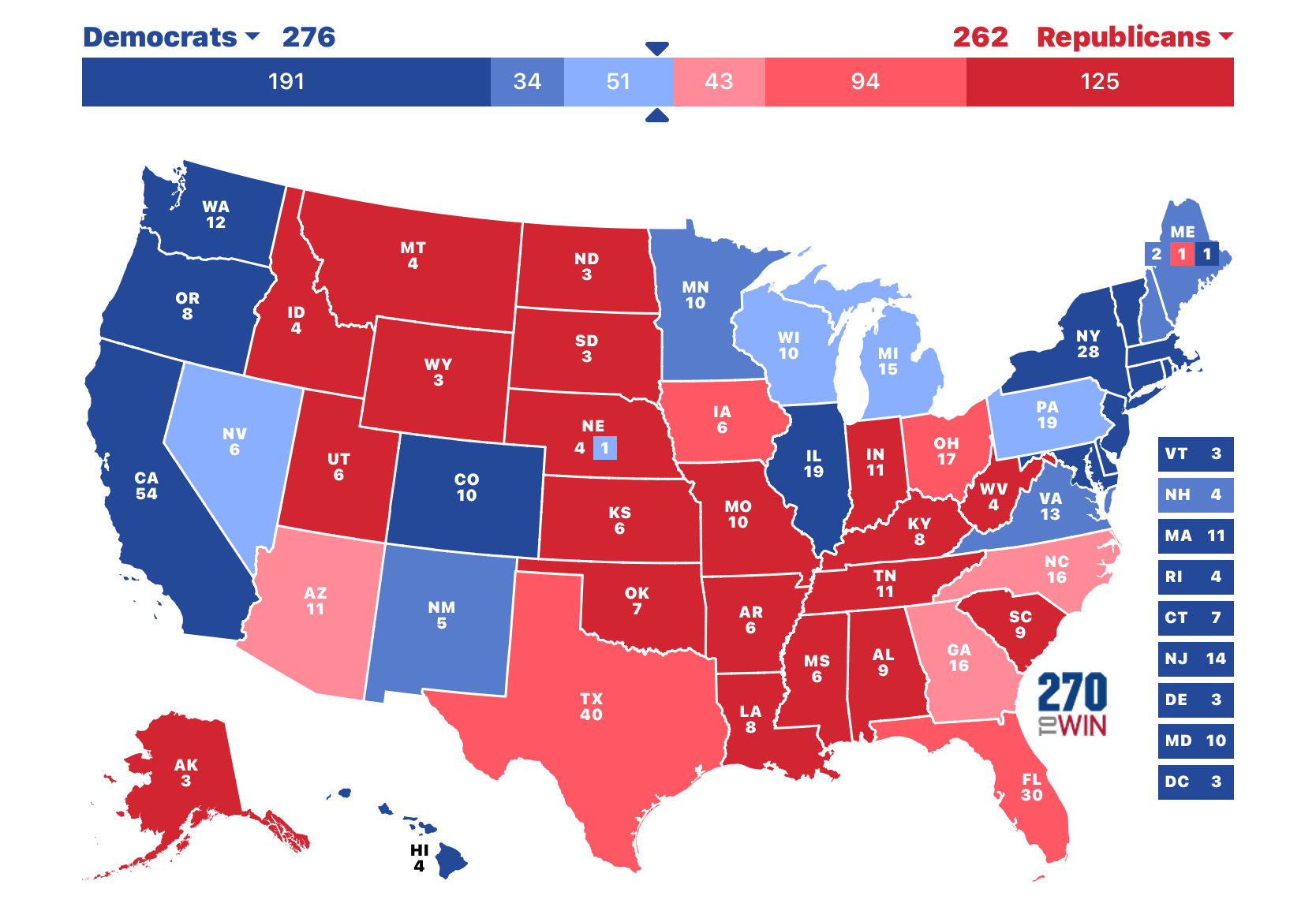
If you’ve looked closely at Electoral College maps, you may have noticed a tiny bit of blue in the Midwest. That blue symbolizes one of Nebraska’s five electoral votes. Nebraska is one of two states (the other is Maine) that allocate electoral votes by congressional district rather than winner-take-all. To be exact, two electoral votes go to the statewide winner, and each congressional district gives an electoral vote to the candidate who wins it. The second district, centered on urban Omaha, typically gives its electoral vote to the Democrats.
Donald Trump endorsed a change to the winner-take-all system last April, but Nebraska Republicans haven’t had the votes. Republicans still have not given up. Trump dispatched Lindsey Graham to win over enough Republicans to force the change. If enough votes can be wrangled to overcome a Democratic filibuster, Nebraska’s Republican governor will have to call for a special session to enact the changes. The New York Times reported that the MAGA effort to change the rules is being held up by a single Republican state senator.
If anything is driving the MAGA politicians to push through last-minute changes, it is Donald Trump’s declining poll numbers. A few months ago, Trump looked likely to cruise to re-election. Now Georgia is a tossup, polls and models are favoring Kamala Harris, and Nebraska 2’s one electoral vote could change the outcome in a close election. It could all come down to Omaha if Harris loses the Sunbelt states of Arizona, Georgia, Nevada, and North Carolina but wins the Rust Belt states of Michigan, Pennsylvania, and Wisconsin. (See that map here.)
Four years ago, Republicans complained - with some justification - about changing voting rules during a pandemic. This year, they are working to change rules for no other reason than that they are worried about the outcome.
I am cautiously optimistic that courts will rein in these attempts to put governmental fingers on the scales of the elections, but even if the legal process does keep the partisans in check, uncertainty has already been injected into the electoral system, both as a justification for the changes and a by-product of partisan tinkering.
The attempts to sway the outcome of the election through nefarious rule changes also tell us a lot about the ethics and principles of the MAGA Republican Party, not that we need any more confirmation of their moral bankruptcy and willingness to subvert any rule and norm for Donald Trump. Having said that, we should also appreciate and applaud those Republicans who buck their party’s wishes to do the right thing.
GOVT FUNDING DEAL: The chances of an October government shutdown seemed to recede as congressional leaders reached a deal that would extend government spending by three months. The deal would push decisions on a long-term deal until after the election.
ELECTORAL UPDATE: As a temporary feature, I’ve decided to include the current Electoral College map based on Real Clear Polling averages. Bear in mind that several states are tossups that are too close to call, but I’m using the average as found on the website even though some states are as close as 0.1 percent. You can play with the interactive map at 270toWin.