Thursday, May 19, 2022

Random thoughts in a weird week

 You may have been wondering where I’ve been this week. There are several ways to answer that question. Metaphorically speaking, my life has been extremely busy with my son’s graduation from high school, a round of home improvements, and one of the busiest work weeks that I’ve had since the onset of the pandemic. Literally speaking, I’m in Canada on a business trip.

It has been a really busy week with a lot of stuff that I would have loved to comment on if I had the time. Up until now, I haven’t, however, so I’m going to take the opportunity to make some quick hits now.

Photo by AbsolutVision on Unsplash

The China East Airlines crash When China East Airlines Flight 5735 crashed back in March, I suggested foul play as a possibility. This week a Wall Street Journal report revealed that information from the flight data recorder indicated that the plane was intentionally placed into a nose dive into the ground. As I wrote at the time, “There are very few reasons that an airplane would fly straight into the ground,” but that catastrophic structural failure and foul play were the two most likely scenarios.

The Journal report doesn’t name the perpetrator or even confirm that it was a crewmember, citing the possibility that someone else might have gained entry into the cockpit and taken over the controls. Since 9/11, US airliners typically have hardened cockpit doors, but foreign carriers, especially those that fly domestic routes, may not have this protection.

The cockpit voice recorder, the other “black box” that records cockpit sounds, may hold the answer to these questions. The CVR was reported to be in the US in early April, but the Journal report does not indicate whether CVR data has been analyzed.

An AP report that China denies that US investigators leaked the FDR details is also worth noting, but I’m going to go with the leaker on this one.


This week’s elections Wow, what a mess. As Steve pointed out, voters fired Madison Cawthorn (who shouldn’t let the door hit him in the butt on the way out, at least partly because he might like it) by less than two percentage points. But at least North Carolina Republicans avoided the facepalm, even if it was a near thing.

Not so for Pennsylvania Republicans. They may have rejected Kathy Barnett, but they did give the nod to Doug Mastriano, who has been connected with QAnon and who marched at the “Steal the Vote” rally on January 6 and is being subpoenaed by the January 6 committee for his role in attempting to overturn Pennsylvania’s vote for Joe Biden.

This is not a good guy. If elected governor, Mastriano could conceivably use his authority to change Pennsylvania’s Electoral College selection by refusing to certify election results or seeking to throw out Democratic votes. This may not succeed in the end, but it would certainly provoke a constitutional crisis.

No one who was involved in Trump’s coup attempt should be trusted with any public office again. Unfortunately, many will be. At the very least, these people should be kept as backbenchers and not given executive power or positions of influence over administering elections.

There is some evidence that Republican leaders were against Mastriano and tried to favor other candidates, but Democrats hyped the radical that they thought would be easiest to beat. They may regret the strategy soon, but for now, the ball is in the GOP’s court.

Will Republicans coalesce behind a man who is a literal danger to democracy or will they do the right thing and abandon Mastriano to vote for Democrat Josh Shapiro, a third-party candidate, or just stay home? In the old days, principled Republicans would abandon the party when dangerously bad candidates were nominated, but these days that firewall too often fails amid “Flight 93” election rhetoric.

And speaking of bad Republican candidates, Dr. Oz’s Senate race is too close to call and The Former Guy is telling him to just declare victory anyway.


Baby formula blues You’ve undoubtedly heard about the baby formula shortage by now. The problem is primarily one of supply, some of which relates to pandemic disruptions but is primarily a factor of a recall by Abbott Laboratories. The Abbott factory that makes a large share of baby formula sold in the US was shut down after four infants were sickened in February and two died.

As Reuters explains, there seems to be no definitive link between the formula and the sickness, but federal regulators nonetheless shut down the plant citing other issues. Abbott and the FDA have agreed on steps to reopen the plant, but the company says that it will take six-to-eight weeks after the plant gets the okay to reopen to get new formula into stores.

In this case, the federal cure seems worse than the problem. Well-meaning regulators have created a crisis where there is no evidence that formula was part of the original infant deaths. In any case, four cases of illness is an extremely small share of the total number of American infants who were eating - and still need - baby formula. Millions of babies are now threatened by the FDA’s action.

The case reminds me of the Johnson & Johnson vaccine scare. Steve Berman pointed out back in April 2021 that a pause in the approval for the J&J COVID vaccine was due to an infinitesimal number of cases of severe side effects. The doubt that the pause sowed among a public already skeptical about COVID vaccines probably cost more lives than the vaccine itself would have.

Was Biden responsible for the baby formula crisis? No. At best, he might have been able to intervene to restart the plant earlier, but such interference in the government’s police powers is also frowned upon. From a limited government standpoint, I should also point out that the government is not responsible for ensuring an adequate supply of baby formula. However, given the fact that federal regulators did cause the crisis, Biden’s decision to invoke the Defense Production Act, which authorizes the president to expand production of basic resources, does make sense, as does increasing the importation of baby formula.

The saga is a cautionary tale about placing too many eggs in one basket, but the Wall Street Journal notes that the aforementioned oval objects were placed in the carrier at least partly by government policies. These include both a protective tariff of 17 percent on imported formula and government WIC contracts that allowed four manufacturers to dominate the US baby formula market.


Political extremism Finally, Tucker Carlson has been blamed by many for touting the anti-immigrant replacement theory that motivated the Buffalo murderer. While Carlson and the others who pushed this alarmist, racist worldview are not directly responsible for the killings, their hands are also not clean.

When you push the idea that the country is being destroyed from within night after night, the logical consequence of the dire predictions is that someone is going to take it seriously and take matters into their own hands. It’s the same as Trump’s admonition in January 6 to fight because they are stealing our country. That may be figurative language, but it’s also language that many take literally.

Right wing pundits and politicians are breeding a generation of extremists. And I mean that literally. The proof is in the mounting death toll and arrest statistics of right-wing and white nationalist agitators.

This is not going to end well.

From the Racket

Thursday, May 12, 2022

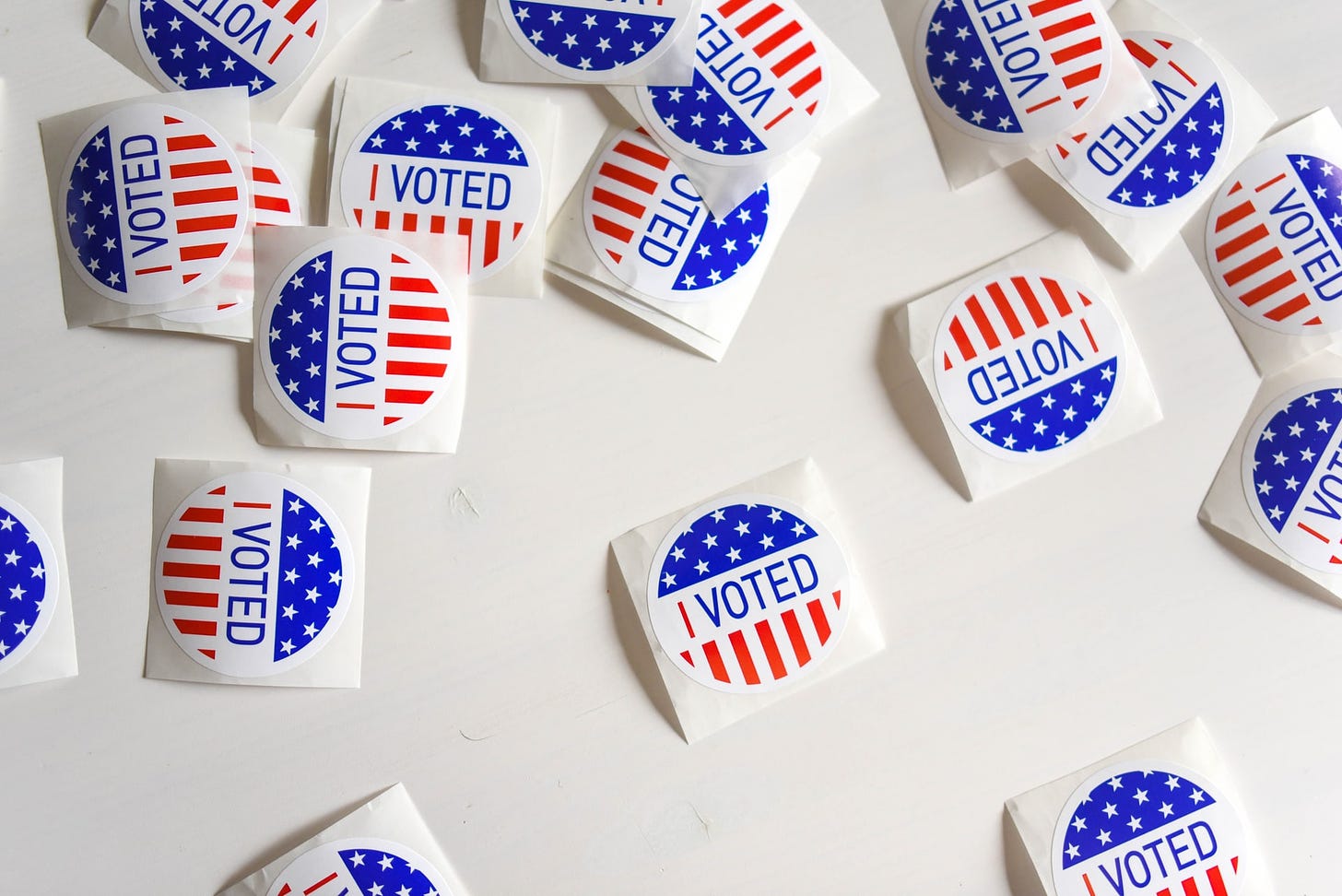
What is your vote really worth?

 From time to time, as elections approach, I think about the value of a vote. The right to vote and have your vote actually count, as opposed to authoritarian elections where the dictator gets 99 percent, is priceless, but your individual vote is not worth as much as you think it is.

Votes are essentially a commodity and are subject to the laws of supply and demand. One of the economic laws that most of us are familiar with states that prices, or value in this case, decrease as supply increases. So in an election with many other voters, your vote is worth less than in an election in which there are few voters.

Photo by Element5 Digital on Unsplash

Local elections have few voters, especially in off years. For instance, my county had about 20,000 voters in 2020 and about 371,000 people voted in my congressional district. My vote would obviously carry a lot more weight in a county-wide (1/20,0000) election (or smaller) than in the congressional contest (1/371,000).

If we expand the view to statewide elections, my vote matters even less. In Georgia, where I live and vote, there were about 4.9 million voters in 2020. My vote was a drop in the bucket.

In presidential elections, the individual vote makes the least difference. Aside from the fact that you are one among all the other voters in your state, you have 49 other states and the Electoral College to contend with.

The Electoral College uses a winner-take-all system in every state except Maine and Nebraska, which distribute their electoral votes by congressional district. So if you reside in one of the approximately 40 states that is not a battleground state (a list that varies somewhat from year to year), your state’s electoral votes are fated to go to one party or the other and there’s not a dang thing you can do about it. Votes for president by Democrats in Texas or Republicans in California are essentially worthless.

This isn’t to say that I oppose the Electoral College or think that minority party members shouldn’t vote if they live in a state dominated by the other party. The Electoral College is designed to prevent populous states from overwhelming the smaller states in presidential elections and it does that well.

If there was no Electoral College, small states like Arizona, Ohio and Wisconsin would never see presidential candidates. Contenders would spend all their time in big, metropolitan states where the donors and big media markets are. As the system currently stands, candidates need the small states.

The Electoral College also helps to provide circuit breakers to guard against fraud. Without the Electoral College, Republicans could have “found” extra votes in a state like Texas to offset the few votes needed by the Trump campaign.

I’m not just picking on Republicans though. Democrats probably would have tried the same thing in a close election like that of the year 2000. I don’t trust either party when it comes to counting votes.

Even if you know without a doubt that your state is going to go for the opposing party’s presidential candidate, it’s still important to vote. Why? Because of all those local races where your vote really does matter. The presidential and statewide races may be the main event, but there are other fights on the card where you can have an impact.

And those races probably affect your life much more than who is sitting in the White House. With Congress all but paralyzed by both parties’ inability to compromise, the filibuster, and legal challenges to any legislation that somehow does run the gauntlet, it’s rare to see any big changes coming through Washington, D.C. Not so for state and federal governments.

In quite a few states and cities, the elections are decided in the partisan primaries because you can’t get elected dog catcher as a member of the minority party if you are outside a few pockets of opposition. Primary elections reward extremism since the party base comprises the pool of primary voters. As a result, we get de facto one-party rule and a lot of broadly unpopular legislation that comes with it. This is why deeply partisan states like Texas, New York, Florida, and California are home to so many radical (and radically stupid) laws.

To counter this, we need more moderates voting in primaries and we need more minority party voters pulling the lever in general elections. That’s particularly true in smaller elections where a small number of voters could change the outcome.

And these are the elections that matter. If you don’t like the way your school system is run, vote in the school board election instead of federal politicians who want to dictate a national education policy. Concerned about crime in your town? Vote for mayors and councilmen who will clean up the city rather than national-level demagogues.

The irony is that these small elections that matter the most and have the most direct effect on our lives are the hardest to become educated about.

Right now, early voting is underway in Georgia’s primary elections. My deep-red county is one of those in which the November election is a mere formality so I’m trying to do my due diligence and research the candidates, especially those vying to replace our old county commissioner, who is retiring. There are two options and both campaigns are run primarily through Facebook pages, which mostly consist of pictures of grandkids and professions of love for the county, and yard signs. It’s all about name recognition.

I took the unusual step of tracking down email addresses for both candidates and sent them a few questions are relevant issues. So far, neither has responded.

And don’t get me started on judicial elections. Georgia is one of the states where judges are directly elected in nonpartisan elections, but just try to find information about these candidates. (For years, one of the most popular articles that I wrote was a voter guide for judicial candidates. I was the only one that did one.) It’s largely a moot point anyway because only two of the seven judicial races on my ballot have more than one candidate.

I’m definitely thankful for the right to vote. I’m also thankful that we have elections that matter.

But exercising the right to vote is an act that people should give more thought to than just looking for the (R) or (D) after a candidate’s name. Find out what the candidates stand for (and whether they are crazy or not, a big problem lately), don’t just vote for the guy with the most signs or the one your party recommends.

It isn’t easy, but research those local races and vote in them, don’t skip them. That’s where your vote matters most.

From the Racket

Tuesday, May 10, 2022

A ban too far

 The Supreme Court has not overturned Roe v. Wade, but you’d never know it from listening to both sides on the abortion debate. The draft opinion that was released last week has yet to become law and, depending on what happens behind the scenes at the Court, may never become law. This hasn’t stopped the pro-choice movement from engaging in end-of-the-world histrionics as Steve noted yesterday. It also hasn’t stopped the right from spiking the football and trying to kick extra points even though the ball has not yet crossed the goal line.

It was only six years ago that Donald Trump was roundly criticized by pro-life activists for suggesting that women should be punished for obtaining abortions. For the most part, the pro-life movement has traditionally looked to protect both women and babies by focusing any criminal charges on those who provide abortions.

Now, however, at least one state is proposing such a law. The Washington Post reports that Louisiana Republicans are considering a bill that would allow women who get abortions to be charged with homicide. The text of the bill, which protects life “from the moment of fertilization,” expands the state definition of homicide to include unborn babies and would be enforced “without regard to the opinions and judgments of the Supreme Court of the United States.”

To be fair, not all pro-lifers support the bill, which is blatantly unconstitutional in its call to ignore federal courts. In fact, Louisiana Right to Life, the state’s preeminent pro-life group opposes the measure.

“The abortion industry, for decades, has exploited women and unborn children for profit. Women are a victim in today’s society because of the way the abortion industry sells abortion to our society. Our long-standing position has been to hold those accountable who are performing the abortions not necessarily the mother who’s having the abortion,” Ben Clapper of Louisiana Right to Life told Baton Rouge’s WAFB-TV.

The Louisiana bill comes on the heels of criminal charges against a Texas woman in connection with a self-induced abortion. Even though Texas law exempts women from being prosecuted for abortions, Lizelle Herrerra was charged with murder back in April, reports NBC News. Although the charges were quickly dropped, per Reuters, there are other cases of women being convicted for taking action that results in miscarriage.

In most cases, criminal codes target abortion providers rather than women. An example is a new Tennessee law that makes it a criminal offense to distribute abortion medication unless the doctor is physically present is an example.

So far, Louisiana appears to be the only state seeking to prosecute mothers who obtain abortions, but there seems to be somewhat wider support for other measures. In a move that seems calculated to summon up “Handmaid’s Tale” cosplayers, some Republicans have suggested overturning the legal precedent that prohibits bans on contraception.

At least two Republicans have criticized, the Supreme Court decision in Griswold v. Connecticut, which struck down the ability of states to ban contraception. One of these Republicans is Blake Masters who has vowed to only vote to affirm justices that would overturn Roe, Griswold, and Planned Parenthood v. Casey, another landmark abortion ruling. Masters is currently a senatorial candidate in the Arizona Republican primary.

The second, however, is Marsha Blackburn, the sitting Republican senator from Tennessee, who commented during the Ketanji Brown Jackson confirmation hearings that Griswold was "constitutionally unsound." Blackburn does not seem to have called for the decision to be overturned since Alito’s draft opinion was released, however.

In Idaho, House State Affairs Committee Chairman Brent Crane, quoted by the Idaho Statesman, said that he would hold hearings to consider bans on emergency contraception and abortion pills, citing safety concerns. Crane clarified that he did not oppose contraception in general.

There does not seem to be a real move afoot by Republicans to ban contraception, but some, like Mississippi Governor Tate Reed, don’t rule it out. In an interview with Jake Tapper, Reed gave CNN its headline by only saying that banning contraception was "not what we are focused on at this time."

Meanwhile, a new Tennessee law that was widely reported to ban contraception, does not. The Tennessean reports that the state’s new law only bans abortion-inducing drugs that end pregnancies and not contraceptives or “morning after” pills that prevent conception.

A third new category of restriction is comprised of laws that restrict traveling out of state for abortions. A proposed law in Missouri would ban interstate travel for abortion by the state’s residents. This seems likely to violate the Interstate Commerce Clause, but legal scholars say that there is no clear precedent addressing the issue of states restricting their citizens while outside the state boundaries since the Fugitive Slave Act cases that date back before the Civil War.

“There’s no clear precedent saying that states can’t try to regulate out-of-state conduct if it has some effect in-state or if it [involves] one of their citizens,” David Cohen, a professor of law at Drexel University’s Kline School of Law said in Politico. “What these laws are doing is saying, ‘We have a different understanding of how America works, and that understanding is that if you live in this state, we control you everywhere you are.’”

Other states are considering legislation similar to the Missouri travel ban, which is modeled on the Texas law that moves enforcement of anti-abortion law to private citizens in civil cases. Both the Texas law and the Missouri bill are examples of atypical legislation that could be used to expand the power of the state far beyond abortion if courts allow them to stand.

Finally, Minority Leader Mitch McConnell has said that Republicans would consider federal legislation to ban abortion at the national level if the Supreme Court strikes down Roe. This is an empty threat, however, since McConnell has also said that he would not support scrapping the filibuster to pass the ban. With the filibuster in place (and possibly even without it thanks to moderates like Collins and Murkowski), there is no chance of a federal ban clearing the Senate, much less President Biden’s desk.

I don’t think for a moment that it is a mainstream idea among Republicans to prosecute moms who get abortions or ban contraceptives or regulate interstate travel to get abortions, but I do think that such talk will be construed as mainstream by a lot of voters. I wrote last month that one of the biggest threats to the looming red wave this November was stupid things that will be said by Republicans. The draft opinion provided the spark for many such stupid comments. Stupid comments that are frightening to a lot of voters.

Keep in mind that while the conservative pro-life movement is happy about the prospect of overturning Roe, about 70 percent of Americans are not happy with the looming decision. An overwhelming number of polls show that a large majority want abortion to remain legal (although most want some restrictions on the practice).

Even those of us who support restrictions on abortion feel that many of these measures go too far. The point where unborn babies become alive is an uncertain one and the vast majority of voters support exceptions for rape, incest, to protect the life of the mother, and in cases of serious health problems for the baby. Effective, low-cost, available contraception is one of the best answers to reducing the need for abortions.

Republicans would do well to move on from the abortion issue if and when the Supreme Court hands down its decision overturning Roe. Pushing for more and more restrictive policies and denouncing birth control is only going to help the Democrats fire up their own base and push moderates away from the GOP.

From the Racket