Thursday, December 16, 2021

The Fed takes an interest in inflation

 I’ve been skeptical that inflation will morph into a long-term problem, but the Fed is taking no chances. Yesterday, Federal Reserve Chairman Jerome Powell said that the Fed would taper off its purchases of Treasury securities at a faster rate than had been previously announced in November and hinted that interest rates will be raised soon. The two measures are designed to decrease the money supply and rein in inflation.

Tapering is the opposite of quantitative easing, in which the central bank buys securities from the market, driving up prices. As the Wall Street Journal explains, when bond prices go up, yields go down. This translates into lower interest rates for things like mortgages and corporate borrowing.

As I’ve noted in the past, there are several components to inflation. One is the supply-side problems that restrict the availability of goods, driving up prices. The other is the demand side, which is driven by increasing wages and stimulus like the COVID relief bills. Increasing demand also has the effect of driving up prices. Tapering is designed to address the demand-side causes of inflation.

Photo by Sahand Hoseini on Unsplash

So, what does that mean in practical terms? For one thing, if you are planning a big purchase such as a house or car, you might want to accelerate those plans to take advantage of lower interest rates. As the tapering takes place, prices for bonds should fall, driving yields and interest rates up.

On the other hand, if you are a saver or a lender, you stand to gain from rising interest rates. US interest rates have been very low for more than two decades following cuts after the September 11 attacks and the Great Recession. As a result, savers have been punished with little or no return on their nest eggs. BankRate.com’s list of the best savings accounts lists the highest interest rate at 0.60 percent annually, a rate that probably wasn’t keeping pace with inflation even before the pandemic.

Rising interest rates should dampen some of what Alan Greenspan used to call “irrational exuberance” and help to slow the somewhat overheated economy. When interest rates rise, money is more expensive to borrow and therefore large purchases are not as attractive as they were under our near-zero interest rates.

Powell’s policy of raising interest rates is a Reaganite - or at least a Volckerite - policy. (To be fair, Volcker was appointed by President Carter in 1979. Reagan nominated him to a second term in 1983.) When inflation was running rampant in the 1970s, President Reagan and Fed Chairman Paul Volcker found that the cure for the monetary ill was sharply increasing interest rates. In 1981, Volcker raised the prime lending rate to 21 percent, a rate associated with credit card debt these days, to put an end to inflation that raged at about 11 percent.

The downside was that the cure for inflation also involved a sharp recession. This downturn lasted from 1981 to 1982 and inflicted losses on Reagan’s Republicans in the midterm elections. Afterward, however, the disappearance of the stagflation problem led to a long economic expansion.

The good news is that current inflation is not as severe as it was in Volcker’s day. Therefore, the medicine that we are about to take hopefully won’t taste as bad either. Rather than 21 percent interest rates, Fed officials are now predicting a prime rate of about 0.9 percent rather than the previously forecasted 0.3 percent. It will likely take three separate rate increases to get to that point.

There are still signs that inflation is already starting to recede. MarketWatch notes that Fed’s manufacturing index fell, an indication that the market is correcting and that supply problems are easing, and Powell noted that most forecasters are predicting that inflation will “move down significantly over the next year as supply and demand imbalances abate.”

A remaining question is whether wages will continue to rise or will themselves taper off. Greg Ip writes in the Wall Street Journal that the labor market has become less efficient at matching workers with available jobs, partly because the American method of dealing with the pandemic was to let large numbers of workers get fired and then give them generous unemployment benefits. This led many workers to lose their connections and made it difficult to get plugged back into a good job. As a result, businesses are having problems filling jobs with qualified workers and must raise wages to compensate.

Over the next few months, we’ll find out whether the tighter money supply also helps to rein in wages. Dampened demand could lead to slower job and wage growth, which would help to further slow inflation.

The toughest pill to swallow will be for the Democrats. The party is already on track to lose the House and possibly the Senate in 2022. A slowing economy probably won’t help matters although slowing inflation might.

This might be why, as Erick Erickson pointed out, Democrats are shifting their focus from Build Back Better to an overhaul of the Voting Rights Act. The country really does not need more stimulus as the Fed not-so-frantically tapers and the dynamic duo of Manchin and Sinema have stalled the “human infrastructure” bill anyway. It’s unlikely that the voter bill will find the votes to pass either, especially given Republican filibusters, but it may help to fire up voters in the Democratic base.

From the Racket

Wednesday, December 15, 2021

More election smoking guns and a grim COVID milestone

 Last week, I wrote about the Powerpoint presentation in Mark Meadows’s documents that were handed over to the January 6 commission. Slides in the presentation laid out a plan for Vice President Pence to refuse to accept electors from contested states and recommended declaring a national emergency to throw out electronic votes from across the country. This presentation represented damning evidence of a serious attempt to steal the election with what can accurately be called a coup attempt against the president-elect. Since the revelations last week, however, new details of the plot have not stopped coming.

Image by D1_TheOne from Pixabay

First, Politico reported that Jenna Ellis, a lawyer for the Trump campaign and a prominent name in the many election lawsuits filed around the country last year, authored two memos in the days leading up to the insurrection that closely mirror the strategy laid out in the Powerpoint. In the first memo, dated December 31 and delivered to Trump’s office, Ellis argued that Pence should simply refuse to open ballots from states that the Trump campaign deemed to be fraudulent. In a second memo addressed to Jay Sekulow, another Trump lawyer and chief counsel of the American Center for Law & Justice, Ellis argued that the Electoral Count Act was unconstitutional and the electoral vote count should be halted when the count reached Arizona. That memo was dated January 5.

If all this sounds familiar, it is because a similar memo was revealed back in September. This memo, authored by John Eastman, another Trump lawyer and a speaker at the “Stop the Steal” rally that preceded the attack on the Capitol, laid out a scenario that was almost identical to the Ellis memos and the Meadows Powerpoint.

The Powerpoint itself has been traced to Phil Waldron, a retired US Army colonel, who was reportedly working with Trump’s legal team. The Washington Post reported that Waldron “said that he visited the White House on multiple occasions after the election, spoke with President Donald Trump’s chief of staff ‘maybe eight to 10 times’ and briefed several members of Congress on the eve of the Jan. 6 riot.”

Waldron denies that he was the person who sent the Powerpoint to Meadows and George J. Terwilliger III, a lawyer representing Meadows, told the Post that it was not clear that Meadows did anything with the Powerpoint after receiving it by email. We do know, however, that Meadows pressed the Justice Department to investigate claims that votes were changed by an Italian military satellite, so it is by no means clear that the former chief of staff would not have acted on the legal claims in the memos and the Powerpoint. (The full presentation is available on the web here.)

I’m sure that you are wondering which members of Congress were allegedly briefed on the plan. The Post reports that Waldron claims to have briefed Lindsey Graham (R-S.C.) and Ron Johnson (R-Wis.). Neither of those senators has responded directly to the allegation that they were privy to the seditious memos or Powerpoint.

But wait! There’s more!

The January 6 commission also got a trove of emails and text messages from Meadows. Many of these messages were exchanged while the Capitol attack was occurring.

Some of the messages from an anonymous Republican lawmakers advocated for having Republicans from contested states send alternative slates of electors to Washington. Meadows reportedly responded, “I love it.” Others showed support for the quest to disenfranchise millions of voters. The last seems to be an attempt to get Meadows’s attention during the riot.

CNN reporting on the messages says that Meadows was in direct contact with organizers of the “Stop the Steal” rally. One of these people texted Meadows for help on January 6, saying “'[t]hings have gotten crazy and I desperately need some direction.’”

The messages, most of which have not been made public, may answer a lot of questions about what Donald Trump was doing during the Capitol riot. For instance, CNN reported that the commission cited an email in which Meadows said before the rally that “the National Guard would be present to 'protect pro Trump [sic] people' and that many more would be available on standby." A major question that needs to be answered by the investigation is why these National Guard troops were not dispatched immediately to put down the riot, but Meadows’s statement that they were there for the protection of pro-Trump demonstrators may be a big part of the answer.

Among the other messages were texts from Fox News hosts such as Sean Hannity and Laura Ingraham. The pair acknowledged that it was Trump supporters who were ravaging the Capitol, not Antifa as some would later claim, and that Trump’s inaction was damaging his legacy. The concern expressed by the Fox hosts on January 6 is a sharp contrast to how they have rationalized and downplayed the riot in the months since.

After Meadows turned over the documents in question, he stopped cooperating with investigators. As a result, the House voted to hold him in contempt yesterday. Only two Republicans, Reps. Liz Cheney (Wyo.) and Adam Kinzinger (Ill.), voted to hold Meadows accountable.

With revelations like we have seen so far, it is no wonder that Republicans didn’t want a January 6 investigation. The details are deeply embarrassing to the party and to supporters of The Former Guy.

Still, holding coup plotters and insurrectionists accountable should not be a partisan issue. What is at stake is the Constitution and our electoral system itself. Whether it is their intention or not, those who would give Trump and his minions a pass on January 6 run the risk that such an attack on the foundations of our Republic will happen again.

And it may not be Republicans to blame next time. Just as Gavin Newsom can learn from the Texas abortion bill and use the same strategy to attack the Second Amendment, a corrupt Democrat could follow the Eastman-Ellis model for throwing out inconvenient Electoral votes.

The fundamental problem is that everyone knows that the trail leads to Trump. Meadows did not go rogue and come up with a plan to steal the election by himself. Donald Trump’s fingerprints are all over the attempt to stop the Electoral vote count, and Trump still holds the Republican Party within his hypnotic grasp, much as Zach Galifinakis used his mind control powers on Steve Carell in “Dinner for Schmucks.”

As a result, the Republicans will continue to be hammered by a prolonged series of revelations about January 6. It is true that Republicans are on track to win control of the House in next year’s midterms, but that still leaves more than a year for investigators to dig up dirt and there are a lot of skeletons hidden in Republican closets and backyards.

I release you.

Share


The United States passed another COVID milestone recently with the death of 800,000 Americans since the pandemic began. US News put that number in perspective when it noted that one out of every 500 Americans has died of COVID-19. The previous milestone of 700,000 deaths was reached only two and a half months ago in early October.

What makes this marker all the more tragic is that the vaccines for COVID-19 have been widely available for more than six months. While the Delta variant was somewhat more vaccine resistant than the original alpha strain, vaccines still protected against serious illness and hospitalization. The vast majority of American deaths from COVID since last spring could have been prevented.

The people who have spent the last two years scaring people away from vaccines and arguing that masks are tyranny have blood on their hands.

The pandemic is a powerful argument for competence over ideology in government officials, although in a perfect world we’d be able to pick from a competent candidate with our preferred ideology. A nation the size of the United States would have suffered hundreds of thousands of deaths regardless of who was in charge, but there can be little doubt that Donald Trump made the pandemic worse.

Trump famously declared the pandemic over after just a few months in 2020 and then advocated business as usual, even as people kept dying by the thousands. Dr. Deborah Birx, once a staple of Coronavirus press briefings, believes that Trump’s policy of denial cost as many as 130,000 lives.

This argument extends to the states. Per capita death data shows that the top 10 hardest-hit states are dominated by Republicans, whose skepticism about the pandemic made it difficult to enact public health measures. The only two blue states in the top 10 were New York and New Jersey, which were ground zero for the US pandemic and which didn’t have a chance to implement protective measures in the early days.

A pandemic of a deadly infectious disease is going to be bad. Such a pandemic without effective leadership and with widespread conspiracy theories and partisans actively undermining mitigation efforts is going to be much worse.


Tweet of the Day: No comment necessary.

Friday, December 10, 2021

Yet another smoking gun


Image by D1_TheOne from Pixabay

There was more bad news for Republicans from the January 6 commission this week. Mark Meadows, the former White House Chief of Staff, is suing the commission to try to avoid a congressional subpoena, but at least some damage has already been done as more very damning documents have come to light in materials that Meadows has already provided to investigators.

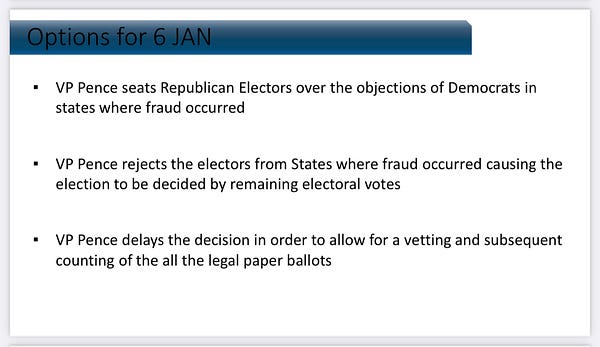
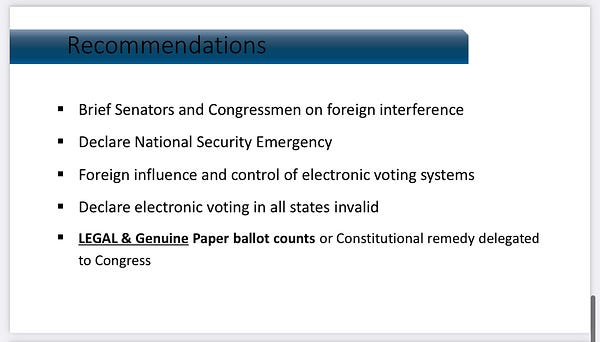
The newest Republican crisis comes in the form of two Powerpoint slides that were part of a 38-page presentation that Meadows had already provided to commissioners. Per Forbes, it is unclear who made the presentation, which was titled, “Election Fraud, Foreign Interference & Options for 6 JAN.”

Hugo Lowell, who covers Congress for the Guardian, tweeted the two relevant pages.

For the record, the first slide is titled “Options for 6 Jan” and gives three possible courses of action for Vice President Pence. Those options included:

  • VP Pence seats Republican electors over the objections of Democrats in states where fraud occurred

  • VP Pence rejects the electors from states where fraud occurred causing the election to be decided by the remaining electoral votes

  • VP Pence delays the decision in order to allow for a vetting and subsequent counting of all the legal paper ballots

To be clear, none of these courses of action would have been permitted by the Constitution. The constitutional role of the vice president, i.e. the president of the Senate, is only to ”open all the Certificates, and the Votes shall then be counted” and then “the Person having the greatest Number of Votes shall be the President.” Pence ultimately reached the correct conclusion that he had no authority to make decisions about electors or delay the Electoral College vote tally.

The second slide is titled “Recommendations,” which were as follows:

  • Brief senators and congressmen on foreign interference

  • Declare National Security Emergency

  • Foreign influence and control of electronic voting systems

  • Declare electronic voting systems in all states invalid

  • LEGAL & genuine Paper ballot counts [emphasis in the original] or Constitutional remedy delegated to Congress

There are a couple of things that jump out here. By January 6, The Former Guy’s legal remedies had been exhausted and claims of widespread fraud had been debunked. As we learned from other legal documents filed in September, the Trump campaign knew within days of the election that its fraud claims were bogus. Additionally, in the runup to January 6, two months after the election, the creators of the Powerpoint still could not name a credible source of “foreign interference.” This was clearly a Hail Mary.

The final two bullet points of the slide are chilling. The Trump Administration was seriously considering an attempt to throw out all electronic votes in every state, not just the six battleground states that Trump was contesting. This would involve disenfranchising millions of voters. And not just Biden voters either.

After tossing out the electronic ballots across the country, the Trump Administration would have counted “LEGAL & genuine Paper ballots.” The plotters no doubt hoped that these votes would be tallied in Trump’s favor.

As with the options presented to Vice President Pence, there is no constitutional authority for the president to throw out electronic votes and demand that only paper ballots be counted. There is an implicit admission that no law allows the president to do this in the recommendation that a “National Security Emergency” be declared. The sop to allowing Congress to determine a “constitutional remedy is hypocritical when it was the Trump Administration that would have been creating the constitutional crisis with its unconstitutional actions.

The problem with this course of action, aside from the fact that it is a direct assault on the Constitution and American democracy, is that the United States is not one of the “sh-th-l- countries,” as Trump called them. In America, presidents can’t just declare emergency powers to be in effect and then do whatever they want. We have laws that define what powers presidents have in an emergency.

The Brennan Center has published a comprehensive list of presidential emergency powers, and there are a lot of them. In fact, the list cites 136 different statutory powers granted to the president in an emergency. Of those 136 laws, only one relates to elections.

50 U.S.C. §§ 1701-170, better known as the Emergency Economic Powers Act (IEEPA) grants the president the power to impose sanctions in the event of foreign interference in a US election. An example would be if a foreign power, say Russia for example, attempted to influence the outcome of a presidential election in the United States.

No law, from the Constitution on down, gives the president the power to throw out votes and then determine which ones are genuine and should be counted.

Ladies and gentlemen, what we are talking about here is a blatant attempt to launch a coup against the duly-elected president-elect. The pieces are coming together to paint a detailed picture of what the Trump Administration had in mind last January and what it was working toward behind the scenes. Mark Meadows’s Powerpoint dovetails nicely with the memo from Trump lawyer John Eastman that came to light back in September.

About the same time that the Powerpoint was revealed, Meadows stopped cooperating with congressional investigators and will face a contempt vote by the House. The former chief of staff is attempting to claim executive privilege, but as I discussed back in 2020, executive privilege is not a defense against a criminal investigation. Its purpose was never to allow presidents to abuse their authority and then hide the evidence. And besides, Trump is no longer the executive and is no longer privileged.

It’s no wonder that Republicans didn’t want a commission to investigate the January 6 insurrection. There are a lot of skeletons hidden in a lot of closets belonging to former Trump officials. Those skeletons are now coming to light, and it looks as though they will continue to do so over coming months.

Share


There is another bit of news that I’d like to discuss today. As I was writing this piece, the Supreme Court issued an important ruling on the Texas abortion law. The ruling did not overturn the law but did allow lawsuits challenging it to continue.

Yesterday, a Texas judge in a separate case ruled that the Texas abortion ban was unconstitutional. Per Reuters, State District Court Judge David Peeples ruled that the law was an “unlawful delegation of enforcement power to a private person.”

I fully expect the law to be struck down at some point because these cases are not about abortion. Rather, the cases are about whether private citizens can be deputized to infringe on rights (and abortion is a right according to the Supreme Court) in areas that courts have prohibited governments from acting. The concept is a novel and frankly disturbing one if it is applied to other freedoms such as the right to bear arms or the right to free speech.

The Mississippi law is a much better vehicle for limiting or striking down Roe v. Wade.


The tweet of the day:

From the Racket

Thursday, December 9, 2021

Biden's court commission is a hung jury

 Remember about a thousand years ago when Joe Biden took office? Okay, it wasn’t really a thousand years ago, but it feels that way at least.

Anyway, not too far into his tenure as president, Biden signed an Executive Order that empaneled a bipartisan commission that would examine ideas for reforming the Supreme Court. This was an obvious response to progressive calls to expand the Court in response to President Trump’s appointments of three new justices, appointments which may tip the Court to the right. I say “may” because this is still somewhat in doubt as Chief Justice John Roberts moves toward the center in a great many decisions.

Photo by Claire Anderson on Unsplash

After eight months of deliberations, the commission has completed its final 294-page report (a good chunk of which is footnotes) and presented it to the president. The commissioners endorsed their product with a 34-0 vote so one thing that cannot be said is that the progressives on the body ran roughshod over the conservatives. There was input and agreement from both sides.

The report does more than to just address expanding the Court. It also looks at other suggested reforms such as term limits for justices, restricting jurisdiction, requiring a supermajority for certain cases, legislative overrides of Court rulings, reining emergency orders, and increasing transparency.

The issue on everyone’s mind is Democratic proposals to expand the number of justices on the Court. There, the report notes that the Constitution does not stipulate the number of justices on the Court and that the size of the Court has fluctuated throughout our history. There have been nine justices on the Court since 1869, but there have been attempts to change that since then. Most notably, FDR tried to “pack” the Court in 1937, but the plan was defeated.

The current move to expand the Court stems from what Democrats call a violation of norms by Republicans who refused to confirm President Obama’s appointment in an election year but who then rushed to confirm President Trump’s pick in 2020 on an even shorter timetable. Proponents of expansion also argue that even the possibility of expansion could act to moderate the Court and that an expanded Court could give an increased diversity of backgrounds and perspectives.

The report gives a balanced argument against packing the Court as well. A primary argument against the move is that setting a precedent of expanding the Court would undermine both judicial independence as well the Court’s legitimacy. The report also notes that public opinion overwhelmingly opposes expanding the Court, which makes it “difficult to justify Court-packing on grounds that it might serve democratic interests.”

Interestingly, both sides claim that their side is protecting democracy by either expanding or preserving the Court. I think that most people on both sides believe it when they say so.

In the end, the commission decided not to endorse either side, noting that “there is profound disagreement among Commissioners over whether adding Justices to the Supreme Court at this moment in time would be wise. As a Commission, we have endeavored to articulate the contours of that debate as best as we understand them, without purporting to judge the weight of any of the arguments offered in favor or against calls to increase the size of the Court.”

The commission also discussed two other “structural reforms” to the Court. The first would involve a “shifting or rotating set of nine (or more) Justices from among a larger set of Article III judges.” The second would involve having justices sit on panels to hear cases. This panel system could take a variety of forms including having different panels for different types of cases or having justices randomly assigned. The commission concludes that the legality of these reforms is questionable due to the Constitution’s specification that “[t]he judicial Power of the United States, shall be vested in one supreme Court” [emphasis in the report]. A proposal to give ideological balance to the Court also runs afoul of the Constitution’s stipulation that presidents nominate justices.

At the present time, there is no real chance of expanding the Court because Democrats don’t have the votes. They are likely to be even further away from that goal after the 2022 midterms, so the sections on court-packing are probably the least interesting reforms covered by the report. There are other proposals that might win some Republican support, however. Term limits are one example.

The report notes, “The United States is the only major constitutional democracy in the world that has neither a retirement age nor a fixed term limit for its high court Justices.” Forty-seven states also mandate term limits for judges.

There is a strong argument that it is not in the national interest for justices to stay on the bench until they die or can time their retirements to take place under an ideologically friendly administration. The possible structures of term limits are limitless, but Court discusses staggered 18-year terms (although 12-year terms would also reportedly work well), which “would ensure that all Presidents have the opportunity to appoint two Justices to the Supreme Court in each term they serve.”

“This predictability, proponents argue, would strike a more appropriate balance than the current system between two important features of our constitutional system of checks and balances: judicial independence on the one hand and long-term responsiveness of the judiciary to our democratic system of representation on the other,” the report continues.

An advantage to this system would be that the makeup of the Court would reflect the will of the voters rather than the whims of fate and the health of the nine sitting justices. The parties would have to nominate credible presidential candidates to influence the balance of the Court rather than having some presidents hit the jackpot with a plethora of appointments while some go for their entire presidency without a single nomination.

The report also offers a mandatory retirement age as an alternative to term limits. Mandatory retirements would limit the tenure of justices but would not provide for replacements on a schedule.

Opponents of term limits offer a variety of arguments that range from increasing the politicization of the confirmation process to unintended and unforeseen consequences that would be impossible to predict. A major problem with term limits is that they would probably require a constitutional amendment, although this is debated. The Good Behavior Clause is generally interpreted to mean that justices serve a lifetime appointment as long as there is no cause for impeachment.

Requiring an amendment would effectively mean that it won’t happen anytime soon. Even a few Republican votes would leave the effort short of a two-thirds majority in both houses of Congress or state legislatures and Democrats can’t be sure that all of their own members would vote for reforms.

Fixing the details of a transition to fixed terms would provide more opportunities to lose more votes as well. Congressmen who agree with term limits in principle could find a dozen reasons to vote against any concrete proposal that comes before Congress.

Another potential reform is jurisdiction stripping. The Constitution states, “The supreme Court shall have appellate Jurisdiction, both as to Law and Fact, with such Exceptions, and under such Regulations as the Congress shall make” [emphasis in the report]. Exceptions have been made in past, such as the 1789 Judiciary Act, which, as the report states, “made no provision for Supreme Court review of criminal cases tried in the lower federal courts.” In 1996, Congress limited the Supreme Court’s ability to review state death penalty cases in a law that the Court itself upheld. In 2006, Congress also stripped all US civilian courts of the ability to rule on cases about noncitizen enemy combatants. More frequently, Congress has limited the jurisdiction of lower courts.

Jurisdiction stripping works in certain limited cases but might cause problems if it was implemented on a broader scale. For example, if Congress tried to strip the Supreme Court of the ability to rule on all cases that involve cultural issues, there might be unintended consequences. Such a broad limitation might not even be constitutional. The Supreme Court would ultimately decide.

A supermajority requirement is an additional idea. Many landmark cases that left deep marks on the country have been 5-4 decisions with a single swing justice marking the difference between two extreme alternatives. Since 1823, at least 60 proposals to require supermajorities in at least some cases have been considered and failed.

Depending on your perspective (and probably on the individual case being considered), there is concern that a supermajority requirement could make it too difficult to protect constitutional rights. For example, conservatives would appreciate the supermajority in a case that attempted to restrict Second Amendment rights but would find the requirement annoying in a case that attempted to expand religious freedom. With any reform, there is both an upside and a downside.

The last chapter of the report deals with emergency orders. Both sides seem to understand the need for emergency orders in an age of nationwide injunctions and orders from lower courts and issues that need to be rapidly decided, for example, challenges to COVID-19 pandemic restrictions. Requests for stays of execution also fall under this category.

The commission suggests that the Court give reasons when it issues an emergency order to aid in transparency. In many cases, orders are simple one-page documents with no details about the Court’s reasoning. An additional reform would be to clarify that emergency orders are of limited value as precedent when compared full cases argued before the Court. The need for emergency orders could be reduced by passing a statute that limits the ability of lower courts to issue injunctions outside their jurisdictions.

With respect to executions, there are two possible reforms. The first is to provide for automatic stays at certain stages of the appeals process. The second is to reduce the number of votes required to stay an execution from five to four. As the report notes, “It takes four votes to put a case on the court’s docket via a writ of certiorari, but it takes five to stop an execution.”

The Supreme Court and our judicial system are not perfect. The courts do make mistakes and there is room for improvement. I’m not in favor of expanding the Court, but I could find myself signing on to some of the other suggested reforms.

However, I don’t foresee any changes in the Court anytime soon unless the justices decide to adopt them unilaterally. After all, if 34 commission members can’t agree, what hope is there that 535 members of Congress will get on board? We are just too divided to pass a statute reforming the Supreme Court, much less a constitutional amendment. That doesn’t mean that it isn’t worth talking about, however.

Share

David Perdue lost my vote yesterday. As I discussed earlier this week, the former senator is challenging Brian Kemp for the Georgia gubernatorial nomination next year.

I was a Perdue skeptic from the beginning, but yesterday the candidate said in an interview with Axios that he would not have voted to certify Georgia’s vote in 2020 if he had been governor. Here’s the money quote:

“Not with the information that was available at the time and not with the information that has come out now. They had plenty of time to investigate this. And I wouldn’t have signed it until those things had been investigated, and that’s all we were asking for.”

Aside from the fact that there were investigations that failed to turn up any widespread voter fraud, Perdue is saying that he would not have fulfilled his duty as governor and would have attempted to throw out the votes of hundreds of thousands of his fellow Georgians. That’s a dealbreaker for me, as well as for Patrick Chovanec, who put it succinctly in my tweet of the day.

I intend to vote for Gov. Kemp for re-election (always subject to change if conditions warrant), but, as I said in my own tweet, “Hey @GaRepublicans, Listen to me now, hear me later, and believe me next November: David Perdue, the coup abettor, will not get this conservative’s vote. Ever. No matter what Democrat runs against him.”

From the Racket