Tuesday, February 11, 2025

Terror on the Potomac

 The United States has had a long run when it comes to airline safety. The last serious airline crash involving a domestic airliner was in 2009 when Colgan 3407 crashed in Buffalo. To find a domestic jetliner crash, we have to go back to Comair 5191 in Lexington, Kentucky in 2006 or, for a mainline carrier, Southwest 1248 (although some might dispute whether Southwest is a mainline carrier), a runway overrun accident at Chicago-Midway in 2005. Asiana 214, a Korean airline, did crash a Boeing 777 in San Francisco in 2013, the last time a heavy airliner crashed in the US.

That streak broke on Wednesday night when a regional airliner operated by an American Airlines contractor collided with a US Army Blackhawk helicopter near Reagan National Airport in the District of Columbia.

First, a word about airline organization. There are two tiers of airlines. When you buy a ticket on an airline, you may expect to fly a Boeing or Airbus product, but many smaller markets are served by regional jets or turboprops that are operated by companies that contract with the major airlines.

This situation dates back to the 1990s and the advent of regional jets when major airline pilots represented by the Airline Pilots Association negotiated scope clauses that didn’t allow the new jets to be crewed by mainline pilots. RJs, as they came to be known, were operated under contract by less experienced crews and used as a stepping stone to gain experience for the more lucrative mainline jobs. The major airlines farmed out regional flying to the lowest bidder and renegotiated contracts periodically, often whipsawing pilots of competing contractors against each other.

The accident aircraft, a Canadair Regional Jet (CRJ) 700, was operated by PSA Airlines, a wholly owned subsidiary of American Airlines. As such, it’s correct to say that it was PSA Flight 5342 as well as American 5342.

On a personal note, I used to fly a CRJ-700 for Atlantic Southeast Airlines (ASA), a Delta Connection carrier based at Atlanta Hartsfield. The CRJ is a few decades old at this point, but it is a good airplane that is very capable and has an impeccable safety record.

I say all that to say this: The CRJ pilots had years of training and flight experience. They also had federal Airline Transport Licenses, but they did not have nearly as much experience as the crew of an American 737 or Airbus would have. Still, I don’t think that made a difference in this case.

Share

On January 29, the CRJ was on approach to Reagan National (DCA) after departing Wichita, Kansas. At about 8:47 pm, the plane collided with a US Army VH-60 Blackhawk. One of the first things I notice from the video is that it was a clear night. Low ceilings and visibility were not a factor unlike an earlier crash into the Potomac in 1982 when ice on the wings drove Air Florida 90 into the frigid waters after only a few seconds of flight.

The Blackhawk is the Army’s workhorse helicopter that replaced the venerable UH-1 Huey of the Vietnam era. There are a multitude of variants of the Blackhawk including a special operations version and a naval “Seahawk,” but the helicopter involved in the accident was a VH-60 variant assigned to a VIP transport unit, essentially a government “business” helicopter.

The Blackhawk was reportedly on a training flight, leading many to ask why it was flying at 300 feet at night on a training flight. The answer is that the crew wasn’t necessarily a new crew doing primary training, but they were probably training to carry out their mission. Army helo crews fly low and fast because that enhances their chances of survival in a hostile environment. They might also have been using night vision goggles (NVGs).

Video of the accident shows the CRJ approaching the runway with its bright landing lights shining. A smaller light approaches from the left of the video, which would be from the right side of the airplane where the copilot sits. When the two lights converge, there is an explosion.

A replay of the radar tape on Facebook (I’ll caution that the validity of this post is unverified) shows the helicopter crossing between the runway and the approaching CRJ at about 300 feet. The airliner was descending towards the runway and the two craft converged, falling into the river. Below is a representation of the radar data superimposed on a satellite map, also taken from Facebook.
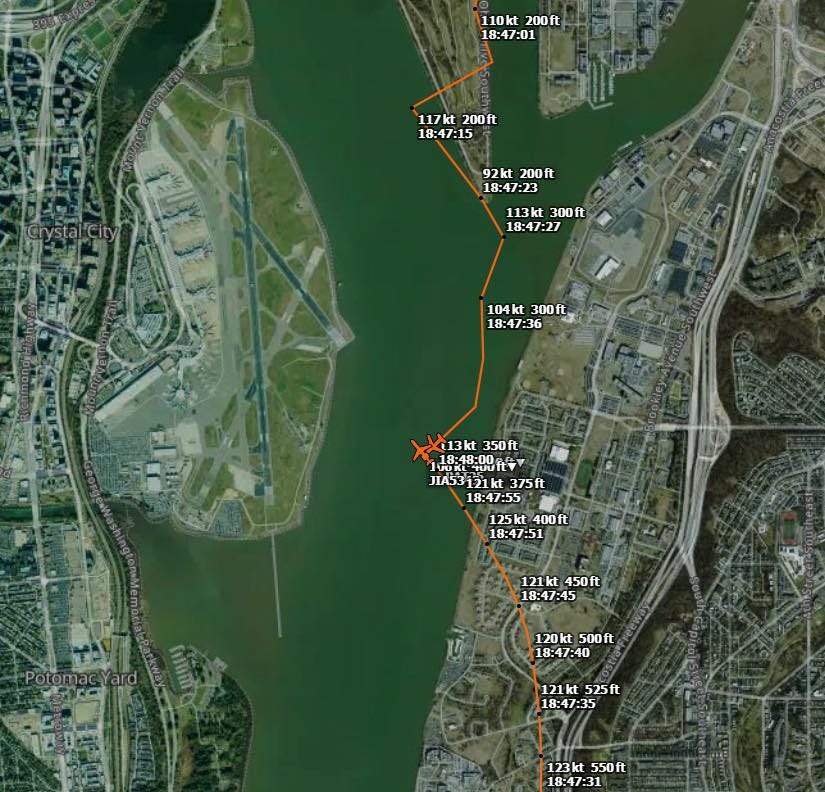
May be an image of map and text
Facebook screenshot

Thanks to modern technology, the ATC recording is also available online. As you listen to the recording, the CRJ is Bluestreak (the PSA callsign) 5342 and the helicopter is Pat 25.

Share The Racket News ™

Twice the controller asked the pilot of Pat 25 if he had the CRJ in sight. Twice the helo pilot acknowledged that he had visual separation. The helicopter was instructed to pass behind the CRJ.

The big question in the aftermath of the crash that killed 64 passengers and crew on the CRJ and three crewmembers in the helicopter is why the helicopter failed to see and avoid the jetliner with the big bright landing light.

If the helicopter was to the aircraft’s side, the landing light would not be visible. Unlike car headlights that shine onto the ground in front of the car, landing lights have nothing to illuminate to make them visible to the side, but other aircraft lights should have been visible

As a pilot who flies into congested airspace, I can tell you that it is not uncommon to have helicopters buzzing around near airports. Law enforcement, news organizations, and the military all often operate near airport traffic patterns. It is unusual to have a helicopter cross in front of you on short final, however, but then Pat 25 was not supposed to be in front of the airliner.

Airliners are equipped with safety equipment such as TAWS (terrain avoidance warning system) to warn about proximity to the ground and TCAS (traffic alert and collision avoidance system) to warn about proximity to other aircraft. The problem is that the TCAS is inhibited at low altitude to avoid distracting nuisance alerts around airports. Below 1,000 feet, the crew would not have been alerted.

It’s still early in the investigation process, but it looks as though the cause of the crash will likely be pilot error on the part of the helicopter crew. We may never know why the helicopter flew into the CRJ, but one possibility is that he thought he had the traffic in sight but was looking at the wrong airplane. I do not know whether the Blackhawk had flight data and cockpit voice recorders that would be installed on the airliner.

Washington, DC has some of the busiest and most restricted airspace in the country. Reagan National is located near a number of sensitive sights such as the White House, the Capitol, and the Pentagon. The approaches to DCA are very demanding in terms of both navigation and traffic avoidance.

I have flown into DCA as a pilot, but I probably never will again. After September 11, the airport was heavily restricted to private traffic with onerous approval requirements that include carrying an armed security officer. These days, most business jets go to Dulles. I can tell you that pilots are busy when they fly into DCA, but the view of Foggy Bottom from the cockpit is fantastic.

An additional factor in the crash may be short short-staffing in the Reagan National Tower. Listening to the audio, it is difficult to tell how many controllers are on duty, but some towers often have only one controller at night. At some smaller airports, I have been cleared for the approach, landing, and taxi to the gate by the same controller… at the same time!

The controller on duty Wednesday night sounded busy but competent and professional. Nevertheless, another pair of eyes may have caught the fact that the Blackhawk wasn’t following instructions.

The only real question I have about the controller’s actions is whether he pointed out the helicopter to the CRJ crew. If he did, it wasn’t on the audio that I heard, and the PSA pilots may have been totally unaware of the danger without such a warning. The NTSB accident report may fault the controller for that omission.

What I can tell you with certainty is that the crash does not fit the hot takes by partisans on either side. There is no evidence that DEI had anything to do with the crash as Donald Trump and some Republicans have suggested. Both pilots and controllers are certified to federal standards before they can get their jobs. Controllers also have to get checked out on the specific airspace that they control. Aviation is a merit system, at least to a degree, despite what some talking heads say.

In fact, FAA standards for pilots have gotten higher in recent decades. The 2009 Colgan crash spurred a reform of pilot licensing that increased requirements for Airline Transport Pilot candidates and also reformed airline rest rules.

Beyond FAA standards, airlines do have the ability to set their own minimum standards for pilot experience. These standards fluctuate due to supply and demand rather than DEI. In the mid-2000s, it was difficult for even high-time, experienced pilots to find jobs. In the years prior to the pandemic, the situation was reversed with the airlines hiring as many pilots as they could to replace a wave of retirees. That isn’t to say that minorities might not be hired with lower flight time than a white male, but they still have to be competent and licensed.

The crash also was not due to Donald Trump’s spending freeze or the fact that Trump had not appointed a replacement FAA administrator after the Biden-era administrator resigned effective January 20. While federal agencies do need good leadership, they don’t fall apart in nine days.

In summary, ignore the hot takes (except mine) and let the NTSB work. At the moment, the most likely cause seems to be pilot error by the Blackhawk crew, but that still does not fully explain the accident.

Thanks for reading The Racket News ™! This post is public so feel free to share it.

Share

JEJU CRASH UPDATE: You may recall that I speculated that the Jeju crash in South Korea last month was due to a double engine failure. That theory seems more likely after recent reports that bird remains were found in both engines of the 737. That crash is also still under investigation.


From the Racket News

It’s about power, not spending

 A lot of ink has been spilled over DOGE and the Battle of US AID. A lot more will be spilled before it’s over, but much of what is being written misses the point.

Republicans are telling a lot of stories about waste and abuse at US AID. Some of these stories are true. Many are not. Many others lack context, such as the $6 million for Egyptian tourism that actually originated in the first Trump White House per fact-checkers.

man wearing Donald Trump mask standing in front of White House
Photo by Darren Halstead on Unsplash

Share

I could explain that foreign aid from all sources, about $72 billion in 2023, is only about one percent of the federal budget. US AID’s budget, at $40 billion is slightly more than half of that.

I could explain that most foreign aid money is spent in the United States. US AID typically purchases large amounts of American agricultural products to send to needy countries. Those purchases have stopped, which will negatively impact American farmers.

Likewise, US AID partners with Christian charities and ministries around the world, the agency’s closure will leave a gaping hole in charitable budgets and directly lead to starvation and illness in many poor countries.

As Christianity Today notes, “Most of USAID’s budget goes to grants for specific development projects, including at Samaritan’s Purse, World Vision, World Relief, Catholic Relief Services, and many other faith-based groups. It supports local Christian health clinics in Malawi and groups providing orphan care.”

I could point out that Trump’s new Secretary of State, Marco Rubio (who, by way of full disclosure, I volunteered for in 2016), was a staunch supporter of US AID until a week or so ago. So were Melania and Ivanka Trump.

Even Elon Musk worked with US AID to deploy Starlink in places like Ukraine. US AID’s inspector general was investigating the agency’s relationship with Starlink prior to DOGE’s onslaught.

US AID is a tool of American soft power. It helps to build friendships and allies around the world while promoting American and Western values. If MAGA isolationists want to withdraw into our borders and ignore the rest of the world (except Gaza apparently), they can do it but it won’t make America great and China is ready to fill the void. In fact, China is already stepping up.

But none of this is the real issue. The real issue is that the Trump Administration and Elon Musk’s DOGE are trying to establish dominance over Congress, at least bypassing the legislature and possibly rendering it irrelevant.

The problem is that no president, not even Donald Trump has the authority to undo an act of Congress with an Executive Order. That includes both the laws establishing the agency (where the specific text of the law does matter) and its congressional appropriations.

Despite what you may have heard, US AID’s existence is rooted in congressional statutes. JFK originally created the agency with an Executive Order, which was authorized by the Foreign Assistance Act of 1961, but Congress cemented the agency’s existence as a separate entity from the State Department with a statute in 1998.

Additionally, the Impoundment Control Act of 1974 prohibits the president from refusing to spend appropriated funds or shifting them to other items (with certain limited exceptions). The White House can’t just veto laws passed by Congress by not spending the money or shifting funds to more favored projects. The Constitution contains a veto process, and this ain’t it.

While I do have problems with some of the items that have been funded by US AID, the lawful process for dealing with these expenditures is to go back to Congress which is controlled by Republicans, and fix the problems in the new budget.

Donald Trump should know all this because unlawfully impounding funds is what led to his first impeachment. I have to wonder if Trump picked this budgetary fight out of spite because of his earlier experience with Congress.

With Republicans in control of both houses of Congress and the party singularly uninterested in holding Trump and/or Musk accountable, it will fall to the courts to preserve the American constitutional system. The judicial branch was created to be similar to the conservative in William F. Buckley’s famous phrase, standing “athwart history, yelling ‘Stop,’ at a time when no one is inclined to do so, or to have much patience with those who so urge it.”

That’s also the role of the courts in times like this. With (almost) half the country cheering Trump’s abuses of power on, the courts have the duty to blow the whistle and stop the Administration’s actions where they exceed his lawful authority. The courts should be a roadblock to unlawful abuses of power.

To some extent, this is already happening. One of the first legal snags hit by the new old Administration was an injunction against Trump’s birthright citizenship EO. As I’ve explained in the past, Trump’s interpretation of birthright citizenship is blatantly unconstitutional and at least two courts have ruled against him so far. A federal judge has also blocked DOGE’s access to Treasury Department payment systems and another paused the buyout plan for government workers.

Look for more injunctions in the coming days and weeks, but the longer that Trump remains in power and the more judges that he appoints, the greater the chance that he will find loyalist judges who support his decrees over the law.

But not everything Trump does is unlawful and not everything is bad. Firing the heads of the Kennedy Center and putting himself in charge is awful but probably lawful, I’m not sorry to see government DEI programs go, but at the same time, it’s going too far to remove references to the Tuskegee Airmen from Air Force Basic Training (since reinstated) and references to Women in Leadership from NASA websites.

Even more disturbing are cuts, buyouts, and firings at defense intelligence agencieslaw enforcement, and among the military leadership. At a time when the world is a tinder box and China is making aggressive moves toward Taiwan, Trump’s staffing cuts could dangerously weaken US preparedness. Trump’s new attorney general, Pam Bondi, also shut down a DOJ task force that targeted Russian oligarchs as one of her first acts. The massive personnel cuts are bloodless but are reminiscent of Stalin’s purges of experienced officers that left Russia woefully unprepared for WWII.

Share

Elections do have consequences, but that does not mean that Trump gets to ignore Congress and existing law. Legal policies can still be bad, and there will also be plenty of constitutional but unwise ideas to deal with. It will take untold years to repair the lawful damage that Trump does over the next few years.

But Trump will continue to push the bounds of his power until and unless he is stopped. That has been his MO for a decade now. Even when he is stopped, he will push elsewhere, like squeezing a balloon causes it to bulge outward at another spot… until it pops.

And to make matters worse, Trump is using an unelected, unaccountable, pseudo-federal agency to push the bounds of his power. There is a lot that we don’t know about DOGE including whether its workers have passed security checks and exactly what they are doing. The potential security threat from DOGE could far exceed that of Hillary Clinton’s “homebrew” email server, but those concerns are quashed because DOGE is on the right team.

I’m aware that a lot of my readers don’t consider Trump’s actions to be predominantly bad, but they should consider that Executive Orders can be easily undone by the next Democratic president. And there will be another Democratic president unless Republicans end elections or at least stop them from being free and fair.

If you like how Trump is stretching presidential authority until it’s no longer recognizable to “own the libs,” you probably wouldn’t have liked it if Obama, Biden, or Harris did the same things. And you won’t like it when 2028 voters are sick of Republicans and elect a Democrat who pushes the bounds further but acts in a progressive direction.

Back in 2009, I thought that Democrats were ready for leadership by a strongman. I wasn’t necessarily wrong about that, but I was wrong in that Republicans got there first. The party that claimed to be constitutionalist would be more than happy to install The Donald as president for life. I’ve seen at least one “president for life sign” and Trump seems open to the idea. Some Republicans are already talking about amending the Constitution and Trump raised the prospect of a third term last week.

I’ve seen no evidence that more than one or two congressional Republicans would act to oppose Trump if he declared himself emperor. Just ask RFK.

The next four years are not going to be pretty, but just how bad things are going to get may be determined within the next few months. If the courts keep the president in check until the midterms and then the voters send a clear message by giving Democrats a majority (a likelihood in the House but a longer shot in the Senate), then we will hopefully emerge from Trump II with America in a recognizable state. But if the Supreme Court is no more willing to stand up to the would-be strongman than congressional Republicans, we are in deep trouble.

I usually avoid the trope of “the most important election of our lifetime,” but the 2026 midterms will be consequential. If Republicans keep hold on Congress and are allowed to rubber stamp the appointment MAGA loyalists to the courts, the days of our constitutional republic might well be numbered. Our check and balances and guardrails are being systematically dismantled.

There’s also the question of what will happen if Trump and his Republican backers simply refuse to accept unfavorable court decisions. Let’s all hope that it doesn’t come to that.

We will have an idea of which way events will break over the next few months to a year. Court decisions involving the trumped-up (the pun is a happy coincidence) allegations against US AID will likely be a bellwether for whether Trump will be allowed to run roughshod over the Republic. If he can bypass Congress here, it won’t be the last time.

If you’re a constitutionalist, you should be very nervous. If you’re a Trump supporter, maybe the alligator will eat you last.


From the Racket News