Wednesday, June 8, 2022

Matthew McConaughey on guns


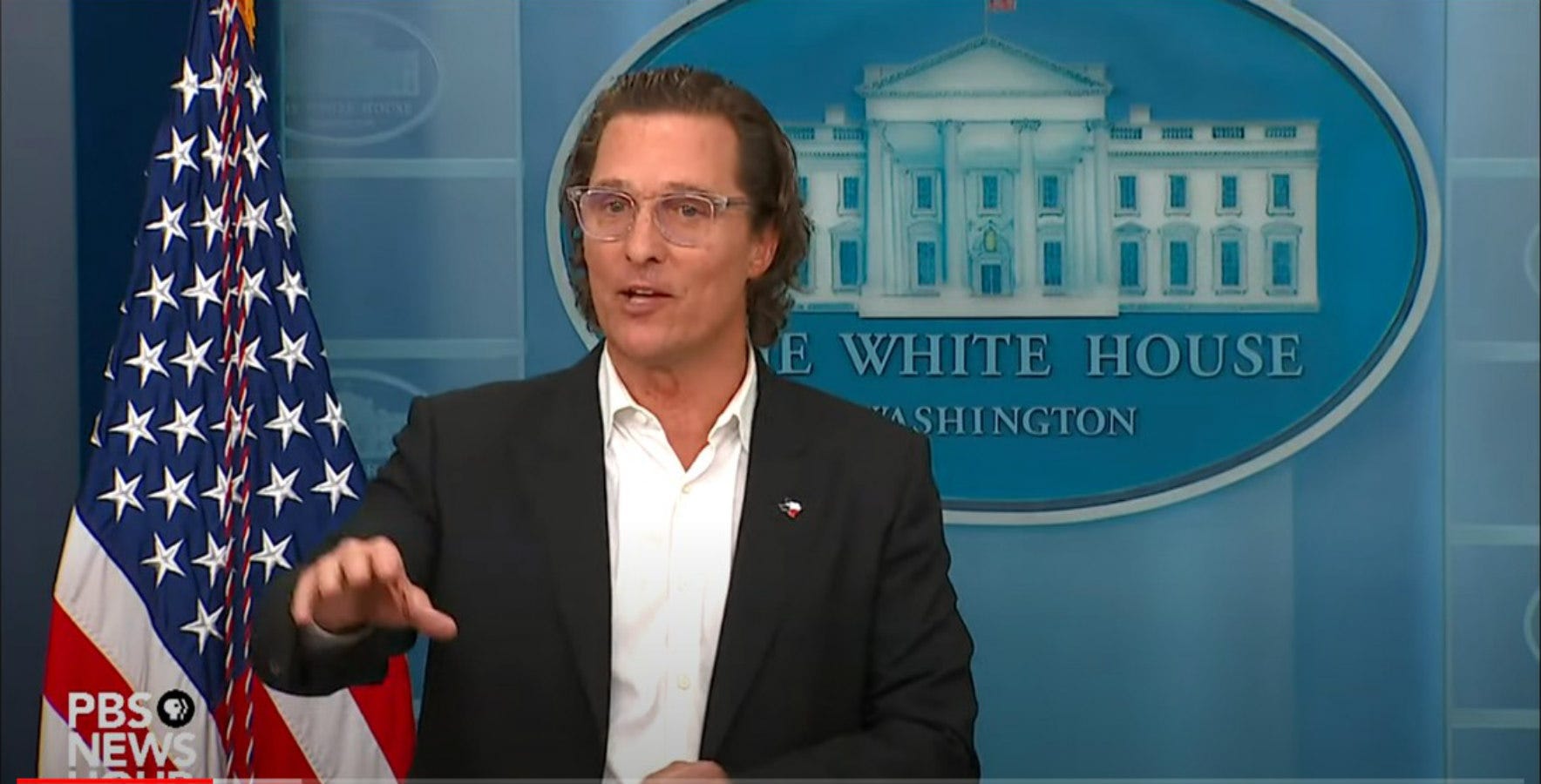
Photo credit: YouTube screenshot from PBS News

Most of us don’t like it when celebrities insert themselves into political issues… unless they are on our side. True to form, when actor and Uvalde native Matthew McConaughey made a series of recommendations on how to take steps to resolve our crisis of mass shootings, the response was like a political Rorschach test.

Speaking at the White House yesterday after a meeting with President Biden, McConaughey made an emotional call for gun reforms that he believes would help prevent future attacks similar to the one that killed 19 children and two teachers at a school in his hometown.

“Make the loss of these lives matter,” McConaughey said.

Emotion can be a dangerous thing at a time like this. Some emotion is appropriate in such a time of tragedy. Mourning the lost and a desire to prevent future attacks can spur us to make needed changes to address what clearly is a serious problem in modern America.

On the other hand, emotion can also lead us to act irrationally and impulsively at a time when we need to carefully consider the impact of our actions. Sometimes quick, ill-considered action can fail to address the real problem and may even make it worse. This is called the Law of Unintended Consequences.

As H.L. Mencken put it, “Every complex problem has a solution which is simple, direct, plausible — and wrong.”

These types of misdirected solutions are on parade when it comes to the issue of guns.

As I’ve written in the past, we need to take steps to keep guns out of the hands of people who are homicidal, but we need to balance those reforms with our individual constitutional right to bear arms. I think that most people in this country believe that we can find an appropriate middle ground.

To start with, I think we need to reframe the debate around the idea of reforming gun laws rather than instituting more gun control. “Gun control” is a term with deeply negative connotations for gun owners. “Gun reform” would start with the assumption that gun rights for law-abiding citizens are constitutionally protected, but that their accessibility by certain high-risk individuals is what should be controlled.

McConaughey is not an anti-gunner. He does not advocate gun confiscations or repealing the Second Amendment. While I don’t agree with all of McConaughey’s suggestions, they are not radical.

“We need responsible gun ownership,” McConaughey said. “We need background checks. We need to raise the minimum age to purchase an AR-15 rifle to 21. We need a waiting period for those rifles. We need red flag laws and consequences for those who abuse them. These are reasonable, practical, tactical regulations.”

Let’s take those ideas one at a time. First, we do have background checks, but they need to be improved. In particular, we need to include mental health problems and juvenile records in background checks. Right now, there is no federal standard requiring mental health records be made available for gun background checks. Likewise, juvenile records may not be completely included in a background check.

Right now, most states don’t require background checks for private sales. As I wrote last week, very few mass shooters get their guns through private transactions, but whether we should require background checks for these sales is a discussion worth having.

Second, McConaughey suggests raising the minimum age to purchase an AR-15 to 21. Again, this is not a radical idea, although I’m not sure how effective it would be. The data on mass shootings shows that very few such incidents occur in schools. Workplace attacks by adults are far more common. We also know that very few traditional gun crimes are perpetrated with AR-15s. With this strategy, we may impact a lot of prospective gun owners for very little return.

And it’s possible that such a law would be unconstitutional. An Oregon court last year ruled that it was impermissible age discrimination to prohibit pistol sales to people under 21.

There are a couple of caveats in this case. First, the prohibition was the policy of private business, not a law. Second, the case is still winding its way through the legal system. As far as I can tell, no federal or state law setting a minimum age for gun ownership has been struck down on an age discrimination basis.

Third, McConaughey asks for waiting periods. There are two problems here. The first is that a Rand Corporation analysis of gun control methods found evidence that waiting periods could reduce gun suicides and total homicides, but the evidence is inconclusive for mass shootings where shooters often plan their attacks carefully over a long period.

Per the study, waiting periods would be most likely to reduce suicides, the highest share of gun deaths, because such acts are often impulsive responses to a short-lived crisis. Waiting periods could also give law enforcement more time to investigate possible straw purchases and complete background checks.

In fact, Senator Thom Tillis (R-N.C.) told the Wall Street Journal yesterday that extending waiting periods to several weeks for gun buyers under 21 would provide investigators with time to check for juvenile criminal histories among sealed records. This seems to be the best argument for waiting periods with respect to combatting spree killings.

On the other hand, an unintended consequence of waiting periods would be to imperil victims of domestic violence. I don’t know of statistics that detail how many women are attacked or murdered by stalkers or domestic partners while waiting for gun permits, but I do know that these cases are not exactly rare. There can be valid reasons for someone to urgently need a gun for self-protection. The Uvalde massacre provided a reminder that we can’t always depend on police for protection.

A compromise here might be to require waiting periods for the purchase of an AR-15-style rifle, but again, the data shows that pistols are far more likely to be used in spree killings than so-called “assault rifles.” Ultimately, the evidence shows that focusing on weapons rather than shooters is a mistake.

McConaughey’s final suggestion is the implementation of red flag laws, and I believe that this is an area where both parties should be able to agree. Most spree killers share characteristics that include a criminal record, a history of violence, and/or a history of mental illness. It is these factors that we should use to screen out people who should not have a gun or who at least bear much closer inspection.

Red flag laws are not about punishing people before they commit a crime. They are about holding people responsible for past violent and threatening behavior. A good red flag law would include due process for the gun owner to appeal an order removing his guns as well as providing penalties for abusive and fraudulent reports.

I’m not on board with everything that McConaughey suggests, but I do think we need to reform gun laws. Rather than preserving gun rights, maintaining access to guns for homicidal individuals with histories of violent behavior is a threat to the Second Amendment. When voters feel threatened, they will vote for more and more politicians who are hostile to gun rights.

What’s more, those who misrepresent McConaughey’s position as a radical assault on the Second Amendment are being intentionally dishonest. Nowhere in his remarks does McConaughey, a gun owner himself, advocate banning AR-15s or confiscating guns already in private hands. He is not a “gun-grabber.”

McConaughey’s best ideas are red flag laws and continuing to refine and enhance background checks to plug gaps that previous rampage killers have exploited. This won’t stop every shooting spree, but it will make it more difficult for people who are dangerously violent or mentally ill to slip through the cracks.

“Responsible gun owners are fed up with the Second Amendment being abused and hijacked by some deranged individuals,” McConaughey said.

I think he’s right. I know I’m fed up.

Share

I also wanted to point out that top members of the Proud Boys were charged with seditious conspiracy in connection with the January 6 insurrection plot by the Department of Justice this week. CNN reports that the Proud Boys had pleaded not guilty to lesser charges.

These people are either traitors to the Constitution or useful idiots exploited by The Former Guy. Most likely, they are somewhere in between.

BREAKING: As I post this, numerous outlets are reporting than a man armed with a handgun, knife, and pepper spray was arrested near the home of Justice Kavanaugh. The man was reportedly angry about the leaked draft of the abortion ruling and planned to kill the justice.

From the Racket

Tuesday, June 7, 2022

The looming food shortage

Just when you thought it was safe to go back to the grocery store…

Seriously, the four horsemen of the apocalypse are quickly marching through the 2020s. We’ve had the pandemic, the war in Ukraine, spiking energy prices, and you can even read inflation into Revelation 6:6. Now there is the prospect of a food shortage complete with famines in some places.

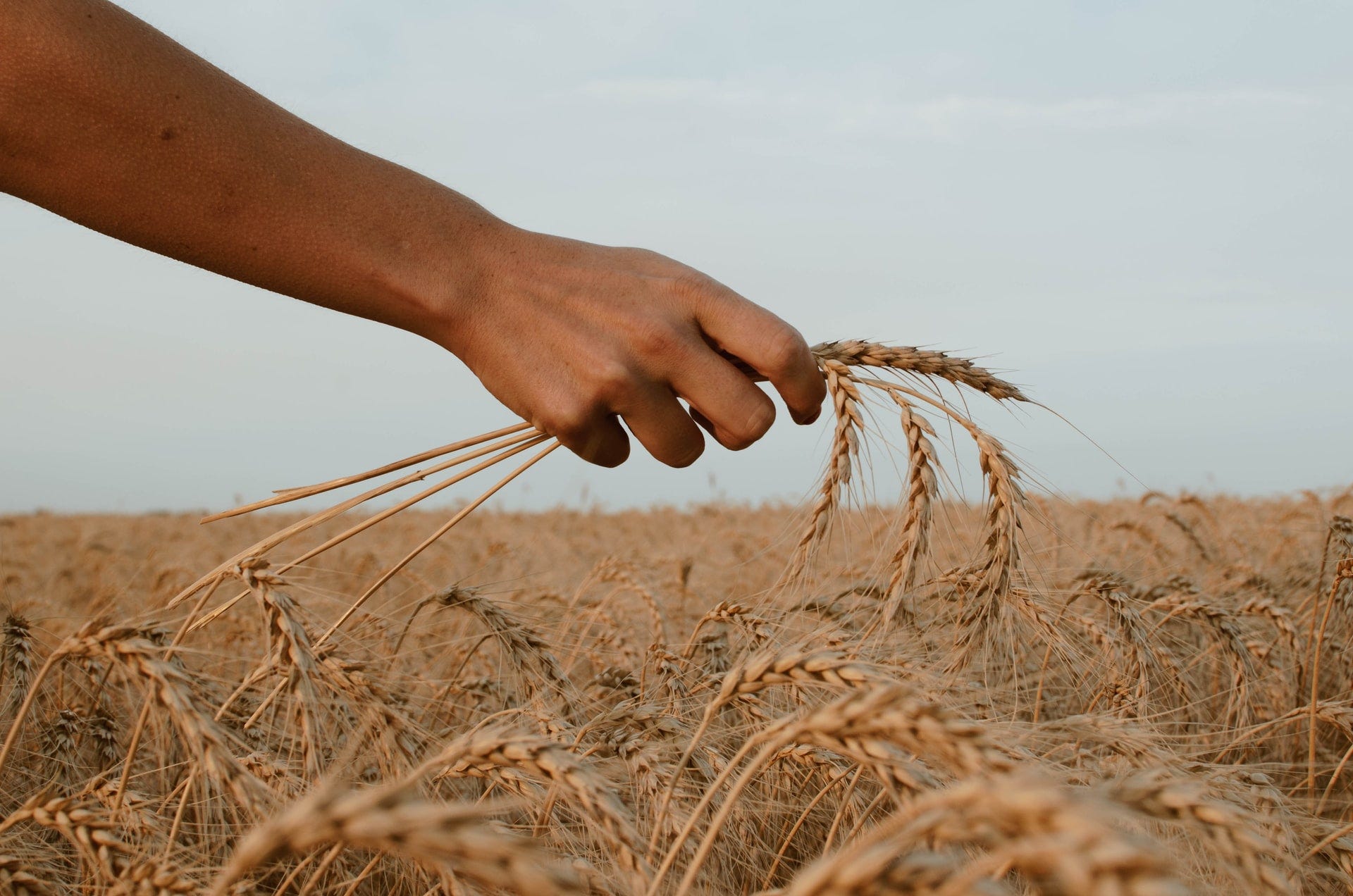
Photo by Paz Arando on Unsplash

There is a rumor going around on the internet that “something” is going on with regard to a series of supposedly suspicious fires at food processing facilities around the country. This theory has been thoroughly debunked, not least by Glenn Beck who pointed out, “In any given year, there are half a million fires reported to local fire departments. About 5,300 of them are manufacturing or processing facilities. That comes to about 440 per month. If there are fires in 440 manufacturing or processing facilities a month from coast-to-coast, wouldn’t we expect at least a handful of them to be at food processing facilities?"

The truth is that the problem is not an American one. This is unlike the baby formula shortage over the past few months, which was an American phenomenon and occurred for entirely different reasons. That shortage seems to be starting to ease as Abbott resumes production and formula is imported to bridge the gap. No, the world’s food problems are rooted in the Ukraine war and Russia’s strategy of isolating and starving the Ukrainians into submission.

If, like me, you went to school in the 1980s or before, you may remember the Ukraine (it was “The Ukraine” back then) was referred to as the “Breadbasket of the Soviet Union.” The former province of Tsarist Russia and former Soviet Republic had fertile fields filled with amber waves of grain that supplied food to much of the rest of the empire and its allies. In 2021, shortly before the invasion, Bloomberg reported that Ukraine was the largest exporter of sunflower oil, the fourth largest exporter of corn, and a major provider of grain to countries all over the world.

The Russian invasion changed all that.

When Russian hopes for a quick victory evaporated, Putin’s armies shifted to a strategy of attrition. The Russian invaders, “Orcs” to the Ukrainians, both stole and destroyed Ukrainian crops as well as attacked the infrastructure that Ukraine needs to get its crops to market and blockaded seaports on the Black Sea. Much of Ukraine’s harvest has been looted, burned, or simply can’t be brought to international markets.

A recent estimate from Ukrainian forecasters predicted that Ukraine’s winter wheat harvest, about 95 percent of its total wheat production, would be cut by about a third from 32.2 million tons down to 20.1 million tons. This has significant implications not only for Ukraine’s economy but for world food markets as well.

But that’s only half of the equation. The other half is that boycotts and sanctions on Russian food exports further exacerbate the problem.

To get an idea of what could happen in world food markets, look at what has happened in energy markets over the past few months. Despite domestic oil production in the US that has risen dramatically since Trump left office (yes, you read that right, oil production has risen under Joe Biden), prices have increased because oil markets are worldwide, not local.

Whether artificial or actual, a decrease in supply drives up prices elsewhere even if we aren’t getting our oil from the Russian pipelines where the spigot is now closed. This is because the consumers that used the supply that has dried up now have to compete for oil from different sources. This competition for a limited supply increases prices.

The same dynamic is likely to be seen in food markets, which as Fox News points out, were stressed by pandemic supply problems even before Putin’s invasion. Even though the United States produces a lot of food, we also export a lot of what we produce. If prices for export markets go up, food producers can be expected to send more food overseas unless domestic prices rise in competition.

Here in the US, we won’t be going hungry, but we will be paying more at the grocery store. The more serious problem will be in countries where food supplies were tenuous even before the shortage. Quartz provides a list of countries that are heavily dependent on Ukrainian and Russian food exports. Quite a few entries on the list are countries where famines have been a reality in the not-so-distant past. Countries like Somalia, Eritrea, and Sudan.

It’s worth noting that Russia has played the famine game before. In the 1930s, Stalin’s communist regime starved an estimated 3.9 million Ukrainians, partly through bureaucratic incompetence and partly through devious purpose. Ukrainians call this the Holodomor, a combination of the Ukrainian words for “hunger” and “extermination.” Now, history may be repeating itself.

And speaking of history, the new Russian strategy of attrition and slowly grinding down the Ukrainian defenders is hardly unique in warfare but reminds me a lot of the American Civil War. When the Union failed to crush the rebellion quickly in the early days of the war, federal forces implemented General Winfield Scott’s “Anaconda Plan” of slowly strangling the Confederacy.

In three years of fighting, the Union army failed to reach the Confederate capital of Richmond with frontal assaults. Ultimately, the Confederacy was starved into submission by a strategy that began with a naval blockade of its ports. The Yankees bisected the Confederacy by driving down the Mississippi River. General Sherman drove through Georgia and South Carolina destroying crops and railroads. Both food crops and cotton, the South’s main source of cash, were destroyed along with the transportation infrastructure of the day that took crops to market and supplied troops at the fronts. The North didn’t destroy the South’s will to fight, but it did destroy its ability to resist.

That seems to be the Russian goal. In a war of attrition, Russia has much greater manpower reserves to draw upon and, although Russia’s economy is sanctioned, it isn’t being physically destroyed like that of Ukraine.

The Russian goal is likely two-fold. First and most obvious, the Russians want to bleed the Ukrainian army dry and starve the country into submission. Second, they want to inflict enough pain on the world that there will be an outcry to lift the sanctions (or like Saddam Hussein’s Iraq, to avoid the sanctions through smuggling and black markets).

We are entering a dangerous phase of the war. Ukraine has pushed the invaders away from Kyiv but the operations in the eastern part of the country are turning into a meatgrinder. Russian losses have been extremely high, but President Zelensky recently said that Ukraine is losing 60 to 100 soldiers per day. (By way of comparison, the US, a much larger country, averaged 220 service deaths per day in World War II, but only about 50 per day at the height of Vietnam.) That is unsustainable for long.

As the war bogs down, it is also disappearing from the front pages amid mass shootings, elections, and the Outrage Du Jour. The world may not remember why the sanctions are being imposed, but Ukrainians are still fighting and dying against the invaders. They have little choice in the matter.

The war would look very different without world aid to Ukraine. Weapons and relief supplies have enabled the country to hang on and actually beat back the invaders in places. Without NATO’s help, the war might well have ended according to Putin’s original plan.

At this point, Ukraine’s best hope is that Russia’s economy and will to fight peter out before Ukraine’s own ability to resist crumbles. Getting to that point is going to mean continued pain for many other countries around the world. Famines and economic upheaval may even spark unrest elsewhere, but the cost of keeping the pressure applied to Putin will probably be less than the cost of removing sanctions in the long term.

That doesn’t mean that opposition parties like the Republicans won’t make gains by capitalizing upon voter concerns and laying every problem at President Biden’s feet with an #OldManBad message. And Republican control of Congress might well be what Vladimir Putin needs to break the sanctions on Russia and continue his war of aggression.