Monday, March 7, 2022

The case for (and against) no-fly zones for Ukraine

 Like everyone else, I’ve been watching the situation in Ukraine closely over the past week. Even though the valiant Ukrainian defenders are putting up a heckuva fight against the invading Russians, unless Vladimir Putin decides to pack up his army and go home, the war is probably only going to end one way.
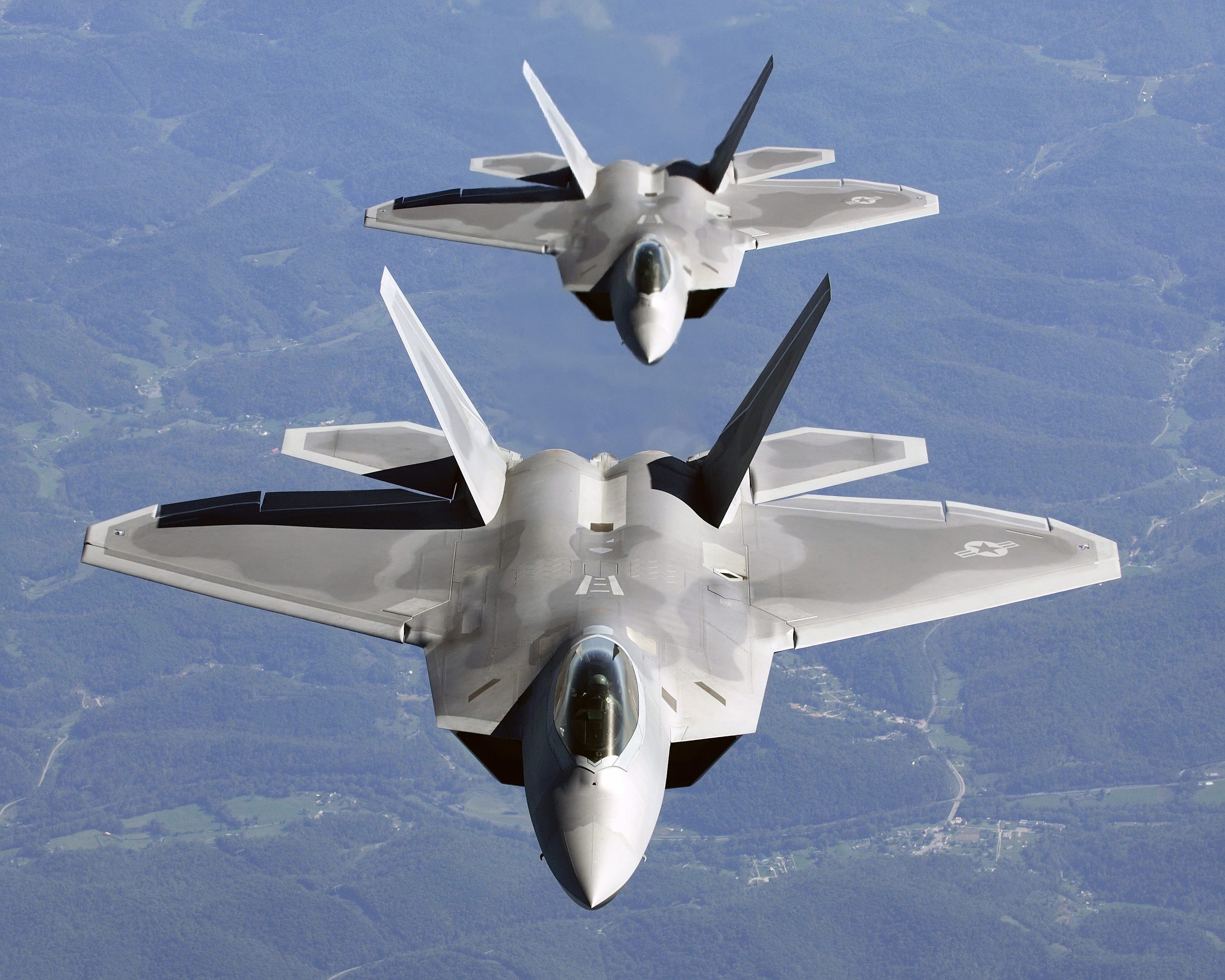
F22 Raptors By U.S. Air Force photo by TSgt Ben Bloker

The Russian army has historically relied on its superior numbers to crush opposing armies and my guess is that this is how the Ukraine war will play out as well. Think back to WWII when the Germans had superior training and, for much of the war at least, superior equipment. But the Red Army had an endless supply of humanity. So many, in fact, that they were rumored to have marched penal battalions through minefields to clear them.

Today, Vladimir Putin’s supply of soldiers is not endless, but it is much deeper than that of Ukraine. The Russian army can expect to be reinforced and have its losses replaced. The Ukrainian army has only as many replacements as there are Ukrainians.

Adding to the imbalance is the Russian air force. Even though Russia has not been able to gain air supremacy, air attacks on Ukrainian cities are destroying the country’s infrastructure and are increasingly being used against civilians. Ukraine’s government has asked for NATO to establish a no-fly zone over the country to even the odds.

There is also the real possibility that without control of the air, Ukraine will eventually lose the war of attrition. I can see only a limited number of other possibilities. For instance, the Russian economy might collapse and lead to either a popular uprising or a coup against Putin. Either possibility might lead to Russia giving up the invasion. The only other real possibility is that US or NATO intervention would even the odds and make victory impossible for the Russians.

The longer NATO waits to intervene, the bigger the intervention would have to be. Where a no-fly zone might be decisive now, if the allies do nothing until Ukraine’s army is on the brink of destruction, NATO armies would need to put boots and tanks on the ground to roll back the Russian advance.

The rub is that a no-fly zone would pit NATO fighter jets against Russian planes unless the invaders ceded the skies to NATO. That doesn’t seem likely.

It could also lead to other escalations. If the Russians don’t accept their loss of airpower over Ukraine, the next logical step would be to attack the bases that the NATO fighters operate from. Since these planes would probably stage from NATO bases, there is a possibility that the Russians could launch airstrikes against NATO countries. At that point, Article 5 could be invoked and we would find ourselves in a full-scale war with Russia.

Is Vladimir Putin crazy enough to attack NATO airbases? Well, he did just invade a country that is a close ally of NATO countries.

The bottom line is that Putin doesn’t believe that NATO will fight. Since he took control of Russia, Putin has invaded Chechnya, Georgia, and Crimea. He has also launched numerous cyberattacks on Ukraine and other countries as well as meddling in the US election. Until now, he has paid very little in the way of a price for his actions and for the most part, got what he wanted.

The blame for that goes to a succession of US presidents as well as other world leaders. Bill Clinton, George W. Bush, Barack Obama, and Donald Trump all failed to halt Russian aggression. Trump even reportedly planned to pull the US out of NATO, and Germany blamed The Former Guy’s antipathy to allies and affinity for isolation for pushing them towards Russia and China.

So now we have arrived at the point of Vladimir Putin’s largest gamble yet. The Russian leader believes that he can conquer Ukraine and annex the country into his neo-Russian empire. He doesn’t believe that anyone will stop him.

What happens if Russia does take the whole country? The fighting won’t stop. Russia might gobble Ukraine, but it would take a while to digest. The fighting spirit of individual Ukrainians leads me to believe that they would keep fighting even without a government or an army. Ukraine might well become a European Afghanistan.

Beyond Ukraine, if Putin really wants to rebuild the Russian empire, there are other targets. The NATO countries of Lithuania, Latvia, and Estonia sit exposed on a salient with Russia and Belarus on one side and the Baltic on the other. These Baltic states are much smaller and easier to digest than Ukraine.

Likewise, Finland, which also shares a border with Russia, and Sweden are on Europe’s northern flank and are not currently NATO members. They have expressed interest in joining the club since the Ukraine invasion started, a possibility that drew a warning of “serious military-political consequences” from Russia.

In the Budapest Memorandum of 1994, the US, along with Russia and the UK, agreed to “provide assistance” if Ukraine was attacked. That vague wording provides a lot of wiggle room, but the specific language of the North Atlantic Treaty requires the US to come to the assistance of a NATO member that is attacked. That treaty holds the force of law. If Putin attacks a NATO ally, the US is going to war.

If it’s likely that we will have to fight Russia in the next few years, there is a case to be made that we should do it now. Putin’s army seems riddled with incompetence, corruption, and ill-trained and poorly-motivated soldiers. If he is allowed to annex Ukraine and rebuild to gobble up another country, those mistakes will likely be corrected before he strikes again. If the allies had confronted Hitler in 1938, before the Wehrmacht had honed its blitzkrieg skills, millions of lives might have been saved by the shorter war.

After the crisis fades, sanctions may be removed and other European countries may go back to their carefree ways. Another isolationist administration, whether Trump or someone else, might withdraw American soldiers and fracture the alliance. Vlad may even be able to rehabilitate his image in the West (and with those like Tucker Carlson) if he is seen as the victor in the Ukraine war.

Right now, NATO holds the edge. That might not be the case in another decade or two.

What about Putin’s nuclear threat? There is at least a reasonable chance that Putin is bluffing. Or that if he isn’t, that the oligarchs and generals wouldn’t stand by and allow him to initiate a nuclear war. But there is a nonzero chance that Putin would have the attitude that if he loses, everyone loses and that his generals would follow his orders.

There is no guarantee that Putin won’t go nuclear if the war continues to go poorly for Russia even with direct intervention by NATO. After all, the world’s economic warfare against Russia and aid to Ukraine will be what made Russia’s defeat possible.

The problem with standing aside is that the nuclear threat is not going away. If the world does nothing now because of the possibility of a nuclear confrontation, we increase the chances that we will be placed in the same situation again. That may be when Putin tries to take Poland or the Baltic states. It may be when China tries to take Taiwan. It may be when a nuclear Iran decides to conquer the Persian Gulf or North Korea decides to go south.

We have entered the era of nuclear blackmail and how we handle Putin will help to determine whether we face a similar situation in the next few years. If the world pushes back strongly enough against Putin - and especially if Russia loses the war - it will go a long way towards protecting other vulnerable countries.

If nuclear blackmail becomes commonplace, sooner or later someone is going to push the button. The best way to avoid that possibility is to stand up to Putin and Russia now.

The West has been left with a series of bad options. We can either let a free country be overrun and be complicit in the accompanying bloodbath or we can oppose Putin and risk a nuclear war. If we allow him to take Ukraine, there is every reason to believe that he will be back to gobble up another country in a few years. If that country is a NATO country, we will once again face the prospect of nuclear blackmail but with the legal imperative to respond. Once again, there will be a decision about whether to risk nuclear annihilation, and if NATO doesn’t resist an attack on its members it has no reason to exist.

NATO is faced with a no-win situation, but so is Vladimir Putin. If Putin loses the war, he likely loses his country and maybe his life. If he wins, he commits his country to a bloody quagmire.

That may be Europe’s salvation. We can hope that Russia will be unable to cause trouble elsewhere if its armies are occupied trying to keep a lid on Ukraine. This is especially true given Russia’s extremely low birth rates that will make growing new armies very difficult in coming decades.

But while NATO is tied down confronting Russia, other countries, such as China, will be tempted to follow the Putin Plan.

Share

In a court filing, the January 6 committee has alleged that Donald Trump and attorney John Eastman engaged in a criminal conspiracy to steal the election.

Like the John Durham filing that sparked a flurry of claims that Trump was right about spying what seems like 100 years ago, the January 6 committee claim is not in the form of an indictment. Rather the filing is part of a case in which the committee is seeking emails and documents from Eastman, author of a memo that outlined a plan to steal the election, who has invoked the Fifth Amendment to avoid testifying.

Lawyers for the House wrote, “Evidence and information available to the Committee establishes a good-faith belief that Mr. Trump and others may have engaged in criminal and/or fraudulent acts, and that Plaintiff's legal assistance was used in furtherance of those activities.”

The 61-page document includes exhibits that back up claims that Trump and his cohorts knew that they had lost the election but pressured “the Vice President to manipulate the results in his favor.” The filing also states, “The conspirators also obstructed a lawful governmental function by pressuring the Vice President to violate his duty to count the electoral certificates presented from certain States.”

The House does not have the authority to indict suspects, but the committee can refer its findings to the Department of Justice for prosecution.

I don’t think we’ve heard the last of this. The Fifth Amendment, by the way, does not protect against subpoenas for evidence.


Tweet of the Day:

From the Racket

The economic fallout of Ukraine

 When you think about the economic impact of Russia’s invasion of Ukraine, the obvious subjects are Ukraine and Russia. Ukraine’s economy is being ravaged by fighting while the Russian economy is being destroyed by sanctions. However, the $80 trillion question is what the impact will be on the world beyond the two combatants.

Oil is the basis for the question. Shutting off the Russian economy from the rest of the world probably wouldn’t dent many bottom lines except that Russia has the eighth largest oil reserves in the world and is the fifth-largest producer. Russia currently produces more oil than Saudi Arabia.

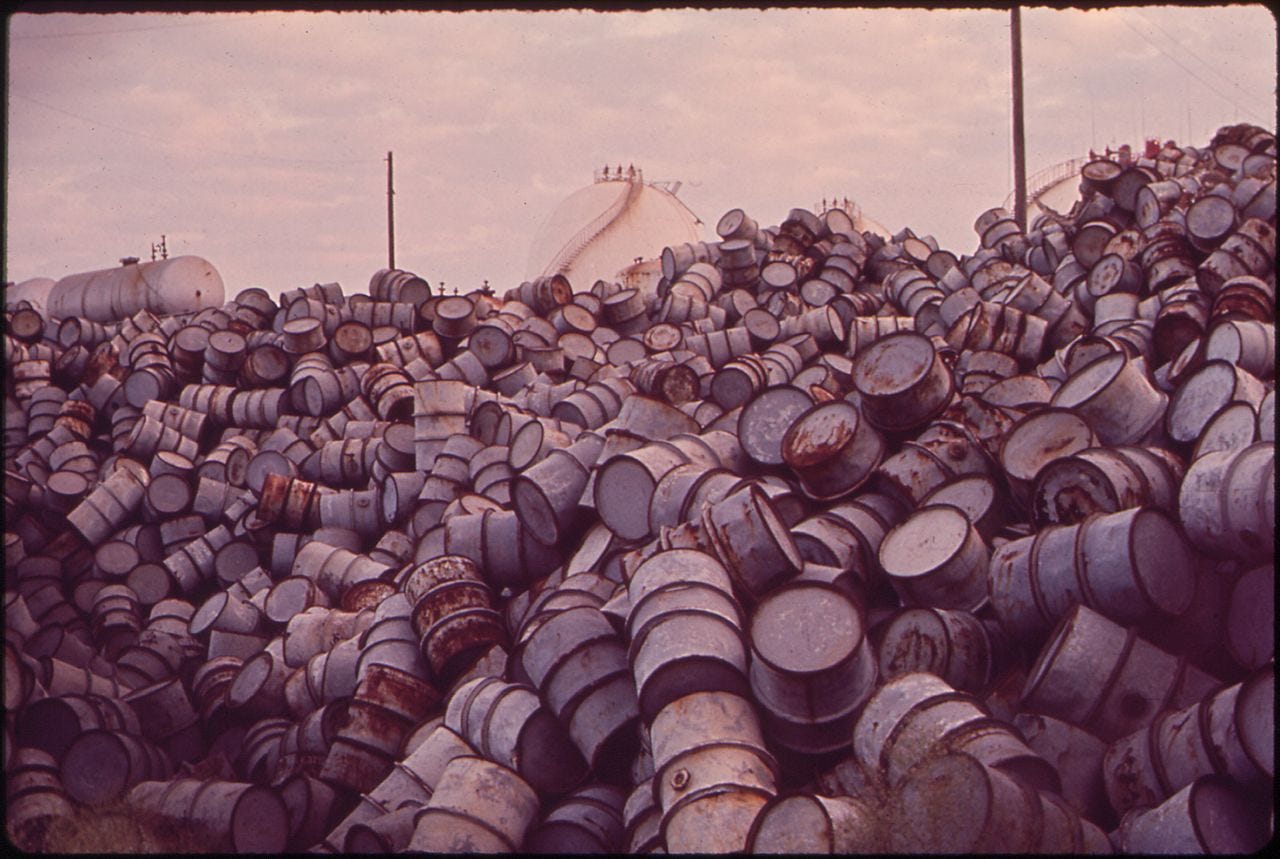
Oil drums in Lousiana in 1973 By Messina, John U.S. National Archives and Records Administration, Public Domain, https://commons.wikimedia.org/w/index.php?curid=17102273

One of the big debates of recent days has been whether Russian oil and natural gas should be subject to the sanctions that are beginning to devastate Putin’s economy. On the surface, it seems hypocritical to exempt Russian oil from sanctions while shutting off other sorts of trade ranging from financial transactions to aircraft parts.

There are at least two problems with shutting off Russian oil. First, not much of Russia’s “black gold” (“Russian tea?”) goes to the US, but a lot goes to our European allies. Russia’s biggest oil customer by far is China, followed by the Netherlands and Germany. South Korea and Japan are also large consumers of Russian oil along with other European countries.

This presents a couple of problems. It would likely be difficult to enforce sanctions between two authoritarian countries, neither of which would want to cooperate. My guess is that even if Russian oil was the subject of a worldwide boycott, they would still have a market in China. The Chinese would probably get the oil at a discount because so few buyers would be competing for it.

On the other hand, it would be easy to shut off the flow of oil to Russia’s European customers, but the consequences of doing so have to be considered. March is still cold in much of Europe and the oil is needed for heat as well for running factories and transportation. If the Russian oil spigot is turned off too quickly, before replacement sources can be found, European countries may find their own economies slowing in addition to that of Russia. If Europe falls into a recession, economic difficulties could fracture the anti-Russia alliance.

Only about 3.5 percent of oil imported into the US comes from Russia, but that oil would have to be replaced as well. That small percentage is still a lot of oil, an average of about 20 billion barrels per month in 2021. As more countries compete for the non-Russian oil on the market, prices will be driven up.

Even if the US was totally energy independent, oil and gas prices would still go up here because of the way markets work. If American producers could sell their oil domestically for $50 per barrel or abroad for $130 barrel (as they have already hit briefly), a lot of American oil would be exported. Domestic prices would have to rise to compensate.

Over time, if the crisis lasts that long, oil producers will increase production. The government doesn’t have to tell them to do this. The producers will make that decision on their own as oil prices rise. Basic economics and capitalism tell us that as prices rise, more producers will get into the market to make profits.

It takes time to ramp up production, however. Lead time is required for permitting, drilling, building wells, and assembling the infrastructure to move and refine oil in order to bring it to market. It will likely take months before producers can start bringing new wells online.

Having said that, there’s an erroneous belief that Joe Biden has cut oil production in the US. That is not true, and the president doesn’t have nearly as much control over oil production, a private industry, as many people on both sides seem to think.

The good news is that oil companies already started increasing production last year as we began to exit the pandemic. US oil production dropped off a cliff when demand cratered in 2020 due to the pandemic. Oil producers shuttered wells rather than contribute to a glut with prices already at historic lows. As the pandemic waned, production began to increase and has continued to rise under Joe Biden. In fact, even before the war started, the Energy Information Administration forecasted that US oil production would reach record levels by 2023.

Inflation and supply problems had driven up gas prices, even before the invasion of Ukraine, but gas prices are still below record highs. By the end of 2019, before the pandemic killed demand, the average gas price was above $2.80 per gallon. In January 2022, the average was $3.41. By the end of February, the national average was $3.70 and rising. I fully expect gas to average higher than $4 per gallon when the next report comes out.

Prices were up before the invasion, but a large percentage of the current price can be blamed on Vladimir Putin. In my area, prices have climbed about $1 per gallon since Russian soldiers stepped across the Ukrainian border. There is an undeniable link between the Ukraine war and the recent price spike.

The question is how high oil and gas prices will go and how long they will stay elevated because the world economy runs on oil. Uncertainty and rising prices make people and businesses pull back and stop spending unnecessarily. People on tight budgets cannot absorb an extra $20 to fill their tank without cutting elsewhere. If enough people stop spending, we could see an economic downturn.

So the Biden Administration and our European allies have tough choices to make. How do they isolate Russia and turn the screws on Putin while not shooting themselves in the foot? My guess is that the flow of Russian oil will eventually be shut off, but it will take some time to bring all the players on board.

But it may not be as long as you think. Oil companies can read the writing on the wall and are already starting to divest themselves of Russian business. BP, ExxonMobil, and Shell have already announced that they are exiting partnerships with Russian oil companies. The West just doesn’t want to do business with Russia and consumers don’t want Russian products, whether it is vodka or oil (or whatever else they might produce aside from cybercrime).

The matter is made more complicated by domestic politics, however. Republicans seem determined to blame Biden no matter what he does. A Sunday tweet by Senator Marsha Blackburn (R-Tenn.) is a good example. Blackburn called attention to the gas price in 2020 at the depths of the pandemic, drawing a contrast to current prices. But on Fox News just a few hours earlier Blackburn had called oil “Russia’s currency” and said that the US and allies need to “shut down” the Russian oil trade. Never mind that this would drive up prices even further. Or maybe that’s exactly what Blackburn has in mind.

If the Republicans really wanted Biden to sanction Russian oil, they’d make it easy for him by saying that the two parties were coming together to fight Putin on behalf of Ukraine. They could explain that rising gas prices due to Russian oil sanctions were a difficult sacrifice that we all need to make for the greater good.

But no. What we see is the GOP blaming Biden for high gas prices while simultaneously pushing for policies that would drive oil higher. That seems a bit dishonest to me.

Further complicating matters is the fact two other major oil producers are under sanctions as well. Donald Trump placed sanctions on Iranian and Venezuelan oil, which ironically aided Russian oil producers. But if Biden removed these sanctions on the grounds that Russia was a bigger current threat, Republicans would undoubtedly attack him for being soft on terror and pro-socialist.

Why is it that God placed so much oil in so many politically unstable and hostile places? At least we have Canada, although even if Biden had not canceled the Keystone pipeline, it would not have been open for business until next year. Republicans might also want to sanction Canadian oil in retaliation for the breakup of the trucker protest. Who knows?

There are other producers who are not being sanctioned, but the Saudis just refused to increase production. Remember what I said about presidential power being limited when it comes to oil production? Perhaps slow-walking arms sales to the desert kingdom would change Saudi minds.

The Biden Administration could do things to help relieve pressure. Permitting for new leases could be expedited and pipelines from Canada approved, but those are long-term solutions. In the short term, we could waive the federal gas tax and maybe even allow Iran and Venezuela to replace some of Russia's oil. Keeping these sanctions lifted could be contingent on good behavior.

The bottom line is that oil is a finite resource. Only so much can be produced in a day (about 101 million barrels per day, by the way.) The world needs oil to run and there are only certain places where we can get it.

I’m old enough to remember the Arab oil embargo of the 1970s, if barely. In retaliation for American support of Israel in the 1973 Yom Kippur War, Arab oil-producing countries stopped selling oil to the United States. As a result, there were high prices (for the time), shortages, and rationing. Cutting off Russian oil could conceivably cause similar problems, but these would be self-inflicted.

In the long term, we should also be looking for more ways to break our addiction to oil. High prices will help to incentivize such moves. Alternative energies are more attractive when oil prices are elevated. In that way, Vladimir Putin’s aggression in Ukraine may contain the seeds of Russia’s ultimate economic decline as it drives the world away from its main export.

For now, though, we have to deal with the world as it is, not the way we wish it was. We have to accept our current levels of production and consumption. For now, we have to make hard choices.

The West wants to help Ukraine, but it also wants to avoid slipping into another economic downturn. A recession could erode support for the Ukrainians and end up hurting their war effort as well.

The Ukraine war is currently a war of attrition. It is a race to see whether Ukraine’s ability to resist will outlast the Russian economy’s ability to support the invasion army. Our interlinked global economy makes for strange bedfellows, but allied governments would be wise to tread cautiously as they move to isolate Russia. The consequences of each move has to be carefully - but quickly - considered.

From the Racket

Wednesday, March 2, 2022

SOTU was a solid hit but not a homerun

 President Biden delivered his State of the Union last night, and as is normally the case, the hot takes are a Rorschach test of political perception. If you like Biden, you liked the speech. If you don’t like Biden, you saw it as a hot mess.

There’s really nothing new about that. If Joe Biden and Donald Trump delivered the same speech, their respective partisans would both declare it to be great, although they might cheer different parts.

In my view, expectations for the speech (transcript and video here) were pretty low, and the president mostly met them. This is was due to both the dumpster fire situation that America and the world find themselves in and the continuing allegations that Biden is “Grandpa Dementia.” That the president could find anything positive to say and then say it without looking like a drooling idiot meant an automatic hit with extra bases if not a home run.

Even taking the soft bigotry of low expectations into account, Biden did well. The beginning of the speech, which concentrated on the situation in Ukraine, was strongest and received warm, bipartisan applause. Much of the country seems united around Ukraine, although not necessarily behind Biden’s handling of the crisis. Some Republicans, such as Mitt Romney and Condoleeza Rice, have lauded Biden’s efforts, but most can’t find anything nice to say, even if, like The Former Guy, they can’t say exactly what they would do different.

The Ukraine crisis may have actually helped Biden by giving him something to talk about aside from inflation and the failed Democratic agenda for 2021. The problem was that the section about Ukraine seemed to be stapled onto the beginning of a 2020 stump speech.

The litany of programs that accompanies a SOTU is always my least favorite part. Usually, about 90 percent of the partisan wish lists never become law, but it does become fodder for activists on both sides. This was both good and bad for Biden last night.

It was good because a lot of the individual items that President Biden advocated will be popular with voters. A great many parts of Biden’s agenda are popular with voters on an individual basis but then lose support when partisan lines are drawn. These include ideas such as allowing Medicare to negotiate drug prices and government aid for child care.

The policy rundown also helps to dispel some incorrect notions about what Biden’s policy is. For example, if you haven’t listened to Biden but only listen to people talk about Biden, you probably didn’t know that he has never supported defunding the police or open borders (which almost no one really supports). Two moments from last night’s speech that could have been delivered by a Republican were when Biden said, “The answer is to FUND [emphasis his] the police with the resources and training they need to protect our communities,” and “we need to secure the border and fix the immigration system.”

The downside for the partisan wish list is that it isn’t going to go anywhere. This is basically the same list of proposals that Democrats have tried to push through over the past year. It didn’t go anywhere then and it is unlikely to go anywhere now because the congressional math has not changed. Unless the Biden Administration can sweeten the pot enough to bring Joe Manchin, Kirsten Sinema, and maybe even some Republicans on board, they are just talking into the wind.

As a conservative, I didn’t find a lot to agree with in the details of Biden’s wish list but that isn’t to say that I found nothing. There are areas of agreement between the two parties and that is where Biden’s focus should be. Passing legislation requires bipartisan coalitions, not pandering to wingnuts.

On COVID, Biden promised to continue to work for vaccines and treatments including being able to deploy vaccines against new variants within 100 days. Biden also called for continued free vaccines, post-infection treatments, tests, and masks.

“It’s time for Americans to get back to work and fill our great downtowns again,” Biden said. “People working from home can feel safe to begin to return to the office.”

“Our schools are open,” he added. “Let’s keep it that way. Our kids need to be in school.” 

Biden also said that “with 75 percent of adult Americans fully vaccinated and hospitalizations down by 77 percent, most Americans can remove their masks, return to work, stay in the classroom, and move forward safely.”

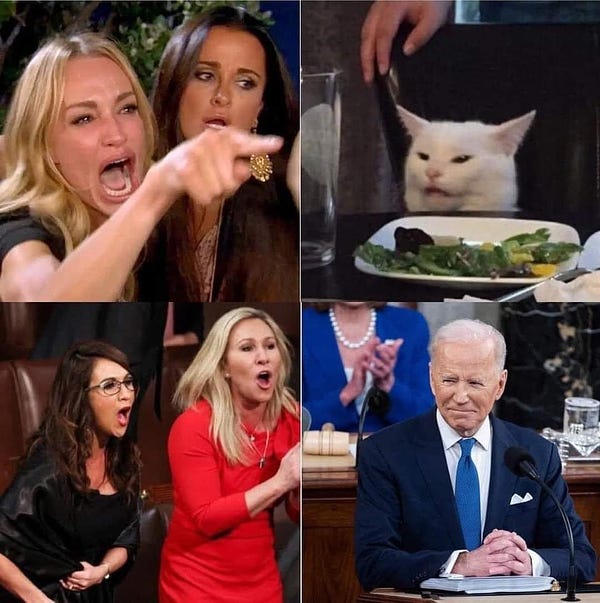
In a moving moment in the section on veterans, the president memorialized his own son, Beau Biden, who died of cancer. This set the stage for the worst moment of the night when Lauren Boebert yelled, “You put them there [in a flag-draped coffin]! Thirteen of them!” At that point, Reps. Boebert and Marjorie Taylor Greene tried to start a chant or cheer against the president but were quickly told to sit down by members of their own party.

The speech ended on a strong and optimistic note, which was what Biden needed to do.

“My report is this: the State of the Union is strong—because you, the American people, are strong,” Biden closed. “We are stronger today than we were a year ago. And we will be stronger a year from now than we are today. Now is our moment to meet and overcome the challenges of our time. And we will, as one people. One America. The United States of America. May God bless you all. May God protect our troops.”

While I disagree with quite a bit of Biden’s platform, I was struck by the contrast between his optimism and the gloom and doom that continually comes from the Republican Party where we are perpetually one election away from irreversible decline and tyranny. Even when they win.

More and more, I’m hearing talk of revolutions and national divorces from the GOP. I don’t like that.

I also don’t like the Democratic prescription for the country, but I do like Biden’s vision for a strong and united America. My hope is that he really believes this and will seek to be more unifying over the next two years than he has so far.

No, the speech wasn’t perfect. It had flubs, such as when Biden inadvertently said the “Iranian people” when he meant “Ukrainian.” It had things I don’t support, such as expanded LGBTQMNOP rights and protecting the right to abortion.

For all its faults though, it did leave me with a good taste in my mouth and feeling some hope and pride rather than the pessimism that has permeated the country for days, weeks, and years at this point.

I’d call that a win.

Share

On another topic, I’d like to salute my son, Ethan. As some of you may know already, Ethan is a graduating high school senior and has decided to enlist in the Air Force.

Ethan turned 18 a few weeks ago and spent Monday getting poked and prodded at MEPS, the Military Entrance Processing Station. At the end of the day, he took the oath to become a military airman. Because of the pandemic, visitors are not allowed to attend the ceremony, but a video of the oath is posted on the MEPS Facebook page.

With everything going on in the world, we are naturally a bit anxious for him, but we are proud of his decision and we think that serving in the Air Force will be good for him. We are just hoping for a very quiet few years.

His current status is enlisted in the Delayed Entry Program until he graduates high school. Ethan will report for Basic Military Training sometime this summer.

Although I’m concerned for my son, as any parent would be, I have to admit that he gets it honestly. If I hadn’t had a back problem that disqualified me, I probably would have done the same thing.

Photo credit: Atlanta MEPS Facebook screenshot

Share

From the Racket

Sunday, February 27, 2022

Putin's humiliation: The Ukraine war turns ugly for Russia

 The best-laid plans of mice and men often go awry. This week, Vladimir Putin seems to be getting some first-hand experience in plans going awry.

After what the world thought would be a quick invasion and occupation of Ukraine began on Thursday, Russian advances quickly bogged down. In four days of fighting, the Russian army has still not been able to capture the Ukrainian capital of Kyiv although they have reached the city’s suburbs.

Around the internet, there are videos of burned-out Russian armored columns and other Russian vehicles that have reportedly run out of gas, some abandoned and some with soldiers nearby being taunted by Ukrainian civilians. Ukraine has reportedly captured hundreds of Russian soldiers and has both set up a hotline for concerned parents to call the Ministry of Defense and allowed POWs to call home. Some captured Russians claimed that they were told that they were being sent on a training mission, not going to war.

Ukraine is winning the propaganda war online, but what about the actual war in the field? The situation is confused, but it is generally agreed that the Russians have been confined to occupying narrow slivers of territory near Ukraine’s borders. LiveUAmap.com shows Russian-controlled territory as well as updates on reports from the various fronts.

We do know one thing for sure and that is that Kyiv remains in Ukrainian hands despite nightly shelling and airstrikes and Russian columns approaching from several directions. Ukrainian news reported on Saturday that there were heavy Russian losses at Hostomel airport to the north of the city where a Russian general commanding an elite unit was among the dead.

Senator Marco Rubio tweeted on Saturday night that US intelligence had learned the Russian objectives for the invasion. Four days into the war, none of the goals have been met.

For those interested in the root causes of Russia’s military difficulties, another Twitter thread by Stanimir Dobrev of International Review gives some background. The answer lies in poor planning, untested and untrained troops, bad strategy, and corruption among other things.

The news from the rear has not been any better for Russia. World opinion has swiftly turned against Vladimir Putin and his invaders. One of the first notable cracks in the small pro-Russia bloc was when China, Russia’s new strategic partner, issued a statement saying that Ukraine’s sovereignty should be respected.

“China firmly advocates respecting and safeguarding the sovereignty and territorial integrity of all countries, Chinese Foreign Minister Wang Yi said in a statement. “This equally applies to the Ukraine issue.”

In another blow to the Russian homefront, the White House and the EU announced the expulsion of some Russian banks from the international SWIFT financial communications network. The decision comes as sanctions mount and Russia becomes more and more isolated. When world financial markets open on Monday, there is a good chance that the ruble and Russian stocks will collapse.

If Mr. Putin thought that the world would stand aside as his armies rolled over Ukraine, he was mistaken. Far from fracturing NATO, the alliance seems stronger than ever. NATO is deploying new ground and air forces to surrounding countries and member nations are shipping arms to Ukraine’s defenders. The Biden Administration approved $350 million in aid that will include Javelin anti-tank missiles and Stinger anti-aircraft missiles. The Baltic states, NATO members and probably high on Putin’s target list themselves, are sending additional missiles as well. Even the Germans are getting into the act, reversing a long policy against sending weapons to conflict zones.

On top of all that, stopping the expansion of NATO was one of Putin’s primary war aims. His rash action may have been counterproductive on that point. Russia cautioned Finland and Sweden against joining the alliance, but the two nations brushed off the warning. Both countries already cooperate closely with NATO. Assuming that Ukraine survives as an independent nation with a government that is not run by Russian proxies, I think that there is a high probability that it will be admitted to the alliance after the war.

No matter how bad it looks online, Russia could still pull off a victory. In a conventional war, resources like men and material carry a lot of weight. Russia has a significant edge on both. Although Ukrainian morale and motivation are high, Russia’s advantage in numbers could carry the day. I’ve assumed from Day One that Kyiv would fall and US intelligence has warned that this could happen within days.

Stagnant fronts run the risk of leading the Russians to escalate. Thus far, the Russians seem to have tried to avoid civilian casualties and wanton destruction, but as they become desperate to make gains, that may change. This could take the shape of more indiscriminate airstrikes or the use of thermobaric rockets, weapons that were used in Chechnya and that are devastating in an urban setting.

The fall of Kyiv and even the occupation of the entire country wouldn’t necessarily mean the end of the war. The fighting spirit of the Ukrainians would probably mean a long and difficult occupation for the Russians. A puppet regime would also have problems.

Until it declared independence in 1991, Ukraine has been dominated by Russia for hundreds of years with the exception of a few even darker years when it was dominated by Nazi Germany. It looks to me as though the people there are tired of being under the thumb of authoritarians. Ukrainians seem more than willing to die for their country… and to kill for it.

Share

In nonwar news, Donald Trump spoke at CPAC on Saturday. In his speech, he finally came out against the invasion of Ukraine, calling it “an outrage” and an “assault on humanity.”

Trump also said that he plans to run for president again in 2024, saying, “We did it twice, and we'll do it again.” Trump lost his second presidential bid but has refused to acknowledge reality.


As expected, President Biden nominated Ketanji Brown Jackson to the Supreme Court. Jackson is a Harvard graduate who was first nominated to the bench by Barack Obama. Biden nominated her to the US Court of Appeals for the DC Circuit in 2021. She received three Republican votes (Collins, Graham, and Murkowski) in that confirmation process. Jackson is well-qualified and will almost certainly be confirmed.


Marjorie Taylor Greene (R-Ga.) and Paul Gosar (R-Ariz.) also made news when they attended the convention of the America First Political Action Committee, a white supremacist group.

In a clip tweeted by Liz Cheney, Nick Fuentes leads the crowd in cheers for Russia and Putin who they say “is Hitler and they say it’s not a good thing.”

This was not Gosar’s first flirtation with Fuentes, but Greene pled ignorance in another video posted to Twitter.

From the Racket