Wednesday, September 23, 2020

Another Red State Is Becoming A Battleground

 Fresh on the heels of news that two red states, Georgia and Iowa, are dead heats in the presidential election comes another indication that Joe Biden is taking the fight to states that are typically considered safe for Republicans. This time the alarm bells are ringing in Texas, a state that has not voted for a Democratic presidential candidate since 1976.

The extent of Republican concerns for the Lone Star State is shown by a Politico report that Texas is among several battleground states that received million dollar cash infusions from the Republican National Committee. The $1.3 million payment is the largest-ever grant from the RNC to the Texas State GOP.

Underscoring the problem is a new poll from the Tyson Group that shows President Trump trailing Joe Biden by a 44-48 margin with five percent undecided. The poll also found that Trump’s approval in the state was underwater by four points at 45 percent.

Senator John Cornyn is also struggling in his re-election bid. At 35 percent approval, Cornyn holds a two-point lead over MJ Hegar, his Democratic challenger, with 11 percent undecided.

As with the Georgia and Iowa polls, the new Texas poll is not an outlier. FiveThirtyEight‘s list of state polls shows a race that has tightened dramatically since the beginning of August when Trump had a seven-point advantage in a YouGov survey. The polling average now shows the president with a lead of less than one point.

Texas is generally considered to be one of the reddest of the red states, but recent elections there have told a different story. Notably, Ted Cruz won a very narrow victory against Beto O’Rourke in 2018 by less than three points. That year Republicans lost two congressional seats in Texas as well as 12 seats in the Texas House and two in the state Senate.

But those statistics don’t tell the whole story. That same year, Gov. Gregg Abbott was re-elected in a 13-point landslide. The real story in Texas goes deeper than just assuming that Democrats are making across-the-board gains.

As any Texan will tell you, Texas is unique. The state makes up about seven percent of the land area of the United States and about 8.6 percent of the US population. Texas contains tiny frontier towns and huge urban metropolises as well as a long international border with Mexico.

Even though the perception of Texas as a conservative bastion, Texas’s major cities are deep blue as is much of the border area (which undercuts the Republican theories about illegal immigrant crime waves). In fact, political patterns in Texas resemble those in the nation at large. Sparsely populated rural areas tend red while the cities and the border go blue. In the age of Trump, suburbs are increasingly trending Democrat as well, which helps to account for the loss of Republican seats in 2018.

One area where Texas is different is in its racial demographics. Hispanics make up 40 percent of the population of Texas. In 2018, about 70 percent of Texas Hispanic voters supported O’Rourke in the senatorial election. This is a significant increase from the 63 percent that voted for Obama in 2008 or the 61 percent that voted Clinton in 2016. An obvious conclusion is that Trump’s racial rhetoric has pushed more Hispanics toward the Democrats.

On the other side of the scale are the Texas transplants, many of whom immigrated to the state from blue states such as California. A CNN exit poll from 2018 found that Texas natives preferred Beto O’Rourke while newcomers supported Ted Cruz. This new blood likely saved Cruz’s seat.

In 2016, Donald Trump won the state by nine points, which seems respectable until you look at Texas’s electoral history. Mitt Romney’s margin of victory in 2012 was 16 points and John McCain won the state by 12 points. Native son George W. Bush took Texas by an astounding 23 points in 2004.

The lesson here may be that good Republican candidates do well in Texas while weak candidates have a hard time. And by most measures, Donald Trump is a historically weak incumbent who is struggling, not only in Texas but in a growing number of red states.

Even though Trump will likely eke out a victory in the Lone Star State, a close race has other bad implications for the GOP. Money being spent by Republicans to shore up Texas cannot be spent in other battleground states, and, as I pointed out this morning, Biden already has a cash advantage over the Trump campaign. A close race also means that Republicans may lose additional congressional seats this year even if Trump carries the state.

“If Trump barely wins Texas, we lose Texas-22, Texas-24 and possibly Texas-21,” a Texas Republican consultant told Politico. “Democrats probably take the state House in that scenario, too.”

Such a scenario would have been unthinkable only a few years ago.

The worst-case scenario would be that the hemorrhaging continues and that President Trump loses Texas on November 3. Without the 38 Lone Star electoral votes, Trump would lose even if no other states flipped from the 2016 results. Realistically, however, if Texas is lost, most of the other battlegrounds will be turning blue as well.

Republicans have little choice but to pour resources into Texas to defend a must-win state. That necessity will thin their assets in other battleground states and make it even harder for Donald Trump to overcome Joe Biden’s ubiquitous advantage in the closing days of the campaign.

Originally published on The Resurgent

Polls Show Dead Heat In Georgia And Iowa While Biden Racks Up YUGE Cash Advantage

 Apair of new polls on Tuesday underscored the difficulty that Donald Trump’s campaign will have in eking out a victory as two red states fall into the tossup column. The news is made worse by the revelation that Joe Biden holds a fundraising advantage as the campaign enters its final phase.

In Georgia, an Atlanta Journal-Constitution poll showed Biden and Trump in a dead heat at 47 percent each. Another one percent backed Libertarian Jo Jorgensen. Only four percent were undecided.

The poll also showed close races for Georgia’s two Senate seats, although Republican David Perdue is running ahead of President Trump. Democrat Jon Ossoff trails Sen. Perdue by only two points while Kelly Loeffler narrowly leads a pack in the special election for her seat. Loeffler polls ahead of a crowded field with 24 percent while fellow Republican Doug Collins and Democrat Raphael Warnock both have 20 percent.

It is tempting to dismiss the poll as an outlier, but most recent polls have showed a close race. The outlier among recent polls is a WSB-TV survey that found Trump up by seven points.

In Iowa, the Des Moines Register found another 47-47 tie. This poll showed four percent supported another candidate with only three percent undecided.

As in Georgia, recent Iowa polls show a tight race. Trump has had only a 1-2-point advantage in the few polls conducted in the Hawkeye State since April.

With few voters undecided, there is scant opportunity for Donald Trump to pull ahead to a comfortable lead in these states that were assumed to be safe Republican territory. Even worse, Dick Morris’s maxim that undecided voters usually break for the challenger and against the incumbent may mean that Biden now has a slight structural advantage. In any case, the Trump campaign must expend resources to shore up states that should be safe.

And resources are getting thin. Politico reported that the Biden campaign out-raised Trump last month with a record-setting $365 million fundraising haul. The Biden campaign outspent Trump by two-to-one and still has a $466 million to $325 million advantage on cash reserves, a $141 million edge. The Trump campaign’s cash shortage has forced the cancellation of television ads in several battleground states, in most of which Trump is already trailing.

If the cash crunch persists, it will make it difficult for Team Trump to answer Biden’s final onslaught of ads. With early voting already underway, Donald Trump desperately needs a break in order to reverse Biden’s “Joe-mentum.” With a shortage of cash and bad poll results all over the map, that break won’t be easy to either find or exploit.

Originally published on The Resurgent

Monday, September 21, 2020

Here Are Trump’s Likely Supreme Court Nominees

 As the race to confirm a replacement for Ruth Bader Ginsburg heats up, the White House has hinted at two possible candidates and President Trump has promised to name a woman to replace the popular liberal jurist. One candidate was a finalist for Trump’s last appointment to the High Court while the second possibility is a Latina who might help Trump with Hispanic voters.

On Saturday, President Trump told reporters, “It will be a woman, a very talented, very brilliant woman. I haven’t chosen yet, but we have numerous women on the list.”

The statement, which was reminiscent of Joe Biden’s pledges to pick a woman for his running mate and to appoint a black woman to the Supreme Court, has not been criticized by Republicans, who normally oppose such demographic tests. In fact, a Republican crowd at a Trump rally in North Carolina cheered the idea of a gender-based pick.

A leading candidate for the seat is Amy Coney Barrett, a Seventh Circuit judge from New Orleans, who graduated from law school at Notre Dame. The Seventh Circuit is headquartered in Chicago and Barrett has served in her position there for just under two years after teaching at Notre Dame for two decades.

Barrett was a finalist for the appointment to fill the last opening on the Court. She is a staunch conservative and pro-life judge who once clerked for Justice Scalia. In 2018, she was widely considered to be a bigger threat to Roe v. Wade than Brett Kavanaugh.

Last year, Trump said of Barrett to Jonathan Swann of Axios, “I’m saving her for Ginsburg.”

In the other corner is Barbara Lagoa, who is currently a justice on Florida’s Supreme Court. Lagoa is a Cuban-American, born in Miami, who graduated from Columbia Law School and was appointed to Florida’s Third District Court of Appeal by Jeb Bush in 2006 and the State Supreme Court by Ron DeSantis in 2019.

There are pros and cons for either choice. Amy Coney Barrett has been more closely vetted than Lagoa, which is both a blessing and a curse. Her anti-abortion beliefs are well-known and would be a lightning rod for Democrats and pro-choice Republicans.

Barrett’s short judicial history leaves few opinions for researchers to comb through as they seek to understand her judicial philosophy. One controversial opinion that will come up a lot in the next few weeks was Barrett’s ruling in 2019 that Purdue University’s handling of a sexual assault allegation may have discriminated against the accused man.

On the other hand, Lagoa has a longer history on the bench but no experience in the federal judiciary at all. She has ruled against voting rights for felons and generally been pro-business in her decisions per the Washington Post. One of her most controversial decisions was her ruling that Gov. DeSantis’s firing of Broward County Sheriff Scott Israel for incompetence following the Parkland, Florida school shooting.

With respect to abortion, Lagoa, a Catholic, is generally considered pro-life. However, she did respond to a question from Senator Feinstein last year by writing that Roe was “binding precedent of the Supreme Court and I
would faithfully follow it as I would follow all precedent of the Supreme Court.” She also responded that Roe was “settled law.”

Florida Republicans say that picking Lagoa could win the state for Trump even though Biden has consistently led in polling of the Sunshine State. Even if Trump does pull out a win in Florida, he would still lose the election if he can’t turn things around in other battleground states such as Arizona, Michigan, Pennsylvania, and Wisconsin where polling also shows him losing to Joe Biden.

Either woman would likely be a good pick for conservatives and constitutionalists, but it remains to be seen whether the additional conservative seat on the Court would be worth the collateral damage that confirming Mr. Trump’s pick could cause. Many Democrats, still smarting over the Senate’s failure to act on Merrick Garland, would like to see President Biden make two appointments off the bat by expanding the Court to 11 justices. This would almost certainly require the elimination of the filibuster and could set of a judicial arms race in which both sides expanded the Court whenever they held the White House and the Senate.

The Supreme Court fight might also cost Republicans Senate seats that could be held otherwise. A new Reuters poll found that 62 percent of adults favored allowing the winner of the election to make the appointment. Only 23 percent disagreed, which indicates that even a large number of Republicans want to let the voters decide the fate of the seat.

Donald Trump has typically performed poorly with women voters. A recent poll from Lake Research Partners and Emerson College Polling found that women favored Biden by 11 points, fueling an 18-point gender gap. Republicans hope that the appointment of a female judge will help make up some of that deficit. The net result may be negative, however, when the effect of going against the will of the voters in filling the seat is considered.

The outcome of a confirmation vote is still in doubt at this point. Republican Senators Susan Collins (Maine) and Lisa Murkowski (Alaska) have said that the Senate should not vote on Mr. Trump’s nominee before the election. The assumption is that this means they would not support a Trump nominee at this time. With 53 Republican votes in the Senate and Vice President Mike Pence as the tie-breaker, Republicans can only afford to lose one more senator.

The confirmation battle is still in its early stages. There is much that we don’t know, including who the nominee will be. One thing is certain, however. That is that the process will be contentious no matter who President Trump picks.

Originally published on The Resurgent
Friday, September 18, 2020

Trump’s Toughest Demographic: Former Trump Administration Officials

 Donald Trump has struggled with minorities and swing-state voters but another demographic seems to be even tougher for him to win over: Former Trump Administration officials. There is a long list of alumni from the Trump White House who have left under a cloud and had bad – even shocking – things to say about Donald Trump. The most recent of these is Olivia Troye.

Olivia Troye was a member of Vice President Pence’s staff for two years. During that time, she worked as an advisor on homeland security, counterterrorism, and the coronavirus pandemic. She served Pence’s lead staffer of the Coronavirus Task Force until leaving the Trump Administration in August. Now she has recorded a devastating ad against Donald Trump for Republican Voters Against Trump.

“Towards the middle of February we knew it wasn’t a matter of if COVID would become a big pandemic here in the United States,” Troye says in the video, “It was a matter of when. But the president didn’t want to hear that because his biggest concern was that we were in an election year and how was this going to affect what he considered his record of success?”

“It was shocking to see the president saying that the virus was a hoax, saying everything was okay when we know that it’s not.” Troye continues. “The truth is that he doesn’t actually care about anyone else but himself.”

Troye cites the example of a Coronavirus Task Force meeting in which the president said, “Maybe this COVID thing is a good thing” because “I don’t like shaking hands with people.” She added that he said that the people wanting to shake his hand were “disgusting.”

Troye’s statement is also confirmed by recordings of the president released by Bob Woodward. Woodward’s tapes reveal a president who said, “I wanted to always play it down” even though he acknowledged “This is deadly stuff” as early as February 7.

Troye’s words might be written off as sour grapes from a disgruntled employee (and undoubtedly will be by Trump’s base) except that her testimony is merely one more installment in a long line of former Trump Administration officials with similar stories and complaints. She joins James Mattis, John Bolton, John Kelly, Rex Tillerson, and a host of others who have said that Donald Trump lacks the capacity to govern and is bad for the country. At least 11 former generals and admirals have raised the red flag on Trump.

The irony is that many of these people were darlings of the Republican right until they parted ways with Donald Trump. Now each is a persona non grata. Nothing will move a person faster from hero to zero in the Republican Party faster than voicing anything critical of President Trump.

The same goes for Olivia Troye, who was largely unknown outside the Administration. Miles Taylor, a former chief of staff in the Department of Homeland Security, told CNN that Troye was “one of the most hardworking, honest public servants I have ever met in my entire career.” Taylor added that DHS recommended Troye for the vice president’s staff because “her background was immaculate, her service was extraordinary, her qualifications were unmatched” and that Pence had personally said that Troye was doing “an incredible job.” Contrast that description with today’s attacks on Troye as a Deep State Never Trumper.

In fact, some of the former staffers were once avid Trump supporters. Anthony Scaramucci, who served on the 2016 Trump campaign as well as briefly serving as the White House Communications Director, now says he realized that “My loyalty to God and the United States of America was more powerful than my loyalty to one man, a man who has left the country we all love weaker, poorer, and sicker due to his malevolence and incompetence.”

Granted that there are exceptions. Some former Trump officials stand by their man even after being fired. Steve Bannon and Jeff Sessions are notable in this category.

The common threads between the critics who served in the Trump Administration are (1) a willingness to serve as advisors to Donald Trump and (2) a realization that Trump is bad for the country after spending time in proximity to the president.

The sheer number of people who come out of the Trump Administration and raise red flags about the president leaves only two possibilities. The first is that Donald Trump is lousy at picking people who are loyal and tends to hire people who are unprincipled enough to seek revenge by making up outlandish stories. The second is that the testimonials are true and that Mr. Trump’s behavior is so egregious and dangerous that he represents a national security threat. The evidence points to the second possibility.

As Miles Taylor pointed out, the warnings from former Administration officials are like police body camera footage that shows voters what is happening inside the Trump Administration. It is up to voters to heed those warnings for the good of both the country and the Republican Party, which is in serious need of a course correction.

“It was the opportunity and honor of a lifetime to be able to serve in the White House,” Olivia Troye says in her video message. “I put my heart and soul into this role every single day. But at some point, I would come home at night, I would look myself in the mirror, and say, ‘Are you really making a difference? Does it matter because no matter how hard you work and what you do the president is going to do something that is detrimental to keeping Americans safe, which is why you signed up for this role? It was awful. It was terrifying.”

“I have been a Republican my entire life,” Troye says. “I am a McCain Republican, I am a Bush Republican, and I am voting for Joe Biden because I truly believe we are in a time of constitutional crisis. At this point, it’s country over party.”

That is the definition of patriotism.


Originally published on The Resurgent
Wednesday, September 9, 2020

Here’s How The Swing States Look After The Conventions

 The Republican and Democratic conventions are in the rearview mirror as we blow past the two-month mark until the election. Mail voting is already underway in North Carolina and early voting will soon begin in other states as well. It’s crunch-time for the campaigns and there is little time left to shift the polls. The big question now is what the state of the race looks like now that there have been a bevy of post-convention polls as well as polls that take into account the civil unrest and revelations about President Trump’s disparaging comments about the military.

Let’s take a look at the battleground states with an overview of recent polling. As I’ve pointed out many times in the past, any single poll does not show the true picture of the race so we will also look at the FiveThirtyEight average of polls for each state and compare today’s average to August 1 to see how the state might have shifted due to the news of the past month.

Arizona is the first of 11 battleground states. Joe Biden leads there by an average of 4.7 points compared to 3.9 points on August 1.

In Colorado, Joe Biden leads by average of 12.1 points compared to 13.2 points on August 1.

Florida is a more interesting case. The race has narrowed here somewhat in recent weeks and Biden now holds a 1.8-point lead as opposed to his 5.9-point lead from August 1.

In Georgia, Donald Trump leads by a bare 1.5-point margin. This is almost unchanged from his 1.3-point lead on August 1.

Joe Biden leads by 7.5 points in Michigan, which is very close to his 8.0-point lead on August 1.

In Minnesota, scene of the George Floyd killing by police, Biden leads by an average of 6.2 points. On August 1, Biden held a 7.6-point lead.

North Carolina is another squeaker. Joe Biden leads by 1.8 points there, which is almost identical to his 1.9-point lead on August 1.

Ohio is also too close to call. Trump leads there by 0.9 points compared with a 0.5-point lead on August 1.

Joe Biden has a comfortable lead in Pennsylvania. The Democrat leads there by 5.1 points on average, compared with 6.6 points in early August.

Donald Trump holds a slim lead in Texas, the only states where polling has flipped over the past month. Trump currently leads by an average of 0.8 points. On August 1, Biden led by an average of 0.5 points.

In Wisconsin, Biden has opened up a comfortable lead. The Democrat currently holds a 7.5-point advantage compared with 7.0 points on August 1.

The most notable thing about the post-convention polling is how stable the battleground states are. Only in Florida has the polling average changed by more than two points, which puts most fluctuations well within the margin of error.

In 2016, close races in the swing states enabled Donald Trump’s unexpected Electoral College fluke. In the last cycle, state polling showed the battleground states to be mostly in or near the margins of error for the polls. At this point, that is not the case in 2020.

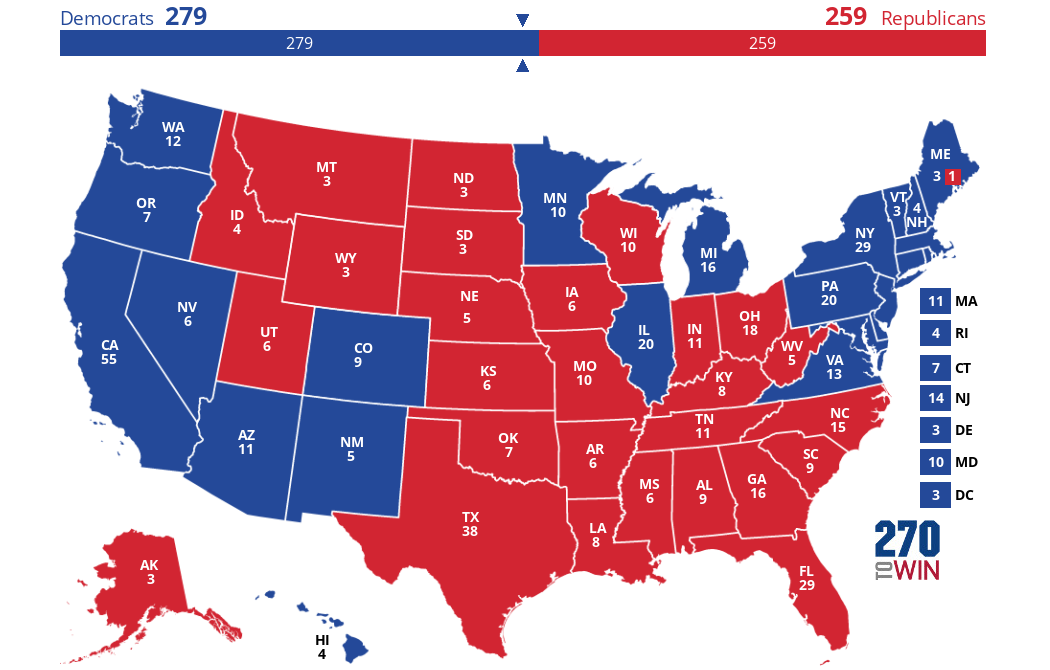
While the trend in Florida is a bright spot for the Trump campaign, the problem is that Joe Biden has other paths to victory in the Electoral College that do not run through the Sunshine State. If we start with the 2016 electoral map, we see that Biden only needs to flip Arizona, Michigan, and Pennsylvania, three states where he has comfortable leads, to win the election by 279-259 electoral votes.

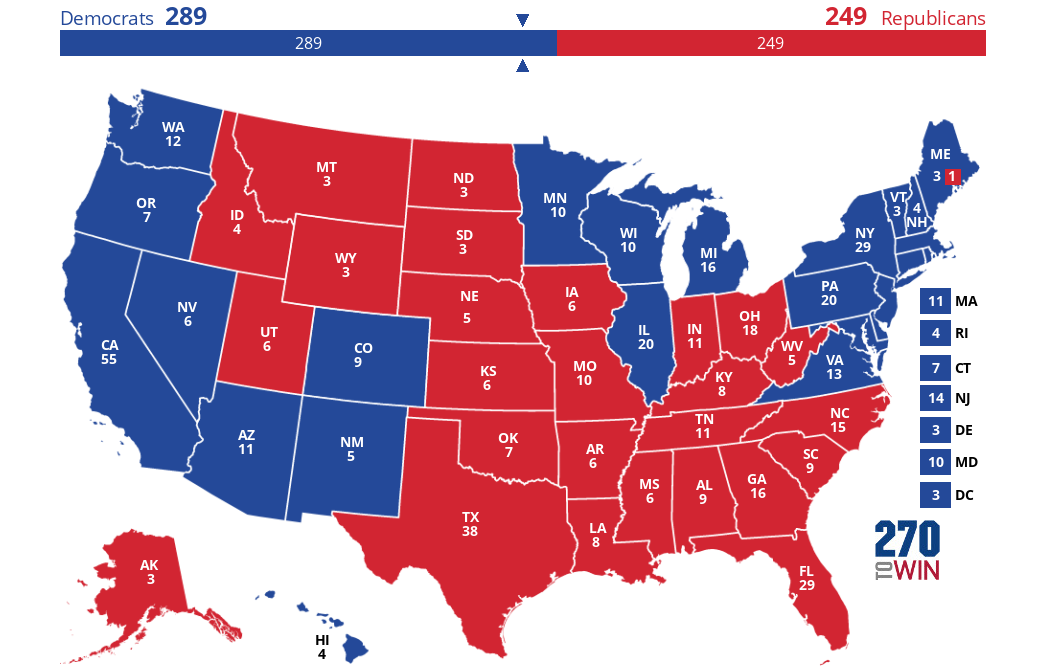
A more likely scenario based on current polling is that Biden takes far more than those three states. Donald Trump will also certainly win Georgia and Texas while Florida, North Carolina, and Ohio remain too close to call. If those states go for Trump, but Biden wins Arizona, Colorado, Michigan, Minnesota, Pennsylvania, and Wisconsin, the Electoral College tally would be 289-249 in favor of Biden. This might represent a good night for Donald Trump.

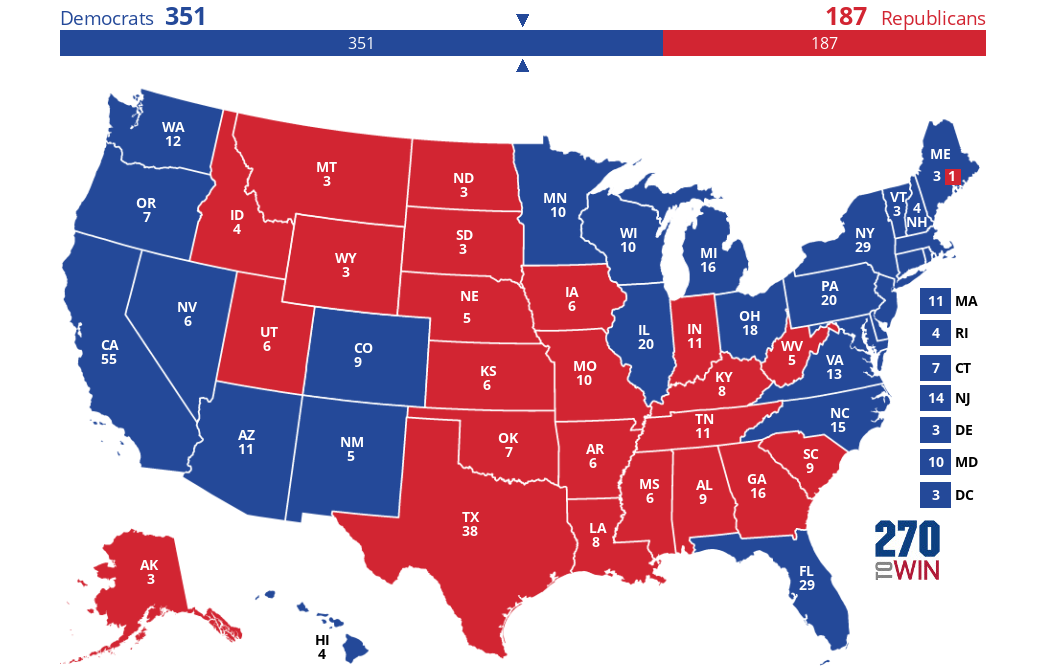
The worst-case scenario for Republicans would be that all three of the too-close-call battleground states break for Biden. The resulting 351-187 Electoral College score would represent a landslide victory for Biden. The last time that a candidate exceeded 350 electoral votes was in 2008 when Barack Obama defeated John McCain 365-173.

Polls are snapshots and not predictive but based on current polling, if the election was held today, Joe Biden would become the next president of the United States. FiveThirtyEight also has a model that forecasts the winner of the election based on current trends. Currently, that model gives Joe Biden a 74 percent chance of winning.

As I discussed last week, polling shows that Donald Trump’s message on crime and the pandemic is falling flat. Even much trust on the economy, once President Trump’s strong point, is being ceded to Joe Biden. At the same time, the president is on the defense due to leaks about his criticisms of the military.

If he hopes to win the election, the president needs to find a message that resonates beyond his base and can bring moderate and independent voters into his camp. He has precious little time to do so.


Originally published on The Resurgent