Wednesday, February 25, 2026
Yes, we have no tariff authority
By now, you have heard that the Supreme Court struck down Donald Trump’s tariff regime. You’ve probably also heard that Trump has essentially decided to ignore the ruling and implement a new 10-percent global tariff under a different law.
To start at the beginning (a very good place to start), the case in question was Learning Resources, Inc. v. Trump, brought by two small family businesses that imported educational toys. In the 6-3 ruling, the Supreme Court held that the International Emergency Economic Powers Act (IEEPA) of 1977 did not convey the power to tax when it authorized the president to “regulate… importation.” Chief Justice Roberts wrote the majority opinion and was joined by Sotomayor, Kagan, Gorsuch, Barrett, and Jackson. Alito, Thomas, and Kavanaugh dissented.
Image created byChatGPT
Justice Roberts points out that federal taxing power lies with Congress in Article I, “The Government thus concedes, as it must, that the President enjoys no inherent authority to impose tariffs during peacetime,” then dryly notes, “The United States, after all, is not at war with every nation in the world.”
For my readers who continue to deny that tariffs are taxes (and you know who you are), Roberts settles that question if the definition of the word did not, using the terms “tax” and “tariff” interchangeably. Roberts equates the two terms and cites the Constitution’s clauses granting Congress the power to tax as a refutation of Trump’s authority to levy tariffs.
Justice Jackson says it explicitly in her opinion, “Tariffs are different in kind. They are a tax on imports; a means of generating revenue from transactions between private parties.”
Tariffs are taxes.
While IEEPA grants the president broad authority (too broad for my tastes) to “investigate, block during the pendency of an investigation, regulate, direct and compel, nullify, void, prevent or prohibit” foreign trade, the power to tax is notably absent from the list.
Major questions doctrine also makes a prominent appearance in Roberts’ opinion. You may remember major questions doctrine from a host of recent Supreme Court rulings in which the Court held that Congress does not hide elephants in mouseholes. Put plainly, if Congress wants to delegate sweeping power to the executive branch, it must clearly spell out that power in the text of the law, in Roberts’ words, “in explicit terms, and subject to strict limits.”
“That pattern is plain,” Roberts writes, “When Congress grants the power to impose tariffs, it does so clearly and with careful constraints. It did neither here.”
Gorsuch gives an excellent rationale for major questions doctrine in his concurrence, writing, “Article I vests all federal legislative power in Congress. But like any written instrument, federal legislation cannot anticipate every eventuality, a point my concurring colleagues have observed in the past. And highly resourceful members of the executive branch have strong incentives to exploit any doubt in Congress’s past work to assume new power for themselves. The major questions doctrine helps prevent that kind of exploitation. Our founders understood that men are not angels, and we disregard that insight at our peril when we allow the few (or the one) to aggrandize their power based on loose or uncertain authority.”
In his dissent, Justice Kavanaugh cites the sweeping powers that Congress did delegate in IEEPA, saying, “As they interpret the statute, the President could, for example, block all imports from China but cannot order even a $1 tariff on goods imported from China.” That’s a fair point.
Kavanaugh also argues that tariffs are not subject to major questions doctrine because “tariffs were not an ‘unheralded’ power when Congress enacted IEEPA in 1977 and authorized the President to ‘regulate… importation’ of foreign goods” and that presidential preeminence in foreign affairs made the question moot. Kavanaugh supports his position by citing tariffs implemented by Presidents Nixon and Ford under similar language and circumstances, although not under IEEPA.
Roberts answers Kavanaugh by noting that Nixon’s were a “temporary measure,” in place for only five months, and were limited to congressional maximums. Kagan further notes that Nixon’s tariffs cited the Tariff Act of 1930 and the Trade Expansion Act of 1962, rather than the Trading With the Enemy Act, the predecessor to IEEPA.
The most important aspect of the tariff ruling is that the Supreme Court asserted its independence and acted to rein in a president whom it had previously granted almost unlimited power. Donald Trump has famously repeated that Article II of the Constitution lets him do “whatever I want,” including apparently being allowed to “destroy the country,” but on Friday, the Supreme Court shattered that belief.
For all Trump’s attacks on the Court, it is interesting to note that two of the three justices that he appointed in his first term ruled against him. This should make people who worried that the Court was rubberstamping Trump’s policies feel a lot better. In fact, it’s delicious that Trump’s own picks were instrumental in his defeat. I love hearing people who cited judges as the reason to vote for Trump complain when those same judges uphold the rule of law. It smells like… judicial objectivity.
I’m more concerned about Thomas, who seems to have gone over to the Dark Side, than the Trump Three. Thomas dissented that “The Court has long conveyed to Congress that it may ‘invest the President with large discretion in matters arising out of the execution of statutes relating to trade and commerce with other nations.,” and seems to put few limits, other than the Legislative Vesting Clause and the Due Process Clause, on Congress’ ability to hand the president its work.
Speaking of Thomas, it is extremely concerning that he and Alito, champions of originalism and constructionism under Democratic presidents, would find a taxing power for the president where none exists in the text of the statute or the half-century of history and tradition since it became law. Does anyone really think that these justices would find a similar policy by Barack Obama or Joe Biden to be constitutional?
The shift of conservative justices to twist the law to back Trump is just as concerning as the tendency of the Court’s liberal wing to find ways to rule for Democratic presidents. It is easy to dismiss both wings as partisan, but I think that there is a real human tendency to let our biases influence our opinion, especially in a subject as complex as constitutional law.
Likewise, Kavanaugh complains, “The United States may be required to refund billions of dollars to importers who paid the IEEPA tariffs, even though some importers may have already passed on costs to consumers or others. As was acknowledged at oral argument, the refund process is likely to be a ‘mess.’”
That may be, but should executive overreach be excused merely because undoing the mess made by the abuse is difficult? In most other instances, I would venture to guess that even Kavanaugh would say the answer to that was no. Saying that a government abuse is too large to correct is a course guaranteed to encourage massive government abuses.
And then there’s the aftermath. Trump probably set a land speed record for ignoring a Supreme Court order when he announced that tariffs would continue with a different legal justification mere hours after the ruling. Honestly, if you didn’t expect this, I don’t know where you’ve been for the past year.
First, I want to point out that going back to the well with a different legal theory is not technically defying the Court. In certain circumstances, the Court may give a roadmap to legal theory that it would accept. Joe Biden did this after the Supreme Court struck down his student loan forgiveness program. Biden revamped the program with a different underlying legal argument and tried again. Student Loan Forgiveness 2.0 was headed back to the Supreme Court when Trump won in 2024, and the DOJ dropped the case shortly after, so we will never know for sure if Biden would have gone 0-2.
The new/old tariffs are now being justified under Section 122 of the Trade Act of 1974. As Fortune explains, Section 122 tariffs come with some limitations. First, Section 122 tariffs are limited to 15 percent. Trump started at 10 percent but raised the tariffs to the 15-percent maximum on Saturday. Second, the maximum duration of the tariffs is 150 days, after which they must be extended by Congress. There is some speculation that Trump could remove and immediately reapply the tariffs to get around the time limit.
Finally, Section 122 tariffs are specifically to address a balance of payments problem. This is a problem for Trump for several reasons, including the fact that the US does not have a payment imbalance. Even though we have a trade deficit, which increased in December despite the tariff wars, foreign investment coming into the country has created a net balance of zero.
But Trump’s worst problem is that he and his lawyers have argued for the past year that his tariffs are about trade deficits, national security, lack of respect, and hurt feelings, basically everything except the balance of payments. As Neal Katyal, the lawyer who just beat Team Trump at the SCOTUS, pointed out on the platform formerly known as Twitter, the DOJ just finished telling the justices that Section 122 did not apply to the Trump tariffs.
The new tariffs will be challenged in court, but it is unlikely that they will get before the Supreme Court within 150 days. An exception might be if the Court grants a hearing on its interim docket (aka the emergency, shadow, or short-order docket) or if Trump renews the tariffs.
In the meantime, as Rick Woldenberg, owner of Learning Resources, told PBS, “At least our tax rate went down, because most companies -- most countries were being taxed at 18, 19, or 20 percent…. So now, at 10 percent, that's about a reduction in half. It didn't go to zero. And 122, Section 122 can only impose a tax for five months. So I guess we will see what happens after that.”
Of course, the new 15-percent tariff is close to what Woldenburg and the rest of the country had to deal with before.
At this point, there are two big takeaways. The first and most obvious is that the Tariff Man is not giving up his tariffs. With the economy slowing, the Supreme Court offered Trump and Republicans an escape route in which they could back off the trade wars, blame the judges, and hope the economy recovers by November. That was never in the cards. Find someone who is as dedicated to you as Trump is to tariffs. The Trump Administration will live and die for tariffs and trade wars, even if the economy crumbles around them.
Second, Trump never seems to even consider trying to go through Congress to get ironclad tariff authority. With his cult following in the GOP and the natural Democrat affinity to taxes and protectionism, it shouldn’t be that hard for a master dealmaker to get such legislation across the goal line. But no, it’s all about twisting existing law to let him do what he wants. It’s all about unilateral action.
As Justice Gorsuch wrote in his concurrence, “It can be tempting to bypass Congress when some pressing problem arises. But the deliberative nature of the legislative process was the whole point of its design. Through that process, the Nation can tap the combined wisdom of the people’s elected representatives, not just that of one faction or man. There, deliberation tempers impulse, and compromise hammers disagreements into workable solutions. And because laws must earn such broad support to survive the legislative process, they tend to endure, allowing ordinary people to plan their lives in ways they cannot when the rules shift from day to day.”
In other words, Congress, do your job.
From the Racket News


Thursday, February 19, 2026
Pro-life or anti-abortion?
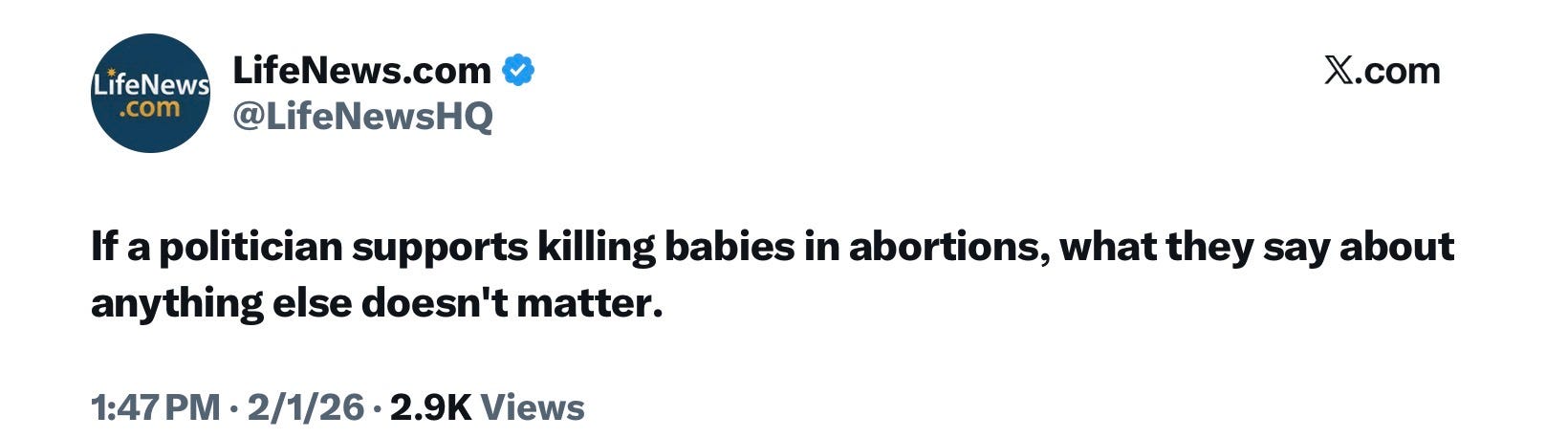
A couple of weeks ago, I was struck by a post on the platform formerly known as Twitter. LifeNews, an account that I’ve followed for a very long time, said, “If a politician supports killing babies in abortions, what they say about anything else doesn't matter.”
I couldn’t disagree more.
I’ll start by saying that I’m pro-life. I can remember first hearing about abortion when I was in the upper grades of elementary school. A girl I knew was doing a project about abortion and surveyed some of us other children. My reaction at the time was a disbelieving, “How is that legal?” Honestly, I’m still not sure.
While I do oppose abortion, I realize that my position is in the minority. To a certain extent, anyway. Most Americans seem to be centrists on the issue, rejecting both unfettered abortion as well as strict bans. The national consensus seems to be somewhere along the “safe, legal, and rare” axis.
For me, being pro-life also does not end at abortion. I’m pro-life when it comes to life-saving vaccines and safety net programs, for example. As I’ve pointed out in the past, pro-family policies like funding daycares, providing health insurance for children, and making it more affordable to have children would probably help to reduce demand for abortion, since financial pressures are cited as one of the top reasons for abortion. I also think that if a government is going to mandate the birth of unborn children, it has a moral obligation to help the parents pay for them. Likewise, contraception should be made readily available to prevent unwanted pregnancies. I’ve found that a lot of pro-lifers do not hold this view.
All that is to say that I’m both pro-life and anti-abortion, but I have a more nuanced view than just saying anyone who supports abortion is evil. Part of that is because I started talking to people on the opposite side of the issue. Sure, there are people who are radical, but the vast majority of pro-choice people that I’ve talked to don’t celebrate every abortion and don’t want up-to-the-moment-of-birth infanticide. They want an early limit in the pregnancy and availability for people with health problems and inadequate financial resources. We can argue about the validity of these positions, but it’s a far cry from the stereotype portrayed by the right. I’ve also learned that pro-choicers don’t have three heads or a tail.
Getting back to the LifeNews post, with a very few exceptions, I don’t think single-issue voting is a good idea in this day and age. If you start out using abortion as your sole issue, you might, for instance, soon find yourself defending people accused of sexual abuse of the same children that you want to ensure are born.
Is the sex trafficking of minors really better than abortion? That’s a no from me, dawg.
But a lot of the people I talk to on the pro-life side seem to hold unborn babies above the post-born in their political calculations. To cite another example, the Trump Administration’s cuts to USAID and other foreign aid programs have been immensely damaging to the third world. Poverty-stricken countries that relied on the US for food and medicine were abruptly cut off with no opportunity to find alternate sources. Food that was already purchased was destroyed rather than handed out as a last shipment. The death toll from starvation and disease is estimated at more than 700,000 people, more than 500,000 of them children. I hear zero concern about this from the pro-life movement.
In general, the pro-life movement seems to be more of an anti-abortion movement than a true pro-life movement. Being pro-life should include protecting post-born children with vaccines, not winking at anti-vaxxers as nearly-eradicated diseases likemeasles return with a vengeance. What is amazing is how quickly these diseases are returning due to the loss of herd immunity from declining vaccination rates. Being pro-life should include protecting the elderly with good access to medical care. It should not include telling the elderly that they need to sacrifice themselves for the economy in a pandemic.
The irony is that the rhetoric on both sides does not always match the results. The US abortion rate ticked down for decades under both Democratic and Republican presidents before starting to trend upward again under [wait for it] Donald Trump in his first term. Since then, abortion has once again continued to rise under both Trump and Biden, despite the Supreme Court overturning Roe v. Wade.
![trend upward again under [wait for it] Donald Trump](https://en.wikipedia.org/wiki/Abortion_statistics_in_the_United_States#/media/File:U.S._abortion_rates_from_1973_Guttmacher.png)
Part of the problem is that abortion pills make it very easy to end a pregnancy now. A trip to the local (or out-of-state) abortion clinic is now almost superfluous. You can just get the drugs by mail. There is a lawsuit challenging mail-order abortifacients, but [wait for it again] the Trump Administration just last month asked the courts to delay a decision on the case. This is the same Administration that says it wants to be “flexible” on the Hyde Amendment that bars taxpayer funding for abortion.
So, in the grand scheme of things, the issue of abortion is a lot more nuanced than the activists would have you believe. I’d probably venture to guess that even Life News doesn’t agree with everything that Donald Trump says and does on abortion, but I’m equally sure that they won’t celebrate the decline of abortion under Barack Obama.
In my view, if we want to reduce abortion in a world in which abortion technology is advancing to streamline the process, the focus should be on winning hearts and minds rather than putting forth more top-down bans. Winning the moral argument that unborn babies are human beings and deserving of life and dignity should be paired with a bipartisan push to make parenting easier and more affordable.
But pro-life groups cede their moral authority when they make the Life News argument that voicing support for legal abortion is the worst thing that any politician can do, while supporting corrupt politicians with no respect for life or law. Most voters are going to see this for the naked partisanship that it is, and the movement ends up kneecapping itself. The pro-life movement, like the pro-gun movement, will find itself in a continual existential crisis if it joins itself at the hip to an increasingly dysfunctional Republican Party. Long-term success for both movements requires a broad bipartisan base.
You can’t find pro-life politicians in the Democratic Party, you say? First, that’s not true. John Bel Edwards, a recent governor of Louisiana, was a pro-life Democrat, and there used to be more. Second, if pro-lifers want to see more pro-life Democrats, they need to feed, water, and cultivate pro-life liberals where they can find them, rather than reflexively declaring that the worst Republican is better than the best “Demonrat.” As Jesus said, seeds can’t sprout on rocky ground. (And yes, there are Democratic Christians as well; many are growing bolder about their faith and their politics.)
I said before that single-issue voting isn’t the best idea in the current economic climate, but there is an exception to that. If you’re going to vote on one issue and one alone, the most important issue of the moment is preserving the Constitution and our democracy. (Yes, we are also a republic. A republic is a form of democracy.)
If we lose our Constitutional protections and our freedom to choose our government, most of the other issues we quibble about will really matter. And that includes abortion and other pro-life issues, because authoritarians are famously anti-life when it comes to their opposition. Anti-abortion groups may be okay with that. Pro-life groups won’t be.
Friday, February 13, 2026
Droning on in El Paso
The trending news of this week was the abrupt shutdown of the El Paso airport by the FAA. Shutting down flight operations at airport is a very uncommon step, especially an airport the size of El Paso City (by the Rio Grand-eee) that is a regional transportation hub. The revelations about why the shutdown occurred were disturbing for a number of reasons.
As originally implemented, the shutdown encompassed a 10- mile ring around the airport and extended from the surface to 17,000 feet. The airspace was closed to all traffic for 10 days. Seven hours later, it was gone.
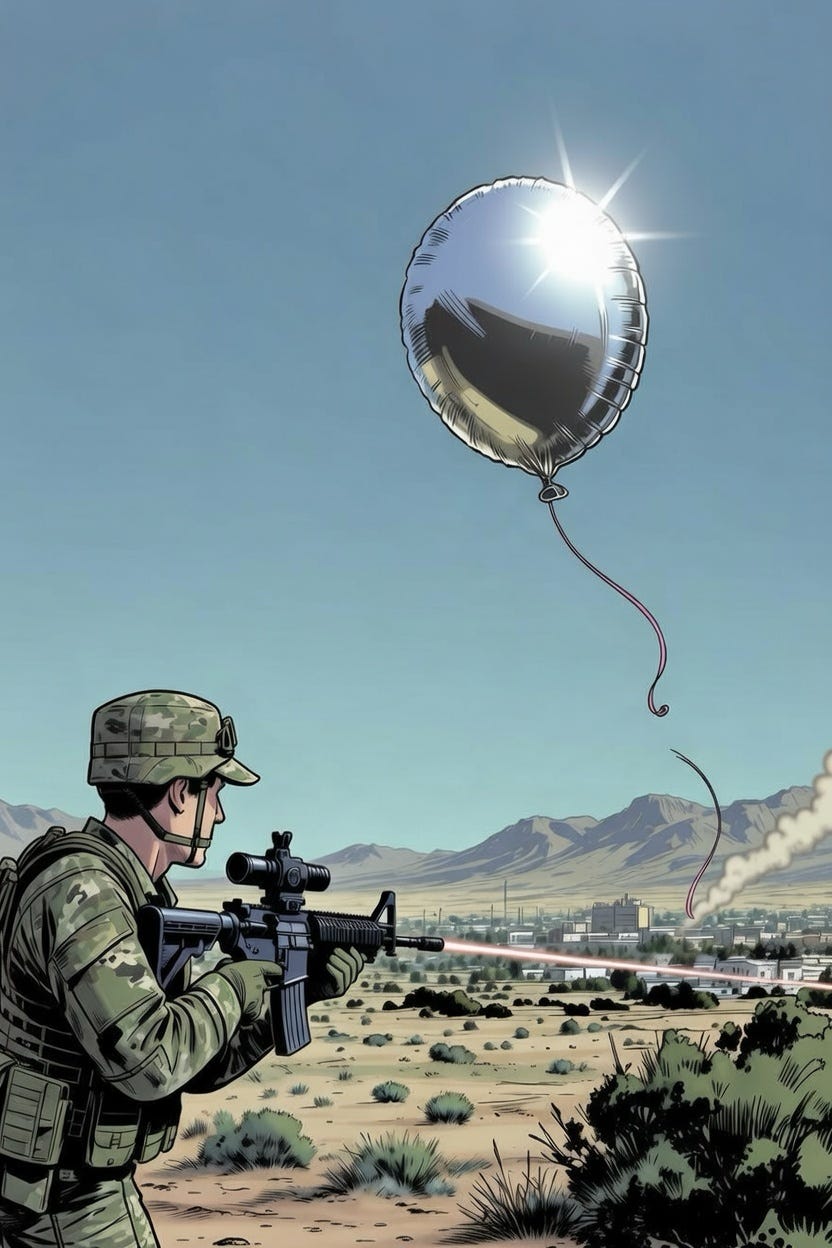
Image created by Grok
What followed was a rapidly changing series of excuses. First, the Administration blamed drones operated by Mexican cartels. There have been unauthorized drone operations around airports in Europe that disrupted flight operations, but I’m not aware of similar incidents in the US. Those incidents resulted in flight delays, but nothing close to a 10-day suspension of operations.
Over the last few years, drones have achieved near-ubiquity. Ukraine revolutionized drone warfare in its battle against the Russians, and the autonomous vehicles are now being used for deliveries by Amazon and Chick-fil-a, among others. Camera drones are a common sight at sporting events, including the Olympics. At a conference, I even met a TVA drone pilot who used one of the aircraft to inspect the inside of nuclear reactors.
You might wonder, with the growing number of drones in the air, how novice operators avoid conflicts with larger, manned aircraft. Back in 2017, a drone collided with an army helicopter over Staten Island, but technology has added layers of safety since then. The FAA now requires a pilot certification for small UAS (unmanned aerial system) drones under 55 pounds.
There are two main tracks for remote pilots, the official FAA term for drone flyers. The first is the remote pilot certificate, which requires a training course and a written test. An alternative for hobby flyers is the recreational flight exception, which can be obtained via a free online course that yields a printable certificate.
Drone operators are supposed to stay below 400 above the ground (AGL) and outside of controlled airspace, which can extend all the way down to the surface near airports. There are several mobile apps that include maps with airspace information for remote pilots, and some drones even include a built-in database and control logic that won’t allow them to launch in restricted airspace. Of course, these safeguards could be disregarded or bypassed by malevolent operators.
It is definitely possible that bad actors could use drones aggressively. The cartels have reportedly used them to deliver both explosives and drugs, but there seems to be no reason why the cartels would attack (for lack of a better word) the El Paso airport.
The lack of logic surrounding the claim may be why the story broke down so quickly. Explanation 2.0 was that the military was testing a laser at Fort Bliss. Again, this story fell flat.
The military is used to working with the FAA. There are charted, permanent military operations areas (MOAs), restricted and warning areas where the boys in green go to play with their toys without disrupting civilian traffic. There are also temporary flight restrictions (TFRs) for places where traffic needs to be specially regulated. TFRs are often used for VIP movements, sporting events, or disasters. These areas usually have exceptions for airlines, medical transport, and flights on IFR flight plans, but that was not the case in El Paso.
To top it off, military testing is usually planned in advance, not on the spur of the moment. The slapdash, frantic, shut-it-down-for-10-days didn’t really fit that explanation either.
Cue Explanation 3.0. This time, the explanation is embarrassing enough to ring true.
Per an analysis by The Independent, the army was testing a high-energy laser in the area, and eventually handed the device off to Customs and Border Protection. The CBP saw what they thought was a Mexican cartel drone.
“So, anyway,” as the meme goes, they “started blasting,” without notifying the FAA.
The “drone” turned out to be a balloon, apparently of the party rather than the Chinese spy variety. It isn’t clear how the FAA learned about the CBP’s balloon target practice, but when they did, they shut the airport down. The 10-day duration apparently came from the military’s initial schedule for the testing.
While there is a risk from illicit drone activity, I think the biggest risk is from drones unintentionally blundering into the flight paths of manned aircraft. It’s certainly not impossible that terrorists could launch a drone swarm against airports or other targets, but El Paso would be low on the priority list of such plotters.
What we have in El Paso seems to be a string of miscommunications (or probably more accurately, noncommunications) followed by frantic attempts at CYA. Some amount of secrecy is to be expected when the military is involved, but the El Paso stories seem more akin to CBP and ICE coverups of wrongdoing. The shift in stories is reminiscent of the changing official line regarding Renee Good, Alex Pretti, or any number of beatings, arrests, and detentions over the past year.
The bottom line in El Paso was incompetence and dishonesty. This time, the result was the cancellation of 14 scheduled flights and the rerouting of an unknown number of private and medical flights. El Paso is a frequent customs stop for aircraft entering the US, so the inconvenience was likely worse here than it would have been at many other airports.
No one died this time (as far as we know, but lives could have been endangered by the interruption in air ambulance flights), but the whole matter is emblematic of the lack of professionalism and the cover-up culture that characterizes the Trump Administration.
Drones in the wrong hands can be a serious threat. I’m glad we are developing countermeasures and defenses against drones accidents and attacks, but these devices need to be in the hands of operators who are well-trained and will exercise good judgment. From everything I’ve seen over the past year, that is not a description that applies to Kristi Noem’s Department of Homeland Security.
If there is an upside to the whole mess, it’s that the cost of operating the laser was probably less than scrambling an F-22 Raptor at $70,000 per hour to destroy the balloon with a $400,000 AIM-9X Sidewinder missile. That was the method used to blow up the alleged Chinese spy balloons* in 2023.
*The US later determined that the balloons were not spying and had probably blown off course. It isn’t clear whether the sensors on board were truly weather instruments or could have been used in intelligence collection.
**More trivia at no extra charge: The call sign of the balloon buster flight was “Frank,” honoring a US WWI ace, Frank Luke, who shot down 14 German observation balloons. The heavily-defended balloons were difficult targets. The F-22s on the mission were part of the 27th Fighter Squadron, a descendant unit of Luke’s 27th Aero Squadron.
DE-ICING Spring is coming early to Minnesota, or at least ICE is leaving. Border Czar Tom Homan said the immigration surge there is ending, and the agents are being withdrawn. It isn’t clear whether the agents will be redeployed elsewhere, but they are on the payroll and they have to do something to justify their existence. I doubt they will be picking up litter like the National Guard. There is a good chance that they will show up again soon in some other blue state or city.
ICE WATCH The DHS claimed that two Minneapolis men provoked an ICE agent to shoot and wound one of them. The government story has shifted (see above) since originally claimed that the two Venezuelans attacked agents with a broom and shovel. Now the DOJ is dropping the charges, which would be unusual if the assault had actually happened.
EXTRA BONUS As another bonus, I’m including artwork created by ChatGPT. I ultimately went with Grok’s offering, but I like this one so much that I decided to add it in.

Subscribe to:
Comments (Atom)