Monday, March 2, 2026

A sticky situation

 In the pantheon of Southern mythology, there is a collection of stories purportedly from Uncle Remus. The stories are not politically correct today because they are set in the antebellum era and include a lot of racial stereotypes, but at one time, they were popular enough to inspire a Disney movie (not shockingly not available on Disney+). I enjoyed the stories when I was little (even though I don’t endorse the racist tropes), and one that stuck with me was the story of the tar baby.

As with many Uncle Remus stories, Brer Rabbit was the protagonist of the tar baby saga. Much like the roadrunner and coyote cartoons, Brer Rabbit was constantly having to outwit Brer Fox, who always wanted to have him over for dinner.
undefined
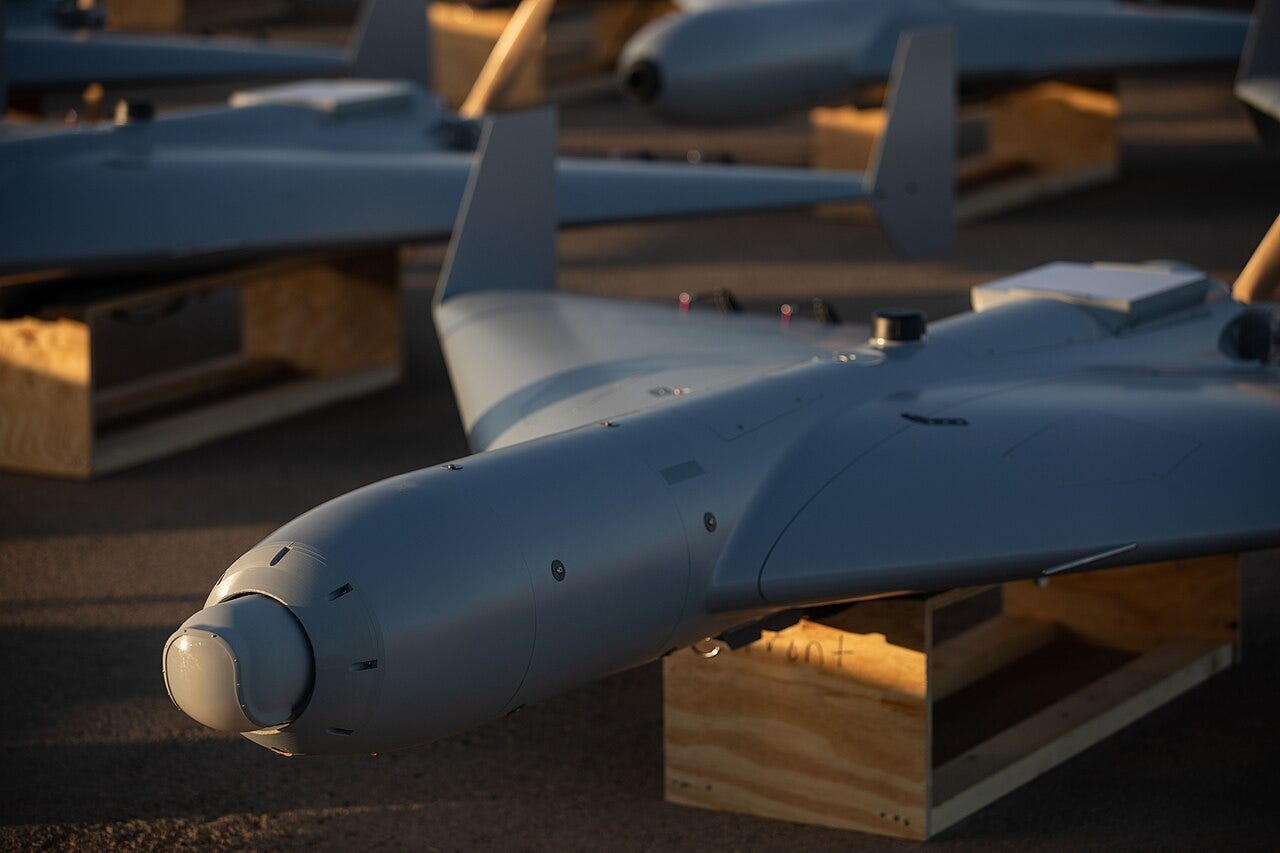
Low-cost Unmanned Combat Attack System (LUCAS) drones were used for the first time. These drones cost $35,000 each.(US Central Command/Wikimedia)

Share

In the tar baby tale, Brer Fox sets a trap for Brer Rabbit in the form of a lump of tar shaped as one of the forest creatures. Brer Fox goads Brer Rabbit into hitting the tar baby, and when he does, his arm gets stuck. The more he struggles to free himself, the more stuck he gets until all his arms and legs are immobile.

What does the tar baby have to do with a political blog, you may wonder. My point here is that it is often much easier to get into a situation than to get out of it.

The first few days of Iran War II (Electric Boogaloo) have gone extremely well for the Coalition of Two. Iran’s leadership has been decimated, and over 1,000 targets have been struck. The cost to the US is three dead and five seriously wounded. At least nine people have been killed in Israel, and casualties elsewhere are unknown.

That sound you hear in the background is MAGA and the war hawks patting themselves on the back as rumors spread that Iran’s new leaders are willing to talk (or possibly not). But Iran was talking prior to the outbreak of war, allegedly even making major concessions, and right now they are also threatening revenge for the death of the Supreme Leader in the form of their largest offensive ever. It would seem that the Iranian regime is not broken.

There was never a serious question about whether the US and Israel could hammer Iran in the opening days of the war. They’ve done that before, and they did it exceptionally well this time. The total inability of Iranian air defenses to down even one attacking plane is astounding and almost miraculous, a testament to Western technology and tactics, which apparently included liberal use of standoff weapons launched from outside Iranian airspace rather than going toe-to-toe with surface-to-air missiles.

No, the US excels at tactical warfare. It’s the long-term, strategic thinking that we tend to have problems with.

Prof. Robert Pape, who wrote the book (or a book anyway) on air power, points out that the initial success does not mean the war is over. Instead, the fact that the decapitation strikes did not cause the regime to collapse likely means that there won’t be a quick end to the war, or at least not a quick victory.

“Here is the strategic reality most people are missing,” Pape posted on the platform formerly known as Twitter, “Airpower alone has never produced positive regime change. I don’t mean rarely. I mean NEVER.” [emphasis his]

On his Substack, Pape further explains, “Strikes aimed at changing regimes change internal politics first — and rarely in the attacker’s favor.” Generally, nationalist sentiments arise during air campaigns, often leading to extreme outcomes.

“External attack narrows political space,” Pape continues. “Moderates lose oxygen. Security institutions consolidate authority. Nationalism becomes the organizing force.”

In recent history, we’ve seen how even sustained ground attacks can’t always break an authoritarian regime. In two years of brutal fighting in Gaza, Israel could not eradicate Hamas, an Iranian proxy.

The lack of desired results and the desire for success can produce pressure on the attacker to turn it up a notch. That could mean hitting more targets that were previously off limits or possibly sending in ground troops. The sunk cost fallacy is a real thing in foreign policy.

In the case of Iran War II, the Trump Administration is going to be facing other pressures as well. Most obviously, the war is already unpopular. Polling both before and after the onset of hostilities shows that at least a plurality of Americans disapprove of the war. It’s almost like he didn’t even try to persuade the public of the need for war [sarcasm alert].

With midterms approaching quickly, Republicans need a win - and quickly - but matters could get worse. There are already indications that Trump’s claims that Iran was close to developing a nuclear weapon were false. If those claims and the Omani claims that Iran was ready to make concessions are confirmed, public opinion may take a further nosedive. And that’s not even mentioning the possibility of rising gas prices as the Straits of Hormuz become unnavigable.

There are more physical pressures as well. The war in Ukraine has illustrated to the world how quickly modern militaries can burn through logistical stocks, and even before the war, Gen. Dan Caine, chairman of the Joint Chiefs, had warned that weapon stockpiles were almost depleted after last year’s Iran War I, attacks on Houthi rebels in Yemen, and aid to Ukraine.

The Wall Street Journal reported on Sunday that Trump had said that the war might last a week, but supplies of air defense interceptor missiles and cruise missiles were already in short supply. By one estimate, the US used 10-15 percent of its supply of Tomahawk cruise missiles on the first day.

That sort of burn rate is not only unsustainable in the current conflict, it may leave the US and its allies (the ones we have left anyway) at a disadvantage in other theaters. If, for example, China decided to make a move on Taiwan, we would also use mass quantities of ordnance (assuming we didn’t just step back and let China act in their sphere of influence).

To put it another way, time is on the Iranian regime’s side. If they can survive the next week, their chances of staying in power increase dramatically as the US and Israel run short on ammunition.

So what can we expect in our war with Iran? There seem to be three likely possibilities. The first is that the TACO principle takes control. Israel’s YNet reported on Sunday that Trump had already floated the idea of a ceasefire.

A second possibility is escalation. The vocal minority pushing for regime change will not want to stop short, and that throng likely includes influential members of the Trump cabinet. The president will almost certainly be pressured to push just a little bit harder.

The third and probably most likely scenario is that Trump finds something to call a victory and walks away. This is a version of the TACO option, but it comes with some tangible concession that Trump can point to as a justification for the whole thing. Moving the goalposts isn’t hard when you never said what the goal was.

To be clear, I’m not rooting for Iran or wanting the US to fail, but I am a realist, and not only do there seem to be serious flaws with Trump’s strategy, I’m not even sure that he has a Plan B if the plan of a massive aerial onslaught fails. This feeling was bolstered by reports that the US had identified potential leaders of a new government, but accidentally killed them.

I hope that I’m wrong. I hope the regime falls. I hope democracy sprouts in Iran and throughout the Middle East. But most of all, I hope that we don’t get all our appendages stuck in a sticky mess that we can’t disengage from.

So, how did Brer Rabbit escape the sinister tar baby? You won’t get spoilers from me. You’ll have to find out for yourself.

Thanks for reading The Racket News ™! This post is public so feel free to share it.

Share

GOVT GONE WILD An almost blind refugee who spoke little English died in New York after being dropped off by CBP at a closed donut shop in the middle of a winter storm. Nurul Amin Shah Alam, 56, was detained on February 19, reports Chicago’s ABC 7. CBP released him the same day after it was determined that he was not eligible for deportation, but rather than releasing him to his family or returning him to his home, they left him at a Buffalo Tim Horton’s. He was found dead of exposure several days later.

There are growing indications that ICE and CBP are giving detainees “starlight tours,” a euphemism for dropping them off in the middle of nowhere in life-threatening conditions.


From the Racket News

Wednesday, February 25, 2026

Yes, we have no tariff authority

By now, you have heard that the Supreme Court struck down Donald Trump’s tariff regime. You’ve probably also heard that Trump has essentially decided to ignore the ruling and implement a new 10-percent global tariff under a different law. To start at the beginning (a very good place to start), the case in question was Learning Resources, Inc. v. Trump, brought by two small family businesses that imported educational toys. In the 6-3 ruling, the Supreme Court held that the International Emergency Economic Powers Act (IEEPA) of 1977 did not convey the power to tax when it authorized the president to “regulate… importation.” Chief Justice Roberts wrote the majority opinion and was joined by Sotomayor, Kagan, Gorsuch, Barrett, and Jackson. Alito, Thomas, and Kavanaugh dissented. Image created byChatGPT Justice Roberts points out that federal taxing power lies with Congress in Article I, “The Government thus concedes, as it must, that the President enjoys no inherent authority to impose tariffs during peacetime,” then dryly notes, “The United States, after all, is not at war with every nation in the world.” For my readers who continue to deny that tariffs are taxes (and you know who you are), Roberts settles that question if the definition of the word did not, using the terms “tax” and “tariff” interchangeably. Roberts equates the two terms and cites the Constitution’s clauses granting Congress the power to tax as a refutation of Trump’s authority to levy tariffs. Justice Jackson says it explicitly in her opinion, “Tariffs are different in kind. They are a tax on imports; a means of generating revenue from transactions between private parties.” Tariffs are taxes. While IEEPA grants the president broad authority (too broad for my tastes) to “investigate, block during the pendency of an investigation, regulate, direct and compel, nullify, void, prevent or prohibit” foreign trade, the power to tax is notably absent from the list. Major questions doctrine also makes a prominent appearance in Roberts’ opinion. You may remember major questions doctrine from a host of recent Supreme Court rulings in which the Court held that Congress does not hide elephants in mouseholes. Put plainly, if Congress wants to delegate sweeping power to the executive branch, it must clearly spell out that power in the text of the law, in Roberts’ words, “in explicit terms, and subject to strict limits.” “That pattern is plain,” Roberts writes, “When Congress grants the power to impose tariffs, it does so clearly and with careful constraints. It did neither here.” Gorsuch gives an excellent rationale for major questions doctrine in his concurrence, writing, “Article I vests all federal legislative power in Congress. But like any written instrument, federal legislation cannot anticipate every eventuality, a point my concurring colleagues have observed in the past. And highly resourceful members of the executive branch have strong incentives to exploit any doubt in Congress’s past work to assume new power for themselves. The major questions doctrine helps prevent that kind of exploitation. Our founders understood that men are not angels, and we disregard that insight at our peril when we allow the few (or the one) to aggrandize their power based on loose or uncertain authority.” In his dissent, Justice Kavanaugh cites the sweeping powers that Congress did delegate in IEEPA, saying, “As they interpret the statute, the President could, for example, block all imports from China but cannot order even a $1 tariff on goods imported from China.” That’s a fair point. Kavanaugh also argues that tariffs are not subject to major questions doctrine because “tariffs were not an ‘unheralded’ power when Congress enacted IEEPA in 1977 and authorized the President to ‘regulate… importation’ of foreign goods” and that presidential preeminence in foreign affairs made the question moot. Kavanaugh supports his position by citing tariffs implemented by Presidents Nixon and Ford under similar language and circumstances, although not under IEEPA. Roberts answers Kavanaugh by noting that Nixon’s were a “temporary measure,” in place for only five months, and were limited to congressional maximums. Kagan further notes that Nixon’s tariffs cited the Tariff Act of 1930 and the Trade Expansion Act of 1962, rather than the Trading With the Enemy Act, the predecessor to IEEPA. The most important aspect of the tariff ruling is that the Supreme Court asserted its independence and acted to rein in a president whom it had previously granted almost unlimited power. Donald Trump has famously repeated that Article II of the Constitution lets him do “whatever I want,” including apparently being allowed to “destroy the country,” but on Friday, the Supreme Court shattered that belief. For all Trump’s attacks on the Court, it is interesting to note that two of the three justices that he appointed in his first term ruled against him. This should make people who worried that the Court was rubberstamping Trump’s policies feel a lot better. In fact, it’s delicious that Trump’s own picks were instrumental in his defeat. I love hearing people who cited judges as the reason to vote for Trump complain when those same judges uphold the rule of law. It smells like… judicial objectivity. I’m more concerned about Thomas, who seems to have gone over to the Dark Side, than the Trump Three. Thomas dissented that “The Court has long conveyed to Congress that it may ‘invest the President with large discretion in matters arising out of the execution of statutes relating to trade and commerce with other nations.,” and seems to put few limits, other than the Legislative Vesting Clause and the Due Process Clause, on Congress’ ability to hand the president its work. Speaking of Thomas, it is extremely concerning that he and Alito, champions of originalism and constructionism under Democratic presidents, would find a taxing power for the president where none exists in the text of the statute or the half-century of history and tradition since it became law. Does anyone really think that these justices would find a similar policy by Barack Obama or Joe Biden to be constitutional? The shift of conservative justices to twist the law to back Trump is just as concerning as the tendency of the Court’s liberal wing to find ways to rule for Democratic presidents. It is easy to dismiss both wings as partisan, but I think that there is a real human tendency to let our biases influence our opinion, especially in a subject as complex as constitutional law. Likewise, Kavanaugh complains, “The United States may be required to refund billions of dollars to importers who paid the IEEPA tariffs, even though some importers may have already passed on costs to consumers or others. As was acknowledged at oral argument, the refund process is likely to be a ‘mess.’” That may be, but should executive overreach be excused merely because undoing the mess made by the abuse is difficult? In most other instances, I would venture to guess that even Kavanaugh would say the answer to that was no. Saying that a government abuse is too large to correct is a course guaranteed to encourage massive government abuses. And then there’s the aftermath. Trump probably set a land speed record for ignoring a Supreme Court order when he announced that tariffs would continue with a different legal justification mere hours after the ruling. Honestly, if you didn’t expect this, I don’t know where you’ve been for the past year. First, I want to point out that going back to the well with a different legal theory is not technically defying the Court. In certain circumstances, the Court may give a roadmap to legal theory that it would accept. Joe Biden did this after the Supreme Court struck down his student loan forgiveness program. Biden revamped the program with a different underlying legal argument and tried again. Student Loan Forgiveness 2.0 was headed back to the Supreme Court when Trump won in 2024, and the DOJ dropped the case shortly after, so we will never know for sure if Biden would have gone 0-2. The new/old tariffs are now being justified under Section 122 of the Trade Act of 1974. As Fortune explains, Section 122 tariffs come with some limitations. First, Section 122 tariffs are limited to 15 percent. Trump started at 10 percent but raised the tariffs to the 15-percent maximum on Saturday. Second, the maximum duration of the tariffs is 150 days, after which they must be extended by Congress. There is some speculation that Trump could remove and immediately reapply the tariffs to get around the time limit. Finally, Section 122 tariffs are specifically to address a balance of payments problem. This is a problem for Trump for several reasons, including the fact that the US does not have a payment imbalance. Even though we have a trade deficit, which increased in December despite the tariff wars, foreign investment coming into the country has created a net balance of zero. But Trump’s worst problem is that he and his lawyers have argued for the past year that his tariffs are about trade deficits, national security, lack of respect, and hurt feelings, basically everything except the balance of payments. As Neal Katyal, the lawyer who just beat Team Trump at the SCOTUS, pointed out on the platform formerly known as Twitter, the DOJ just finished telling the justices that Section 122 did not apply to the Trump tariffs. The new tariffs will be challenged in court, but it is unlikely that they will get before the Supreme Court within 150 days. An exception might be if the Court grants a hearing on its interim docket (aka the emergency, shadow, or short-order docket) or if Trump renews the tariffs. In the meantime, as Rick Woldenberg, owner of Learning Resources, told PBS, “At least our tax rate went down, because most companies -- most countries were being taxed at 18, 19, or 20 percent…. So now, at 10 percent, that's about a reduction in half. It didn't go to zero. And 122, Section 122 can only impose a tax for five months. So I guess we will see what happens after that.” Of course, the new 15-percent tariff is close to what Woldenburg and the rest of the country had to deal with before. At this point, there are two big takeaways. The first and most obvious is that the Tariff Man is not giving up his tariffs. With the economy slowing, the Supreme Court offered Trump and Republicans an escape route in which they could back off the trade wars, blame the judges, and hope the economy recovers by November. That was never in the cards. Find someone who is as dedicated to you as Trump is to tariffs. The Trump Administration will live and die for tariffs and trade wars, even if the economy crumbles around them. Second, Trump never seems to even consider trying to go through Congress to get ironclad tariff authority. With his cult following in the GOP and the natural Democrat affinity to taxes and protectionism, it shouldn’t be that hard for a master dealmaker to get such legislation across the goal line. But no, it’s all about twisting existing law to let him do what he wants. It’s all about unilateral action. As Justice Gorsuch wrote in his concurrence, “It can be tempting to bypass Congress when some pressing problem arises. But the deliberative nature of the legislative process was the whole point of its design. Through that process, the Nation can tap the combined wisdom of the people’s elected representatives, not just that of one faction or man. There, deliberation tempers impulse, and compromise hammers disagreements into workable solutions. And because laws must earn such broad support to survive the legislative process, they tend to endure, allowing ordinary people to plan their lives in ways they cannot when the rules shift from day to day.” In other words, Congress, do your job. From the Racket News