Showing posts with label scandal. Show all posts

Tuesday, September 29, 2020

Donald Trump Is Being Buried Beneath Tsunami Of Bad News

They called Ronald Reagan the “Teflon President,” but, when it comes to not having bad news stick, the Gipper had nothing on Donald Trump. Much of Trump’s tenure has been marked by bad news (much of it the result of bad decisions by the president) but very little has stuck to Mr. Trump. Now, a month prior to the election, the bad news continues to hit the news cycle at an alarming rate.

Beyond this weekend’s revelations about President Trump’s tax avoidance, consider a few of the stories that have emerged over the past few weeks:

  • Bob Woodward’s taped interviews in which the president admitted that he understood the danger of Coronavirus but “downplayed” the pandemic
  • Nearly 500 former generals and admirals endorse Biden in a joint letter that says Trump is “not equal to the enormous responsibilities of his office”
  • Trump’s former Coast Guard chief says Trump is waging an ” insurgency… on our constitutional rights”
  • On at least two occasions, Trump refused to commit to a peaceful transfer of power if he loses the election, saying he doesn’t want to be “cheated”
  • The Senate report on Hunter Biden failed to find criminal wrongdoing or break new ground despite years of claims and investigations, which led to Trump’s own impeachment
  • The intelligence officer who gave Trump 300 daily briefings wrote in the Denver Post that “As damaging as his faulty leadership has been, four more years would be devastating”
  • US Coronavirus deaths surpassed 200,000, the highest national death toll in the world
  • The Varieties of Democracy study found that executive respect for the Constitution was at its lowest level since 1865 and corruption was at its highest level since Warren G. Harding
  • Olivia Troye, Pence’s lead aide on the Coronavirus Task Force endorsed Biden, saying that Trump “doesn’t actually care about anyone else but himself”
  • Trump has sparred with health officials about the readiness of a COVID-19 vaccine and claims that the White House can overrule FDA authorization to speed the drug to market
  • The allegation that Trump called wounded military veterans “suckers and losers”
  • A former National Security Council official said the White House pressured her to say John Bolton’s book was a security risk in an attempt to delay its publication
  • Continuing civil unrest and high racial tensions
  • Polling found that more voters think Trump is unfit for office than Biden

And that’s just for the last four weeks.

Atop this mountain of red flags, warnings, and incompetence now comes the news that Donald Trump has paid nothing or next to nothing in taxes for at least 11 of the past 15 years. While paying fewer taxes is a worthy goal, it will be embarrassing for the billionaire (or is it “millionaire”) presidential candidate whose tax reform was a lightning rod for many middle-class taxpayers who ended up paying more. At the very least, Trump’s tax shenanigans may add fuel to Joe Biden’s plan to increase taxes on the wealthy, an idea that already has overwhelming popular support, even among a majority of Republicans.

To be fair, it hasn’t been all bad news. Trump’s Arab-Israeli treaties were good news and didn’t get the coverage that they would have in a different year. A year when a signatory to the treaty wasn’t leaving open the possibility of an unpeaceful presidential transition.

There was also the Supreme Court vacancy which, although Republicans see it as good news, might not be. The opening has energized Republicans but it has also energized the left. And the numbers seem to be on the side of the opposition.

Justice Ginsburg was far more popular than Donald Trump (by about 15 points) and voters favor leaving the seat vacant until the outcome of the election can be determined by double-digit margins. If Amy Coney Barrett proves to be an unpopular nominee, the Supreme Court vacancy could end up being the final nail in the coffin of the Trump campaign by swaying unaffiliated voters against Trump. Ironically, confirming Barrett before the election might also give Trump-skeptical Republicans one less reason to vote for the president since the Court will have a definite conservative tilt.

Despite the onslaught of bad news interspersed with a few favorable items, Trump is bearing up better than expected under the onslaught. Make no mistake, that doesn’t mean he’s doing well, but the situation could always be worse. Trump’s average approval rating currently sits at 43.7 percent, somewhat recovered from the summer doldrums, and right where it has been for the majority of the past three years.

That is not nearly good enough to win re-election. Biden leads by an average of seven points in national polls. When the Electoral College is considered, Biden leads in all of the swing states and is becoming competitive in red states such as Georgia and Texas.

But Trump’s resilience may be enough to prevent the complete collapse that would overtake a candidate with a less zealous base. What is astounding is that the bottom has not dropped out of the president’s polling given the volume of bad news. Even more astounding is the fact that Mr. Trump is polling ahead of incumbent Republican senators such as Lindsey Graham.

My theory is that the 43-percent is made of several disparate groups of voters. One of the largest segments is the “My Trump, right or wrong” crowd for whom the president can literally do no wrong. A second group is voters who don’t like Trump but who fear Biden and the Democrats more. A third group is the partisans who will simply vote for any candidate with an (R) after his name.

We have also become numbed by the sheer volume of mind-numbingly shocking and, frankly, alarming revelations about the president. He’s been so bad for so long that it takes a lot to move the needle after five years of the media spotlight on the president’s erratic behavior. Abnormal has become the new normal or, as WWII GIs used to say, “Situation Normal: All Fouled Up (SNAFU).”

The high floor (so far) for Trump is both good and bad for Republicans. In the short term, it is good because it will help the party minimize its losses this November and Republicans need to maintain the Senate, or at least a big enough caucus to filibuster, to check the progressive agenda. In the long term, however, it can be dangerous for the party because so much of the Republican identity is now based on personal loyalty to Donald Trump. It will be difficult for conservatives to steer the party in a positive direction post-Trump if most Republicans are still members of the personality cult.

Donald Trump won’t make finding a new Republican direction easy. He won’t be going away after the election, no matter how it turns out. The president will be cheering (and jeering) from the Twitter sidelines and directing his legions of followers, a faction that will likely remain formidable.

For the moment, however, the real question is what tomorrow will bring. Trump is facing a daily dribble of bad news that is similar to the bad news cycle that Hillary Clinton endured in 2016 with health problems, leaked emails, and a lack of direction. That year, the steady drip of bad news finally broke her once solid lead after James Comey’s letter to Congress was released.

This year, Trump is already well behind his challenger only a month out from the election. The steady flow of negative press will make it even more difficult for Trump to climb out of the electoral cellar. It’s impossible to predict the next fire that the Trump campaign will have to put out, but the fires will undoubtedly continue until Election Day.

Originally published on The Resurgent

Saturday, April 4, 2020

Trump Fires Inspector General Involved In Ukraine Scandal


President Trump took time out from his response to the pandemic to fire Michael Atkinson, the inspector general of the intelligence community. Atkinson was responsible for vetting the whistleblower report that broke the Ukraine scandal. The Washington Post reported that Trump sent a letter to Congress Friday night informing legislators that he intends to fire Atkinson within 30 days.
“It is vital that I have the fullest confidence in the appointees serving as inspectors general,’’ Trump said in the letter. “That is no longer the case with regard to this inspector general.”
Trump hired Atkinson for the IG job in 2017 but has considered firing him several times since the news of President Trump’s controversial phone call with Ukrainian President Zelensky broke last September.
Presidents often announce controversial decisions on Friday afternoon to avoid bad press. In normal times, people don’t pay attention to political news n weekends. However, in the midst of a deadly pandemic with 95 percent of the country sheltering at home, many Americans will be watching the news on Saturday. Atkinson’s firing will likely bump the Coronavirus death toll from the top story spot at least temporarily.
Ironically, the pandemic had caused the Ukraine scandal and impeachment to fade from the public memory. Impeachment concluded with an acquittal for the president on February 5. It was only two months ago but it seems like a different lifetime.
Senate Majority Leader Mitch McConnell recently told radio talk show host Hugh Hewitt that the impeachment “diverted the attention of the government” from the looming threat of Coronavirus. However, the president is apparently able to multitask while steering the country’s response to the pandemic.
Even if no one else was thinking about Ukraine and impeachment, Mr. Trump was.

Originally published on The Resurgent

Friday, January 17, 2020

Can Lev Parnas Be Trusted?


Lev Parnas, an indicted Republican fundraiser, has dropped a bombshell into the impeachment hearing in the form of mountains of notes, text messages, voicemails, pictures, and other documents relating to Rudy Giuliani’s shadow diplomacy in Ukraine. Parnas is naming names from President Trump on down as he spills the beans on what happened behind the scenes as the Trump Adminstration allegedly pushed President Zelensky to announce an investigation of Joe and Hunter Biden. The big question is whether Parnas can be trusted.

The short answer is no. Parnas lacks credibility and has plenty of incentive to bend the truth in order to ingratiate himself to Congress and bargain his way out his own legal troubles. The longer answer is that what Parnas lacks in credibility, he makes up for in documentation.

For those who haven’t been following the emerging situation, Parnas and Igor Fruman were arrested last October at Dulles International Airport just prior to leaving the country on one-way tickets. The pair were charged with attempting to funnel money from foreign governments to American elected officials. Both men were associates of Rudy Giuliani and were involved in Giuliani’s Ukrainian fishing expeditions for dirt on Joe Biden. Though both men were US citizens, Parnas was born in Ukraine and Fruman was born in Belorus, both former republics of the Soviet Union.

In early November, Parnas agreed to cooperate with the House impeachment probe. It was only this week, however, that a trove of documents from Parnas was made public by House investigators after receiving judicial approval. The document releases can be viewed here.  

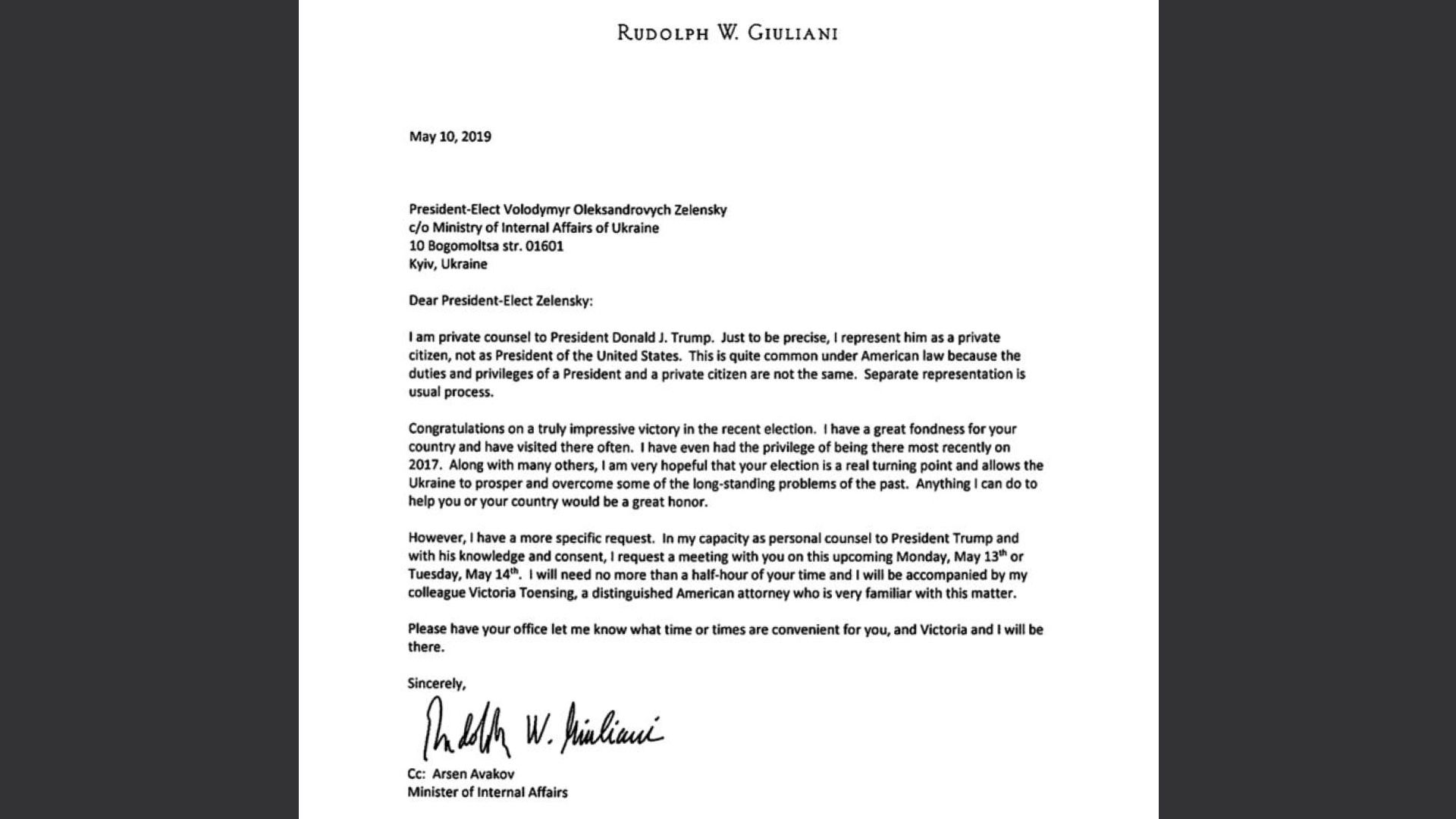
Since Parnas himself is not a credible character, the documents that he has presented are more important than his own testimony, which so far has not been under oath. Some of the documents are more credible than others. For example, Parnas’ handwritten notes are questionable but a letter from Giuliani to Zelensky is more compelling.

The Giuliani letter is important in that it undercuts one of President Trump’s strongest defenses, namely that he was acting in the national interest. In the letter, Giuliani specifically claims that he represents Trump “as a private citizen, not as President of the United States.”


Also compelling are the series of text messages between Parnas and Robert Hyde, another Republican donor who is currently running for Congress in Connecticut. The pair’s now-famous message exchange indicated that US Ambassador to Ukraine Marie Yovanovitch was under their surveillance to the extent that they knew not only her location but whether her phone and computer were on. If the messages are genuine, it is very difficult to explain why they were keeping tabs on Yovanovitch for any reason that is not either creepy or sinister. If the messages are not genuine, it is difficult to explain why they were constructed to include Hyde, an unknown.

Interesting but not as damaging is Parnas’ undated note on a Ritz-Carlton-Vienna pad. One item on the to-do list reads, “Get Zalensky [sic] to announce that the Biden case will be investigated.” The note supports previous testimony that Trump’s goal in withholding the Ukrainian aid money was to force the announcement, but without context such as a date, it is impossible to know if it is genuine or was created later.

While there may be some doubt about the note’s legitimacy, there is no doubt that Parnas himself is the real deal. Among the releases are text messages between Parnas and Giuliani, including one in which Giuliani told Parnas that he needed to get then-Ukrainian President Petro Poroshenko and Prosecutor General Lutsenko “on the record about the ambassador and Biden” and asked, “Can you make it happen?”

Parnas also appears in photographs with a veritable Who’s Who of Republican and Trump Administration officials including Giuliani, Kellyanne Conway, Mike Pence, and numerous poses with President Trump. Most of these officials deny knowing Parnas and say that they don’t recall taking the photos.

The piece de resistance, however, is a copy of an email from Jay Sekulow in which the president’s personal attorney writes to John Dowd, another lawyer who was also once an attorney for Trump, on the subject of “Lev Parnas and Igor Fruman.” Sekulow told Dowd, “I have discussed the issue of representation with the president. The president consents to allowing your representation of Mr. Parnas and Mr. Furman [sic].” The obvious question here is why Donald Trump is involved at all in the legal representation of two low-level flunkies.

Lev Parnas is a sketchy character and his claims should be questioned and verified, but that does not mean that they are irrelevant. In the end, Parnas is one more link in the chain of evidence against Donald Trump along with the OMB and Pentagon emails released under the Freedom of Information Act that pointed to Trump as the source of the aid freeze, and the new GAO assessment that the president violated the law in withholding the aid. Parnas’ claims and evidence must be viewed within the context of other evidence and testimony to help complete the picture of what happened.

The revelations of the past few weeks both underscore the mistake Democrats made in rushing the impeachment vote and the fortunate decision of Speaker Pelosi in delaying the referral of the articles to the Senate. Without the delay, the new information would still be coming out but the Senate might already have dismissed the case. On the other hand, if Democrats had taken their time, they could have transmitted a more complete case to the Senate, where many Republicans seem determined to ignore any new information that has come out since December 18.

As the impeachment trial gets underway in the Senate, the one thing that seems is clear is that the more information that comes out, the worse things look for Donald Trump. While it is still extremely unlikely that Senate Republicans will vote for removal, Congress and the media will keep shining lights on the actions of Trump and his agents in Ukraine. If the president survives impeachment, the tales of his abuses of power and corruption may mean that his stay in the White House is only prolonged by a few months.

Originally published on The Resurgent
Tuesday, January 14, 2020

There May Be More Witnesses At Senate Impeachment Trial After All


All hope is not lost for those who would like to see a real impeachment trial in the Senate rather than a pro forma acquittal of the president. When Senate Majority Leader Mitch McConnell announced last week that he had the votes to move forward on a quickie trial without Democratic input, it seemed that the impeachment would be over in a jiffy. Now, however, it looks as though the House impeachment managers may have a chance to call witnesses in the Senate after all.

On Tuesday morning, CBS News reported that unnamed “senior White House officials” said that they expected several Republican defections in the upcoming vote to establish ground rules for the trial. In addition to the usual dissidents, Lisa Murkowski of Alaska, Susan Collins of Maine, and Mitt Romney of Utah, the report also named Lamar Alexander of Tennessee, Corey Gardner of Colorado, and Rand Paul of Kentucky as Republicans who might possibly vote to hear additional witness testimony.

 Sen. Roy Blunt (R-Mo.), the Senate’s number four Republican, confirmed Tuesday afternoon to The Hill that Republicans did not have the votes to dismiss the impeachment articles out of hand, saying, “I think our members generally are not interested in a motion to dismiss. ... Certainly, there aren't 51 votes for a motion to dismiss.”

McConnell, speaking to reporters on Tuesday, also said in a Fox News report that “All 53 of us [the Republican caucus] have reached an agreement,” but he did not say exactly what that agreement entailed. McConnel did hint that a decision on witnesses would be made “at the appropriate time” and that “both sides will call witnesses they want to hear from” at that time.

The possibility of more testimony and evidence is even more important in light of evidence that has come to light since the House impeachment vote last month. First, a Freedom of Information Act request unveiled emails that directly implicated Donald Trump in the freeze of aid to Ukraine. Then former National Security Advisor John Bolton announced that he would testify if subpoenaed by the Senate. Then Lev Parnas, an indicted associate of Rudy Giuliani, turned over thousands of pages of documents, text messages, and photos to House investigators. The Senate should also subpoena White House officials and Rudy Giuliani, who ignored subpoenas from the House.

The cracks in Republican opposition to a trial that allows new evidence may be the result of polling that shows voters strongly oppose a dismissal of the articles of impeachment. Morning Consult found that voters supported a trial with more witnesses by more than two-to-one. Majorities of Democrats and independents favored more witnesses while Republicans were almost evenly split on the question.

While it is by no means certain that the Senate will call additional witnesses, it is at least no longer a foregone conclusion that Senate Republicans will block additional testimony. Regardless of which side of the impeachment debate you stand on, this is a good thing. Hearing more witnesses and seeing more evidence would present an opportunity for the Senate to get to the truth of the matter.

If you are a Trump supporter and believe the president is innocent, then you should support additional testimony and evidence that may exonerate the president and, in so doing, embarrass the Democrats. If you are a Trump critic, you should support the deeper inquiry because further evidence may help build a more compelling case that Mr. Trump abused his office. The only logical reason to oppose further investigation is if you believe that additional evidence will undermine your preconceived ideas about what happened.

As Louis Brandeis famously said, “Sunlight is said to be the best of disinfectants.” American voters want sunlight to shine on the details of the Ukraine scandal and let the chips fall where they may. The Senate should honor their wishes.

Originally published on The Resurgent

Saturday, January 4, 2020

Emails In Ukraine Scandal Point Directly To Trump


It has been several weeks since President Trump was impeached, but the evidence for abuse of power continues to roll in. Earlier this week, the defense website, Just Security, obtained unredacted emails that point directly to President Trump’s involvement in delaying aid to Ukraine and show that Administration officials questioned the legality of the move.

The emails were originally released in redacted form in December in response to a Freedom of Information Act request by the Center for Public Integrity. A federal court mandated that the government release 300 pages of emails, which were made public in two batches on Dec. 12 an Dec. 20. The emails obtained by Just Security can be compared with the redacted releases to confirm their accuracy as well as determine what the Trump Administration considered worthy of censorship.

Among the revelations from the redacted emails was the news that the Ukrainian aid was delayed immediately after the president’s July 25 phone call with Ukrainian President Zelensky. CNN reported last month that the redacted emails showed that efforts to freeze the aid began about 90 minutes after the phone call concluded.

Although the president’s interest in the aid predated the phone call, Michael Duffey, associate director of national security programs at the Office of Management and Budget (OMB), emailed Pentagon officials within hours of the call, instructing them to “please hold off on any additional DOD obligations of these funds….”

“Given the sensitive nature of the request,” Duffey added, “I appreciate your keeping that information closely held to those who need to know to execute the direction.”

Duffey was among the White House officials subpoenaed by House Democrats during the impeachment hearings last year. He did not comply with the subpoena and failed to show up at the hearing.

The emails show that Pentagon officials were concerned that the freeze violated the Impoundment Control Act. The law requires certain steps if the executive branch does not spend money appropriated by Congress. These steps, including congressional notification, were never taken by the Trump Administration. The Administration also never provided a rationale that explained either the initial freeze or its subsequent release.

Deputy Under Secretary of Defense Elaine McCusker followed up with an email to Mark Sandy at the OMB asking if the pause had been approved by legal counsel. The question was redacted in the original email release.

Sandy formalized the freeze on July 25 with a footnote in a budget document that held the money until Aug. 5. Initially, the hold was not deemed to affect the expenditure of the money by the end of the fiscal year.

The next day, July 26, Under Secretary of Defense for Policy John Rood emailed Secretary of Defense Mark Esper expressed unanimous agreement among the “Ukraine Deputies Small Group” that the aid should be released. The same email notes that the freeze was at “the President’s direction via the Chief of Staff [Mick Mulvaney].”

On Aug. 6, Duffey notified McCusker that the freeze was being extended. On Aug. 9, McCusker notified Duffey and Sandy at OMB that time was running out to spend the money before the end of the fiscal year. Subsequent emails continued to extend the freeze through the end of August, raising red flags at the Pentagon. Contractors became aware of the hold by Aug. 27 and Politico revealed the freeze publicly in an Aug. 28 story.

The emails point toward the Oval Office as the source of the freeze. In one example cited in the article, Duffey wrote on Aug. 30, that there was “clear direction from POTUS to continue to hold.”

Officials expressed hope that the money would be released after Vice President Pence met with Zelensky on Sept. 1, but the freeze continued after the meeting with the hold extended again on Sept. 5.

When McCusker emailed Duffey on Sept. 9 saying that the DOD would not be “able to ‘fully’ obligate by the end of FY,” Duffey responded by shifting the blame to the Pentagon, despite McCusker’s repeated warnings that time to spend the money was running out.


“OMB developed a footnote authorizing DoD to proceed with all processes necessary to obligate funds,” Duffey wrote in a formal email that copied in OMB and Pentagon lawyers. “If you have not taken these steps, that is contrary to OMB’s direction and was your decision not to proceed. If you are unable to obligate the funds, it will have been DoD’s decision that cause any impoundment of funds.”

McCusker’s incredulous response was, “You can’t be serious. I am speechless.”

Two days later, on Sept. 11, Duffey emailed McCusker that the freeze had been lifted. When she asked why, he responded, “Not exactly clear but president made the decision to go. Will fill you in when I get details.”

Just Security notes that, in the end, $35.2 million of the aid could not be spent before the fiscal year ended and it expired. The money had to be reappropriated by Congress.

As I discussed back in November, the aid was released two days after the inspector general notified members of the House Intelligence Committee about the whistleblower report. The whistleblower may have actually spurred the president to release the aid in time to avoid a larger violation of the law.

The email chains undercut Republican claims that the aid was held up due to a policy review. There is no evidence in the exchanges that any policy review was being conducted. Instead, officials bided their time while trying to convince the president and the OMB that the freeze was a bad idea. At the same time, many sought legal advice because they were concerned that they could become scapegoats if the money was not released in time for the money to be spent, which would have been a definite violation of the law.

The emails point directly at the president as the source of the freeze. The timing of the freeze points back toward President Trump’s request for the “favor” of a Ukrainian investigation into Crowdstrike and the Bidens as a motive for delaying the aid. The incriminating email exchanges between White House and Pentagon officials also explains why the Trump Administration refused to allow its staffers to testify and ignored congressional subpoenas for documentation about the freeze.

Further, comparing the redactions with the full emails shows that the Justice Department attempted to conceal Pentagon concerns about the freeze. Many of the emails that were redacted contain questions about the legality of the delay and warnings that the money might not be spent in time to comply with the Impoundment Act.

The release also shows that the Democratic decision to rush impeachment was an error. While this error has been somewhat mitigated by Speaker Pelosi’s decision to delay referring the articles of impeachment to the Senate and deny Donald Trump the ability to conduct a pro forma trial while information is still coming out, the House could have done a much better job of investigating the incident. If a third party organization could obtain this information quickly through the Freedom of Information Act, there is no reason that the House could not have asked courts to enforce its subpoenas and compelled Duffey and others to testify.

With the new information, the House can still rectify its mistake. House Democrats should reopen the impeachment investigation and keep digging. The officials mentioned in the email chains have firsthand information linking the freeze to the president. Congress – and the American public – needs to hear from them.

Originally published on The Resurgent

Saturday, December 7, 2019

Play The Reverse Card


One of the many frustrating problems of modern politics is the partisan nature of almost every aspect of every issue. As many of us have pointed out, the parties seem to flip their positions based on who is in office at the time. This is no way to run a country, especially one that values the rule of law.

As an exercise, I find it useful to look at events with the roles reversed. For me personally, if I would oppose an action by a Democrat, I also oppose it when Donald Trump does it and vice versa. The mental exercise helps me to keep my principles straight rather than bending to partisan biases. It helps to keep me objective.

Along those lines, let’s play a game. Let’s imagine that American politics have rules similar to a giant game of Uno. In our game, let’s throw the reverse card down and see what happens.

In our reversed, bizarro world, Hillary Clinton won the election. Now three years into her Administration, witnesses come forward to allege that she demanded a quid pro quo from a foreign leader, let’s call him the president of Scandalstan, in exchange for access and foreign aid, which has already been approved by Congress. Further, the witnesses claim that Hillary ordered her trusted personal fixer, Sidney Blumenthal, to bypass the State Department’s chain of command and go to the Scandalstan himself to do campaign research.

At some point, Hillary gets the idea that there is a massive scandal against her presumptive Republican opponent, Donald Trump, brewing in Scandalstan. Preferring to face a weaker opponent, she pressures the president of Scandalstan to announce a public investigation that names Trump personally. She ties this announcement to a White House meeting with the new president of Scandalstan and then places a hold on military aid, which Scandalstan needs to defend itself against an incursion by its arch-enemy, Evilonia.

However, Scandalstan doesn’t seem to be taking the hints. Months go by and they haven’t announced the investigation. The Scandalstanians say that they don’t want to get involved in American politics.

So, Hillary agrees to a phone call with the Scandalstanians. In the call, they exchange pleasantries and President Clinton (I shudder to type those words) notes that America does a lot for Scandalstan but that the US does not get much out of the relationship. The president of Scandalstan then says that he needs more American missiles to defend his country against the Evilonian tanks.

“I would like you to do us a favor though,” are the next words out of Hillary’s mouth. She wants Scandalstan to “find out what happened” with people running a website that claims that Hillary is a secret serial killer. The president agrees to look into the people running the fake news site. He stresses that his aids have already spoken with Blumenthal on the matter and that he will do whatever he can to stay in Hillary’s good graces.

Then Hillary asks the president for another favor. She wants him to help Blumenthal look into Ivanka Trump’s business dealings in Scandalstan, which Hillary believes are corrupt. There is no firm evidence of corruption. Hillary doesn’t have enough information to instruct the DOJ to get a warrant or go to a grand jury for an indictment, but she knows that the whiff of Ivanka’s corruption could hobble Trump’s campaign enough for someone like John Kasich or Ted Cruz to become the nominee.

The call, along with other associated meetings on the subject of the investigations, sets off alarm bells in the heads of many staffers. Several White House employees who were privy to the call go to in-house lawyers with their concerns and others file whistleblower reports. Through it all, the vital military aid to Scandalstan is still locked up tight with the end of the fiscal year rapidly approaching. If the aid isn’t released by the end of September, Congress will have to appropriate the money again and Scandalstan’s soldiers will be hard-pressed to fight off the Evilonian tanks.

But then a whistleblower report is leaked. Coincidentally, Hillary releases the aid to Scandalstan the next day. This allows her a fig leaf in her claim that there was no quid pro quo because Scandalstan got its aid without announcing the investigation.

Republicans are apoplectic at Hillary’s behavior. Not only did she try to sell access to the Oval Office for a political investigation, the evidence is strong that she tried to use aid appropriated by taxpayers to benefit her reelection campaign and smear her likely opponent. When Republicans ask the Clinton Administration for documents relating to the delay in the Scandalstan aid, they face a stone wall.

However, the debate over quid pro quos and whistleblowers and the original intent of impeachment obscures one of the most important facts of the entire Ukraine scandal. For a president to use his office to leverage a foreign government to conduct (or announce) a sham investigation of a political opponent is wrong on its face. The favors requested in the president’s own call summary represent a flagrant abuse of power. 

Although no analogy is perfect, this is an accurate representation of the case against Donald Trump. It merely changes the names. If Republicans are honest with themselves, I’m sure that they would be extremely angry at Hillary’s abuse of power in using her position to further her own political career. In fact, the allegations that Hillary used her position as Secretary of State to enrich herself and that she acted as though she was above the law were two of the many very good reasons that Republicans gave back in 2016 when they argued that Hillary was unsuited for the presidency.

Let’s look further as well. Assume that Hillary had been the president who was the subject of the Mueller report’s claims that there were 10 separate episodes of obstructive behavior. Even though Mueller did not ask for an indictment of the president, based on his understanding of the DOJ policy that a sitting president cannot be indicted, Republicans would not hesitate to call Hillary’s behavior disqualifying and impeachable.

Finally, consider the use of a national emergency as a legislative tool. It isn’t difficult to picture Hillary Clinton using the pretext of a national emergency to do what Congress has decided not to do. Maybe Hillary would use a state of emergency after a spate of mass shootings or a terror attack to declare a ban on the private use of “assault rifles.” Maybe she would declare the current health care system a public health crisis and use a national emergency to implement a public option. Again, Republicans would rightly consider such actions to be an impeachable subversion of congressional authority.

To be fair, there is also a weakness in Democratic handling of the impeachment process, however. The Constitution is silent on how the House conducts the impeachment process, an inquiry is not even a constitutional requirement, so the Democrats have much leeway in the nuts and bolts of the process. It also isn’t necessarily a disqualifying factor that Democrats did not allow Republicans to call irrelevant witnesses or unmask the whistleblower. Even though the statute does not protect the whistleblower’s identity from disclosure by anyone other than the inspector general, there are legitimate public policy reasons for protecting the anonymity of whistleblowers.

The best reasons for slowing the impeachment process come from Jonathan Turley and David French. In his French Press column, French argued that the Trump Administration’s stonewalling of Congress is not improper based upon precedent that the president and his immediate advisors cannot be compelled to testify before Congress. This position is based upon a Nixon-era interpretation and was also supported by the Clinton and Obama Administrations. The argument is based upon the president’s need for independence from Congress as the head of a co-equal branch of government.

Second, Prof. Turley argued in his testimony, not that Donald Trump was not guilty of the charges before him, but that the investigation was not complete. Turley told congressional investigators, “A quid pro quo to force the investigation of a political rival in exchange for military aid can be impeachable, if proven. Yet moving forward primarily or exclusively with the Ukraine controversy on this record would be as precarious as it would premature.”

“In the current matter, much remains unknown in terms of key witnesses and underlying documents,” Turley said later. “There is no explanation why the matter must be completed by December.”

As both French and Turley point out, House Democrats have not exhausted all means of obtaining more evidence against Donald Trump. Rather than submitting requests, Congress could issue subpoenas for testimony and documents and ask the courts to enforce the subpoenas on an expedited basis. While Republicans often point out that President Obama rejected congressional subpoenas from the Republican House, it is also true that the Obama Administration turned over the subpoenaed documents when confronted with a court order.

Likewise, lawsuits against Donald Trump’s abuse of national emergency statutes are also winding their way through the legal system. A resolution to these cases could impact the articles of impeachment. If the president loses the case and refuses to back down, it would be another clear example of an abuse of power.

I’ve made no secret of the fact that I believe that Donald Trump’s actions justify impeachment, but that does not mean that I support a willy-nilly rush to impeach before a self-imposed deadline. Polling shows that a plurality of Americans supports impeachment but further investigation and revelations of corruption by the Trump Administration would help to build public support for his impeachment and removal. If there is to be any chance of removing Donald Trump, then overwhelming public support is required. With the current slim edge favoring removal, that strong public pressure on Republicans is simply not there… yet.

I’ll close with more words of wisdom from Jonathan Turley. As you read his quote, don’t forget that Turley was actually called to testify by House Republicans in Trump’s defense.

“The House should not assume that the Republican control of the Senate makes any serious effort at impeachment impractical or naïve,” Turley said. “All four impeachment inquiries have occurred during rabid political periods. However, politicians can on occasion rise to the moment and chose principle over politics.”

Originally published on The Resurgent

Wednesday, November 27, 2019

Trump Just Threw Giuliani Under The Bus


That thumping sound that you just heard was Donald Trump tossing his personal attorney, Rudy Giuliani, under the wheels of the presidential limo. Yesterday, the president denied that Giuliani was working in Ukraine on his behalf.

When asked by Bill O’Reilly on his radio program what Giuliani was doing in Ukraine on his behalf, President Trump answered, “Well, you have to ask that to Rudy, but Rudy, I don't, I don't even know. I know he was going to go to Ukraine and I think he canceled a trip. But, you know, Rudy has other clients other than me. I'm one person.”

“So, you didn't direct him to go there on your behalf?” O’Reilly probed.

“No, but you have to understand, Rudy is a great corruption fighter,” Trump responded. “He's one of the greatest in the last 50 years.”

The president went on to suggest that Giuliani “felt personally insulted by what happened during my campaign because there were a lot of bad things happening.”

O’Reilly pushed further, saying, “Rudy Giuliani, he's your personal lawyer. Giuliani's your personal lawyer. So, you didn't direct him to go to Ukraine to do anything or put any heat on them?”

Trump continued to deny coordinating with Giuliani, answering, “No, I didn't direct him, but he's a warrior, Rudy's a warrior. Rudy went, he possibly saw something.”

President Trump’s denials are at odds with the facts. Back in May, Giuliani told the New York Times that he was traveling to Ukraine to investigate the “origin of the special counsel’s investigation into Russia’s interference in the 2016 election” and “the involvement of former Vice President Joseph R. Biden Jr.’s son in a gas company owned by a Ukrainian oligarch.”

At the time, Giuliani said that Trump “basically knows what I’m doing, sure, as his lawyer.”

The call summary released by the White House of President Trump’s July 25 phone call with Ukrainian President Zelensky also undercuts Trump’s attempt to distance himself from Mr. Giuliani. Zelensky tells Trump that “one of my assistants spoke with Mr. Giuliani just recently and we are hoping very much that Mr. Giuliani will be able to travel to Ukraine and we will meet once he comes to Ukraine.”

Trump seems totally unsurprised that his lawyer has been in touch with the Ukrainian president. Responding to Zelensky, he says, “Mr. Giuliani is a highly respected man. He was the mayor of New York City, a great mayor, and I would like him to call you.”

Further, when the whistleblower scandal first broke, Giuliani claimed that his efforts were aided by the State Department. While the State Department denies that Giuliani worked for them, texts and emails released last week show that Giuliani was in contact with Secretary of State Pompeo as well as Gordon Sondland and Kurt Volker.

During last week’s impeachment hearings, witnesses testified that the president’s team instructed diplomats to “talk to Rudy.” Ambassador George Kent also testified that Giuliani vetoed a proposed “anti-corruption statement” to be presented by President Zelensky because it did not mention the Bidens or Burisma.

Mr. Giuliani is currently the subject of three different federal investigations. In addition to both counterintelligence and criminal investigations into his activities in Ukraine, the US attorney in Manhattan and DOJ are investigating his business activities and the FBI is investigating whether he may have been influenced by a foreign government. Additionally, four of Giuliani’s associates have already been charged with campaign finance violations.

The prospect of Trump throwing Giuliani to the wolves raises interesting possibilities. If Giuliani senses that he is being hung out to dry, he has already hinted that he has damaging information about Donald Trump. Just last week, Giuliani said in an interview with Fox News, “I've seen things written like he's going to throw me under the bus. When they say that, I say he isn't, but I have insurance.”

Later, Giuliani tried to walk back his comment, tweeting that it was “sarcastic” and claiming it related to the “Biden Family’s 4 decade [sic] monetizing of his office.” Logically, it hardly makes sense that dirt on Biden would prevent Trump from throwing Giuliani under the bus.


President Trump’s move to distance himself from Giuliani is strange, considering that Republicans say that the impeachment hearings are going nowhere. It may signal that federal investigators are closer to indicting Giuliani than was previously known. If Giuliani believes that he is being abandoned by Donald Trump, he may cooperate with House investigators and agree to testify in the impeachment hearings to protect himself.

Whatever happened between President Trump and Ukraine, Rudy Giuliani was in the middle of it. For the nation to learn the truth, Giuliani needs to testify.

Originally published on The Resurgent

Saturday, November 23, 2019

The Evidence Against Trump (So Far)


After a week of public testimony in the impeachment inquiry, there are now mountains of transcripts regarding President Trump’s handling of relations with Ukraine. The argument for impeachment boils down to a comparatively few nuggets of information, however, and there is much chaff mixed with the grains of wheat. To that end, I thought it would be useful to identify some of the main pieces of evidence against the president.

So far, it is Gordon Sondland, the ambassador to the European Union, who has emerged as the key witness against the president. Sondland, a Seattle millionaire who made his money in the hotel industry, was a Trump supporter in 2016 but canceled a fundraiser for the Republican nominee after Trump attacked the Khan family, Muslim-American parents of a fallen US soldier. Sondland later donated $1 million to the Trump inaugural committee and was subsequently appointed ambassador to the EU in March 2018.

In his public testimony, Sondland, who said that he did not have “access to all of my phone records, State Department e-mails and many, many other State Department documents” and was “told I could not work with my E.U. staff to pull together the relevant files and information,” said that Energy Secretary Rick Perry and Ambassador to NATO Kurt Volker “worked with Mr. Rudy Giuliani on Ukraine matters at the expressed direction of the president of the United States.” Together, Perry, Volker, and Sondland are referred to as “the Three Amigos.”

“We did not want to work with Mr. Giuliani,” Sondland said, but “We all understood that if we refused to work with Mr. Giuliani, we would lose a very important opportunity to cement relations between the United States and Ukraine. So, we followed the president's orders.”

“Mr. Giuliani's requests were a quid pro quo for arranging a White House visit for President Zelensky,” according to Sondland. “Mr. Giuliani demanded that Ukraine make a public statement announcing the investigations of the 2016 election/DNC server and Burisma. Mr. Giuliani was expressing the desires of the president of the United States, and we knew these investigations were important to the president.”

“In July and August of 2019, we learned that the White House had also suspended security aid to Ukraine. I was adamantly opposed to any suspension of aid,” Sondland continued. “I tried diligently to ask why the aid was suspended, but I never received a clear answer; still haven't to this day.”

After President Trump told the Three Amigos to “talk with Rudy,” Sondland says that the group kept other members of the Cabinet and White House staff in the loop, stressing that they believed that they were pursuing legitimate policy goals and were not a rogue operation. Specifically, Sondland named Secretary of State Pompeo, his Counselor Ulrich Brechbuhl, his Executive Secretary Lisa Kenna, Ambassador John Bolton, Dr. Fiona Hill, Tim Morrison, Chief of Staff Mick Mulvaney, and Mr. Mulvaney's Senior Advisor Rob Blair. Sondland also said that he raised his concerns about the delayed aid in a meeting with Vice President Pence that included several other people. So far, all of the people named by Sondland have refused to testify with the exceptions of Hill and Morrison.

“Everyone was in the loop,” Sondland said.

As it turns out, Rudy Giuliani had been working on the Ukrainians for a while already. The New York Times reported last May that Giuliani was headed to Ukraine in hopes of pushing the Ukrainians into investigating two matters that could benefit Trump in his quest for reelection. “One is the origin of the special counsel’s investigation into Russia’s interference in the 2016 election,” The Times said. “The other is the involvement of former Vice President Joseph R. Biden Jr.’s son in a gas company owned by a Ukrainian oligarch.”

Sondland said he remembered the July 10 meeting with Ukrainians and recalled “mentioning the prerequisite of investigations before any White House call or meeting.” However, he disputed the accounts of NSC staffer Fiona Hill and Lt. Col. Vindman that John Bolton abruptly terminated the meeting at that point.

Over the course of the negotiations, the prerequisite for an investigation evolved into the mere announcement of an investigation. “He had to announce the investigations,” Sondland testified. “He didn't actually have to do them, as I understood it.”

In an answer to Rep. Will Hurd (R-Texas), Deputy Assistant Secretary of State for European and Eurasian Affairs George Kent made clear the nature of the statement that Zelensky was being asked to present. “That was not an anti-corruption statement, sir,” Kent said. The Three Amigos “shared a draft with Rudy Giuliani and Rudy Giuliani said it would not be acceptable if it didn't mention Biden, Burisma, and 2016.”

Sondland did not dispute David Holmes’ account of a phone call between Sondland and the president on July 26. He also said that he had no reason to believe that investigations were not discussed as Holmes testified. He said that the subject of the Burisma investigation likely came up because “because we had been hearing about it from Rudy and we presumed Rudy was getting it from the president.”

Sondland said that he first learned about the hold on the Ukrainian aid package on July 18. It was in this conference call that Ambassador Taylor testified that a White House Office of Management and Budget employee had said “her boss had instructed her not to approve any additional spending of security assistance for Ukraine until further notice.” The direct “boss” of the OMB is Mick Mulvaney, who also serves as chief of staff and reports directly to the president, but the term also could have referred to President Trump himself.

Negotiations had been in process with Ukraine since May regarding the phone call between Presidents Trump and Zelensky. Sondland said that the White House requests began as “very generic for an investigation of corruption in a very vanilla sense” but “as time went on, more specific items got added to the menu, including the Burisma and 2016 election meddling, specifically -- the DNC server, specifically.”

While Sondland says that he was not specifically told that the aid package was subject to the same conditions as the White House meeting, he says that was the implication. Indeed, Sondland said that he relayed that belief to Andriy Yernak, a top advisor to Zelensky, just after a meeting that included Pence during the vice president’s trip to Warsaw for the Sept. 1 anniversary of the beginning of World War II. Sondland also expressed his belief that release of the aid was connected to the announcement of investigations to Taylor and Lt. Col. Vindman.

Sondland also said around Sept. 9 that he finally asked the president “an open-ended question… what do you want from Ukraine?”

He said that Trump answered, “I want nothing. I want nothing. I want no quid pro quo. Tell Zelensky to do the right thing.” However, it should be noted that Trump’s denial came as the scheme was falling apart and the White House was gearing up for damage control.

The witnesses provide important background to the summary of the July 25 phone call between Trump and Zelensky. Several of the witnesses were present for the call and reported that they concerned enough to talk to legal counsel. The summary itself backs up the claims of the witnesses and is itself important evidence against President Trump.

On the call, Trump first laments that the relationship between Ukraine and the US is not “reciprocal.” Zelensky then says that Ukraine would like to buy more Javelin missiles from the US. Trump immediately responds by asking for a “favor.” Trump then specifically cites Crowdstrike, the company that investigated the DNC hack in 2016 and cites a discredited conspiracy theory that the DNC server was sent to Ukraine. Zelensky then responds that his administration has already been in contact with Rudy Giuliani on the matter. Trump next asks that Zelensky “look into” Burisma but specifically mentions “Biden’s son, that Biden stopped the prosecution… and Biden went around bragging that he stopped the prosecution.” Zelensky promises that the new Ukrainian prosecutor “will look into the situation, specifically to the company that you mentioned….”

Ambassador Sondland was not on the July 25 call and said that he only read the transcript when it was publicly released. “Looking back, I find it very odd -- very odd that neither I, nor Ambassador Taylor, nor Ambassador Volker ever received a detailed read-out of that call with the Biden references,” he mused.

If any doubt as to the motives of Trump and Giuliani remained, Giuliani admitted in a CNN interview on Sept. 20 that he asked Ukraine to investigate Joe Biden and on Oct. 17 Mick Mulvaney told reporters at a press conference that “corruption related to the DNC server” was “why we held up the money.” Back in June, as negotiations were underway on the “anti-corruption statement,” President Trump told George Stephanopoulos of ABC News, “ I think I'd take it” if a foreign country offered him dirt on a political opponent.

While it is true that no one has yet testified that President Trump directly ordered that the aid be exchanged for the Ukrainian announcement, there seems to have been no doubt among White House staff as to the president’s intent. There is an abundance of circumstantial evidence as well as the words of President Trump, Rudy Giuliani, and Mick Mulvaney that supports the understanding of the witnesses. There are also problems with the Republican denials.

First, only the president had the authority to delay the aid package. This is not a decision that could have been made by low-level staffers. Testimony indicates that the State, Defense, and NSC were unanimous in their disapproval of the delay even if they had the power to enact it. Even Mulvaney would not have made a call of this sort without presidential approval.

Second, the Trump Administration claimed that the aid was delayed due to concerns about corruption. In reality, the Defense Department had certified that Ukraine had met the congressional standards placed on the aid not once but twice. The first certification was in May, not long after the Times reported on Rudy Giuliani’s trip to Ukraine. The second was in July just prior to the conference call in which Sondler and Vindman learned of the hold placed by “the boss.”

Even though Ukraine had been certified as meeting the standards to receive the aid, the money was not released until more than two months later. The hold was finally removed from the aid package on Sept. 11, two days after the inspector general of the intelligence community notified Democrats and Republicans of the House intelligence committee that he had received the whistleblower complaint and found the information credible.

Finally, the Republican stonewalling lends credence to the claims of the witnesses against the Administration. So far, senior Trump Administration officials have denied the witness allegations, but have declined to do so under oath. The Administration has also refused congressional requests for documents and information. Failure to answer a congressional subpoena is itself grounds for impeachment per Sen. Lindsey Graham (R-S.C.) and it is fair to assume that if the Administration possessed exculpatory evidence that it would make it public.

The evidence that Donald Trump abused his office as president and bartered aid approved by Congress for an announcement of an investigation into Joe Biden that would benefit him personally is strong. The case is made stronger by the fact that Republicans who have direct knowledge of the President’s actions refuse to testify and provide exculpatory evidence. However, the president cannot escape the consequences of his actions by ordering his subordinates not to cooperate with Congress.

The Trump Administration should provide any information that could prove the president’s innocence to congressional investigators. At a minimum, Bolton, Mulvaney, and Pompeo should testify under oath so that the country can learn the truth.

To justify the president’s actions, the Trump Administration must explain why the aid to Ukraine was delayed for months and why it was not released until after the scandal broke.

If not, it’s time to impeach.

Originally published on The Resurgent