Saturday, February 24, 2018
The Biggest Problem With "50 Shades"
Friday, November 18, 2016
The decline of marriage may be over
![]() |
| Marriage on the mend (Public Domain/Pixabay) |
The decline of marriage may be over
Friday, June 26, 2015
Marriage ruling is case of emperor having no clothes
Saturday, May 30, 2015
New poll shows social conservatives in decline
Saturday, April 4, 2015
Americans believe in Jesus, but don’t know Bible
New polling released on Good Friday shed new light on Americans’ religious attitudes. The polls showed that Americans are still believers, but may not put their beliefs into practice.
A Rasmussen poll of 800 Americans found that two-thirds believe that Jesus Christ was the son of God and was resurrected from the dead. Rasmussen also found that 39 percent consider Easter to be one of our nation’s most important holidays.
Nevertheless, according to Gallup, even though 56 percent of Americans say that religion is very important in their life, nearly half seldom or never attend church services. The percentage of Americans saying that they never attend church has more than doubled since 1994. The number attending church regularly has fallen as well.
The decline in church attendance may be related to shifting opinions on religious issues. Rasmussen also reported last week that 53 percent of Americans oppose religious freedom laws like the controversial Indiana law enacted this week. Opposition is based on the fear that the laws might lead to discrimination against gays and lesbians, even though 51 percent think that the media makes the laws sound more problematic than they really are.
Nevertheless, the same survey showed that 70 percent believe that a Christian wedding photographer should have the right to refuse a job for a gay wedding. This number has declined from 85 percent in 2013.
Support for gay marriage has exploded at the same time that church attendance has declined. From 27 percent in favor of same-sex marriage in 1996, Gallup now finds support for gay marriage at 55 percent.
In other areas, the declining influence of Christianity can be seen as well. Single-parent households have more than tripled as a share of American households since 1960 according to the Atlantic. Almost half of American first births, 48 percent according to CBS News, are out of wedlock.
The increase in unwed mothers and single parents destabilizes American society. Single-parent families are much more likely to live in poverty and require government financial assistance than traditional families. Children of single-parent families are much more likely to be abused and more likely to become involved in violent crime, drug abuse, and premarital sex according to the National Fatherhood Initiative.
The evidence shows that even as a majority of Americans claim to believe in Jesus Christ, few are living out his commands and the guidelines of the Bible. The disconnect may be due to rising Biblical illiteracy connected with declining church attendance. Fewer than six in 10 Americans can name even half of the 10 Commandments according to Barna Research Group.
George Gallup found the root of the problem: “Americans revere the Bible--but, by and large, they don't read it.”
Read the full article on Examiner.com
Saturday, February 7, 2015
Can Scott Walker unite the GOP?
The factions of the GOP are split and the Wisconsin governor is one of few candidates that can bring them together.
Scott Walker, the Republican governor of Wisconsin, has generated much buzz as a potential presidential candidate since he addressed the Freedom Summit in Des Moines, Iowa on January 24. Walker has jumped to the front of a crowded Republican field and may be uniquely qualified to unite the various factions of the Republican Party.
There are a number of factions within the GOP, the two most obvious being the establishment and the Tea Party. In addition to these groups, there are also religious conservatives, foreign policy conservatives, and libertarians. Most of the potential Republican nominees are championed by only one or two of these groups. For example, Chris Christie and Jeb Bush fall into the establishment category. Ted Cruz, Ben Carson and Sarah Palin are prominent candidates from the Tea Party. Mike Huckabee and Rick Santorum have the support of the religious wing of the GOP. Rand Paul is the obvious libertarian choice and no strong foreign policy candidates have yet emerged. Scott Walker is one of few candidates with the potential to bridge the divides between these groups.
Establishment excitement
Establishment Republicans like Scott Walker for his effectiveness and his experience as the governor of Wisconsin. Many conservatives favor a governor with proven leadership abilities after two terms of the meanderings of a former community organizer who was never tasked with a management position until he won the White House. The proven ability to get things done and forge majorities is a big plus for the next Republican nominee.
Additionally, establishment Republicans appreciate the fact that Walker is the best vetted candidate in the country. Likewise, after successfully managing three hotly contested campaigns (two gubernatorial campaigns and recall attempt), the potential for unforced errors is less likely than with untested candidates. Both areas have plagued many Tea Party candidates in the past and caused Republicans to lose races that should have been easily winnable.
Terrific Tea Partier
From the Tea Party point of view, Scott Walker is a fighter. He faced down Wisconsin’s public employee unions and won. He also cut taxes and moved the state budget from a deficit to a surplus. According to National Review, 95 percent of the state’s employers think that Wisconsin is on the right track, reflecting Walker’s pro-business and limited government policies. Walker’s new budget proposal also bans the use of Common Core assessment tests in Wisconsin’s public schools.
Walker’s views largely match those of Tea Party favorite Ted Cruz, but, unlike Cruz, Walker has a record of accomplishment. Where Cruz has made a name for himself in making principled, but ultimately unsuccessful stands against Obamacare and the debt ceiling, Scott Walker can point to a record of accomplishments in Wisconsin.
Religious, but not radical
Walker can also appeal to both religious and secular Republicans. He grew up as the son of Baptist pastor, notes the Milwaukee Journal-Sentinel. As a boy in Iowa he even started a “Jesus USA” club to do good deeds. In March 2014, he attracted the ire of the Freedom from Religion Foundation when he posted Philippians 4:13 on his official state Facebook and Twitter feeds.
Walker is pro-life and a defender of traditional marriage as well. In an October 2014 letter described in the Journal-Sentinel, Walker described how he signed a bill requiring ultrasounds for women seeking abortions and hospital-admitting privileges for doctors at abortion clinics. Walker also cut off state funding for abortion providers. With respect to marriage, Walker supports traditional marriage, but a court decision establishing gay marriage in Wisconsin meant that the issue was not prominent in his reelection campaign. As the governor of a blue state, Walker is seen as more mainstream in his faith than Huckabee and Santorum by secular Republicans.
As governor, Walker also had support from libertarians. Walker’s limited government policies and challenges to public unions drew the endorsement of the national Libertarian Party in 2012. When foreign policy becomes an issue in a national campaign, support from libertarians might become more problematic, especially if the pacifist Rand Paul runs.
Aggressive on foreign policy
On foreign policy, Walker has begun to stake out a claim that is decidedly not pacifist. He recently told ABC News, “I think aggressively, we need to take the fight to ISIS and any other radical Islamic terrorist in and around the world, because it’s not a matter of when they attempt an attack on American soil, or not if I should say, it’s when, and we need leadership that says clearly, not only amongst the United States but amongst our allies, that we’re willing to take appropriate action.”
Walker went on to say, “We have to look at other surgical methods. And ultimately, we have to be prepared to put boots on the ground if that’s what it takes.” He continued, “I don’t think that’s an immediate plan. [But] I wouldn’t rule anything out.”
Walker’s sharp comments come after months of executions by ISIS and the Charlie Hebdo murders in Paris. Polling shows that voters are sharply critical of President Obama’s tepid response to Islamic terror, but are not necessarily ready to commit U.S. ground forces to the fight in Syria.
Immigration impasse
On immigration reform, Walker opposes an amnesty, but does see the need for immigration reform and securing the border. He told ABC News, “We need to enforce the laws in the United States, and we need to find a way for people to have a legitimate legal immigration system in this country, and that does not mean amnesty.”
So far, Walker has been vague about his position on immigration, but at various times has voiced opposition to the idea of deporting all illegal aliens and support for a pathway to legalization. With some conservatives decrying any suggestion of reform as “amnesty,” the issue of immigration is likely to be the most difficult for Walker to negotiate in the Republican primaries.
Other possible uniters
Scott Walker is not the only candidate with the potential to unite the GOP. Several other candidates might possibly bring the establishment and Tea Party, the two largest factions, together, but each has their own weakness. Marco Rubio has broad support, but as a one-term senator has little leadership experience. Rick Perry is a successful governor of Texas, but is under indictment for abuse of official capacity and must overcome his poor performance from 2012. Bobby Jindal is the two-term governor of Louisiana, but faces questions of effectiveness and experience at the national level.
The down side
There are several potential problems that might affect a Walker campaign. A simmering investigation in Wisconsin has searched for illegal coordination between conservative groups and Walker’s gubernatorial campaign. A recent Washington Post column hinted at how Democrats might respond to a Walker candidacy. Points of attack include Walker’s cuts to the University of Wisconsin and the state’s Seniorcare prescription drug program. Walker’s response to a projected budget shortfall was a round of spending cuts. Additionally, Walker is one of the few politicians at the national level without a college degree.
Walker’s largest obstacle at this point is coming to terms with immigration reform. While a small, vocal minority in the GOP opposes any change to immigration laws, a large majority of Americans want the system fixed. According to a Beyond the Beltway poll from December, 48 percent, a plurality, favor “a pathway to citizenship for undocumented workers if they undergo a background check, pay taxes, and learn English.” This is one area where Republicans are out of step with the rest of the country.
Veering right on immigration in the GOP primary may prove fatal in the general election. Some observers believe that Mitt Romney’s fate was sealed in 2012 by his comments in the primary about “self-deportation.” Romney ended up losing the Hispanic vote by 44 percent according to CNN, a worse performance than any Republican candidate since Bob Dole.
So early into the 2016 race, anything can happen. At this point, Walker is not even a declared candidate yet. Nevertheless, he is well positioned to bring Republicans together, an important first step taking back the White House.
Read the full article on Elections Examiner.com
Tuesday, January 27, 2015
Bobby Jindal calls for national revival
Speaking at a prayer rally in Louisiana last Saturday, Bobby Jindal called for a nationwide Christian revival. The Louisiana governor told attendees that spiritual renewal is needed to turn the country around.
According to ABC News, Jindal told the group, “"We can't just elect a candidate and fix what ails our country. We can't just pass a law and fix what ails our country. We need a spiritual revival to fix what ails our country.”
Other reports said that Jindal gave a personal account of his conversion to Catholicism. The 15-minute remarks, summarized in the Guardian, describe how Jindal became disillusioned with religion after the death of his grandfather. Later, a friend gave him a Bible that Jindal he would have sold if it hadn’t been personally inscribed. He was also influenced by a “pretty girl” in high school who wanted to be a Supreme Court justice so she could “help save innocent human lives right here in America” by restricting abortion.
Jindal said that his conversion came while at LSU in a chapel service that he had attended to hear a friend sing. He was moved to drop to his knees and worship by a film depicting Jesus Christ on the cross.
“God chose that moment to hit me harder than I’ve ever been hit before,” Jindal said.
Jindal, who is seriously considering a presidential campaign in 2016, skipped an event in Iowa attended by other potential candidates to attend the prayer rally. Donald Trump, Scott Walker, Ted Cruz, Mike Huckabee, Rick Perry, Rick Santorum, and Chris Christie were in attendance at the Freedom Summit in Des Moines according to National Journal.
Jindal is not alone in calling for a return to Judeo-Christian values and religion in America. Many conservatives link the destruction of marriage and the family with the explosive increase in entitlement spending. The debate over same-sex marriage, federal mandates on abortifacient and contraceptive drugs, and the continuing controversy over abortion have created a crisis for religious freedom in America.
The Louisiana rally was sponsored by the American Family Association, a pro-family group that is considered “extremist” by the Southern Poverty Law Center due to its opposition to gay rights and same-sex marriage.
According to the Guardian, Jindal concluded his remarks saying, “It is like God has given us the book of life. He doesn’t let us see the pages for today, tomorrow. He doesn’t promise us everything will go the way we want. He doesn’t promise you your sports team will win, or you’ll get the promotion at work. He doesn’t promise you you’re going to win the next election or that everything’s going to happen like you want. But he does let you see the last page in the book of life. And on the last page, our God wins.”
Read the full article on Examiner.com
Friday, September 12, 2014
Will next economic collapse start one year from today?
What if there is a pattern going back more than a decade in American history that shows that the last two economic crises occurred on a predictable seven year cycle? What if this pattern occurred at the same time as many other indications became evident, giving reason to believe that the pattern itself was not a coincidence? Would it be possible to predict when the next economic crisis would occur and prepare for it?
Rabbi Jonathan Cahn believes that he has discovered just such a pattern within recent American history that stretches back before the September 11 attacks of 2001. Cahn, the author of the best-selling book, “The Harbinger,” discovered the astounding fact that the financial crashes of 2001 and 2008 both occurred on the same day of Jewish calendar. What’s more, that date was the very day and year of the Jewish calendar on which ancient Biblical law called for debts to be erased.
“The Harbinger” gained immediate popularity, but was also the subject of fierce criticism from some theologians. Cahn had answered much of this criticism is interviews. Additionally, Jose Bernal has written a valuable book answering the critics of “The Harbinger.” Bernal’s book is “The Truth About the Harbinger.”
Cahn’s discovery centers around the Shemitah years on the Jewish calendar. The Shemitah (Sabbath or sabbatical) year was established in Deuteronomy 15:1-2 when the ancient Israelites were instructed, “At the end of every seven years you shall grant a release of debts. And this is the form of the release: Every creditor who has lent anything to his neighbor shall release it; he shall not require it of his neighbor or his brother, because it is called the Lord’s release.”
The traditional day to forgive debts was Elul 29, the last day of the Jewish year. In 2001, this date occurred on September 17, the largest single day crash of the stock market in U.S. history according to rankings by the Wall St. Journal. The crash occurred as financial markets reopened in the wake of the September 11 terrorist attacks. Seven years later, the Elul 29 of 2008 was on September 29. This date superseded September 17, 2001 as the largest stock market crash as prices collapsed after the House of Representatives voted down a bipartisan plan to bail out banks with tainted “toxic” mortgage securities.
Now Cahn has released a new book, “The Mystery of the Shemitah.” Charisma News says the new book details Cahn’s new discoveries about the Shemitah cycle that extend farther back in American history more than 100 years. World Net Daily notes that the book debuted at number five on Amazon’s Top 100 list. This is in spite of the fact that Cahn fell ill as the book was published and could not go on a promotional tour.
Cahn’s theory does not merely hinge on the fact that dates on the Jewish calendar match up to catastrophic events in American history. In “The Harbinger,” Cahn points out many other parallels between recent events in the United States to events thousands of years ago just prior to the destruction of ancient Israel at the hands of the Assyrians, the ancestors of today’s radical Islamists. Cahn asserts that these specific parallels, including specific words, dates and actions, mean that God is shaking Americans in attempt to warn them about impending judgment if the country remains on its current course. The specific details of the parallels are too numerous to discuss here, but were addressed in a previous Examiner review of “The Harbinger.”
In “The Harbinger,” Cahn makes the point that the September 11 attacks were similar to an early attack by the Assyrians on ancient Israel. Rather than accepting the attack as a warning and a call to repentance, the Israelites made a vow of defiance, echoed in Isaiah 9:10. Interestingly, two prominent American elected officials referenced this obscure verse in the wake of the September 11 attacks and President Obama paraphrased it in reference to the 2008 financial collapse.
Cahn goes on to describe how the September 11 attacks led to both record-breaking stock market crashes which occurred exactly seven years apart on the Jewish calendar. One of the main tools used to stave off a recession in the wake of the attacks was a cut in interest rates. With interest rates at abnormally low levels, saving was discouraged and people were motivated to take advantage of cheap loans to buy houses. The increased demand for real estate inflated a bubble that eventually burst in 2008, causing the financial crisis.
The process by which a nation attempts to defy God’s plans for judgment and call for repentance by using its own devices to resolve the crisis is referred to as the Isaiah 9:10 effect by Rabbi Cahn. The irony is that the action of the nation under judgment instead “sets about a chain of events that brings about the very calamity that it sought to avert,” as Cahn wrote in “Harbinger.”
On September 13, 2015, one year from today, will come the next Elul 29 of a Shemitah year. The Shemitah year begins on the evening of September 24, 2014 according to American calendars. September 25 is Rosh Hashanah, Tishrei 1 of the Jewish year 5775. The entire year is Shemitah, but Cahn writes in “The Mystery of the Shemitah” that “it is at the Shemitah’s end (September 13, 2015) and its wake that the most dramatic repercussions are felt.”
In a 2013 interview, Examiner asked Rabbi Cahn whether he believed that September 13, 2015 would be the date of another “shaking” or judgment. “I haven’t been led to be dogmatic concerning what may or may not happen,” he answered, “but I think it’s wise to keep our eyes open.”
In “The Mystery of the Shemitah” he goes further. Cahn points out that since September 13, 2015 is on Sunday, American financial markets will not be open that day, but “there is the possibility of a trigger event that takes place outside the time of the markets’ openings that could bring about a market collapse – as in the case of 9/11.” He also notes that the last day that markets will be open prior to Elul 29 will be Friday, September 11, 2015.
Cahn also points out that there will be two solar eclipses in 2015. The first will be on the exact center point of the Shemitah, March 20. The other will occur on the last day of the Shemitah: Elul 29 or September 13.
Nevertheless, he writes, “Nothing significant has to happen…. The phenomenon may manifest itself in one cycle, not in another, and then again in the next. And the focus of the message is not date-setting but the call of God to repentance and return. At the same time, something of significance could take place, and it is wise to note the times.”
Whether a shaking and judgment occurs in this Shemitah or not, Cahn leaves no doubt that, without repentance, it will occur. “No nation,” he writes, “can defy the ways and will of Him who is its source of blessings and expect those blessings to continue.”
Although he has no specific message on what lies ahead, Cahn does have advice for believers. He speculates that the timing of the completion of the new tower on the World Trade Center site may be of note. One World Trade Center, often called the Freedom Tower, is expected to open in 2014 after numerous construction delays. The first tower in the complex, 4 World Trade Center, officially opened on November 13, 2013.
Cahn also suggests that “it would be wise to take note of America’s crossing of key thresholds in its spiritual and moral descent.” This could possibly suggest a link to a ruling on same-sex marriage, support for Israel, persecution of Christian believers, or a variety of other issues that deal with Christianity that are being discussed in the public square today. Cahn cites “the offering of their sons and daughters in the fires of Baal and Molech” as the “sin that would bring about the nation [of Israel]’s destruction.” The parallel in the United States might be sacrifice of more than one million Americans annually through abortion.
In the end, although Cahn is uncertain about the nature of judgment as well as its timing, he writes, “I believe a great shaking is coming to this nation and to the world. I believe that this shaking will involve economic and financial collapse, though it will not necessarily be confined or limited to those realms.”
Given the current state of the American economy and the world, Americans, regardless of their spiritual beliefs, would do well to prepare for hard times.
Read the full article on Atlanta Conservative Examiner
Saturday, September 6, 2014
Save America: Take your family to church
Recent polls now show that almost three quarters of Americans believe the nation is on the wrong track. The reality is that regardless of whether Republicans win control of the Senate this year and the presidency in 2016, it will be very difficult to solve the problems facing America today. Many of the most serious issues facing the country stem from cultural changes that cannot be solved solely by changes to government policies. Americans who are serious about changing the direction of the country should begin by taking their families to church. To save America, it will take a moral revolution that can only come from God, not government.
Even though some polls show that church attendance is still strong in the US, ChurchLeaders.com reports that counts by denominations and local churches show that church attendance is down and still declining. Although about 40 percent of the population reports that they attend church, the real number is probably less than 20 percent and not keeping pace with population growth.
It is likely that the decline in church attendance can be connected with many of America’s social and economic ills. Movement away from traditional Judeo-Christian morality may be responsible for a change in social mores that has led to an expansion of government and a growth in entitlement spending.
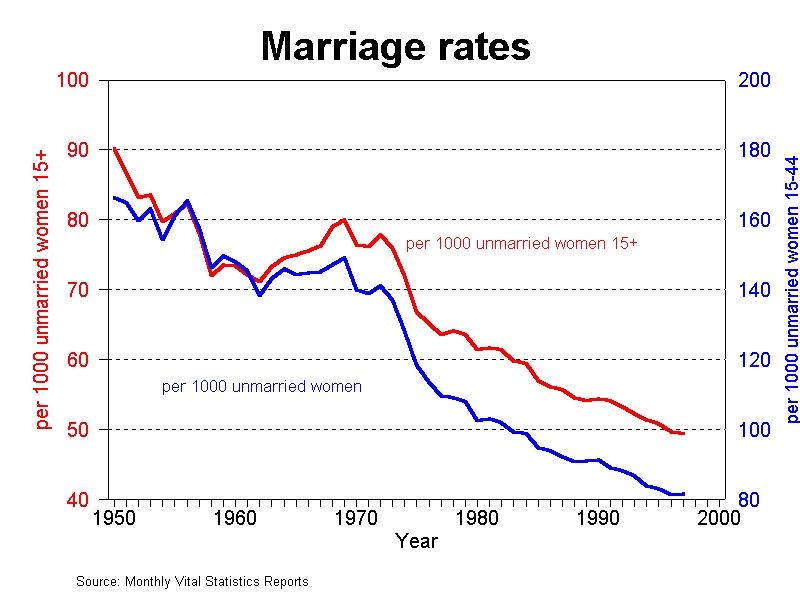
While there is no hard data or studies establishing a causal relationship between church attendance and fundamental shifts in American society, it is easy to see a correlation between the two. The movement away from traditional religion has occurred at the same time as a sharp decline in marriage. According to Census data, the share of unmarried couples cohabiting has risen from one percent in 1960 to more than 11 percent today. At the same time, the marriage rate has declined from 90 percent in 1950 to 36 percent. Both men and women are delaying marriage until later in life.
Unsurprisingly, the decline of marriage has led to an increase in the share of children living in single-parent homes. Two-parent families have declined from almost 90 percent in 1960 to less than 70 percent today. Put another way, according to The Atlantic, at 31 percent of U.S. households, “single parents have more than tripled as a share of American households since 1960.”
The change is even pronounced in black families where more than two-thirds of children belong to single-parent families. Many children who do live in two-parent families are not with both biological parents. The trend is not limited to black families. Nationwide, one out of every three children live in homes where the biological father is absent.
Given the enormous costs of raising children, it should come as no surprise that with the growth of single parent families has come a similar growth in federal entitlement spending. As more children grow up within broken families, the federal government has borne an ever larger financial share of the burden of parenthood. Federal entitlement spending has grown from less than one percent to approximately 13 percent of GDP with no sign of slowing.
The effects of single-parent families on children are well documented. According to the National Father Initiative, growing up in single-parent families, particularly families where the father is absent, puts children at risk for a variety of negative outcomes. Such families are more likely to live in poverty due to the fact that a single mother often cannot work a full-time job and care for her children. Children of absent fathers are more at risk for emotional and behavioral problems, juvenile delinquency, drug and alcohol abuse, sexual activity and teen pregnancy, and even bad grades.
The problem of single-parent families is a vicious cycle. Statistics show that children who grow up in single-parent families are more likely to experience divorce themselves as well as being less likely to marry in the first place. In many cases, children of single parents grow up to head their own single-parent families, which in turn require more government help.
Due to the unintended consequences of entitlements, such programs would be problematic even if the federal government could afford them. In reality, entitlements are unaffordable. The Heritage Foundation points out that 61 percent of federal spending is on mandatory items such as entitlements. Further, 31 cents of every federal dollar spent is borrowed. This has led to a federal debt of more than $17 trillion. When unfunded liabilities such as Social Security and Medicare are included, the total debt comes to $127 trillion, according to Forbes.
The problem of the growth of government deficit spending on entitlements is not merely an economic issue. It is also a moral issue. Growth in government is largely a response to the decline of the family and entitlements fill the vacuum of money and stability in single-parent families. Because a government check cannot fully replace a missing mother or father, these entitlement payments make the problem worse in the end by making marriage and traditional families seem optional.
The destruction of the family causes other problems as well. The problem of out-of-wedlock pregnancy is undoubtedly related to the abortion issue as well. According to the Centers for Disease Control, more than 85 percent of women who abort their babies are unmarried. The Guttmacher Institute notes that 75 percent say that they cannot afford a child, a problem that is often associated with single-parent, single-income families. Half specifically cite their desire to not be a single parent or problems with their husband or partner. While the rate of abortions in the U.S. is declining somewhat, more than 1 million abortions still occur in the U.S. each year.
Another possible, but less conclusive, result of the destruction of the family is increased homosexuality. Accurate statistics on the rate of homosexuality are hard to find (due to small sample size and self selection), but the theory that homosexuality in some people is related to domineering mothers has been around for decades, such as a paper by Dr. Marvin Siegelman from 1974 and several books by Dr. Joseph Nicolosi, author of “A Parent’s Guide to Preventing Homosexuality.” While the left disputes this view, little is definitely known about the root causes of homosexuality.
Some psychologists and psychiatrists have advanced therapies based on these theories of environmental causes for homosexuality. In spite of being attacked by gay activists and leftists, there is evidence that these therapies can help some homosexuals. In some cases, liberals have sought bans against gay reparative therapy, even though such bans violate the freedom of speech of doctors and the freedom of choice of families. If homosexuality is a result of strong mother figures for some gays, then the rate of homosexuality should increase as the rate of single-parent families increases.
The negative effects of homosexuality are less disputed. Dr. Timothy Dailey of the Center for Marriage and Family Studies summarized the risks of homosexuality. These include an increased risk of suicide, domestic violence, and substance abuse in addition to greater risk for a variety of sexually transmitted diseases. Lesbians also have a higher risk for a variety of cancers.
Today, the United States resembles the Israel of the Bible in many ways. As Isaiah described, in spite of the blessings that God has bestowed upon America, the nation increasingly produces “bad fruit.”Americans increasingly revel in pleasure and immorality and our moral compasses are so distorted that we frequently “call evil good and good evil.” In America today, religion is being from the public square and people who follow the teachings of the Bible are increasingly in conflict with laws enforcing the new morality. Ancient Israel was destroyed by God’s judgment and some, such as Rabbi Jonathan Cahn, believe that America is already undergoing the early stages of judgment as well.
When viewed in context, it is apparent that a change in governmental policy is not sufficient to reverse the decline of the American family and the budget-busting entitlements that go along with it. What is needed is a national revival and a return to traditional family models.
The only way to reverse the trend of ever-increasing government entitlements is to reduce the need for those entitlements in the first place. By returning to a traditional family model where two parents share the responsibility for raising children, there will be less need for government intervention and support. Changes in policy without attacking the underlying problems will be doomed to failure.
The government cannot force Americans to return to traditional and time-proven methods of bearing and raising children, but a true revival and voluntary return to the Biblical teachings has the capability to change the course of American society and culture. Such a cultural shift will be necessary for the long term prosperity – and even survival – of the United States.
A revival has to start somewhere. If you want to save America, take your family to church. Teach your kids the value of the traditional family. Show them that when spouses fight, it doesn’t mean that the marriage has to end. If you love your children, try to make your marriage work. You can start this process by taking your family to church to learn about God’s forgiveness. You might save your country as well as your soul.
Read the full article on Examiner.com
Tuesday, August 26, 2014
Perry indictment is part of campaign of harassment against conservatives
The news of the indictment against Texas Governor Rick Perry on charges of abuse of official capacity and coercion of a public official surprised the country and shook up the early presidential race for 2016. Debate ranged from how the charges would affect Perry’s chances at winning the Republican nomination and the White House to whether Perry would be convicted. A surprising number of liberals and Democrats have broken ranks to defend what many call an unconstitutional attempt to criminalize politics as usual. This is not the first time in recent memory that prosecutors have pressed charges against Republicans on dubious grounds.
In Texas, the Travis County DA office has prosecuted other high profile Republicans. In 1993, Rosemary Lemberg’s predecessor, Ronnie Earle, indicted newly elected U.S. Senator Kay Bailey Hutchison on charges of misusing her previous office of state treasurer according to National Review. Hutchison was originally elected in a special election and faced the prospect of running for reelection in 1994 with the indictment hanging over her head. She pressed for a quick resolution and, when the case went to trial, Earle told the court that he could not proceed without the admission of records seized from Hutchison’s office without a search warrant. The judge promptly ordered the jury to return a verdict of not guilty.
After the acquittal, Hutchison requested that the records be released, saying, “The case was not there. They turned around and ran because they knew the longer they went, the more embarrassing it was going to be. . . . They thought the lady would crack. Well, the lady wouldn’t crack.”
In 2010, it was Tom Delay’s turn to face the Travis County DA. Delay was convicted on money laundering charges stemming from accusations that he funneled corporate money to Republican candidates. Delay, a former Speaker of the U.S. House of Representatives, was sentenced to three years in prison, but remained free on bail while he appealed. His conviction was overturned in 2013 by a three judge panel of a Texas appellate court. The decision said that evidence in the case was “legally insufficient” according to the Washington Post.
In 2008, Senator Ted Stevens (R-Alaska) was indicted on felony charges of failing to properly report gifts less than four months before that year’s election. He was found guilty of making false statements on Oct. 27 and promptly lost his reelection fight to Mark Begich. A few months later in February 2009, an FBI agent became a whistleblower and revealed that prosecutors and FBI agents had withheld key evidence and witnesses that would have supported Stevens’ claims of innocence as well introducing evidence that they knew to be false. In April 2009, a federal judge vacated Stevens’ conviction. Politico reported in 2012 that a special investigator’s review of the case found that misconduct by the prosecutors and FBI had tainted the trial. Stevens died in a plane crash in 2010 and his Senate seat remains in Democratic hands.
Two other Republican governors, Chris Christie (N.J.) and Scott Walker (Wisc.), are also potentially under investigation according to Salon. In New Jersey, prosecutors are trying to tie Chris Christie to the “Bridge-gate” scandal as well as diversion of Port Authority money to New Jersey road and bridge projects and real estate deals by David Samson, Christie’s appointee to chair the Port Authority’s Board of Commissioners. According to Esquire, anonymous “sources with intimate knowledge” of U.S. Attorney Paul Fishman’s investigation say Christie’s Port Authority appointees and former chief counsel “face near-certain indictment and are being pressed to hand up Christie.”
Walker may come under investigation for illegally coordinating with outside groups in his 2012 fight against recall. Walker triumphed in the election, but, as described by the Milwaukee Journal-Sentinel, the Milwaukee County prosecutor, a Democrat, launched a John Doe probe, an investigation allowed under Wisconsin law that allows the government to “compel people to produce documents and give testimony, as well as bar them from talking publicly about the investigation.” A federal judge ordered an end to the probe in May 2014, according to MSNBC, noting that no laws had been broken. Under Wisconsin law, issue ads that do not endorse or attack a specific candidate are not considered expenditures for a campaign and are not subject to laws regarding coordination with the candidate. This issue was previously decided in Wisconsin Right to Life v. Barland.
Republicans do not have to be prominent elected officials to attract the attention of partisan prosecutors. Since 2013, a series of articles in the Wall St. Journal have detailed how prosecutors in Wisconsin have subpoenaed 29 conservative groups in the John Doe probe. In June 2014, the Journal noted that so far prosecutors have failed to show probable cause that any crime had been committed and pointed out that the coordination in Wisconsin strongly resembled the President Obama’s 2012 campaign. Nevertheless, recent reports by the Milwaukee Journal Sentinel and Fox News indicate that personal information from members of conservative groups such as Wisconsin Club for Growth were released by a federal appeals court and posted online, allegedly by mistake.
The John Doe probe in Wisconsin is reminiscent of the IRS harassment of conservative groups that has been ongoing under the Obama Administration. Far from targeting high profile Republicans, the IRS focused its abuse on grassroots leaders of Tea Party groups. In one instance, cited by the Chicago Sun-Times, Catherine Engelbrecht, a small business owner involved with two nonprofit political groups beginning in 2010, was suddenly subjected to more than 15 federal audits and inquiries. In addition to the IRS, she was contacted by OSHA, the FBI, and the Bureau of Alcohol, Tobacco and Firearms, among others.
The IRS admitted to both the harassment of conservative groups and illegally leaking confidential tax information to liberal groups during the 2012 presidential election. In June 2014, the Daily Signal reported that the IRS had agreed to pay $50,000 to the National Organization for Marriage. The IRS had leaked the group’s donor list, including names and contact information to the gay activist group, the Human Rights Campaign, which then published the data. Even though leaking confidential tax information is a felony, no criminal charges have been filed against anyone at the IRS.
There are also indications that Lois Lerner, the official at the center of the IRS scandal, may have had a history of malicious prosecutions at the Federal Election Commission as well. The Illinois Review reported that Republican senate candidate Al Salvi was the subject of several FEC complaints regarding campaign finances in the last weeks of his 1996 campaign against Dick Durbin. The complaints were ultimately dismissed in 2000, but not before Salvi received a strange offer from an FEC official he identified as Lois Lerner. Salvi says that, in a conversation that included Mike Salvi, his brother and attorney, Lerner told him, “If you promise to never run for office again, we'll drop this case.” Salvi refused. Four years and $100,000 in legal fees later, the FEC case against Salvi was dismissed.
These high profile cases are likely not the only instances of malicious prosecution of conservatives. At the state and local level, it is easy for such cases to avoid national scrutiny. The Wisconsin John Doe probe has largely been ignored by the national media. (Those aware of similar cases can contact the author.) In many other instances, such as harassment of California supporters of Prop 8 and the demonization of the Koch brothers, there was no prosecution, but a blatant attempt to intimidate and silence conservatives.
It is increasingly evident that the harassment, intimidation and malicious prosecution of Republican officeholders and conservative activists, often in the name of campaign finance reform, are an integral part of the Democratic playbook. As long as such attempts at stifling free speech succeed with no consequences for the left, they are likely to continue.
Saturday, March 29, 2014
Fates of 2005's top ten RINOs should alarm GOP purists
In recent years, many conservatives have blamed RINOs – Republicans in name only – for the recent Republican failures at the polls as well as for the failure of the GOP to stop the explosive growth in government. The use of RINOs as a target and scapegoat is not new and predates the advent of the Tea Party. But are RINOs really to blame for Republican Party’s woes and would the party be better off if RINOs were kicked out?
In 2005, four years before Barack Obama became president and sparked the Tea Party movement, Human Events published a list of that year’s top ten most wanted RINOs. Where are these RINOs today? Have they been replaced by Tea Party inspired conservatives or are they still subverting the Republican Party from within?
The first RINO on the list is Lincoln Chafee, at the time a senator from Rhode Island. Chafee lost his seat to Democrat Sheldon Whitehouse in 2006. He left the GOP a year later according to Ballotpedia and was elected governor of Rhode Island as an independent in 2010. He became a Democrat in 2013.
Next is Olympia Snowe, a senator from Maine. Snowe retired from the Senate in 2012 and was replaced by Angus King, an independent who consistently votes with the Democrats. Since her retirement, Snowe started Olympia’s List, a website that promotes candidates who “follow the principles of consensus-building.”
Arlen Specter, the next RINO on the list, is infamous in conservative circles. Specter left the Republican Party in 2009 to become a Democrat. He lost the 2010 Democratic Senate nomination to Joe Sestak, who then lost the general election to Republican Pat Toomey. Arlen Specter died of non-Hodgkins lymphoma in 2012. Since taking office, Senator Toomey has scored 100 percent from the American Conservative Union.
Susan Collins, also a senator from Maine, is number four. Collins is still serving in the Senate as a Republican and faces reelection in 2014. Her voting record makes her the most liberal Republican in the Senate according to the American Conservative Union, but she remains to the right of most Democrats.
Connecticut Rep. Chris Shays was replaced by Democrat Jim Himes after the 2008 elections. In 2010, he ran an unsuccessful campaign for Joe Lieberman’s Senate seat. He lost that primary to Linda McMahon, who in turn lost the general election to Richard Blumenthal, a far left Democrat.
Gov. George Pataki of New York was the next most wanted RINO. Pataki was succeeded by three consecutive Democrats, Eliot Spitzer, David Paterson, and Andrew Cuomo, when he left the governorship in 2006. Cuomo was instrumental in passing strict new gun control laws after the Sandy Hook mass murder as well as introducing same sex marriage into the Empire State.
Rep. Sherwood Boehlert of New York retired in 2006. His congressional district in the Utica area is now represented by Republican Richard Hanna, a moderate with a 52 percent lifetime score from the American Conservative Union.
The next name on the list, Mitt Romney, is also well known to Republicans. In 2005, Romney was governor of Massachusetts. Human Events singled him out for his support of gun control and civil unions. Unmentioned was his namesake health care program, Romneycare. Romney declined to run for reelection and was succeeded by Democrat Deval Patrick, whose expansion of Romneycare significantly drove up costs and who is staunchly in favor of strict new gun controls.
At number nine is Mike Castle, at the time the sole congressman from Delaware. In 2010, Castle ran for the Republican nomination for the Senate seat vacated by Vice President Joe Biden. Castle lost the nomination to Tea Party candidate Christine O’Donnell, who subsequently lost the general election to another liberal Democrat, Chris Coons. O’Donnell is perhaps best remembered for her declaration in a campaign ad that “I am not a witch.”
In the final analysis, the majority of the 2005 RINOs were replaced by more liberal representatives. Five eventually lost to Democrats and one was replaced by a leftist independent. Another lost a primary to a more conservative candidate who lost the general election to a Democrat. One was replaced by another moderate Republican. With one 2005 RINO still serving, only one was replaced by a more conservative official.
The important thing to learn may be that when a state’s voters elect a moderate, it is because that is what they feel is best for their state. Staunch conservatives are not likely to get elected in New York and Maine. If a moderate Republican there is to be replaced, the odds are good that it will be with a liberal Democrat. Those who think that moderate Republicans are as bad as or worse than Democrats need look no further than Obamacare. When the Affordable Care Act was passed, not a single Republican in either the House or the Senate voted for it. Not even the RINOs. Ninety percent of Democrats did.
NOTE: The quest for political purity is no longer limited to the Republican Party. James Taranto of the Wall St. Journal recently described how Markos Moulitsas of Daily Kos celebrated the fact that many moderate Democrats had been evicted from Congress as well. Although Moulitsas did not use the term “DINO,” he cited ten Democratic moderates from 2004 and celebrated the fact that eight are no longer in office. The remaining two Mary Landrieu (La.) and Mark Pryor (Ark.) are likely to lose this November. The results of this cleansing were similar to that of Republican RINOs. The majority of moderate DINOs were replaced by members of the other party. Only Joe Lieberman (Ct.) was replaced by a more liberal senator.
Originally published on Atlanta Conservative Examiner
Tuesday, September 17, 2013
Navy Yard killer shared traits with other rampage murderers
Already there are voices calling for increased gun control in the wake of Aaron Alexis’ murders of 12 people in the Washington Navy Yard yesterday. As Examiner reported, traditional gun control seems to be counterproductive in reducing crimes and mass killings, but an analysis of this and other shootings reveals several common threads between many perpetrators of rampage killings. Diagnoses are made more difficult by the fact that the killers in many of the rampages are often killed themselves, but in many cases, the killer had been diagnosed with some form of mental illness or can plausibly be considered to have an undiagnosed mental illness. Other factors, such as video games, movies, or broken families are also common.
Aaron Alexis is reported to have been undergoing treatment for mental illness with the Veterans Administration according to the Washington Times. The report indicates that Alexis had reported hearing voices in his head and suffered from paranoia. NBC News reports that Alexis had two prior arrests for gun related crimes. In 2004, he allegedly shot out the tires of another man’s car during “an anger-fueled ‘blackout’” in Seattle. In 2010, he was arrested in Texas for shooting his gun through the ceiling of his apartment. The bullet went through his ceiling into the apartment upstairs. Alexis told police that the shooting was accidental. According to Seattle police, Alexis was present at the September 11 attacks and was an “active participant in rescue attempts” [at the World Trade Center according to the Telegraph] and may have suffered from post-traumatic stress disorder (PTSD).
The Daily Mail also reports that Alexis’ best friend, Nutpisit Suthamtewakul, 31, of Ft. Worth, said that Alexis was obsessed with violent video games. Mr. Suthamtewakul said that Alexis would often play “zombie” shooter games for much of the night. Mr. Suthamtewakul also said that Alexis was a “hard core drinker.”
Atlanta’s 11 Alive News also reported a third arrest in Georgia. On August 10, 2008, Alexis was arrested in DeKalb County for disorderly conduct. There was no indication that a weapon was used. He was also discharged from the Navy Reserve in 2011 for unspecified misconduct. None of this prevented Alexis from obtaining a security clearance to work as a navy contractor. CNN reported that Alexis’ security clearance was renewed in July.
The full details of Alexis’ family and childhood are not available, but reports of the family make no mention of his father. A Newsday article quoted a former neighbor of the family’s apartment in Brooklyn who noted that the family consisted of a mother, a daughter, and two boys. Mr. Alexis reportedly lived with his grandmother in Seattle.
In the case of last year’s shootings at Newtown, Ct., the Hartford Courant and NBC’s WPTV reported that Adam Lanza was a frequent player of violent first-person shooter video games. Police report that Lanza destroyed his computer before his rampage, so the exact extent of his video gaming may never be known. Lanza was known to have been diagnosed with Asperger’s syndrome, a form of autism and had not seen his father since 2010.
Peter Bell, executive vice president of programs and services at Autism Speaks told PBS that some Asperger’s patients do have trouble controlling aggressive thoughts and behavior, but that there is no evidence linking the condition to violence. Nevertheless, Randi Rentz, a teacher specializing in Asperger’s, notes that some of her students exhibit hostility. There is also the possibility that other undiagnosed forms of mental illness were present along with the Asperger’s.
James Holmes, who went on a rampage in a movie theater showing “the Dark Knight” in Colorado in July 2012, apparently came from an intact family, but had seen three mental health professionals at the University of Colorado according to CBS News. Any diagnosis is unknown due to a gag order imposed by the judge in the case, but Holmes reportedly mailed a package to one of the school’s psychiatrists. Because of the gag order, not much information is available about Holmes’ mental state, but Fox News has reported that he was a frequent player of video games including “World of Warcraft,” a role-playing game. One friend told the Telegraph that Holmes preferred “Guitar Hero” to shooter games.
The Week reported that a local gun range owner flagged Holmes after he attempted to join the range. The man called Holmes’ answering machine “bizarre or freakish” and told employees to refer Holmes to him before letting him do anything there. In the months before the killing spree, Holmes’ grades had fallen and he had dropped out of graduate school. Apparently, one of the psychiatrists at the college had become concerned that Holmes might be a potential threat, but he dropped out before her concerns could be addressed according to a report from the local ABC affiliate.
Jared Lee Loughner, who shot Rep. Gabrielle Giffords and killed six others in Tucson in January 2011, was both mentally ill and a video gamer. Several sources, including the Wall St. Journal, report Loughner’s obsession with games. Loughner had a long history of mental illness according to Time. He had made threatening and nonsensical comments to fellow students and teachers at his college. His tests and writings included bizarre and sometimes violent phrases. At times he seemed paranoid and unable to function socially. He was also a frequent user of marijuana which may have made his condition worse. He apparently was rejected for military service due to a failed drug test. He also had stalked several women and, at one point, was involuntarily committed to a mental institution.
A Wall St. Journal investigation of Loughner’s posts in online video game forums showed a number of disturbing posts. He pondered whether one should “hit a Handy Cap Child/Adult” [sic] and theorized that women enjoyed being raped. He also lamented his inability to find a job. According to the report, Loughner played role-playing video games such as “Starcraft,” “Diablo,” and “Earth: 2025.”
Cho Seung-Hui, who killed 32 people at Virginia Tech in 2007, had been diagnosed with mental health problems at an early age according to a well documented report on the massacre by the State of Virginia. In elementary school, he was diagnosed with emotional issues that led to communication problems. In middle school, he was diagnosed with social anxiety disorder, lack of verbal skills and immaturity. In 1999, after the Columbine murders, Cho wrote a paper for his English class that indicated that he wanted to carry out a mass murder as well. He was diagnosed with selective mutism in social situations and depression. At this point, he was given a prescription for antidepressants, after which his condition improved.
Cho had an above average IQ and, with special accommodations in high school, his grades were high enough that he was accepted at Virginia Tech. In eleventh grade, he had improved enough that he was able to stop the counseling sessions and never resumed them after he graduated and began attending college.
As a college sophomore, Cho’s grades began to drop. He changed his major to English, a subject that he struggled with. He became disruptive in class and his creative writing assignments reflected dark and violent themes. He was accused of stalking a female student and had stabbed the carpet with a knife at a party. A friend reported that Cho had threatened to kill himself and Cho admitted to having depression and anxiety, although he denied having suicidal thoughts according to ABC News. Cho talked to three counselors, but failed to come to counseling appointments and pursue treatment. Throughout his school career, Cho was known for not speaking or speaking in barely audible tones.
Dylan Klebold and Eric Harris, the Columbine killers, reportedly had different motives and illnesses. According to an assessment published in Slate, Klebold may have suffered from depression while Harris was likely a psychopath. Based on his journal, a panel of psychologists, psychiatrists, and FBI agents point to Harris’ contempt for others and his total lack of empathy and conscience as evidence of his psychopathic tendencies. Dr. Peter Langman, formerly a clinical director at Kids Peace Hospital and author of “Why Kids Kill,” agrees. His analysis of the writings of Klebold and Harris agrees that Harris was a psychopath while Klebold apparently suffered from a variety of psychoses including depression, paranoia, delusions and disorganized thinking. The two teens famously enjoyed violent video games as well.
Michael Brandon Hill, the gunman who invaded a school in Decatur, Ga. last month, also had a history of mental illness and a criminal record according Examiner. A quick-thinking school receptionist was able to convince Hill to surrender after exchanging shots with police.
There seems to be broad support for a system of screening students for mental illness. Dr. Harold Koplewicz wrote in the Huffington Post that 75 percent of psychiatric disorders appear by age 24 and that early intervention greatly improves the prognosis. Dr. Bill Knaus of the Rational Emotive Behavior Therapy network points out that many mentally ill people are not aware of their illness and therefore will not voluntarily seek help. A particularly dangerous time seems to be when people stop taking their medication, especially if they do so abruptly and without supervision.
One solution to the problem of the mentally ill committing massacres would be reforming laws to allow state and local governments more flexibility in involuntarily committing people who might be a danger to themselves and others. This should include follow up visits to confirm that they remain on their medication and that their condition remains stable. This may also require that privacy laws be amended so that information can be shared between agencies. Such an approach has been used in Colorado where Gov. John Hickenlooper, a Democrat, reformed the state’s involuntary treatment laws in the wake of James Holmes’ killing spree.
A second strategy is to change popular culture. As Lt. Col. Dave Grossman describes on killology.com, violent images and games can condition children to kill in much the same manner that armies condition soldiers to be able to pull the trigger. Although popular culture does not turn all children into remorseless killers, the combination of cultural cues and mental illness may combine to push some people over the edge.
Finally, acting to preserve the family would help to grow stable adults. Children from single parent families and broken homes are far more likely to turn to crime and violence than children who come from stable families as Examiner previously reported. Single parent families are also far more likely to live in poverty and require government assistance as well.
There is a legitimate role for governments to play in keeping firearms out of the hands of potentially dangerous mental patients. However, addressing the underlying issues is much more difficult than returning to traditional and ineffective forms of gun control.
Originally published by Atlanta Conservative Examiner