Showing posts with label Michigan. Show all posts

Thursday, June 4, 2020

Fox News Poll Shows Trump Trailing In Swing States

Three new Fox News polls sampled voters in the swing states of Arizona, Ohio, and Wisconsin. The news in all three states was not good for the president. Mr. Trump, who won all three states in 2016, now trails Joe Biden in each case.
In the Arizona poll, the president trails his Democratic challenger by a 42-46 margin. On the issues, the economy was the only area in which Trump scored better than Biden (by 48-41 percent). Shockingly, Biden even edged out Trump on immigration in this border state by one percentage point. Trump’s net approval rating in Arizona was negative-six points.
The poll also showed that Arizona is a likely spot for a Senate pick-up for Democrats. The poll showed Republican incumbent Martha McSally trailing Democrat Mark Kelly by 13 points.
In Ohio, which has seemed increasingly Republican, the Fox poll showed Biden with a two-point lead (45-43 percent). This is well within the 3.5-point margin of error for the poll. In Ohio, Trump’s 50-percent approval rating gave him a net approval of two points.
Moving to Wisconsin, the poll found Trump trailing Biden by nine points (40-49 percent). The president’s net approval in the state was negative-nine points, closely mirroring the difference in the head-to-head matchup.
President Trump’s poor response to the three crises of Coronavirus, the recession, and the race riots seemed to be driving much of the opposition to his re-election. While Trump scored best on the economy in all three states, Biden rated better on race relations and Coronavirus in all three cases. On immigration, the only other issue tested, Biden was preferred in Arizona (which was a statistical tie on the question) and Wisconsin. Ohio voters liked Trump’s approach to immigration.
As I frequently point out, individual polls are a single data point and should be treated with caution. There are also additional swing states to consider. In addition to the three surveyed by Fox News, Florida, Michigan, North Carolina, and Pennsylvania are likely battleground states this year. For a more complete look at polling in all seven swing states, all of which were won by Trump in 2016, here is a rundown based on Real Clear Politics averages:
Arizona: Biden leads by 2.8 points
Florida: Biden leads by 3.4 points
Michigan: Biden leads by 4.2 points
North Carolina: Biden leads by 0.8 points
Ohio: Biden leads by 1.0 point
Pennsylvania: Biden leads by four points [As a caveat, Trump held a four point lead in the only May poll, but Biden has led in every other recent poll.]
Wisconsin: Biden leads by 3.4 percent
Based on these polling averages and assuming that the tossup states of North Carolina, Ohio, and Pennsylvania go to Trump, Joe Biden would win the electoral vote by 288-250 if the election were held today.
I frequently hear from Trump supporters who are skeptical of all polls since polling pointed toward a Hillary Clinton victory in 2016. In most cases, the surprise states of 2016 were polling within the margin of error by Election Day, and the final Electoral College result hinged on about 70,000 votes. It is whistling past the graveyard to assume that Donald Trump can repeat that performance this year. If Biden still leads in all swing states in November, Trump will have to defy the odds and run the table to keep his job.
Increasingly, the polling for 2020 is not close. On the contrary, more and more red states seem to be moving towards battleground status. For example, the Real Clear Politics average shows Trump only holding a two-point lead in Texas. Likewise, Arizona used to be reliably Republican.
The polling does not predict with certainty that Trump will lose in November, but it is a warning sign that his re-election campaign is in trouble. To turn the tide, the president must change his image, but he seems incapable of doing so.

Originally published on The Resurgent

Friday, May 1, 2020

Michigan Reopen Protests May Do More Harm Than Good

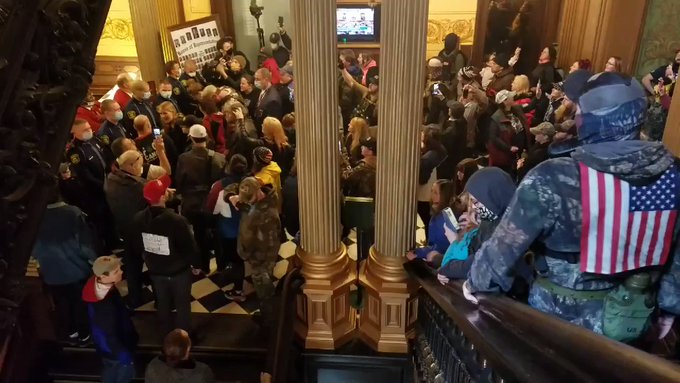
hat does open-carry have to do with rescinding shelter-in-place restrictions for the pandemic? A lot apparently since gun-toting protesters have popped up around the country to demand that the economy be reopened. The latest such protests took place in Michigan where Gov. Gretchen Whitmer has put in place strict guidelines to combat the Coronavirus pandemic there.
Michigan United for Liberty organized Thursday’s rally in Lansing under the name, “American Patriot Rally.” NBC News reported that hundreds of people, some armed, protested at the state capitol. Protesters also carried American flags and chanted, “Let us in!” and “This is the people’s house, you cannot lock us out.” Some protesters entered the capitol building and tried to gain access to the House chamber but were blocked by state police and sergeants-at-arms.
Nothing says “uphold the Constitution and the rule of law” like an angry, armed mob storming government buildings. While I have sympathy for people who are concerned about their financial wellbeing and the economy as a result of the pandemic and the need to shelter-in-place, I am far less sympathetic for unruly demonstrators who use their right to bear arms to implicitly threaten an armed revolt.
Michigan law permits carrying firearms as long as the weapons are for lawful intent and are visible. Interestingly, there seems to be no prohibition against carrying guns inside the state capitol building either.
Michigan’s shelter-in-place rules have come under fire by Republicans for being too restrictive. Michigan’s Republican Speaker of the House Lee Chatfield tweeted, “Instead of essential vs non-essential, we should think safe vs unsafe.” Chatfield said that activities such as lawn care, construction, motorized boating, realtors, and buying seeds and gardening supplies that are currently prohibited should be allowed.
“The Senate Republicans believe a strategic application of ‘Stay Home, Stay Safe’ is appropriate going forward. Individuals living in regions of the state that are experiencing little to no growth in infection rates should be able to return to their jobs to support their families if proper safety protocols are put in place,” Senate Majority Leader Mike Shirkey, a Republican, said in a statement quoted by WZZM News.
Even though protesters disagree with the rules, a Michigan court upheld their legality yesterday. Court of Claims Judge Christopher M. Murray said in the ruling, quoted by ABC News, “Although the Court is painfully aware of the difficulties of living under the restrictions of these executive orders, those difficulties are temporary, while to those who contract the virus and cannot recover (and to their family members and friends), it is all too permanent.” The ruling is in line with precedent that gives executives broad-but-limited powers in temporary emergencies.
And that’s the key. No matter how fervently the protesters believe that the restrictions are a gateway to tyranny or that the pandemic is overblown, the restrictions are neither unconstitutional nor unprecedented. There is a valid reason for the shelter-in-place and the governor has the authority to decide what restrictions are appropriate during the state of emergency.
Michigan has one of the highest rates of Coronavirus deaths in the country. Although the state seems to be on the backside of the curve, some areas are still deeply affected by the pandemic. The state currently reports 41,379 cases with about 1,000 new cases per day. The state has had 3,789 Coronavirus deaths.
Interestingly, despite the fact that “reopen” protesters seem to be almost exclusively Trump supporters, the president has flipflopped the issue. Trump criticized Georgia Gov. Brian Kemp for reopening his state too early recently tweeted that the US made the correct decision in sheltering-in-place, undermining a common talking point of critics of the economic hiatus.
The protesters are also at odds with pubic opinion in Michigan. A recent Fox News poll found that 72 percent of Michiganders were concerned about the Coronavirus pandemic and that those who thought Gov. Whitmer’s order was “about right” or “not restrictive enough” outnumbered those who thought it was “too restrictive” by more than two-to-one. The same is true nationally as 80 percent of Americans and 61 percent of Republicans continue to favor sheltering-in-place per a KFF Health Tracking poll from last week.
Economic activity in a pandemic does not operate under the principle of “if you open it, they will come.” Business activity is unlikely to return to anything resembling normal until people can be assured that they won’t contract the virus or pass it to someone that they love.
There should be room for compromise on Michigan’s shelter-in-place rules, however. Areas that are not hard-hit could have restrictions relaxed to allow farmers to buy and plant seeds. Outdoor activities that are performed in isolation could be safely allowed. Michigan’s outbreak is trending down and may be completely lifted soon.
In any case, if reopen protesters want to change minds and be taken seriously, they should take steps to come across as less wild and crazy than they seem on video from Lansing. In a pandemic, it is not smart to form a crowd of close-standing protesters who are not wearing protective equipment. This is not how you gain sympathy from people concerned about a communicable disease.
Likewise, protesters should leave the guns at home. I am a carry-permit holder and a proponent of Second Amendment rights but there is a time to carry your gun and a time to leave it at home. If you want to win over people, many of whom are not comfortable with guns, you don’t stick guns in their faces. Open carry at such a protest might be legal, but that doesn’t make it smart.
In contrast, a horde of armed protesters pushing their way into the state capitol is likely to convince people that Michigan’s gun laws are too lenient. Scaring people by acting irresponsibly with guns is how you convince people to vote for anti-gun politicians.
I’ve believed for years that most protests are more about protesters feeling good about themselves and blowing off steam than convincing politicians to make any policy changes. If you doubt this, just think about your own reaction to any liberal protest. My rule of thumb appears to be true of the reopen rallies, which are out of the mainstream of public opinion and which may be doing both the reopen and Second Amendment causes more harm than good.
Originally published on The Resurgent

Thursday, April 23, 2020

More Bad News For Trump From The Rust Belt


Iwrote yesterday about the tight races between Donald Trump and Joe Biden in four swing states. Now, a new poll is out that takes a look at three of those states in the Rust Belt. The news is not good for the president.
A new Ipsos poll of registered voters in Michigan, Pennsylvania, and Wisconsin shows the president trailing his presumptive Democratic challenger in all three states. The survey showed Biden leading by 3 points in Wisconsin, 6 points in Pennsylvania, and 8 points in Michigan.
If the president loses all three states and there are no other changes from the 2016 results, he would lose the Electoral College by a 260-278 margin. As I discussed yesterday, the president is also trailing in Arizona so Biden has multiple paths to victory.
The poll had a margin of error of five points for each state so Wisconsin could be considered a statistical tie. Biden’s lead in Michigan and Pennsylvania is outside the margin of error.
Biden’s lead in the poll has expanded over his 3-4-point lead earlier this year. Interestingly, this suggests that Biden is gaining ground even though he has not been able to hold campaign events due to the Coronavirus pandemic. Given Mr. Biden’s penchant for gaffes, he may be doing better by not not holding events.
The results also suggest that the focus on President Trump, who is holding daily press briefings, has not helped his campaign. The president’s daily briefings have come under widespread criticism for his misinformation and misstatements.
Even though Trump has higher approval in these battleground states than he does nationally, his approval rating is still underwater in all three states. His net approval is -6 points in Wisconsin, -4 in Pennsylvania, and -12 in Michigan.
The poll does support the idea that Trump’s handling of the pandemic has hurt him. At 48 percent, Coronavirus is the top concern of voters in all states, and the president rates 20 points below state governors for his reaction to the crisis.
There are many wild cards for the upcoming election but the president has his work cut out for him in making up the deficit against Biden. Among the unknowns are how quickly the economy will recover and whether a second wave of the pandemic will strike before November. In the meantime, if President Trump wants to stem the bleeding, he should leave the press briefings to Drs. Fauci and Birx and Vice President Pence.
Originally published on The Resurgent

Tuesday, November 5, 2019

Swing State Polls Look Bad For Donald Trump


A new round of head-to-head polling from the swing states came in yesterday and the results are somewhat encouraging for Republicans. While Donald Trump trails the leading Democrats in national polling, many of the swing state races are too close to call.

Due to the large number of candidates and states to examine, for clarity, I will present each state separately and give Trump’s net poll rating with each candidate based on the Real Clear Politics average. A negative rating means that Trump is behind and a positive rating means that he is ahead. For reference, I’m also including the latest state-level Trump approval numbers from Morning Consult, which were taken as the Ukraine whistleblower scandal was breaking in late September.
National
Trump vs. Biden               -10
Trump vs. Warren            -7.3
Trump vs. Sanders           -7.9
Trump vs. Buttigieg         -4.5
Trump vs. Harris               -5.3
Trump approval                -13

Arizona
Trump vs. Biden               -1.7
Trump vs. Warren            0.7
Trump vs. Sanders           5.3

Florida
Trump vs. Biden               -2.0       
Trump vs. Warren            0.3
Trump vs. Sanders           1.0
Trump approval                -2

Iowa
Trump vs. Biden               1.5
Trump vs. Warren            4.5
Trump vs. Sanders           1.0
Trump vs. Buttigieg         4.0
Trump approval                -14

Michigan
Trump vs. Biden               -7.7
Trump vs. Warren            -3.0
Trump vs. Sanders           -7.3
Trump approval                -10

North Carolina
Trump vs. Biden               -5.4
Trump vs. Warren            0.2
Trump vs. Sanders           -2.4       
Trump approval                -3          

Ohio (no recent polling)
Trump vs. Biden               -7.0
Trump vs. Warren            -1.5
Trump vs. Sanders           -5.0
Trump approval                -5

Pennsylvania
Trump vs. Biden               -7.3       
Trump vs. Warren            1.7
Trump vs. Sanders           5.4
Trump approval                -8

Wisconsin
Trump vs. Biden               -5.7
Trump vs. Warren            -1.0
Trump vs. Sanders           -2.7
Trump approval                -11

There are a couple of important takeaways from this polling, even though the election is still a year away. The first is that Joe Biden is a stronger candidate in the swing states than Elizabeth Warren or Bernie Sanders. In six of the seven swing states with recent head-to-head polling, Biden leads Donald Trump. Warren fares worst of the three top-tier Democrats, but Bernie Sanders is not much better.

Second, Trump approval is a pretty good proxy for how he stacks up in a head-to-head matchup in most cases, although this is dependent on individual candidates as well and the numbers don’t match up exactly. In only one of the states examined, Iowa, does Trump have a negative approval rating but leads in polling.

Finally, as we saw in 2016, it isn’t enough for the Democrats to win the popular vote and expect that to translate into an Electoral College victory. The Democrats must give Donald Trump a 5-10 point shellacking in the popular vote to be assured of winning enough swing states to secure the White House. This is especially true due to the difficulties of state-level polling in swing states.

Based on the current polling presented above (while assuming Ohio stays red), Joe Biden would win the Electoral College by 333-205 and Bernie Sanders would eke out a 273-265 victory. Elizabeth Warren would lose by 258-280, but many states are actually too close to project in a Warren-Trump matchup. Neither side could be confident of victory at this point, although Warren does seem to represent Trump’s best chance at reelection.

The election is a long way away and a lot can happen. In the current cycle, that is even more true than most years due to the breaking Ukraine scandal, impeachment, the slowing economy, and a number of other factors. While the swing states are not looking good for Donald Trump, they are looking much better than the national average, but that’s why they call them battleground states.

While many of the state-level races are not polled frequently, it will be important to watch them for trends over the next year. Significant movement in one direction or the other could represent a changing dynamic within the election.

Originally published on The Resurgent
Wednesday, May 10, 2017

Pollsters Look For Why They Went Wrong in 2016


A group of pollsters has conducted a postmortem of 2016 election polling to try to determine why so many of the nation’s pollsters and political analysts, including those of us at The Resurgent, got it wrong. The resulting study, released by the American Association for Public Opinion Research, “found that the biggest culprit was state-level polling underestimating the level of Trump's support, most importantly in Pennsylvania, Michigan, and Wisconsin,” observes Business Insider in a classic understatement.

No kidding.

National polls showed Hillary Clinton with an average lead of about three-points, which was very close to the actual popular vote result which Clinton won by two points. The polls were less accurate at the state level, where they showed a tight race, but still pointed to a Clinton victory.

The three perennially blue states in the upper Midwest flipped to Trump and enabled his path to 270 electoral votes. The fundamental question is why pollsters underestimated Trump’s support in these states. On that issue, the analysis found three main factors that likely caused polls to be off in those states.

A major factor was that a large segment of voters waited until the last week before the election to make their decision. In Florida, Pennsylvania and Wisconsin, those late-deciding voters broke decisively for Donald Trump. In Wisconsin, they chose Trump by a 30-point margin. The margin for Trump among these voters was 17 points in Pennsylvania and Florida.

A second major factor was that many polls included too many college graduates in their samples and their assumptions about the electorate. “Voters with higher education levels were more likely to support Clinton,” the report said. “Furthermore, recent studies are clear that people with more formal education are significantly more likely to participate in surveys than those with less education.”

The third factor was that many Trump voters did not admit to preferring Trump in pre-election polling. There had been speculation about reluctance of Trump supporters to admit their preference to pollsters, the so-called “Shy Trump effect,” but the report notes that this effect could also be attributed to late-deciding voters.

Two additional factors were also considered to be less compelling reasons for the polling problems. The report notes that in 2016, turnout grew more in Republican counties than in Democrat counties when compared to 2012. This could have caused an overcounting of Democrat demographics while underestimating Republican support. The report also notes that Donald Trump’s name appeared above Hillary Clinton’s on the actual ballot while polls tended to randomize the order of the candidates. The report considers these effects to be insignificant.

Regarding the pre-election forecasts that Clinton was a shoo-in, the report notes that polling and forecasting are two different things. “Pollsters and astute poll reporters are often careful to describe their findings as a snapshot in time, measuring public opinion when they are fielded,” the report notes. “Forecasting models do something different – they attempt to predict a future event. As the 2016 election proved, that can be a fraught exercise, and the net benefit to the country is unclear.”

Polls are already history when they are published. The measure public opinion on the dates that they are conducted, they do not predict future events. Polling results and trends can be used by forecasters to make predictions, but, if public opinion is changing rapidly, as it did in 2016 with FBI Director Comey’s eleventh hour letter to Congress, then polling is less effective as a forecasting tool.

The analysis also found that there is no consistent partisan bias in recent US polling. While polling underestimated support for Trump last year, the reverse has been true in other recent elections. “Whether the polls tend to miss in the Republican direction or the Democratic direction is tantamount to a coin flip,” said the report.

In 2012, late-breaking support for Barack Obama in the wake of Hurricane Sandy and the Obama bromance with Chris Christie derailed what many thought would be a win for Mitt Romney. In 2004, early exit polling showed that John Kerry would defeat incumbent George W. Bush. When all the votes were counted, Bush won a convincing victory.

Looking back at the 2016 polls, which are still available on Real Clear Politics, the signs were there. Pennsylvania showed a 1.9-point lead for Clinton, which was well within the margin of error of most polls. The latest poll before the election gave Trump a one-point lead. In Michigan, the average showed Clinton up by 3.4 points, still within the margin of error, while the last poll showed Trump with a two-point lead. Wisconsin polling was farther off, showing a 6.5-point lead for Clinton. Trump did not lead in any Wisconsin polls, but won all three states by less than one point on Election Day.

The bottom line for political observers is that polling is not an exact science. This is particularly true in a country that is as closely divided as the United States is today. While polls are useful to give a snapshot of public opinion, they can’t be expected to accurately predict an election winner in a tight race where poll results are within the margin of error.

In retrospect, the fact that polls were as tight as they were going into the final week before the election should have been a red flag for Clinton supporters. For an opponent who was as unpopular as Donald Trump to be within the margin of error of the Democrat candidate in what was almost universally assumed to be a coronation more than an election indicated serious problems with the Clinton campaign.


The surge of Trump voters in the final week may be partially due to the continuing dribbles of scandal from the hacked emails and Director Comey’s decision to reopen the investigation a week before the election, but it also indicates a more fundamental problem for the Democrats. Many of these late Trump voters undoubtedly went for Trump because Democrat messaging failed to convince them that Hillary would improve their own lives and finances. 

Originally published by The Resurgent