Showing posts with label poverty. Show all posts

Sunday, March 5, 2017

Why revival is needed to make America great again

Everyone has an opinion about how to make America great again. Many people on both sides of the political spectrum seem to think that the way to solve America’s problems is to elect a president, any president, of their own party. In reality, if we want to make America great again, the movement must start at the bottom, not at the top. Making America great again will most likely require repentance and a spiritual revival.

Contrary to the beliefs of most people, the president’s power is limited.  Presidents can issue Executive Orders, but we have seen how such decrees can be limited by the courts and Congress. Even in cooperation with Congress, the federal government can only nibble around the edges of one of the largest problems facing the United States, that of entitlements.

Entitlement spending is a ticking time bomb. Entitlements have been increasing since the New Deal era and now make up 65 percent of federal spending according to the National Priorities Project. Entitlements are mandatory spending that fall outside the normal appropriations process and include such programs as Social Security, Medicare, Medicaid, the Supplemental Nutrition Assistance Program (food stamps) and veteran’s benefits.

In 2015, Social Security and federal health spending programs made up 60 percent of the federal budget. Military spending accounted for only 16 percent by comparison. The problem extends to state governments as well. Medicaid spending alone, much of it mandated by the federal government, makes up 30 percent of the budget of Texas and a fifth to a quarter of the budgets of many other states.

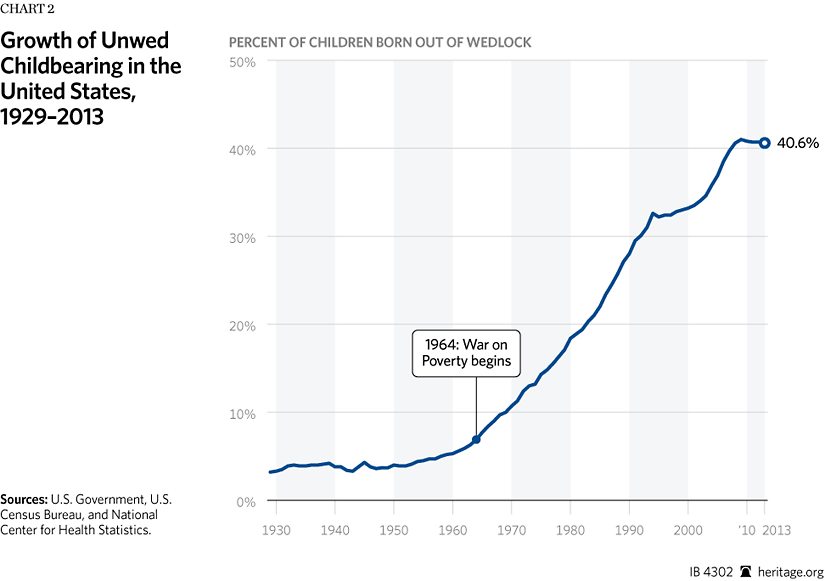
What does entitlement spending have to do with spiritual revival? Entitlement spending has exploded in past decades largely because of the decay of the American family. Unsurprisingly, charts showing the increase of entitlement spending match closely with charts showing the divorce rate and the rise of out-of-wedlock childbearing.

Children from single-parent families are more likely than children from intact families to live in poverty, abuse drugs or alcohol and drop out of school. In a vicious cycle, they are also more likely to have their own children outside of marriage.  

Essentially, government safety net programs, although well-intentioned, made it more attractive for families to split. If the father failed to stick around, the family could get a check from their Uncle Sam.

Ironically, a 1996 Brookings Institution study also noted that the advent of birth control also increased the number of single-parent families. “Before the sexual revolution, women had less freedom, but men were expected to assume responsibility for their welfare,” the report said. “Today women are more free to choose, but men have afforded themselves the comparable option. ‘If she is not willing to have an abortion or use contraception,’ the man can reason, ‘why should I sacrifice myself to get married?’ By making the birth of the child the physical choice of the mother, the sexual revolution has made marriage and child support a social choice of the father.”

Birth control isn’t going away (and shouldn’t), but the growth of entitlements must be addressed. The federal budget deficit cannot be resolved without solving the problem of entitlements. The problem of entitlements cannot be resolved without a change in behavior.

The most likely way to change the behavior that feeds the entitlement beast is a return to Biblical principles. Even the liberal Brookings Institution realizes that the Bible’s teachings lead to a stable and prosperous life. They just don’t put it in those terms.

In 2013, Brookings published “Three Simple Rules Poor Teens Should Follow to Join the Middle Class.” Rule one is to at least get a high school education (Ecclesiastes 7:12). Rule two is to get a full time job (Proverbs 12:11). Rule three is to wait until 21 to get married and have children… in that order (Psalm 127). Brookings is encouraging the Biblical values of wisdom, a good work ethic and intact families.      

It isn’t the government’s place to force Americans to adopt Christian values, but, without implenting a state religion, it should encourage Biblical behaviors that are good for the country and stop encouraging destructive behavior. Barriers to matrimony such as the marriage tax penalty should be eliminated. Require counseling before divorce.

Ultimately, we shouldn’t look to Washington to make America great again. Making America great again will require Americans to become more self-sufficient and reject the endless cycle of entitlements that are busting budgets around the country. More promises of salvation from politicians are not the answer.  


It’s up to us as Americans to take responsibility for our own lives. Learn a trade. Take a menial a job to get a better one later. Stand by your marriage and your children. Take your family to church. Teach them the secrets of life laid down 2,000 years ago. Break the cycle. 

Originally published on The Resurgent

Friday, November 18, 2016

The decline of marriage may be over


Marriage on the mend (Public Domain/Pixabay)

It is still too early to tell, but the decline of marriage may be reversing. New data shows that the number of divorces is falling while the marriage rate has ticked up slightly. Both changes have occurred for several consecutive years.

“The decline [of marriage] has stopped,” Wendy Manning, co-director of the National Center for Family and Marriage Research at Bowling Green State University, told Bloomberg.

The center’s research, based on census data, shows that the number of divorces has fallen for three straight years and is currently at its lowest level in 35 years. Conversely, the marriage rate, which has been declining since the 1970s, seems to have bottomed out and stabilized.

The data is based on the marriage and divorce rates for women aged 15 and older. A comparison chart from the center shows that the divorce rate has hovered around 20 since the 1980s and is currently at a low of 16.9. The marriage rate has continually fallen from a high of 76.9 in 1970 and now stands at 32.3.

There is no definitive answer on what has caused the trends in marriage and divorce to change. A major factor in the falling number of divorces could be that there simply aren’t as many marriages to begin with. Breakups by cohabitating or common law couples would not be reflected in the data.

More Americans are waiting longer to get married as well. ABC News reported in June that the average age at the first marriage had increased by about four years since 1970 for both men and women. Women are an average age of 25.1 and men are 26.8 when they first tie the knot. A few more years of maturity at marriage may contribute to fewer divorces.

“We’ve seen a decline of divorce among people who are younger and an increase among people who are older,” noted Manning.

In fact, the divorce rate might be much lower if Baby Boomers were excluded. Bloomberg previously reported that, while divorce rates were down for younger Americans, they were soaring for Baby Boomers. The high divorce rate among Baby Boomers may have contributed to both the delay in marriage and the lower divorce rate for younger generations by making children of divorce more cautious about getting married in the first place.

Whatever the reason, fewer divorces and more marriages is an encouraging sign and a possible antidote to America’s entitlement crisis. Robert Rector, a senior research fellow at the Heritage Foundation, pointed out that the “principal cause” of child poverty in the United States was “the absence of married fathers in the home.”

Even the liberal Brookings Institution argues that marriage is an important antidote to poverty. Ron Haskins stressed that children who follow three simple rules have only a two percent chance of growing up to live in poverty. Haskins’ advice? “At least finish high school, get a full-time job and wait until age 21 to get married and have children.”


The news of more marriages and fewer divorces is something that Americans on both sides of the political spectrum can and should celebrate. It means that Americans are improving their own lives as well as those of the next generation. It may also provide the means to shrink the welfare state and attack the debt and entitlement crisis. That is a very good thing.

Originally published on The Resurgent

The decline of marriage may be over


It is still too early to tell, but the decline of marriage may be reversing. New data shows that the number of divorces is falling while the marriage rate has ticked up slightly. Both changes have occurred for several consecutive years.

“The decline [of marriage] has stopped,” Wendy Manning, co-director of the National Center for Family and Marriage Research at Bowling Green State University, told Bloomberg.

The center’s research, based on census data, shows that the number of divorces has fallen for three straight years and is currently at its lowest level in 35 years. Conversely, the marriage rate, which has been declining since the 1970s, seems to have bottomed out and stabilized.

The data is based on the marriage and divorce rates for women aged 15 and older. A comparison chart from the center shows that the divorce rate has hovered around 20 since the 1980s and is currently at a low of 16.9. The marriage rate has continually fallen from a high of 76.9 in 1970 and now stands at 32.3.

There is no definitive answer on what has caused the trends in marriage and divorce to change. A major factor in the falling number of divorces could be that there simply aren’t as many marriages to begin with. Breakups by cohabitating or common law couples would not be reflected in the data.

More Americans are waiting longer to get married as well. ABC News reported in June that the average age at the first marriage had increased by about four years since 1970 for both men and women. Women are an average age of 25.1 and men are 26.8 when they first tie the knot. A few more years of maturity at marriage may contribute to fewer divorces.

“We’ve seen a decline of divorce among people who are younger and an increase among people who are older,” noted Manning.

In fact, the divorce rate might be much lower if Baby Boomers were excluded. Bloomberg previously reported that, while divorce rates were down for younger Americans, they were soaring for Baby Boomers. The high divorce rate among Baby Boomers may have contributed to both the delay in marriage and the lower divorce rate for younger generations by making children of divorce more cautious about getting married in the first place.

Whatever the reason, fewer divorces and more marriages is an encouraging sign and a possible antidote to America’s entitlement crisis. Robert Rector, a senior research fellow at the Heritage Foundation, pointed out that the “principal cause” of child poverty in the United States was “the absence of married fathers in the home.”

Even the liberal Brookings Institution argues that marriage is an important antidote to poverty. Ron Haskins stressed that children who follow three simple rules have only a two percent chance of growing up to live in poverty. Haskins’ advice? “At least finish high school, get a full-time job and wait until age 21 to get married and have children.”


The news of more marriages and fewer divorces is something that Americans on both sides of the political spectrum can and should celebrate. It means that Americans are improving their own lives as well as those of the next generation. It may also provide the means to shrink the welfare state and attack the debt and entitlement crisis. That is a very good thing.

Originally published on The Resurgent

Monday, February 17, 2014

Conservatives, Christians and the poor

When it comes to the poor, conservatives and Republicans have a reputation for being heartless. While this reputation may not be deserved, it is one that must be addressed if Republicans wish to be given the chance to lead a country where the labor rate has fallen to a forty year low and the poverty rate is at a 50 year high.

Even though not all conservatives are Christians, liberals often cite two Biblical passages in support of government programs to aid the poor. In Matthew 25:45, God admonishes religious people who are about to be cast into “eternal punishment” that “whatever you did not do for one of the least of these, you did not do for me.” Another common citation is the story of the rich young ruler found in Matthew, Mark, and Luke. In the story, Jesus told the man to “sell all that you have and give to the poor.”

They have a point.

Even though there is no indication that Jesus intended for that specific instruction to be applied to anyone other than the one individual to whom it was addressed, there is ample evidence in the Bible that God wants people to help the poor.

Jesus said in Matthew 26 that the poor will always be with us. No amount of private funding or government aid can eliminate poverty, but if Christians were fulfilling God’s commandment to help the poor there would be much less need for a government “war on poverty.” According to Pew’s Religion and the Public Life survey, there are an estimated 246 million Christians in the United States while the Social Security Administration notes that the median income of Americans is $44,321. This means that if each Christian tithed 10 percent of their income, there would be almost $1.1 trillion available to churches and charities.

Helping the poor should not be limited to writing checks. Much of the benefit derived from both the recipient and the giver is in the human contact that results from the act of giving. When people help others, they feel better about themselves. When the Bible commands Christians to put their faith into action, it does not offer a buyout option.

Two groups that offer Christians, or anyone else for that matter, a chance to help the poor are located in West Georgia. The Rapha Clinic, a medical clinic with several locations in West Georgia and Eastern Alabama, serves the uninsured free of charge with a staff of volunteer doctors and nurses.

In nearby Villa Rica, volunteers from the First United Methodist Church make hundreds of sack lunches for the town’s underprivileged children. The church took on the task of providing the children with food during the summer break when they would not get free meals at school. During a ten week period last year, the volunteers prepared and delivered more than 10,000 sack lunches according to the Times-Georgian. The ministry hopes to double that number this year and expand into even more areas of the county. As the group expanded, it was given a formal name, the “By HIS Hands Summer Lunch Ministry.”

Throughout America and the world, Christians like Sue Brockman, who was instrumental in founding the Rapha Clinic, and Derek Porter, the pastor of the Villa Rica First Methodist Church who started the summer lunch ministry, are helping the poor and sick. In fact, Christians have been helping the poor since the days of Christ. Some Christian charities are small, centering on a single town or county. Others are now large groups with a presence in many countries. The Red Cross was founded by a Christian businessman after witnessing the destruction of the Napoleonic wars. The Salvation Army was founded by a Christian evangelist and remains explicitly Christian, as does CARE, which stands for Christian Action Research and Education. Many hospitals and colleges were founded by Christians of various denominations.

Just because Christians have a rich history of charitable and humanitarian endeavors doesn’t mean that the rest of us should rest on our laurels (halos?). One of the big rationales for the growth of the welfare state has always been that churches and private charities have not done enough to help the poor. The New Deal began the displacement of private and religious charities by the federal government. This process was continued by the Great Society of the 1960s.

This liberal policy of government enforced charity runs afoul of several aspects of Biblical teaching. The most obvious is the admonition in 2 Corinthians 9:7 that everyone “must give as he has decided in his heart, not reluctantly or under compulsion, for God loves a cheerful giver.” Congress and the IRS compel us to give, however reluctantly, and could not care less whether we are cheerful or not as we submit our tax returns.

Second, the Bible clearly values honest work. People who are legitimately in need should be helped, but those who are capable of working should support themselves and their families. In 2 Thessalonians 3:10 Paul wrote, “For even when we were with you, we gave you this rule: ‘The one who is unwilling to work shall not eat.’” Charity should not go to people who could be working to support themselves. Many government programs actually encourage people not to work because they lose their benefits if they do.

Jesus, in Luke 16:1-2, commanded Christians to be good stewards of their resources. A good steward is not wasteful. Government often is. Fraud and waste in government programs are common, although no one can be sure of the exact extent. The universal nature of many government programs such as Social Security and Medicare means that precious resources are spent on the wealthy, who could provide for themselves, rather than the truly needy. Even in the best case, government “charity” funds flow through a huge bureaucracy with an expensive overhead which takes a large percentage before the first dollar reaches the poor.

Government programs also ignore the Bible’s warnings against incurring debt. Proverbs 22:7 warns that “The rich rule over the poor, and the borrower is slave to the lender.” Psalm 37:21 says, “The wicked borrow and do not repay, but the righteous give generously.” Paul writes in Romans 13:8, “Let no debt remain outstanding, except the continuing debt to love one another….” and admonishes “You were bought at a price; do not become slaves of human beings” (1 Corinthians 7:23). What, then, would God think about borrowing 40 cents on the dollar and confiscating money from workers trying to feed their families to pay for a wasteful and inefficient system that encourages the poor not to work?

Finally, there are the unintended consequences of government programs. According to Census data, more than 30 percent of children today live in single-parent families, a three-fold increase from the 1960s when the Great Society declared war on poverty. Factors in the increase include government entitlements, birth control, the declining marriage rate, and others. Given the strong link between poverty and broken families, it seems likely that many government programs perpetuate poverty by discouraging marriage.

If conservatives hope to be successful in scaling back government entitlement programs, then conservatives and Christians must become even more willing to step up and give sacrificially to help the poor and sick. Even if government entitlements go away, the poor will remain.

Originally published on Atlanta Conservative Examiner

Wednesday, November 7, 2012

America past the tipping point

Father, forgive them, for they do not know what they are doing.

Americans have chosen by a narrow margin not to change horses in midstream. They have given Barack Obama a second chance. Hopefully, Mr. Obama will prove himself worthy of their trust.

It seems that America has reached the proverbial tipping point where there are more takers than people to take from. Under President Obama, 75 people went on food stamps for every single person who got a job according to the Weekly Standard. The growth in the welfare state has been so great and so fast that it can no longer be contained. If the tipping point has not yet been reached, it certainly will have been by 2016.

Having won fewer states and a smaller percentage of the vote than in 2008, the president can hardly claim that the voters have given him a clear mandate to stay the course. Instead they have given him a chance to fulfill the promises of bipartisanship that he made in his first presidential campaign.

Obama’s victory may well say less about the promise of his second term than about the failings of Mitt Romney. Even though he did well in the debates, Romney frittered away much of the summer as the Obama campaign launched endless negative ads against him. Romney had little to say as he was portrayed as an out-of-touch rich guy who strapped his dog to the roof of the car. In the end, it wasn’t enough for Romney to promise a repeal of Obamacare, still hated by a majority of Americans according to Rasmussen, and hope that Obama’s incompetence would speak for itself. Romney was right about the 47 percent. It just turned out to be slightly more than 50 percent.

Perhaps the best thing that can be said about Obama’s victory is that he will be left in office to take the full blame for his failures. The upcoming economic recession or stagnation will not fall upon the shoulders of Mitt Romney, the Republicans, or George Bush. That will be cold comfort for the unemployed and for those who see their incomes lag or wealth deteriorate.

Even though Obama will stay on as president for another four years, he will not have the free reign that he did for the first two years of his first term. He will face a hostile congress where even Democratic senators and representatives distanced themselves from him in the election.

In his first term, President Obama resisted compromise with the Republicans even after the Democrats “took a shellacking” in the 2010 midterm elections. He must change if he wants to move the country forward.

Much of the time, a stalemate in the federal government is a good thing. This year it is not.

The first test of Obama’s second term comes on January 1 when the country reaches the fiscal cliff. President Obama must work with the lame duck congress to fix this problem as soon as possible or the fragile recovery will end abruptly and another, even worse recession will strike the country. President Obama must work with Republicans to avert this fiscal disaster for the good of the country.

In the campaign, President Obama paid lip service to fixing the problem of the federal deficit. We cannot tax our way out of debt. One hundred percent taxes on the wealthy would not fund Obama’s past budgets. If the president is serious about the debt, which is now more than 100 percent of GDP for the first time since WWII, he must agree to cuts in the federal budget as his own deficit commission recommended.

Finally, the most pressing international problem that we face is Iran. Over the next few weeks, President Obama will decide whether to renew sanctions on Iran. If he is serious about preventing Iran from obtaining nuclear weapons, weapons that threaten the U.S. homeland as well as Israel, he should do so. He should also commit to a military option if sanctions do not work and voice support for Israel if they decide to strike. Ambivalence and mixed messages to the Iranian government will almost certainly lead to war.

My concern is that none of this will happen. My concern is that Dinesh D’Souza may be right, that Obama is, at heart, an anti-colonialist who wants to bring the United States down to a third world level. He will continue to mount up federal debt until the economy breaks. He will stand aside as Iran arms itself and turn on Israel when they try to defend themselves.

My belief is that under President Obama, unless Republicans in congress are joined by enough Democrats to stop him, will continue on the same wrongheaded course that he has followed for the first four years of his presidency. If the United States manages to avoid lapsing into another recession or depression, the best we can hope for is to muddle through a Lost Decade of high unemployment, rising energy costs and anemic growth. American influence abroad will wan and with it we will see the rise of dictators and the decline of freedom around the world. At home we will lose more freedom as well, from the freedom to follow our religious beliefs to the freedom to own a gun.

If America has reached the tipping point. This election was our last, best hope to return to prosperity. My children will be left with less freedom, few opportunities, and less hope than I had. I and many others will continue to fight the good fight, but with every election lost, every additional entitlement recipient, every activist judge appointed, the tide is harder to turn back. The Republican Party may never win another major national election. If they do, it will still be impossible to roll back all the damage of the Obama years.

Perhaps Atlas is about to shrug.

Originally published on Examiner.com:

http://www.examiner.com/article/america-past-the-tipping-point?cid=db_articles

Friday, September 28, 2012

Democrats must love the poor, they make so many of them

As American voters move steadily toward the presidential election, the fundamental question that they must answer is whether Barack Obama deserves a second term as president. To answer this question, voters must look at the state of the nation as well as their own lives.

One of the most obvious statistics to examine is the unemployment rate. Although nationwide unemployment is down from its October 2009 high of ten percent, Politifact acknowledged earlier this month that under President Obama the unemployment rate has remained above eight percent for 43 consecutive months. This is the longest sustained period of high unemployment since the Great Depression.

The numbers behind the unemployment rate are even worse. The economy is creating jobs, but not enough to keep pace with the growing labor pool and population. According to the Bureau of Labor Statistics, the percentage of Americans employed has fallen from 65.7 percent in January 2009 to 63.5 percent in August 2012. This means that in spite of President Obama’s claims that he has created jobs, the actual number of Americans working has decreased sharply since he took office.

According to the U.S. Census Bureau, the U.S. population in August 2012 was 314 million. In January 2009 when President Obama took office the population was 305 million, an increase of more than 8 million people. According to the BLS figures, this means that 206 million people were working in 2009. There are currently only 194 million Americans working. In spite of an increase in the population of more than 8 million people during President Obama’s tenure, there are 12 million fewer Americans working.

The situation is not good for Americans who have not lost their jobs either. According to the Financial Times, the U.S. median income has fallen to 1995 levels. The decline started with the onset of the recession in 2008, but has continued to decline throughout Obama’s presidency, long after the recession officially ended and the recovery began.

The problems of unemployment and income have led to an increase in poverty. A year ago the New York Times reported that the U.S. poverty rate was at its highest level since 1993. In raw numbers, more Americans are living in poverty that at any time in the more than half century that the U.S. Census Bureau has been publishing figures on poverty.

The increase in poverty means that the government is spending more money on social safety net programs. Bloomberg notes that food stamp use is at an all time high. Spending on food stamps has more than doubled during Obama’s tenure with more than 46 million Americans now receiving the entitlement.

The increase in safety net spending is straining popular programs such as Medicare and Social Security. According to the Medicare Trustees report, Medicare’s hospital fund has been spending more than it takes in since the onset of the recession. The trust fund will be depleted by 2024. The situation is similar for Social Security. According to the trustees report, Social Security is also spending more than it takes in, a problem made worse by President Obama’s payroll tax holiday. The Social Security trust fund is estimated to run out in 2035. The insolvency of both programs has been accelerated by the recession and slow recovery.

The result of Obama’s spending binge is that the United States has run deficits of more than a trillion dollars in each year of his administration. These deficits have increased the federal debt by 40 percent according to the New York Times. The massive federal debt and the prospect of tax increases to pay for it have contributed to the slow recovery.

Perhaps what is most disturbing about these statistics is that even though President Obama often cites the economic difficulties that he inherited as an excuse for his administration’s difficulties, the Great Recession officially ended in June 2009, less than six months into President Obama’s term. Even though he has annually proclaimed “summers of recovery” since then most Americans are not feeling that the economic situation is improving. The Obama recovery has been in full swing for three years. It doesn’t get any better under the current policies.

The Democrats claim to love the poor and it must be so. Their policies have created millions more poor people. The choice that voters have this fall is between more of these policies that provide the poor with subsistence but little else or pro-growth policies that will revive the economy through freer markets and trimming government.

Originally published on Examiner.com

Friday, January 13, 2012

CDC death statistics challenge liberal beliefs

For years, liberals have held that crime was linked to the economy and a person’s socioeconomic status. Although it seems logical that poverty and economic stress could induce people to commit crimes, statistical data observed since the onset of the Great Recession in 2008 challenges the idea.

If there really is a link between poverty and crime, then crime should increase during a major period of economic upheaval such as the Great Recession. The reality, however, is that according to FBI crime statistics, crime rates have actually been falling throughout the past several years.

The release of new cause of death statistical report by the Centers for Disease Control, headquartered in Atlanta, is further confirmation that the link between poverty and crime does not exist. In the new report, homicide is not among the top 15 causes of death in the United States for the first time since 1965. Homicide was replaced as the 15th leading cause of death by “Pneumonitis due to solids and liquids.” In the most recent data for Georgians, Department of Public Health statistics from 1999-2002, homicide was not one of the top ten causes of death.

The declines in crime and homicide are all the more unexpected because of the dramatic increase in gun ownership in the past few years. Gun sales spiked in the weeks and months following Barack Obama’s election victory in November 2008. The trend has not stopped. Atlanta’s 11 Alive reports that, according to the FBI, December 2011 was a record high month for gun sales.

According to a Gallup poll from October 2011, gun ownership is at its highest level in almost 20 years with one in three American adults personally owning a gun. Guns are in almost half of U.S. households. In southern states like Georgia, the gun ownership rate is even higher.

Under prevailing liberal orthodoxy, in a bad economy with gun sales at record high levels, crime rates should be through the roof. As with other liberal beliefs that have recently been discredited, such as the belief that spending is the proper prescription for an ailing economy, it is time to reevaluate the belief that crime is a product of poverty and guns.

Read this article on Examiner.com:

http://www.examiner.com/conservative-in-atlanta/cdc-murder-statistics-challenge-liberal-beliefs

Friday, March 4, 2011

Marriage can be antidote to poverty


Portman (Josh Jensen/Wikimedia Commons)
Many Atlantans probably heard Mike Huckabee, former governor of Arkansas, when he appeared on the Michael Medved Show on February 28.  Huckabee and Medved discussed the Oscars and Natalie Portman’s pregnancy.  Both men agreed that the out-of-wedlock pregnancy of Portman, as well as other high profile stars, sent a “problematic message.”  Huckabee went on to say, “Most single moms are very poor, uneducated, can’t get a job, and if it weren’t for government assistance, their kids would be starving to death and never have health care.  And that’s the story that we’re not seeing.”  This week Huckabee, who won Georgia’s 2008 Republican presidential primary, has been taking heat for his comments. 

As it turns out, there is a lot of evidence to support Huckabee’s position.  The United States is a prosperous country by most standards, but there are always exceptions.  Consistently, just fewer than 15% of Americans are considered to live in poverty.  This number has remained relatively constant since the 1960s.  About 20% of Americans in poverty are under 18 years old.  .  Statistically, it is far more likely that members of single parent families will live in poverty than any other group.  This points to the breakdown of the family as a causative factor in child poverty.

Census data shows a dramatic increase in US divorce rates over the past half century.  The divorce rate rose sharply in the 1970s and remains high, although slightly lower than its highest point which was in 1979 and 1981.  Georgia has had a low divorce rate in the past, but it is rising because, even though the number of divorces is falling, the number of marriages is falling even more.  Three towns in Georgia (Dalton, Albany, and Warner Robins) are among the cities with the highest divorce rates in the nation.  The US divorce rate is one of the highest in the world.

The increase in divorce corresponds to the years following the implementation of President Johnson’s Great Society programs, specifically the expansion of welfare to include people who are not elderly or disabled.  Making welfare available to single parents removed a negative consequence of raising a child outside of marriage (although many other negative consequences remain).  The majority of teenage girls no longer believe that having a baby outside of marriage will cause problems in their life.

To be fair, statistics do show a decrease in the overall rate of poverty since the Great Society, at least until the current Great Recession.  This is largely due to a decrease in poverty in senior citizens.  This may be due to the implementation of Medicare, a health insurance program for the Americans age 65 and over.  By the standards of government social programs, Medicare is successful in that it did meet its goal of helping to reduce poverty of the elderly. 

On the other hand, Medicare is very expensive and getting more so.  In 2010, Medicare alone costs $452 billion, over 12% of the federal budget.  This figure alone does not reflect the true cost of Medicare because the program reimburses doctors at artificially low rates.  This means that doctors must make up those losses by charging other patients more.  More and more doctors are refusing to take Medicare patients at all.  Even charging below market rates for care, Medicare is projected to be insolvent by 2017, only six years from now.

Huckabee (David Ball/Wikimedia Commons)
Statistics show that marriage tends to be associated with lower rates of poverty.  The highest rates of poverty are in families headed by a single woman with children under eighteen.  Almost 40% of these families are under the poverty line.  One quarter of American kids are raised in single parent families and 84% of these families are headed by women.  Most of these women are divorced or separated (58%) or were never married at all (24%).  The idea that poverty is strongly linked to single parent families is borne out by statistics.

Intuitively this makes sense.  If you are a parent, you know how expensive it is to raise children.  In a two income family, both parents are working to pay for food, shelter, clothing, childcare, and other necessary expenditures.  When there are two parents but only one income, child care, a major expenditure is removed, as are costs associated with the second spouse’s job, such as transportation, business attire, and meals.  Additionally, the working spouse does not have to lose income or use sick days when a child is sick. 

On the other hand, a single parent family has only one income (although often multiple jobs) for all necessary expenditures.  This often includes childcare costs since the children cannot stay home alone while the parent earns an income.  When a child is sick, the parent often cannot work unless extended family members or friends can care for the child.  The difficulty and the costs are compounded when there is more than one child.  This is not to say that many or most single parents are not dedicated and loving parents, but they start at a tremendous disadvantage.

The societal costs of single parent families are not limited to the cost of government programs.  One of the most obvious costs involves the fact that children who are unsupervised are more likely to get into trouble.  Children from single parent families are more likely to act out and be aggressive.  They are also more likely to become unwed or divorced parents themselves, perpetuating the cycle of poverty.

It should be in the government’s interest to reduce the number of failing marriages and out-of-wedlock births because this would reduce the number of Americans that are dependent on government entitlements.  Factors that are known to affect the chances of making marriage last include the age of a woman at the time of marriage, whether she was raised in an intact two-parent family, whether religion plays an important role, and whether she had a high income or lived in an area with a high median income, low male unemployment, and low poverty.  Additionally, people who divorce once are more likely to divorce if they marry again.  Unmarried cohabitation is more than twice as likely to result in a breakup as a marriage.

The government can act to reduce the divorce rate by repealing no fault divorce laws and requiring marriage counseling prior to divorce.  In Georgia, a divorce can be granted if only one spouse can establish that refusal to live with the other and that there is no hope of reconciliation.  In approximately 55% of divorces, only one spouse wants out of the marriage and there is no clearly defined cause.  Many of these marriages could be saved.  Further, the government could launch public awareness campaigns similar to anti-smoking and anti-drug campaigns to promote marriage and marriage counseling. 

(Joe Mabel / Wikimedia Commons)
Ultimately, it is up to the spouses to fight for their own marriage and family.  Love alone is not enough to make a successful marriage.  It takes work and communication.  A series at Peachtree Community Church in Villa Rica recently covered the four communication patterns that most threaten marriage from the book Fighting for Your Marriage.  Withdrawal occurs when one spouse is unwilling to engage in important conversations.  Escalation occurs when spouses raise the stakes, making an argument more and more hostile.  Invalidation is when a spouse puts down another, either intentionally or not.  Negative interpretation occurs when one spouse sees the other’s behavior more negatively than was intended.  These communication patterns are found in over 90% of distressed marriages.  (The two-sermon series for February 13 and 20, 2011 is available for download at peachtreecc.org.)

Peachtree Community Church pastor David Reid also recently authored the book Leading to the Bedroom, a couple’s guide to more satisfying sex.  In the book, Reid points out that when faced with conflict, the result for most people is to either get angry or go passive.  Neither is good for communication in a marriage.  To strengthen a marriage, spouses must overcome these natural tendencies.  The ultimate result will be both a stronger marriage and a more intimate and exciting sexual relationship between the spouses.

It is up to the men of Georgia and the United States to step up and work for their marriages and families.  Traditionally, men are the head of the household, but over past decades there has been a tendency for men to become withdrawn and delegate their family responsibilities to women.  This is probably partly due to the fact that welfare makes it more acceptable for them to run out on their kids.  Media focus on sex and portrayals of strong women and shiftless men may also be a factor.  The fact that many boys from broken families grow up without a positive male role model undoubtedly also contributes to the vicious cycle.  All of these factors (and more) combine to make negative changes in the way society views families and parenting. 

The stability of the family is a key to America’s future stability and prosperity.  It is one of the most important issues that we face as a country and one that we must address. 

The Michael Medved Show airs weekdays in Atlanta from 3-6 p.m. on WGKA AM920.  The show can also be downloaded as a podcast on MichaelMedved.com for a small fee.  Archives of the show, including the February 28 interview with Mike Huckabee, are also available on the website.

If you enjoyed this article, please click “FOLLOW” above to receive updates from the Captain Kudzu.