Showing posts with label Joe Biden. Show all posts

Wednesday, November 18, 2020

The Left is already upset with Joe Biden

 Over the past few weeks, I’ve heard rumblings among those Republicans who accept the election results that Joe Biden was set to appoint Bernie Sanders as Treasury Secretary. At least that will get him out of Congress, or so the joke goes. But the real news is even better. The Biden Administration is reportedly steering clear of Sanders and other leading progressives.

In a recent article, Politico reports that the incoming Biden Administration is signaling that it will not consider prominent progressives such as Sanders and Elizabeth Warren for cabinet positions. This prompted Luke Savage in the Jacobin to complain that Biden was “freezing out” the pair.

“Despite spin to the contrary, it’s the latest sign that the Biden team is planning to govern from the extreme center — and that we’ll have to push him to win any progressive gains,” Savage said.

The reality is not that simple. Although Biden is the most moderate Democrat who had a real shot at the nomination, there are strategic forces at play that also make sticking to the center an attractive route for Biden. Much of his moderation will a necessity due to the poor showing of down-ballot Democrats. Republicans are likely to remain in control of the Senate when the dust settles in Georgia and Nancy Pelosi will have a narrower majority in the House next year.

This reality leads Biden to a couple of conclusions. The first is that confirmations will be difficult in a Republican-held Senate. If far-left Democrats are appointed to Biden Administration positions, they will have very difficult nomination fights and may end up being rejected. Cabinet nominations cannot be filibustered thanks to Harry Reid’s implementation of the nuclear option, but if Republicans hold a majority they can vote down controversial nominees.

The second problem for Biden is that congressional leaders will not want to sacrifice votes in a narrowly divided Congress. Some potential cabinet appointments might be hard to replace with reliable Democrats. Elizabeth Warren represents Massachusetts, where a Republican governor would appoint her replacement unless the Democratic legislature amends the process. In some states, the process to fill seats left by appointees departing to join the Biden Administration might take time to complete, leaving congressional Democrats at a competitive disadvantage for weeks or months.

Democrats would also not want to put untried candidates in swing states and districts where they might lose a competitive special election. The Trump-era saga of Jeff Sessions’s seat, which eventually went to Democrat Doug Jones for several years, is a cautionary tale about appointing executive branch officials from even seemingly safe states. Republicans won back the seat this year after losing it in 2018.

There have been several hints at possible Biden appointees, Politico noted. These include:

  • Sen. Doug Jones (D-Ala.) for attorney general
  • Sen. Tom Udall (D-N.M.), who is retiring, for Department of the Interior
  • Sen. Chris Coons (D-Conn.) for secretary of state
  • Rep. Karen Bass (D-Calif.) for Health and Human Services or UN ambassador
  • Rep. Cedric Richmond (D-La.) for an unspecified position

Rep. Bass, along with Rep. Barbara Lee (D-Calif.) are also leading candidates to replace Kamala Harris in the Senate as she leaves to become vice president.

Whatever the reason, bringing moderate Democrats to Washington rather than farther-left progressives is a good thing. If the parties start from a point closer together, it will make it easier to find bipartisan consensus on problems that the country faces. Ultimately, that is what government is about.

It’s also good for both parties. From a Republican perspective, center-left Democrats checked by a Republican Senate are less likely to push for radical change. For the Democrats, not going too far left makes it more likely that they can hold or expand their majorities in 2022 and 2024.

As I wrote after the election, the decision rendered by the American people seems almost miraculously equitable. In large part, the election was a rejection of extremism on both sides as voters sent President Trump packing but refused to hand over Congress to the Democrats. America has often thrived under divided government and it’s likely that will be the case under a Biden Administration that is unable to unilaterally impose its will on the country. Whatever Democrats might want to do, they must bow to the reality that they have to work with Republicans to get anything done.

There is a downside as well though. If he stays in the Senate, Republicans will still have to deal with Bernie Sanders for the foreseeable future.

Originally published on The First TV

Friday, November 13, 2020

Here’s what to expect from the Biden Administration

 As the battle over counting continues, it is increasingly evident that Donald Trump lost the election and that Joe Biden is the president-elect. The transition, which is constitutionally mandated to culminate on January 20, is beginning even without the president’s concession. So, what should we expect from the Biden Administration?

First, the good news is that the dire predictions are wrong. A Twitter follower asked me yesterday if I thought that America would “end up like China eventually if the Democrats take over?” The answer to that question is an emphatic “no.”

We have constitutional protections that the Chinese have never enjoyed that guard against that sort of thing. But the Constitution only protects us as long as we respect the rule of law. That is why it is so important to abide by legal limits and traditional norms even when Republican presidents are in power. Shortcuts around constitutional limits are a two-way street and it should have been obvious that Democrats would return to power some day.

More good news is that Democratic power will be far from absolute. The Senate currently stands at 50 Republicans and 48 Democrats with two races in Georgia yet to be decided. At best, Democrats will have a slim, two-seat margin, but it’s more likely that Republicans will maintain the majority. If the Democrats don’t have a majority then the filibuster gets a new lease on life and controversial progressive ideas such as court-packing, defunding police, tax increases, admitting Puerto Rico as a state, and gun bans are dead on arrival.

That will probably be true even if the Democrats hold a slim majority. A Democratic majority would have the same problem that Republicans did with more moderate members who refuse to go along with controversial proposals. That is especially true of Democrats in red and purple states and districts that have been picked up over the past four years.

Joe Manchin is the current poster boy for the conservative Blue Dog Democrats. The West Virginia senator is typical of centrist pro-gun, pro-life Democrats. There aren’t many conservative Democrats left but even one or two can make the difference in a closely divided Congress. Manchin has already distanced himself from the defund-the-police movement, earning a wordless Twitter rebuke from Alexandria Ocasio-Cortez.

Other moderate Democrats that might join Manchin in the role of swing votes are Kirsten Sinema of Arizona, Mark Warner of Virginia, and Gary Peters of Michigan. The three are not conservative by Republican standards but they do have centrist voting records. Sinema and Peters, who was just re-elected by less than two points, are from very competitive states. They will be voting with an eye toward re-election.

With the radical agenda of the progressives stymied from the outset, Coronavirus and the economy are likely to be the top two priorities for the Biden Administration. As I’ve maintained from the beginning, fixing the economy depends on ending the pandemic. Thankfully, we are growing closer to an effective vaccine that will allow us to return to normal.

The immediate problem is one over which Biden has no authority. Virus levels are rising around the country and the Trump Administration seems to have shifted from a containment strategy to one of treatment. In the absence of a nationwide strategy, many cities and states are implementing their own measures to control the virus.

While at least one Biden advisor has floated the idea of another nationwide shelter order, it is impossible to say with any certainty what the situation will be when Biden takes office more than two months from now. Dr. Anthony Fauci said in an interview with Sinclair Broadcast Group on Nov. 12 that another lockdown may not be necessary, noting that the country already has “COVID-19 fatigue.”

“You can get a lot done without necessarily locking down if you adhere to the fundamental principles that many of us, myself included, have been talking about for quite a while now,” Fauci said.

The measures include “the uniform wearing of masks, the physical distancing, the avoiding congregant settings, and crowds, doing things outside preferentially over indoors, [and] the washing of hands.” Fauci stressed the mitigations need to be done “uniformly throughout the country, not in a scattered way, ” to be most effective. If we abide by these countermeasures, new shelter orders may not be necessary over the next few months.

Fauci also noted that, although distribution of a vaccine may begin as early as December for some high-priority individuals, it will be several months before the vaccines are widely available. The incoming president will have to deal with several months of pandemic but the situation will hopefully be improving by then.

If no Coronavirus relief bill is passed this year, the Biden Administration might shepherd such a measure through Congress in 2021. It is entirely possible, however, that the lame duck Congress can reach an agreement with the White House before President Trump leaves office.

The good news is that as the pandemic recedes, the economy should swiftly improve. The economy will also be boosted by removing Trump’s trade barriers, another measure which should have broad bipartisan support. Biden has signaled that he won’t remove the tariffs unilaterally but will push China for concessions. If the trade wars end as businesses reopen and demand increases in the wake of the pandemic, the economy could be poised to enter a major bull market.

Another international change the Biden Administration will likely make is to rejoin the Paris Accords. It took three years for the US to leave the climate change pact, a process that was completed the day after the election. Biden tweeted that he would rejoin the treaty as soon as he takes office. Since we’ve been in the climate deal all along, rejoining should have only a minimal impact.

Other items that Biden is likely to tackle quickly are reversing many Trump Executive Orders. Trump began his tenure by reversing many of Obama’s executive actions but then followed his predecessor’s example in bypassing Congress with presidential decrees. Executive Orders are easier than getting bills through Congress, but they are also easier to reverse. Democrats learned this in 2017 and Republicans are about to get the same lesson. Among the executive actions in question are Trump’s pro-life Executive Orders, funding for the border wall, and immigration restrictions.

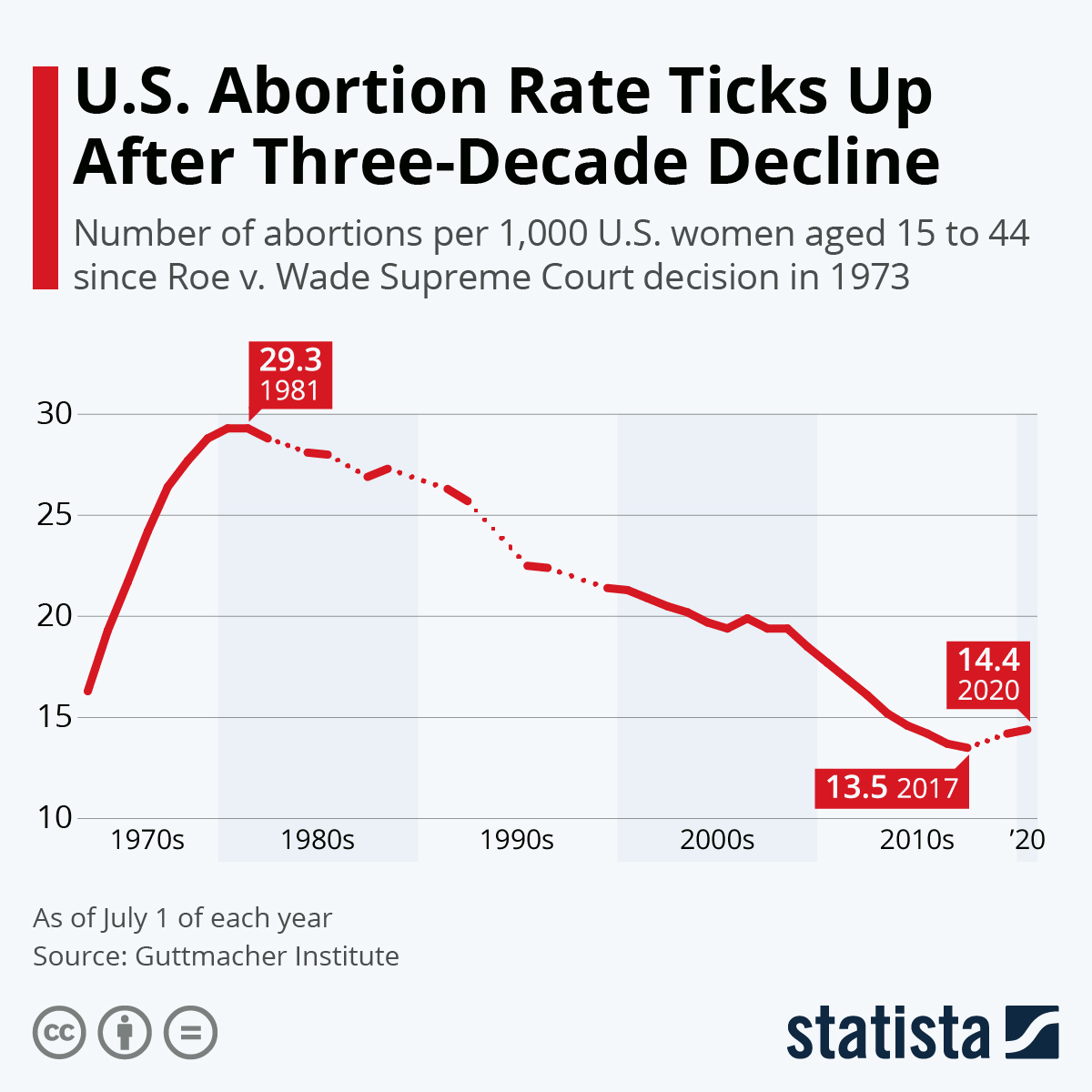
Pro-life conservatives don’t have to worry about a spike in abortions under Biden, however. Even though Donald Trump did not sign a single piece of significant pro-life legislation and his Executive Orders will likely be rescinded, the national abortion rate has been undergoing a four-decade decline. While Biden was vice president, the abortion rate fell below the level from 1973 when Roe v. Wade was decided. I don’t give the Obama Administration much credit for pro-life policy since the decline is likely driven by better and more widespread birth control along with technology that allows people to see the life in the womb, but the good news is that abortion is becoming more rare regardless of which party is in power.

Infographic: U.S. Abortion Rate Falls to Lowest Level Since Roe v. Wade | Statista

I’ve seen a lot of my Republican friends warning that energy prices will skyrocket under Biden and that the Democrats will start and continue “endless wars.” Energy prices are likely to increase even if Democrats aren’t able to pass bills that constrict energy production. The reason is that demand for energy will increase as the economy strengthens. Economic recoveries often drive up energy prices.

There is less evidence for the charge that Biden will start a war. America still has numerous adversaries around the world, but Biden is no more likely to start a war than President Trump has been. Forgotten amid the pandemic news is that the US and Iran were at the brink of war less than a year ago. There is also the chance that Israel or the Trump Administration might order an attack on Iran before Biden takes office, but the president-elect has not signaled any hostile intentions.

In his recent speeches, Joe Biden, who is not and has never been a socialist, has broadcast an intention to seek bipartisanship and try to bring the country back together. With Republicans in control of Congress and able to block his agenda, Biden has every reason to be conciliatory. The longtime senator is also well aware of how Congress works and what is needed to get things done in Washington.

Biden will need to fend off angry progressives on the left, but he also must overcome vengeful Republicans on the right. Mitch McConnell will almost certainly have the votes to stop the Biden Administration in his tracks, but he will also have the ability to move forward good legislation for the benefit of the country. One of the biggest obstacles here will be angry Republicans who view any compromise as “caving” and “surrender” to the left.

Over the next four years, it will be Joe Biden and Mitch McConnell who will together determine the course of the country. If they work together and succeed, they will draw fire from the extremes of both sides, but the country will be better off.

Originally published on The First TV

Saturday, November 7, 2020

Why Kamala Harris can’t depose Joe Biden

 One of the recurring concerns that I’ve heard about the 2020 election is the fear that Kamala Harris will declare Joe Biden incompetent and have him removed from office. Harris would then become president and Nancy Pelosi would be elevated to the vice presidency, or so the theory goes. This was always an unlikely possibility that was intended more as a scare tactic than a concern grounded in reality. As election returns continue to come in, the possibility of such a coup is even more remote.

The most obvious flaw in this conspiracy theory is that Joe Biden has demonstrated over the past few months that he is not senile. It was easier to paint Biden as a dementia patient before he bested Donald Trump in two debates and held a live town hall in front of the nation. Biden has also given several live televised speeches at this point, and the evidence that he is mentally incompetent is just not there.

Biden is also much more popular than Kamala Harris. Although Harris was painted as a shoo-in by many in both the mainstream and conservative media, she was one of the first candidates to drop out of the Democratic primary. She ended her campaign on Dec. 3, 2019 after failing to gain traction.

Although the conservative media paints Harris as a liberal bogeywoman, she is not that popular with the progressive left, which prefers Bernie Sanders and Elizabeth Warren. Black voters rejected her for Joe Biden. Harris currently has a negative favorability rating among the nation at large and is only marginally popular within her own party.

The point here is that Harris has no progressive constituency that would support such a nefarious move against Biden, the man of the hour who is the toast of the Democratic Party after his defeat of Donald Trump. An unpopular vice president removing a popular president under suspicious terms would not end well for either Harris or the country.

If Harris’s relative unpopularity among both Democrats and the nation at large isn’t convincing, the rules for declaring a president incompetent should kill the conspiracy theory. The 25th Amendment sets out the rules for presidential succession so let’s examine what would be required in such a scenario.

The 25th Amendment is a complex amendment that is comprised of four sections. Section one is straightforward:

In case of the removal of the President from office or of his death or resignation, the Vice President shall become President.

The second section is clear and concise as well:

Whenever there is a vacancy in the office of the Vice President, the President shall nominate a Vice President who shall take office upon confirmation by a majority vote of both Houses of Congress.

One part of the conspiracy is debunked here. While the speaker of the House is third in line of succession to the presidency, the speaker does not become vice president if the current vice president assumes the presidency. The Constitution clearly states that the new president will nominate a new vice president, who must then be confirmed by Congress.

The third section details what would happen if the president chooses to step down on his own initiative:

Whenever the President transmits to the President pro tempore of the Senate and the Speaker of the House of Representatives his written declaration that he is unable to discharge the powers and duties of his office, and until he transmits to them a written declaration to the contrary, such powers and duties shall be discharged by the Vice President as Acting President.

While some versions of the conspiracy theory speculate that Biden intends to step down and pass the presidency to Harris, these claims are so far without evidence. Nor do they pass the smell test. No objective observer can watch Biden’s performance in the debates and town halls over the past few months or his address to the country on Friday night and come away with the conclusion that the man who ran for president three times does not really want to be president. This is not a man who intends to take office and then resign.

The fourth and final section of the amendment is the most complex. Perhaps that is why so many of the conspiracy theorists seem not to have bothered to read it.

Whenever the Vice President and a majority of either the principal officers of the executive departments or of such other body as Congress may by law provide, transmit to the President pro tempore of the Senate and the Speaker of the House of Representatives their written declaration that the President is unable to discharge the powers and duties of his office, the Vice President shall immediately assume the powers and duties of the office as Acting President.
     
Thereafter, when the President transmits to the President pro tempore of the Senate and the Speaker of the House of Representatives his written declaration that no inability exists, he shall resume the powers and duties of his office unless the Vice President and a majority of either the principal officers of the executive department or of such other body as Congress may by law provide, transmit within four days to the President pro tempore of the Senate and the Speaker of the House of Representatives their written declaration that the President is unable to discharge the powers and duties of his office. Thereupon Congress shall decide the issue, assembling within forty-eight hours for that purpose if not in session. If the Congress, within twenty-one days after receipt of the latter written declaration, or, if Congress is not in session, within twenty-one days after Congress is required to assemble, determines by two-thirds vote of both Houses that the President is unable to discharge the powers and duties of his office, the Vice President shall continue to discharge the same as Acting President; otherwise, the President shall resume the powers and duties of his office.

Section four spells out exactly how a president can be removed if he is unable to fulfill his duties. The first step is that the vice president and a majority of the cabinet must agree that the president is unable to “discharge the powers and duties of his office.” In other words, removing Biden would not be at the sole discretion of Harris. She would have to obtain the agreement of a majority of cabinet officials who were just appointed by Biden to their jobs to become the acting president. Presumably, loyalty to the Biden would be a factor filling these jobs.

But the process does not end there. If President Biden disputed the cabinet’s decision, he would resume the role of president (and presumably be much less trusting of Vice President Harris afterward). If Harris continued to force the issue, Congress would decide whether the president was capable of continuing. Upholding the president’s removal would require a two-thirds majority in both houses of Congress. This is a higher bar than for impeachment which requires a simple majority in the House and a two-thirds vote in the Senate.

Even if Republicans did not retain control of the Senate, the vote to remove the president would have to be a bipartisan one. Simple math tells us that a two-thirds majority would require 290 votes in the House and 67 votes in the Senate. Democrats briefly held a supermajority in both houses from 2009 to 2011 but Congress will be closely divided in 2021.

When the Constitution is considered, the possibility of Kamala Harris having Joe Biden declared incompetent is even more remote than Donald Trump pulling out a popular vote victory. There is approximately zero chance that Republicans would side with Harris to remove President Biden, but I have to admit that the possibility of Republicans in Congress rallying to save the Biden Adminstration is intriguing.

Nevertheless, some conspiracies go one step further. What if Harris had Biden whacked? Killing the president would bypass sections three and four and revert to the simplicity of section one.

There are multiple problems here, beginning with the fact that there is not a shred of evidence that Kamala Harris is morally capable of ordering the murder of her political ally and friend. There is also the obvious problem of Biden’s Secret Service protection and the inherent risks of such a plot. If such a conspiracy was real and discovered – either before or after the fact – it would be an impeachable and criminal act. At that point, we would likely see bipartisan impeachment proceedings.

It would make far more sense for Kamala Harris to serve Biden loyally and hope to be his successor. There is speculation that Biden may serve only one term due to his age and a vice president who had not committed treason would have an advantage in competing for the Democratic nomination.

However, Republicans can take some comfort from the fact that, although 14 vice presidents have ascended to the presidency only six of these have been elevated through elections. Eight gained the office through the death of the president. So, if Joe Biden survives his term, and there is little reason to think that he won’t, Harris stands a good chance of losing to a Republican candidate in either four or eight years.

The conspiracy theories that Joe Biden is a Trojan horse to install Kamala Harris as president are completely unfounded. These claims are merely scare tactics that were intended to undermine the Biden campaign during the election and should not be treated seriously.

Originally published on The First TV
Thursday, October 22, 2020

Biden answers on court-packing

 After weeks of vague answers on court-packing, Joe Biden has come forward with an answer to the question of whether his administration would attempt to expand the Supreme Court so that Democrats could appoint additional justices to balance out the new conservative tilt of the Court. In an interview with Norah O’Donnell of CBS, Biden backed away from progressive calls to pack the Court but said that he would consider other methods of reforming a judicial system that Biden says “is getting out of whack.”

“If elected, what I will do is I’ll put together a national commission of — bipartisan commission of scholars, constitutional scholars, Democrats, Republicans, liberal, conservative. And I will ask them to over 180 days come back to me with recommendations as to how to reform the court system because it’s getting out of whack,” Biden said in the interview, which will air Sunday on “60 Minutes.”

“It’s not about court-packing,” Biden added. “There’s a number of other things constitutional scholars have debated and I’d look to see what recommendations that commission might make.”

“So, you’re telling us you’re going to study this issue about whether to pack the court,” O’Donnell pressed.

“No,” Biden responded. “Where, there’s a number of alternatives that go well beyond packing.”

“This is a live ball,” O’Donnell responded.

“Oh, it is a live ball,” Biden agreed. “No, it is a live ball. We’re going to have to do that. And you’re going to find there’s a lot of conservative constitutional scholars saying it as well.”

“The last thing we need to do is turn the Supreme Court into just a political football, whoever has the most votes gets what they want,” Biden continued. “Presidents come and go, Supreme Court justices stay for generations.”

Based on the clip, concerns about court-packing will be relieved, but they won’t completely go away. Biden, who has said as recently as last week that he is “not a fan” of court-packing, nevertheless left the door to expanding the Court cracked slightly open. Biden’s answer was not an explicit statement that he will never support packing the Court, but it did assuage concerns that the confirmation of Amy Coney Barrett would make him flip on the issue.

Polling has indicated that voters think both parties are wrong on Supreme Court issues. Most Americans opposed the rush to replace Justice Ginsburg before the election, but numerous polls show that they also oppose efforts to expand the Court. Further muddying the waters, voters approve of Judge Barrett and believe that she should be confirmed to the Court.

It is no surprise that Biden, one of the most moderate Democratic presidential candidates, would distance himself from the unpopular court-packing plans. Biden and his advisors can certainly read the polls and want to avoid handing Republicans a controversial issue with which to erode Biden’s lead.

The obvious question is what sort of reforms Biden’s bipartisan commission might propose. Earlier this week, an article in Bloomberg discussed several alternatives to court-packing, some of which might even gain support from Republicans.

The most obvious and probably the most popular way to reform the Supreme Court would be to impose term limits on justices. This would prevent situations like the last years of Ruth Bader Ginsburg in which justices hang on to their seats in hopes that a friendly president will be elected. Term limits would still have the problem of making the Supreme Court political as presidents campaign on their appointments to the Court, but they would at least fall upon predictable a predictable schedule rather than upending a campaign when a justice dies or retires.

Another alternative would be to reconstitute the Court with a balanced bench. Under this plan, there would be 10 lifetime justices, five appointed by Democrats and five by Republicans. These 10 justices would pick an additional five federal appeals court judges to join the Court for a one-year term. The 15-judge panel would decide cases for that year. Propoenents argue that such a court would be less partisan and more centrist.

A third proposal is a lottery system in which every federal appeals court judge is appointed as an associate Supreme Court justice. Cases would be heard by a panel of nine randomly selected judges with a maximum of five nominated by any president of one party.

Congress could also take away power from the Court by imposing a supermajority requirement. If the Court is not allowed to make sweeping decisions on a 5-4 margin, it would mean that broader agreement would be needed and fewer decisions would be rendered on a partisan basis. In reality, the Court’s conservative wing often fractures and Chief Justice Roberts seems to be the new swing vote.

The final proposal is most likely because it is the simplest and easiest to implement. Congress could simply strip jurisdiction from specific pieces of legislation. While it remains to be seen whether this method would be constitutional, Article III does stipulate that Supreme Court jurisdiction is limited by “such Exceptions, and under such Regulations as the Congress shall make.”

A downside to stripping jurisdiction is that such laws would be difficult to pass without a supermajority or without eliminating the filibuster. The opposition party would be unlikely to support a law over which the Supreme Court had no jurisdiction. Another weakness is that if a law can be passed stripping jurisdiction, a new law can be passed reinstating it.

The battle for the Supreme Court is not over, but we can breathe easier that Joe Biden is not anxious to pack the Court. As with many issues in our divided era, reform proposals are much easier to make than to push through Congress. This is especially true of sweeping changes and constitutional amendments.

The difficulty in making changes is what the Framers intended and is a feature, not a bug, of our system. That does not stop both parties from desperately trying to find shortcuts rather than following the constitutional guidelines.


Originally published on The First TV

Wednesday, October 21, 2020

About the Hunter Biden emails...

 A couple of people have asked me why I haven’t written about the Hunter Biden email brouhaha. One reason I haven’t is that I wasn’t sure about the authenticity of the find. I’m still not, but the recent statements from Director of National Intelligence John Ratcliffe and the FBI make this seem like a good time to address the issue.

To recap, the story of the laptops is pretty shady. David French does a good job of summing up the problems with the scenario in The Dispatch. These problems include inconsistencies in the repair shop owner’s story, questions about why Hunter would repair his computer in Delaware when he lives in LA, and why, if the FBI has had the computer for months, the emails were omitted from the Senate report on Hunter’s activities that was released in September and failed to find criminal wrongdoing. The top line of the report is that Hunter’s activities were “very awkward.”

But problems with the story don’t mean that the laptop trove is not authentic. There is evidence to support the claims as well, such as the Fox News report that Hunter Biden’s signature matches the signature on paperwork at the repair shop, although Fox notes that the signature has not been verified. Fox News also claims to have verified one email with one of its recipients, an anonymous source, who claims that a reference to “the big guy” means Joe Biden.

Now, we also have Ratcliffe’s statement that the emails are “not part of some Russian disinformation campaign.” That was confirmed by the FBI yesterday that the agency had “nothing to add at this time” but would “evaluate the need to provide defensive briefings” to Congress “if actionable intelligence is developed.”

So, it appears that at least some of the emails are genuine but that the investigation is ongoing. It isn’t impossible that incriminating emails were manufactured and salted away among the genuine emails, but let’s assume that all of the emails are genuine. What do they tell us about Hunter Biden and, more importantly, Joe Biden?

The evidence for wrongdoing is pretty thin. What the New York Post originally called a “smoking gun” was an email in which an advisor to the board of Burisma thanked Hunter for “giving an opportunity to meet your father.” That’s it. There is no allegation that anything improper happened at this meeting and, aside from the email, there seems to be no evidence that the meeting ever took place.

In the past, Joe Biden has claimed that he never spoke with Hunter about his “overseas business dealing.” The email does raise questions but does not disprove that claim.

The Biden campaign responded to the Post’s report with a statement that no meeting with Vadym Pozharskyi, the alleged author of the email, was on Biden’s official schedule. The campaign did not rule out the possibility of a brief, informal meeting. If true, that casts doubt on the Post’s claim that the email was a smoking gun for corruption.

For example, if Biden and Pozharskyi were introduced and shook hands, the brief exchange could be considered “meet[ing] your father” as described in the email, but it would fall far short of the nefarious plotting that the Post report implies.

Likewise, the “big guy” email is also not conclusive. The allegation that “the big guy” is the former vice president seems to be based solely on the unsworn testimony of an anonymous source.

There might be supporting evidence out there, but so far we have not seen it. There are no pictures of Biden shaking hands with Pozharskyi. Unlike Donald Trump, Joe Biden has released his tax returns and there is no evidence of questionable transactions. Biden has earned millions since leaving office, but that money is easily traceable to speaking fees in which he earned a minimum of $10,000 per event and lucrative book deals.

In my view, the specifics of the Biden campaign’s denials are telling. Although it has been pointed out that the Bidens have not denied that the emails are legitimate, they have denied the underlying conspiracy theory that the Post report paints. I think that is the core truth of the matter.

In a statement, a Biden spokesman flatly called out the Post’s reporting, saying, “We have reviewed Joe Biden’s official schedules from the time and no meeting, as alleged by the New York Post, ever took place.”

The statement continued, “Investigations by the press, during impeachment, and even by two Republican-led Senate committees whose work was decried as ‘not legitimate’ and political by a GOP colleague have all reached the same conclusion: that Joe Biden carried out official U.S. policy toward Ukraine and engaged in no wrongdoing. Trump administration officials have attested to these facts under oath.”

And that claim is accurate. Numerous organizations on both the right and left have fact-checked the Trump claims about Joe Biden’s activities in Ukraine and found them to be false. Biden, who was vice president at the time that he pressured Ukrainian authorities to fire the country’s head prosecutor. In other words, Biden didn’t make US policy on the issue, he carried it out. Further, US policy matched that of our allies who agreed that the prosecutor needed to go. The US and other Western European nations were pushing for a prosecutor who would be tougher on corruption, rather than more lenient. Ironically, this would have put Burisma and Hunter Biden in legal jeopardy if they had been engaging in shady activities.

Taken in its entirety, the trove has so far been much ado about nearly nothing. For people who were already convinced that Biden was corrupt, the emails are a smoking gun. For others, there is so far no “there” there, even though there was an appearance of impropriety that was, as the Senate Republicans said, “awkward.” If there was firm evidence, the Trump Administration would have investigated and prosecuted Biden years ago rather than waiting until two weeks before the election.

My prediction is that the Hunter Biden saga will have very little impact on the election unless more damning evidence comes to light. I say this for two reasons. First, Hunter Biden is not on the ballot. The allegations are an attempt to tar Joe Biden with Hunter’s activities but so far the evidence does not support the claims. The allegations are not sticking to the candidate.

Second, this election is about Donald Trump, not Joe Biden. In April 2019, long before the impeachment and the pandemic, 52 percent of voters said they would never vote for Trump. Since then, the revelations of Donald Trump’s real – not imagined – corrupt activities with respect to Ukraine and his failing grade on the pandemic have not swung many votes in his direction. In an August poll, by an almost two-to-one margin, Biden voters said that their vote was against Trump rather than for Biden.

Donald Trump is not going to overcome the objections to his character and competence by attacking Hunter Biden. At best, the Hunter Biden story may slightly depress Democratic turnout and motivate some lackluster Republican voters. With Joe Biden leading by double-digits in many polls, it probably won’t be enough to sway the outcome of the election although it could shift some very close states such as North Carolina and Ohio.

Further, Trump’s own erratic behavior is likely to overshadow the already thin claims against the Bidens. Trump is already shifting the focus of the news by walking out of an NBC interview and attacking Anthony Fauci. The upcoming debate will also change the focus of the conversation. The president has little discipline for staying on message and the Hunter Biden story is not very compelling to most voters anyway.


Originally published on The First TV

Wednesday, September 30, 2020

The One Key Takeaway From The Debate

 he presidential debate is over and, as usual, both sides are claiming victory (including in a Trump email that went out before the debate). In the debate that Jake Tapper called a “hot mess inside a dumpster fire inside a train wreck” there was no clear winner. There was a clear loser, however.

The bar was set very low for Joe Biden. Going into the debate, the Trump campaign had been attacking the former vice president’s mental abilities for months, often using deceptively edited videos. They’re still saying it, but after last night it’s a lot less believable

Biden was the old Biden. He stumbled on words a few times but showed plenty of stamina, energy, lucidity, and good humor in the 90-minute debate. Biden did lead off with attacks in the first few minutes of the debate calling Trump a “clown” and a “liar” at various times and asking at one point, “Will you shut up, man?“

Although Biden’s temper flared on occasion, the way he often turned away Trump’s attacks with patience and laughter reminded me of the 1980 debate in which Ronald Reagan laughed off Jimmy Carter’s attacks with a patronizing, “There you go again.” This is probably the only way that Biden reminds me of Reagan.

Trump was also the old Trump, and that was the root of his problems. It is difficult to tell whether Trump prepped for the debate or whether he just winged it after watching Fox News.

The president came across as angry and combative. With his continual interruptions and breaking of the mutually agreed-upon rules, Trump placed himself in the position of having to debate both Biden and moderator Chris Wallace.

In the midst of the brouhaha, Trump missed an easy layup when Wallace asked him to condemn “white supremacist and right-wing militia.” The resulting soundbite will get a lot of airplay.

Trump’s response was, “Who would you like me to condemn? The Proud Boys? Stand back and stand by. But I’ll tell you what, I’ll tell you what. Somebody’s gotta do something about antifa and the left, because this is not a right-wing problem, this is a left-wing problem.”

“Stand back and stand by” is not a repudiation of anything.

Trump also made a YUGE tactical error in accusing Biden of supporting the call to defund police. Biden got his message out that he is “totally opposed” to defunding police and took the opportunity to distance himself from the radical left.

Trump took Biden’s statement that he opposed defunding as a victory. The president seemed to think that it was an “aha” moment and argued that saying the words “law enforcement” would cause the Democrat to “lose all of your radical left supporters.”

In reality, the exchange likely hurt Trump. Joe Biden was not the pick of the radical left. He was the moderate pick. The radical left already knows that Biden is not one of them. The people who didn’t know that Biden was a moderate – uninformed voters and Trump supporters – will realize this after having watched the debate, which further undercuts the Trump campaign’s claims that Biden is a radical socialist.

The radical left’s dislike of Biden pales in comparison to their dislike of Trump. After 2016, few leftists will stay home or vote third party, and now, thanks to Trump, Biden’s moderate position was highlighted before a national audience. By definition, moderate voters are those in the middle. They decide elections.

Having said all that, the one key takeaway is that the debate will not help Donald Trump, but it will make people feel easier about Joe Biden. The bar was set so low for Biden that all he needed to do was string together a few coherent sentences without drooling. He far exceeded that standard and held his own against the bombastic Trump.

On the other hand, Trump needed to seem rational, competent, and in control of himself. On that score, he failed miserably. The president was the proverbial bull in the china shop. He seemed totally lacking in even basic self-control. Donald Trump came across as a male “Karen” (please excuse the expression, I have the utmost respect for real Karens that I know) who has control of the nuclear codes.

For the most part, I disagree with both candidates on policy, but Donald Trump clearly lost the debate based on his poor form and displays of unpresidential temperament. The evening will not help the president with undecided voters and will not win over Biden supporters to his camp. That’s what counts.

In reality, most unaffiliated voters don’t care much about policy anyway. And if they did, it was hard to hear any serious discussion of platforms over the cross-talk and arguing.

Trump supporters are claiming that the president won the debate, but they know better. The tell is that Team Trump immediately started attacking the moderator. If they were happy with their candidate’s performance, they wouldn’t need a scapegoat. The truth is, as Erick Erickson humorously tweeted, that Chris Wallace did about as well as anyone could have under the circumstances.

There were no clear winners in the debate, but there was a clear loser. Donald Trump’s performance underscored the urgent need to remove him from the presidency. If he can’t control himself for 90 minutes, why should he be trusted with four more years?

Originally published on The Resurgent