Showing posts with label abuse of power. Show all posts

Monday, August 10, 2020

With Presidential Emergency Orders, Who Needs Congress?

 By now, most are familiar with President Trump’s plethora of new Executive Orders relating to the economic crisis brought on by COVID-19. The four orders signed yesterday temporarily suspend student loan payments and set student loan interest rates to zero, reinstitute Congress’s moratorium on evictions for some renters and homeowners, reinstate the enhanced unemployment benefits provided by Congress in the CARES Act, and defer payroll taxes for employees whose gross income is less than $4,000 bi-weekly. There are two issues at play with the Executive Orders: whether the measures are beneficial in helping the country recover from the pandemic and whether President Trump has the authority to unilaterally decree such changes.

I have written in the past about the need for more economic relief, but today my larger concern is with the executive overreach by the president. The president cites his national emergency authority in the declarations but the bigger emergency than the pandemic seems to be that Mr. Trump could not get what he wanted from Congress.

There is a poster frequently seen around offices that proclaims, “Failure to plan ahead on your part does not constitute an emergency on my part.” That is where the Trump Administration is. House Democrats passed several relief bills in May and June, but Republicans didn’t negotiate or offer an alternative until late July By that point, Trump’s polling numbers were dropping, many provisions of the CARES Act were expiring, and there was little time to reach a deal with Democrats.

Neither side seemed to really want a deal anyway. Speaker Pelosi drew a hard line, betting that failure to pass the bill would make Trump look bad. For his part, Trump took the bait and threatened executive action, which poisoned the well and all but assured that there would be no deal.

The president’s Executive Orders are obviously intended to curry favor with voters but this attempt at pandering may fall short. The enhanced unemployment benefits decreed by King Donald are less than what the Democrats had been proposing. Unemployed voters who had been receiving $600 supplements are going to realize that their payments are going down. Indeed, the president fought to cut benefits for the unemployed.

At this point, bypassing Congress with declarations of emergency has become Trump’s go-to move. Elected on the basis of his deal-making prowess, Trump has had little luck in dealing with Democrats. The president pushed Mitch McConnell to eliminate the filibuster and, when that failed, he settled on the tactic of using national emergency declarations.

At this point, the president has used national emergencies to legislate what Congress denied him no less than three times. The first was to secure funding for the border wall in February 2019. A few months later, in May 2019, the president declared another emergency to facilitate the sale of arms to Saudi Arabia after Congress balked in the Kashoggi murder. The COVID relief emergency orders are President Trump’s third trip to the well, but, if he is re-elected, we can be sure it won’t be the last. Why should he stop when Congress does nothing?

The same Republicans who rightly criticized President Obama’s abuses of executive authority in very harsh terms have little to say about President Trump’s even more blatant abuses of power. Not negatively anyway. Sen. Lindsey Graham (R-S.C.) and Sen. Kelly Loeffler (R-Ga.), both of whom are facing tough re-election campaigns this year, are among the Republicans who tweeted praise for the Executive Orders.

I wrote recently that burning down the Republican Party was not a good plan, but when the party doubles down on Trump’s abuses of power even as the president crashes and burns in the polls, it makes it very difficult for a constitutionalist to support any of them. Loeffler and Rep. Doug Collins, my two Republican choices in the upcoming Senate special election, seem to differ only in how loudly they proclaim fealty to President Trump.

Whether you agree with Trump’s policies or not, the danger is in the precedent that he sets in his “unpresidented” actions. His tendency to legislate by emergency orders is one that can be easily adopted and expanded by the next Democrat in the White House. You may like Trump handing out money and managing the economy by executive fiat, but you probably won’t like it when President Biden or some other president declares a national emergency to combat climate change or gun violence.

And with the congressional partisans backing their tribe’s president, Republicans won’t be able to stop them. President Trump has shown that our institutions are insufficient to stop a president of poor character who has no respect for the rule of law. The last line of defense is voters who should rebuke, rather than reward, abuses of power, no matter which party the president belongs to.

There is a line in “Revenge of the Sith” where Senator Amidala opines, “This is how liberty dies… To thunderous applause.” That doesn’t seem to be totally correct.

What we are seeing is how democracy dies and authoritarianism rises. It is a slow and gradual process as executives encroach ever further into the role of the legislature. Democracy dies when the legislators don’t fight back and the courts do nothing to uphold the constitutional balance of powers.

This is how democracy ends. Not with a bang but with a whimper.

Originally published on The Resurgent

Saturday, June 13, 2020

Brace For The Bolton Book Brouhaha

Former National Security Advisor John Bolton tossed a hand grenade into the presidential race this week with a press release for his upcoming book. In the memoir of his time in the Trump White House, Bolton will reportedly detail “Ukraine-like transgressions … across the full range of his foreign policy.” 
The book, titled “The Room Where It Happened,” is scheduled to be published on June 23, but has been delayed numerous times by the Trump Administration citing security concerns. The White House still has not yet signed off on the book, which it claims contains classified information.
Bolton’s publisher, Simon and Schuster, issued a press release that said the book covers the “President’s inconsistent, scattershot decision-making process, and his dealings with allies and enemies alike”
“What Bolton saw astonished him,” the release continues, “A president for whom getting reelected was the only thing that mattered, even if it meant endangering or weakening the nation.”
Bolton is quoted as saying, “I am hard-pressed to identify any significant Trump decision during my tenure that wasn’t driven by reelection calculations.”
While Bolton’s book has been long-awaited, its publication is not going to make anyone look good. Both parties committed major errors with respect to impeachment. Democrats rushed the impeachment through based on the Ukraine allegations when there were many more avenues of investigation to be explored. In Bolton’s words, “the House committed impeachment malpractice by keeping their prosecution focused narrowly on Ukraine when Trump’s Ukraine-like transgressions existed across the full range of his foreign policy.”
The Republican error was one of shortsightedness. When the impeachment trial moved to the Senate, Republicans refused to seek the truth and allow witnesses. As a result, they helped the president to remain in office in the short term but they merely delayed the inevitable reckoning for the president’s bad behavior.
Back in January, Bolton agreed to testify before the Senate impeachment hearings, but Republicans didn’t want to hear from him. Instead, it seems that Republicans assumed that if they didn’t hear Bolton during impeachment that they would never have to deal with his testimony. Now, that miscalculation is coming back to haunt them.
Less than five months before the election, the Republican nightmare of Administration insiders telling-all about the shenanigans inside the Trump White House is coming true. The hints of what is to come from John Bolton were revealed only days after James Mattis and a bevy of military leaders openly criticized the president for his handling of the race riots and protests.
Ambassador Bolton does not escape with his reputation intact either. Many Trump critics believe that Bolton should have come forward during impeachment, rather than waiting to offer his testimony to buyers of his book.
Rep. Mike Quigley (D-Ill), who serves on the House Intelligence Committee, told Politico, “At the time the country needed him most, and history will reflect, he chose to sell books. It wasn’t a question in his mind of whether or not he should talk about it. It’s whether or not he should profit from talking about it. Not exactly ‘Profiles in Courage.'”
The 2020 election is shaping up to mirror the 2016 election in some ways. In 2016, Hillary Clinton was beset by a continuous drip of bad luck and scandals. After the hacking of the DNC in the spring, the release of stolen emails by WikiLeaks dogged the campaign for months.
The summer of 2020 is looking a lot like that for President Trump, albeit without the Russian hacking. President Trump has been dogged by bad news, some of it of his own making and some not, for the entire year, which began with impeachment and was followed by the pandemic, the economic crisis, and now nationwide riots and demonstrations against police brutality. The biting criticism from former members of the Administration is only the icing on the cake.
There is more to come. In addition to the release of Bolton’s book, there is a looming Supreme Court decision on whether the president’s tax returns must be turned over to Congress, the expiration of the CARES Act in September, which could trigger a deeper recession, and the possibility of a second wave of Coronavirus infections. There are also many other officials who left the Trump Administration under a cloud and may speak out against the president before the election.
The timing of many of these items, including the publication of Bolton’s book and the release of the tax returns, shortly before the election is directly linked to Trump’s efforts to delay and obfuscate. The Trump Administration is finding out, as so many others have, that the coverup is often worse than the underlying crime.
The Trump campaign seems on the verge of imploding as the president bungles crisis after crisis and as a growing list of former White House officials come forward to say that voters should tell Trump, “You’re fired.” The president’s average approval rating has already dropped sharply since it received a Coronavirus bump in mid-March. The drop is largely driven by the president’s response to the pandemic and the racial crisis. Despite the country’s economic problems, President Trump’s biggest strength remains the economy. However, with a number of crises percolating, Trump’s approval may collapse even further before the election.
If President Trump’s antics cost Republicans the White House and their Senate majority, they will have no one to blame but themselves. If they had listened to Bolton six months ago, they might have made the difficult but correct decision to remove President Trump. The result would have been that the GOP would have fielded a competent candidate, probably incumbent Mike Pence, who would not be trailing “Sleepy Joe” Biden in the polls while waiting helplessly for the next shoe to drop.
Originally published on The Resurgent

Sunday, June 7, 2020

The Law And Order President


Earlier this week, President Trump declared himself “your president of law and order.” In the June 1 speech in the Rose Garden, the president sought to draw a distinction between himself and the rioters around the country, but, after three years of the Trump Administration, it may be too late to pivot to law and order. Thus far, the Trump presidency has been anything but a law and order administration.
Mr. Trump first got himself into legal trouble when he admitted firing FBI Director James Comey over “this Russia thing” on national television. The statement was tantamount to an admission that Trump had been attempting to interfere with a federal investigation.
When the Mueller report on the Russia investigation was completed two years later, it did not find conclusive evidence that the Trump campaign conspired with Russia, although it noted that members of the Trump campaign and Russian government agents did attempt to share information on several occasions. The report did, however, set out 10 separate counts of obstructive behavior by the president. Mueller could not indict the president due to longstanding Justice Department guidelines.
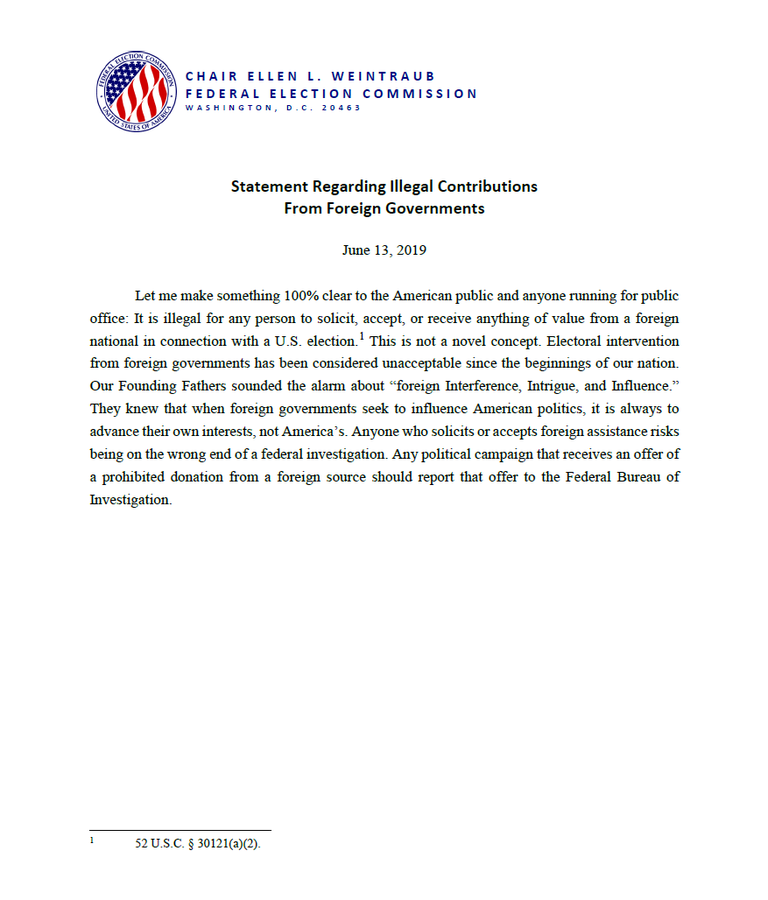
The ink was no sooner dry on the Mueller report than President Trump told ABC’s George Stephanopoulos “I think I’d want to hear it” if a foreign government offered information on an opponent to his campaign. The interview prompted FEC Chair Ellen Weintraub to tweet that it is “illegal for any person to solicit, accept, or receive anything of value from a foreign national in connection with a US election.”
Of course, we now know that Donald Trump was already actively soliciting help from another foreign government by that point. By June 2019 when the interview took place, Trump and his subordinates were already working to get dirt on Joe Biden from Ukraine. In the course of trying to use military aid to pressure the Ukrainian government, the Trump Administration violated the Impoundment Act, which regulates how money appropriated by Congress must be spent.
President Trump also played fast and loose with the law when Congress didn’t accede to his demands. In February 2019, the president declared an emergency in order to divert military funds toward building a border wall. A few months later in May 2019, the president declared another national emergency to enable the sale of $8.1 billion of military items to several countries, including Saudi Arabia and the United Arab Emirates. In both cases, the only emergency was the inability of Donald Trump to negotiate a favorable deal with Congress.
President Trump has also abused his authority to protect some of his loyal footsoldiers. Last month, the president persuaded the Justice Department to drop the charges against former National Security Advisor and longtime Trump friend, Mike Flynn, who had pled guilty to lying to the FBI. Just a few days ago, Trump signaled his intention to protect another longtime ally, Roger Stone. Stone was convicted of seven counts relating to obstructing the Russia investigation including witness tampering and lying to investigators. Trump retweeted a Charlie Kirk tweet calling for a pardon for Stone, who Trump said could “sleep well at night.”
Finally, the president has left a trail of destroyed careers in his attempts to cover his tracks and exact revenge on people who stood up for “law and order.” Most recently, President Trump has fired four inspectors general including the man who vetted the Ukraine whistleblower claim, the woman who revealed the Administration’s poor early response to the pandemic, the man who would chair the board providing oversight for the Administration’s disbursement of pandemic relief funds to businesses, and the man who was investigating both Secretary of State Pompeo’s use of government employees for private errands as well as the national emergency declaration relating to the Saudi arms sale. The common thread in all four cases was that the IGs were doing their jobs in ways that were embarrassing to Donald Trump.
Former Secretary of State Rex Tillerson said that Trump’s ideas often included violating the law.
“So often, the president would say, ‘Here’s what I want to do, and here’s how I want to do it,’ ” Tillerson said, according to the Houston Chronicle, “and I would have to say to him, ‘Mr. President, I understand what you want to do, but you can’t do it that way. It violates the law.’”
A major problem since 2018 is that people like Tillerson, John Kelly, and James Mattis are no longer in the White House. That trio had the intestinal fortitude and independence required to tell a president “no.” Now that these adults are gone, few have enough gumption to tell the president harsh truths and the result has been a long chain of catastrophically bad decisions.
Donald Trump wants to be the law and order president but, for many voters, it is too late for that. For the past four years, we have seen President Trump twisting the law and abusing his office to protect himself and his friends. Sending troops to put down riots won’t erase those abuses of power. In fact, as the president claimed to be “your president of law and order and an ally of all peaceful protesters,” park police were clearing peaceful protesters out of Lafayette Park for the president’s photo-op at St. John’s church in what turned out to be one of the great public relations disasters of the Trump Administration (of which there have been many),
Donald Trump obviously believes that law and order are ideas that apply to others, but not himself or his friends. It is unAmerican for presidents, elected officials, and, yes, police, to have the attitude that the law is for thee but not for me.
Originally published on The Resurgent

Friday, May 29, 2020

Why Trump’s Social Media Executive Order Is Both Illegal And Unwise

Today Donald Trump signed an Executive Order punishing social media companies for the way they moderate online content. The order was specifically aimed at Twitter, which has embarrassed the president this week by add fact-checks to several Trump tweets.
The meat of the Executive Order attacks Section 230 of the Communications Decency Act of 1996, saying, “When an interactive computer service provider removes or restricts access to content and its actions do not meet the criteria of subparagraph (c)(2)(A), it is engaged in editorial conduct. It is the policy of the United States that such a provider should properly lose the limited liability shield of subparagraph (c)(2)(A) and be exposed to liability like any traditional editor and publisher that is not an online provider.”
Here is what subparagraph (c)(2)(A) says:
No provider or user of an interactive computer service shall be held liable on account of—(A) any action voluntarily taken in good faith to restrict access to or availability of material that the provider or user considers to be obscene, lewd, lascivious, filthy, excessively violent, harassing, or otherwise objectionable, whether or not such material is constitutionally protected
Communications Decency Act, subparagraph (c)(2)(A)
The law gives social media companies, “interactive computer services,” wide latitude to moderate a wide variety of objectionable content. The law specifically says that even constitutionally protected material can be restricted if the action is taken in good faith.
Another relevant portion of the law is subparagraph (c)(1) which is literally one sentence before the paragraph cited by the president’s Executive Order. That line says:
No provider or user of an interactive computer service shall be treated as the publisher or speaker of any information provided by another information content provider.
In other words, the law specifically says that social media companies cannot be treated as publishers of information that they do not produce. Despite the plain language of the law, the president’s Executive Order calls on social media companies to be treated like “any traditional editor and publisher that is not an online provider.” Since laws passed by Congress have more weight than an Executive Order, President Trump’s decree is illegal on its face.
Beyond the illegality of the order, its premise is also wrong. In contrast to many Republicans who claim that Section 230 gives special protections to social media companies, the law actually offers protection based on activity rather than status. When Twitter moderates or removes tweets published by its users, it is protected from liability under the law but, when it produces its own content, it is legally a publisher.
“In plain English, this means that my comments on Twitter or Google or Yelp or the comments section of my favorite website are my comments, and my comments only,” David French explained in Time back in January, adding that Section 230 “allows websites to take down racial slurs – all without suddenly also becoming liable for all the rest of their users’ speech.”
This is exactly what Congress intended when it passed the law. In response to several court cases in the 1990s, Congress designed Section 230 to encourage internet providers to moderate and remove offensive content from their platforms rather than allowing the internet to continue to be a cesspool of insults, pornography, and fake news. Well, even more of one anyway.
As Jeff Kosseff, author of The 26 Words That Created The Internet, explained, “For Congress, the motivator for Section 230 was that it did not want platforms to be these neutral conduits, whatever that means. It wanted the platforms to moderate content.”
The rub is that if the government leaves it up to the internet providers to moderate content then there will be as many different versions of what is offensive as there are internet providers. However, the alternative is that the government become the arbiter of what is fair and what is offensive for all companies.
That is where President Trump wants to go. Trump’s Executive Order calls on the Secretary of Commerce, the Attorney General, the National Telecommunications and Information Administration (NTIA), and the FCC to issue regulations determining when internet providers are not acting in good faith, act inconsistently with terms of service, and without a meaningful explanation or allowing users to be heard.
While censorship on social media platforms is not currently a First Amendment issue since the Bill of Rights restricts the government and not private companies, Trump’s plan could make it more difficult to moderate offensive content on the internet by inserting the government into the equation. Twitter has the right to remove content as a private company but if the government directs Twitter to remove or moderate content then it could constitute a First Amendment violation.
Allowing the government to make subjective decisions about the management of content on the internet is never a good idea, but the summer of 2020 is a particularly bad time for Republicans to make such a move. Aside from the strategic fact that Trump’s proposal is an expansion of government into policing free speech on the internet, there are tactical considerations as well.
As we head into the 2020 elections, it looks increasingly likely that Republicans will lose both the presidency and the Senate. If Trump and company act now to set up an infrastructure for micromanaging speech on the internet, it is very possible that a Joe Biden Administration will put that policy fully into place. That fact alone should have been enough to slam the brakes on the Executive Order.
Regardless of the outcome of this year’s election, whatever bureaucratic restrictions the Trump Administration puts on free speech will one day be administered by Democrats. When that happens, it is very likely that the Democrats will use those rules against conservatives. When Republicans give the government a new weapon to brandish, they should remember that sooner or later it will be turned against them.
Originally published on The Resurgent